Are You an Echo? The Lost Poetry of Misuzu Kaneko narrative and translation by David Jacobson, Sally Ito, and Michiko Tsuboi; illustrated by Toshikado Hajiri

Published by Chin Music Press 

Summary:  Born in a Japanese fishing village in 1903, Misuzu Kaneko was fortunate enough to receive more education than most of her female contemporaries.  She worked in her mother’s bookstore and published her poems in magazines.  Then she made the unfortunate decision of marrying one of the bookstore clerks who was abusive, unfaithful, and passed on a devastating disease to Misuzu.  She divorced him, but when he insisted on full custody of their daughter (a right given to fathers only at that time in Japan), Misuzu committed suicide.  The first half of the book tells the story of her life, and the second half is a collection of her poems, written in both Japanese and English.  An author’s note and translators’ note explain the careful work and research that went into creating this book.  64 pages; grades 2-7.

Pros:  This might be the most moving book I have read in 2016.  Misuzu Kaneko’s life was ultimately tragic, but her poetry reveals a beautiful spirit who saw life and hope in ordinary objects around her.  Her poems are accessible to kids, yet infused with deeper meaning.  The gorgeous illustrations should receive Caldecott consideration.

Cons:  I was unprepared for the shock of reading about Misuzu’s suicide.

Pocket Change: Pitching in for a Better World by Michelle Mulder

Published by Orca Book Publishers

Summary:  What is money?  And why do some people have more of it than others?  This book starts with a history of money, which hasn’t been around all that long, and work, which has increased with the introduction of money.  People used to be self-sufficient, but with the Industrial Revolution, they started working to earn money and buy goods and services from others.  Advertising has created even more demand.  The author then moves on to grassroots movements that are helping to look at wealth in different ways and try to distribute it more equally.  Organizations like Kiva and the Grameen Bank provide microloans to give people an opportunity to work their way out of poverty, while groups such as Habitat for Humanity allow them to provide sweat equity instead of money.  Sidebars labeled “My Two Cents’ Worth” give brief personal stories from the author’s life to illustrate the concepts.  A glossary, index, and additional resources complete the book.  48 pages; grades 3-7.

Pros:  A can-do look at how kids can help others around the world.  The interesting history of economics will have readers looking at money, shopping, and advertising in new ways.  Lots of colorful photos on each page give this an appealing look.

Cons:  Not a topic most kids will be interested in without some adult guidance.


Giant Squid by Candace Fleming, illustrated by Eric Rohmann

Published by Roaring Brook Press 

Summary:  Millions of them may live in the oceans, growing to a length of 40 feet or more, yet very little is known of the giant squid.  Scientists first saw a living one in 2006.  Much of what is known about these creatures comes from studying their remains inside sperm whales, whose stomachs can contain thousands of the indigestible squid beaks.  The poetic text of this book tells what little is known of the giants, illustrated with dark undersea paintings that show glimpses of different parts of them.  The final two-page spread is a labeled drawing of the squid’s body.  After that, an author’s note, “The Mysterious Giant Squid” gives more scientific information, and there’s a substantial list of print and online resources.  40 pages; grades K-5.

Pros:  One of my favorite parts of this “job” is learning about topics like the giant squid.  It is amazing that so many of these giant creatures have remained elusive for so long.  The pictures really capture the feel of their deep undersea home, and the author’s note is fascinating.

Cons:  Using the last eight pages to illustrate how the squid’s ink helps protect it (including a few mostly black pages) seemed like a little too much.

Preaching to the Chickens: The Story of Young John Lewis by Jabari Asim, illustrated by E. B. Lewis

Published by Nancy Paulsen Books

 Summary:  Growing up in Alabama, young John Lewis waned to be a preacher. His mama always said, “Work hard and trust in God.”  John loved going to church and found it easy to trust in God.  Working hard took a little more effort.  There was plenty of work to do on the farm where his family lived and grew cotton.  John was put in charge of the chickens on the farm.  After he had fed them and put fresh straw in their nests, he would pretend he was the preacher at church and that the chickens were his congregation.  He even baptized them with water from a syrup can.  When a man offered to trade with his family for one of John’s chickens, he convinced his family to trade other goods instead.  Many years later, John would go on to speak before huge crowds and stand up for those who couldn’t speak for themselves, as a leader of the Civil Rights movement.  An author’s note gives more information about John’s life as an adult.  32 pages; grades 1-5.

Pros:  An interesting slice-of-life look at a boy who rose from an impoverished childhood to do great things for others.  The paintings by award winner E. B. Lewis capture life on the farm.

Cons:  Although the author’s note lists some of Lewis’s accomplishments, there’s not really enough biographical information for a full report on his life.

Smithsonian Maker Lab: 28 Super Cool Projects by Jack Challoner; foreword by Jack Andraka

Published by DK Children 

Summary:  28 projects introduce kids of all ages to the fun of science and technology.  The projects are divided into four sections: Food for Thought, Around the Home, Water World, and The Great Outdoors.  Each activity gets a four-page description that includes colorful photos to take young scientists through each step.  A “How It Works” sidebar explains the science behind each project; some also include “Real World Science” to connect with real life science or engineering.  Glossary and index are included.  160 pages; grades 3-7.

Pros:  While there are some tried-and-true projects (making slime, balloon rocket car), they are presented in a clear and interesting manner.  There are also some quirkily interesting ones, such as making a baked Alaska and creatng models of the planets from rubber bands.  Perfect for libraries starting a maker space or for kids who are interested in trying some science at home.

Cons:  No time to think of any…I’m off to my kitchen to turn a lemon into a battery.

Radiant Child: The Story of Young Artist Jean-Michel Basquiat by Javaka Steptoe

Published by Little, Brown, and Company 

Summary:  Jean-Michel Basquiat grew up in Brooklyn with a mother from Puerto Rico and a father from Haiti.  His childhood was filled with art, both his own works and what he saw around him.  His mother was artistic and regularly took him to art museums.  There were also difficult times for Jean-Michel.  He was in a serious car accident at the age of eight, and spent months recovering.  During that time, his mother brought him a copy of Gray’s Anatomy, which helped him learn to draw the human figure.  A few years later, his mother’s mental illness drove her to leave the family.  Jean-Michel left school and moved to New York City, where he continued to pursue his art in a number of unconventional mediums, including graffiti.  He lived his dream of being a famous artist until his tragic death in 1988 at the age of 27 from a heroin overdose. An author’s note gives more biographical information. 40 pages; grades 1-5. 

Pros:  The story of Basquiat’s life is told in brief, lyrical text, illustrated with beautiful collages inspired by the artist’s work.  The artwork is sure to receive some Caldecott consideration.

Cons:  There are some pretty adult topics covered in this book targeted for elementary students.  Also Basquiat’s work isn’t included anywhere in the book.

New York City Trails: Secrets, Stories, and Other Cool Stuff by Lonely Planet Kids and Moira Butterfield

Published by Lonely Planet 

Summary:  Marco and Amelia, the Lonely Planet Kids, have created nineteen kid-friendly trails around New York City, including Urban Jungle (where to find animals), Game On (sports and games), and Movie Magic (spots you might have seen in the movies).  Each trail gets four pages, with two attractions per page.  There’s a picture (photo, drawing, or a combination of the two), and a brief description of each site, filled with facts that will appeal to kids.  A very complete index rounds things out.  Enjoy other books in the series on London and Paris.  104 pages; grades 3-7.

Pros:  What a great way to get your offspring involved in planning a trip!  Every one of these trails would make an unforgettable weekend for children and parents alike.  The busy, colorful format is sure to appeal to young readers.

Cons:  It would have been nice to include some additional resources, especially websites.

Alpha, Bravo, Charlie: The Complete Book of Nautical Codes by Sara Gillingham

Published by Phaidon Press 

Summary: The four-page introduction explains signal flags, the phonetic alphabet, Morse code, and semaphore, as well as how all of these are used by ships’ crews to communicate.  Then come two-page spreads, one for each letter of the alphabet, that explain what each signal flag means, and give the phonetic, Morse, and semaphore versions of the letter as well.  In between these two pages is a signal flag for that letter on textured paper, cut into the appropriate shape for the flags that aren’t rectangular.  The alphabets are summarized on two pages at the end, followed by additional resources and a glossary of nautical words.  120 pages; grades 1-6.

Pros:  Kids will be drawn to this beautiful book by its design, but will stick with it to learn and use the cool codes.  There is plenty of interesting information in addition to the visuals.

Cons:  The $20 price tag, combined with the somewhat fragile flags may give librarians pause about purchasing this book.

Best in Snow by April Pulley Sayre

Published by Beach Lane Books 

Summary:  “A freeze. A breeze. A cloud. It snows.”  So begins this photo essay on snow, a follow-up to last year’s Raindrops Roll by Sayre.  Each page has a large photo or two of snowflakes in action, covering trees, animals, and the ground.  The sun comes out, the snow softens, and the ice begins to melt.  But before long, the snow begins again.  The final two pages give quite a bit of additional information on snow, along with a short list of books you can read to learn more.  40 pages; ages 3-8.

Pros:  A visually stunning science book which can be enjoyed by all ages.  Not only does it provide excellent information and beautiful photographs, but the writing would be a good mentor text on using strong verbs.

Cons:  Stopping after the thaw would have provided a happier ending.


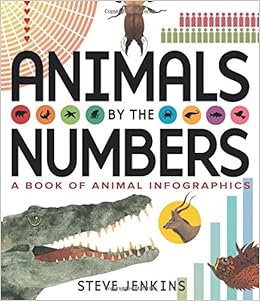
Animals by the Numbers: A Book of Animal Infographics by Steve Jenkins

Published by Houghton Mifflin Harcourt 

Summary:  Teaching kids how to read graphs and charts?  Want to wow kids (or adults) with amazing animal facts (the biomass of termites is twice that of humans; the pistol shrimp makes a sound that’s louder than a jet plane taking off)?  This book has you covered on all fronts.  Looking at many different aspects of animals, including life spans, speed, size, and deadliness, every page has a different infographic that brings the information to life.  The sobering last few pages graph the winners and losers of mass extinctions of the past, including one that is going on right now, and chart the numbers left of some of the most endangered species.  Additional books and websites are listed at the end.  48 pages; grades 2-6.

Pros:  You won’t hear much from any child you hand this book to; he or she will be way too absorbed studying the graphs and charts on every page.  That reader may emerge on occasion to share some fascinating fact with you (a koi fish can live 226 years!  There are 20 times more spider and scorpion species than mammals!).  I’ve already raved about Steve Jenkins’ cut-paper illustrations enough times to fill a pie chart, so I’ll spare you another round.

Cons:  It’s hard to believe those pesky squirrels in my backyard sleep twice as many hours as I do.