Diana’s White House Garden by Elisa Carbone, illustrated by Jen Hill

Published by Viking 

Summary:  World War II is raging, and Diana Hopkins, the 10-year-old daughter of Presidential advisor Harry Hopkins wants to do her part.  Spying and trying to scare off enemies by sticking pins in the couch don’t work out too well, but she’s delighted when she overhears her father and Franklin Roosevelt talking about a new plan to encourage Americans to grow victory gardens.  The first demonstration garden is to be planted right on the White House lawn.  Diana teams up with First Lady Eleanor Roosevelt to create it.  Before long, Diana is outside watering and weeding almost every day, and even gets her picture in the paper, standing in front of her thriving Victory Garden.  On the last page, the Hopkinses and the Roosevelts sit down to a feast that includes beans, carrots, lettuce, and tomatoes from the new garden.  Notes from both the author and illustrator give a bit more information about Diana Hopkins and Victory Gardens, and the research that went into the creation of the book.  44 pages; grades K-4.

Pros:  A nice bit of World War II historical fiction.  Diana is a likeable character, with both a mischievous side and an admirable desire to contribute to the war effort.  My mother, just a bit younger than Diana in 1940, would love this book.

Cons:  Diana’s life looks like it was a lot sadder than portrayed in this book…her mother died before this story takes place and her father, just a few years after.
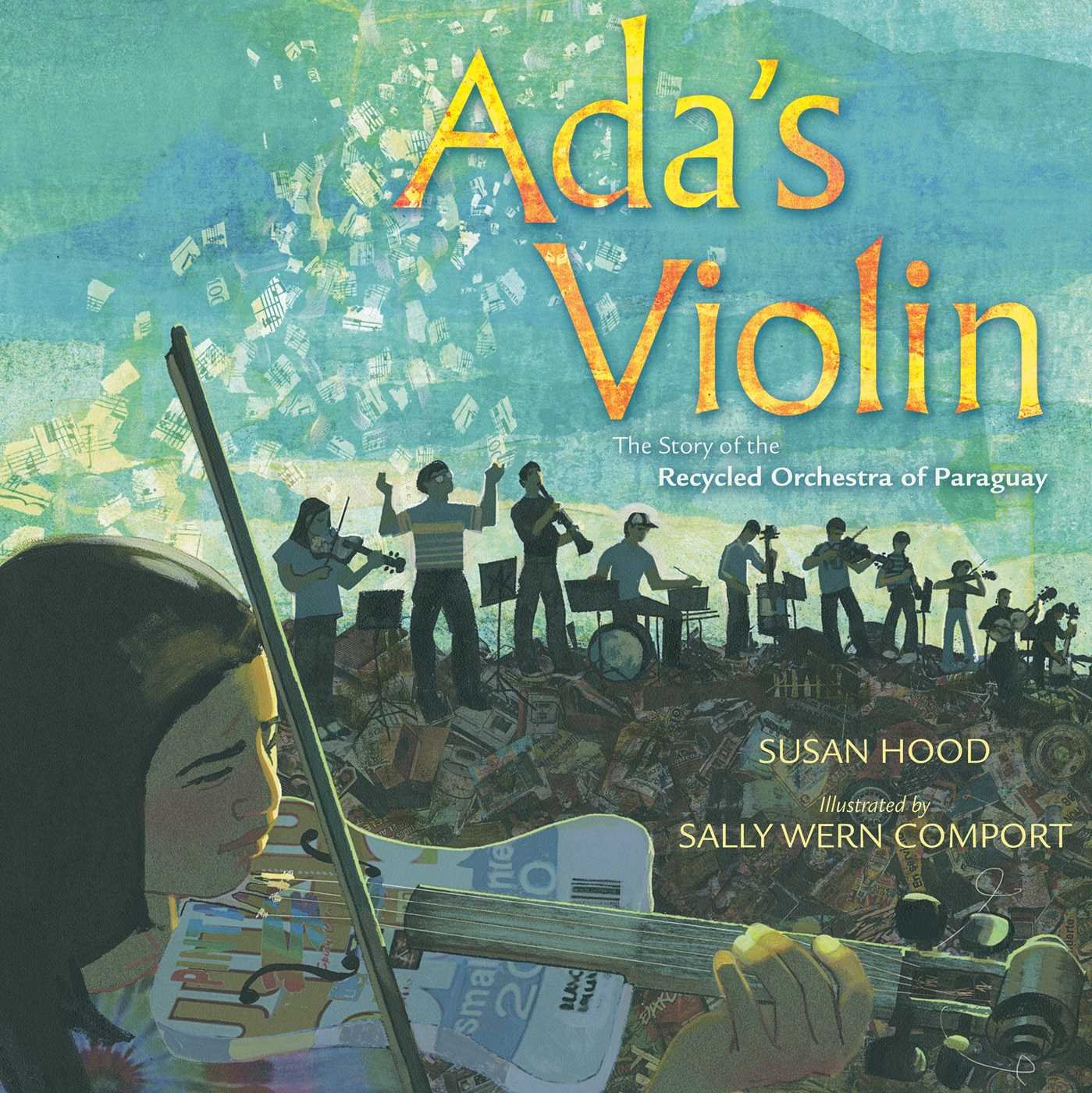
 

Ada’s Violin: The Story of the Recycled Orchestra of Paraguay by Susan Hood, illustrated by Sally Ward Comport

Published by Simon & Schuster Books for Young Readers

Summary:  Ada lived in one of the poorest places on earth, Cateura, Paraguay, home of the garbage dump for the capital city of Asuncion.  Most adults there survive by picking through trash, finding items they can recycle and resell to make a bare subsistence living.  Ada and her classmates appeared to be heading for the same lives as their parents, until a man named Favio Chavez came to town and offered music lessons.  The problem was, he only has a few instruments, and they were so valuable that the kids were afraid to carry them home.  So Chavez got to work making instruments from objects he found in the trash.  Before long, there were enough kids playing to form an orchestra.  Ada loved music and worked so hard that she became first violin.  The orchestra has traveled all over the world, and even opened for a Metallica concert.  Back matter includes an author’s note, sources, and photos of the orchestra and some of their instruments.  40 pages; grades 1-4.

Pros:  An inspiring story of how one man has made an amazing difference in the lives of an entire community. The illustrations do a great job of capturing the designs of the different instruments, as well as the emotions of their players.

Cons:  I wanted to hear the music!  Fortunately, YouTube helped me out.  Just search for “Recycled Orchestra of Paraguay” to learn more and to see and hear these amazing instruments in action.

The Mummy Makers of Egypt written and illustrated by Tamara Bower

Published by Seven Stories Press 

Summary:  Paneb is the head of a family of embalmers; his young son Ipy is being trained to follow in his footsteps.  When Yuya, father of Queen Tiye, dies, Paneb and Ipy oversee a lengthy process of embalming and burial.  Each step is important in preserving the body for the afterlife, and there are many rituals that go with each part of the process.  The Egyptian religion is described, with beliefs about what happened to people after they died.  There’s also a section on the embalming process, with pictures of the tools and the people performing their jobs drawn in ancient Egyptian style.  A lengthy endnote describes the discovery of Yuya’s tomb in the early 20th century; there are also a few photos and drawings of items found in the tomb.  40 pages; grades 3-8.

Pros:  Written and illustrated by an expert on ancient Egypt, this book is clearly a labor of love designed to impart a great deal of information about many aspects of Egyptian culture, both through the text and the illustrations.  The end note, three pages of small type, is a bit daunting, but very interesting and informative.

Cons:  The section on the embalming process (e.g., brain removal through the nose) may not be everyone’s cup of tea.

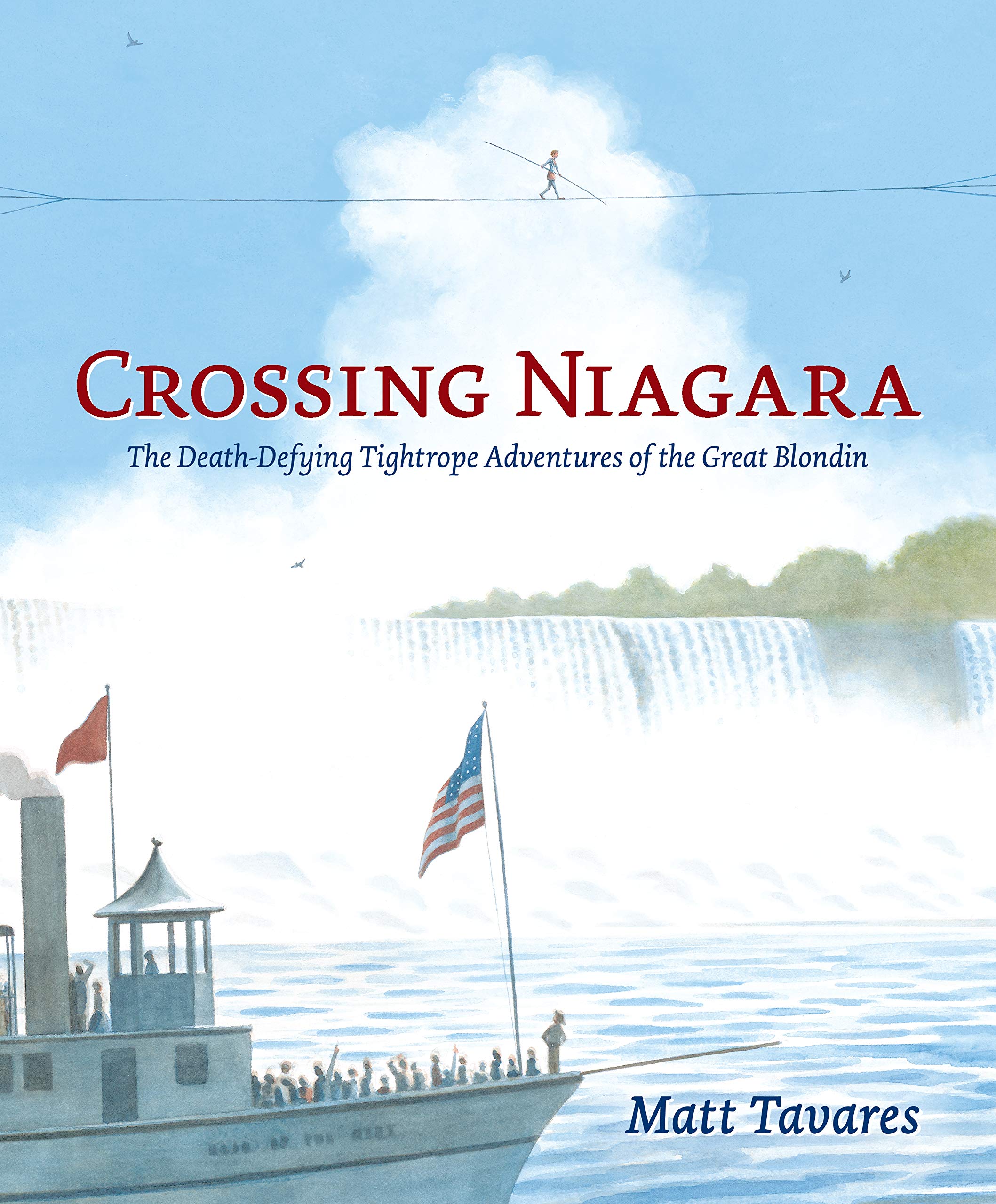
Crossing Niagara: The Death-Defying Tightrope Adventures of the Great Blondin by Matt Tavares

Published by Candlewick Press

Crossing Niagara: The Death-Defying Tightrope Adventures of the Great  Blondin: Tavares, Matt, Tavares, Matt: 9780763668235: Amazon.com: Books

Summary:  Jean Francois Gravelet, a.k.a. The Great Blondin was just five years old when he first performed on the tightrope.  Although he loved his circus career, he longed to do something even more daring.  When he first laid eyes on Niagara Falls, he knew what he wanted to do.  He set up a rope, contacted the newspapers, and on June 30, 1859, he made his first successful crossing, stopping along the way to perform a few tricks, including retrieving a bottle from the Maid of the Mist below and toasting the crowd.  He promised to return on July 4, and this time, he crossed the falls blindfolded.  Over the next two summers, he made many crossings, trying all kinds of stunts.  His ultimate challenge was carrying his manager across on his back (a trick his manager wasn’t terribly enthusiastic about).  When the crowds began to thin, The Great Blondin moved on, but he was forever remembered for his Niagara Falls crossings.  End matter includes a brief author’s note and a bibliography.  36 pages; grades 1-5.

Pros:  The storytelling and large, detailed illustrations combine to make a pulse-pounding tale of daring.

Cons:  I could have enjoyed a little more biographical detail about The Great Blondin.

Olinguito, de la A a la Z! by Lulu Delacre

Published by Lee and Low Books 

Summary: Never heard of the olinguito? Don’t worry, scientists have only known about it since 2006. Lulu Delacre has created an alphabet book with text in both Spanish and English that follows zoologist Dr. Kristofer Helgen through the cloud forest of Ecuador as he looks for and finally finds this little animal. The olinguito doesn’t make an appearance until “W”, though, so the reader gets introduced to many other flora and fauna of the rainforest. Extensive back matter includes information about the discovery of the olinguito, the cloud forest, the illustrations, plus a lengthy glossary…all in both English and Spanish. 40 pages; grades K-4.

Pros: The illustrations are as lush and colorful as the cloud forest. The text could be used as a simple alphabet book or as a resource for research, depending on which parts are used.

Cons: The English is sometimes not as alliterative as the Spanish in the alphabet portion of the book.

Cloth Lullaby: The Woven Life of Louise Bourgeois by Amy Novesky, pictures by Isabelle Aresenault

Published by Abrams Books for Young Readers 

Summary:  Louise Bourgeois (1911-2010) spent her childhood along the banks of a river in France.  Her mother repaired tapestries, and Louise learned the art of weaving from her.  Although she studied math at the Sorbonne, Louise ultimately became an artist.  After her mother died, she made a giant sculpture of a spider, famous for its weaving, and spiders appeared in a lot of her other works.  Later in life, she gathered fabric from many different people and places in her past and created works of art with the different textiles.  She continued to create art right up until the time of her death at age 98.  End matter includes additional biographical information.  40 pages; grades 2-6.

Pros:  The illustrations are exquisite and really capture Louise’s life and art.  The text is almost poetic.

Cons:  This is not a straightforward biography, and kids may find some of the text difficult to understand.  The biographical information at the end is helpful; it may be useful to present it before reading the story.

Anything But Ordinary Addie: The True Story of Adelaide Herrmann Queen of Magic written by Mara Rockliff, illustrated by Iacopo Bruno

Published by Candlewick

Summary: Adele Scarsez never wanted to be ordinary. As a young woman she tried dancing and acrobatics, but they didn’t quite satisfy her desire to entertain and thrill audiences. Traveling to America, she met a young magician named Alexander Herrmann and asked him to marry her. He agreed, and Addie found her true calling as Adelaide Herrmann, magician. She performed as his assistant for many years. When he died, she knew she needed a way to keep the show going. Addie decided to learn the bullet-catching trick, a bit of magic so dangerous that magicians had been killed performing it. However, Addie succeeded, and her show continued for many years. An author’s note at the end tells a bit more about Addie, as well as how Mara Rockliff uncovered her story. 48 pages; grades 1-4.

Pros: The team that produced last year’s Mesmerized returns with another tour de force. The story is fascinating, and the illustrations and overall design of the book, with text in a variety of fonts woven in among the pictures, make this a visual feast.

Cons: I would have liked to have understood the bullet-catching trick while reading the story instead of having to go to the website given on the last page to get a description of what it was.

Whose Eye Am I? by Shelley Rotner

Published by Holiday House


Summary: The eyes have it in this collection of animal photographs and facts about eyes and vision. Many pages feature a close-up of an eye with the caption “Who am I?” with the answer revealed on the following page. Animals are arranged by mammal, bird, reptile and amphibian, and insect. The last page explains how the human eye works, followed by a glossary and index.  32 pages; ages 4-8.

Pros: The beautiful photos and interesting facts make this an inviting book to browse. Readers will also enjoy the guessing game element.

Cons: I found the book a little disjointed; it took me about half the book to pick up on the arrangement by type of animal.

Otters Love to Play by Jonathan London, illustrated by Meilo So

 Published by Candlewick 

Summary: Did you know otters often take over dens left behind by beavers, muskrats, or woodchucks? That’s the first of many facts you’ll learn in this information-packed book that follows a year in the life of an otter mother and her two offspring. As the babies grow, they learn the playful moves that characterize otters, moves that are useful for hunting and self-defense. By the end of the year, the babies have reached their full size, but continue to enjoy sliding and playing in the spring mud. Includes an index and a page of additional information about otters. 32 pages; grades K-3.

Pros: The text has both large and small fonts, so the book can be read as a quick read-aloud, or used for more in-depth research. The illustrations capture the happy, playful otter spirit.

Cons: How could I possibly say anything bad about otters?

The Forest Feast for Kids: Colorful Vegetarian Recipes That Are Simple to Make by Erin Gleeson

Published by Abrams Books for Young Readers 

Summary: The subtitle says it all…this collection of vegetarian recipes are all healthy, colorful, and simple to make. Recipes are divided into sections: snacks, drinks, salads, meals, sweets, and parties. Introductory material includes definitions of cooking terms, measurements, and illustrated guides to kitchen tools and prep techniques. Every recipe is accompanied by labeled photos of each ingredient, as well as a full-page color picture of the final product. 112 pages; ages 6-12.

Pros: Erin Gleeson is a former New York Times food photographer, so the pictures are gorgeous. Recipes are simple and healthy, with plenty of tips to help young chefs find their way around the kitchen. Some of the recipes require a bit more of an adventurous palate than others…more power to you if you can get your 6-year-old to eat kale and black bean tacos.

Cons: According to Amazon reviewers, there are a lot of repeat recipes in this book from the original The Forest Feast cookbook.