The Most Amazing Creature in the Sea by Brenda Z. Guiberson, illustrated by Gennady Spirin.

Published by Henry Holt and Company

Summary: Who is the most amazing creature in the sea? Is it the ocean sunfish who can hold up to 300 million eggs in its body? The blue whale with its tongue that weighs as much as an elephant? Or the box jellyfish with its 24 eyes and deadly venom? Every animal makes a brief case for why it is the most amazing. Each two-page spread is beautifully illustrated with life-like paintings. Grades K-4.

Pros: Readers will love reading about the bizarre features and behaviors of these diverse sea creatures. The pictures will amaze and delight, as well.

Cons: This book is so perfect to use for researching sea creatures that I’m afraid the third grade teachers in my school will grab it before I have a chance to use it with their classes.

The Octopus Scientists by Sy Montgomery, photographs by Keith Ellenbogen

Published by Houghton Mifflin Harcourt Books for Young Readers

Summary: Sy Montgomery travels to the island of Moorea, near Tahiti, to work with a group of scientists who are seeking to learn more about octopuses (in case you’re wondering, this is the correct plural form of octopus. Octopod is also acceptable, but not octopi). Diving from numerous locations around the island, the team hunts for the elusive octopus, which can change into more colors than a chameleon and move its boneless body through tiny holes to hide. They’re looking to learn more about both the behavior and the psychology of the octopus, which has been shown in recent years to be remarkably intelligent. Interspersed with the story of the expedition are two-page spreads that give more information about octopuses, the scientists, and their research facility. A brief bibliography and index are included at the end. Grades 5-8.

Pros: Part of the excellent Scientists in the Field series (“Where science meets adventure”), this book continues that series’ tradition of portraying science as an exciting adventure. Some days pass without a single octopus sighting, but this makes discoveries all the more rewarding. Readers will definitely want to make the acquaintance of an octopus when they finish this book.

Cons: Maybe I am just getting older, but this book’s font seemed unnecessarily small.

One Plastic Bag: Isatou Ceesay and the Recycling Women of Gambia by Miranda Paul, illustrations by Elizabeth Zunon

 Published by Millbrook Press

Summary: When Isatou Ceesay first discovers a plastic bag lying on the ground of her Gambian village, she is impressed with how light and strong it is for carrying things. Years later, she learns that goats are dying from eating plastic bags, and she starts noticing the bags are creating piles of nasty-smelling trash that collect water and attract mosquitoes. When she sees her sister crocheting, Isatou gets an idea. Before long, she’s assembled a team of Gambian women to crochet plastic from the bags into purses that they sell at the market. Proceeds from the sales can be used to improve life for all in Isatou’s village. Includes an author’s note about the real Isatou, a glossary and pronunciation guide of Gambian words, a timeline, and additional resources. Grades 1-4.

Pros: An inspiring, true-life story about the power of an ordinary person to make a difference. The illustrations are a mix of paintings and collage, and every African woman’s dress is a gorgeous print.

Cons:  Ceesay (Isatou’s last name) and the name of her village, Njau, aren’t included in the pronunciation guide.

High Tide for Horseshoe Crabs by Lisa Kahn Schnell, illustrated by Alan Marks

Published by Charlesbridge

Summary: Every spring, millions of horseshoe crabs flock to the shores of the Delaware Bay. As they have done since before the time of the dinosaurs, the crabs lay their eggs in the sand. Meanwhile, flocks of different types of birds make their way to these same shores as they migrate to the Arctic. They are hungry and weak on their arrival, and the horseshoe crab eggs are packed with fat and protein. They feast on the eggs, sometimes doubling their body size in just a few weeks. Many eggs remain, though, buried in the sand until the birds have continued on their way. Then, tiny crabs the size of ladybugs hatch and swim into the sea. People come from all over to watch and study this chapter in the lives of the horseshoe crabs and the birds. Grades K-4.

Pros: Having spent many summers in Cape May, New Jersey, I can remember finding the remains of horseshoe crabs on the beach. I never suspected the fascinating story behind these ancient looking creatures. This book makes science accessible to even the youngest students. The story is clearly written and beautifully illustrated, and the end material gives more interesting information. Readers will want to study the labeled drawings on the end papers.

Cons: I didn’t really understand the page that simply said, “It’s happening!” which seemed to connote an exciting event that wasn’t quite clear to me.

Untamed: The Wild Life of Jane Goodall by Anita Silvey, foreword by Jane Goodall

Published by National Geographic Children’s Books


Summary:  Many may be familiar with Jane Goodall, who is said to be the most recognized living scientist in the western world.  But her familiar story will still appeal to young readers, and it is particularly well told in this book.  It begins with her childhood in England, then covers her move to Kenya as a young woman, and her groundbreaking studies of chimpanzees.  As she grew older, she became passionate about the conservation of chimpanzees and other animals around the globe.  Her organization, Roots and Shoots, provides opportunities for kids to get involved in the issues she is working on.  The final few pages offer facts about chimpanzees, a timeline of Goodall’s life, a family scrapbook of the chimps she studied, maps, and additional resources.

Pros:  The writing is engaging, the story fascinating, and photos of top National Geographic quality.

Cons:  The font is small throughout the text, and even smaller for photo captions.  The captions written in tiny lime green print on a white page are just ridiculous.

Small Wonders: Jean-Henri Fabre & His World of Insects by Matthew Clark Smith, illustrated by Giuliano Ferri


Published by Two Lions

Summary:  Back in the early 1900’s, an eccentric old man lived in a village in France.  His neighbors observed him squatting in the sun for hours to watch beetles, and marveled that he would pay children to gather dead moles and lizards to attract flies.  Imagine their surprise when a procession of cars arrived at their quiet village one day, and out of one of them stepped the President of France!  Turns out the old man was Jean-Henri Fabre, a scientist whose lifelong passion was studying insects.  Other scientists had written about dead insects from faraway places, but Fabre was more interested in the bugs he saw in the fields and woods around him.  He liked to study the live ones to learn about their behavior.  Then he wrote about them in books so beautiful that the President of France came to his house to let him know he had been nominated for a Nobel Prize in Literature.  While Fabre is little known today outside of France, his work influenced Darwin and inspired generations of naturalists.  Grades 2-5.

Pros:  This is an engaging biography of a little-known scientist, which includes a lot of interesting information about insects.  The illustrations capture the amazing creatures Fabre loved as well as his wide-eyed wonder of them throughout the nine decades of life.

Cons:  This is long for a picture book; probably best suited to older elementary students.

A Penguin Named Patience: A Hurricane Katrina Rescue Story by Suzanne Lewis, illustrated by Lisa Anchin

Published by Sleeping Bear Press 

Summary:  When Hurricane Katrina hit New Orleans in 2008 many of the animals at the Audubon Aquarium of the Americas did not survive.  Patience was the oldest of a group of 19 penguins who were rescued and sent to the Monterey Aquarium in California.  This book tells the story from Patience’s perspective, from the day she senses something is wrong to the grand re-opening of the aquarium when the penguins strut down a purple carpet to the sound of “When the Saints Go Marching In”.  The author’s note at the end provides interesting additional information.  Grades K-4.

Pros:  This is a great introduction to Hurricane Katrina and ways that people across the country reached out to help the city of New Orleans.  The large, cheerful illustrations add an upbeat note.

Cons:  The story mentions 19 penguins, and the author’s note talks about a group of 18 penguins.

Lost in NYC: A Subway Adventure by Nadja Spiegelman and Sergio Garcia Sanchez

Published by TOON Graphics

Summary:  It’s the first day at a new school for Pablo; his sixth, and he’s decided it’s just too hard to keep trying to make new friends.  Alicia has other ideas, though, and volunteers to be his partner on the field trip to the Empire State Building.  Before they leave, their teacher, Mr. Bartle, gives them an engaging lesson on the history and layout of New York’s subway system.  In spite of this, Pablo and Alicia manage to get themselves on the wrong train, and eventually the two of them get separated.  Armed with his new knowledge, Pablo manages to negotiate the subway system to get to the Empire State Building, where he’s reunited with the rest of the class and his new friend Alicia.  Grades 3-6.

Pros:  This is an engaging story of friendship with a lot of interesting information about NYC and its subway woven in.  But the real treasure of this book is the artwork.  When Mr. Bartle teaches about the subway, a map springs to life in their classroom, allowing kids to perch on New Jersey and Queens, surrounded by historical photos.  When the kids are lost in NYC, readers could spend an hour poring over the details of each page, with its dozens of diverse characters. There’s even a Where’s Waldo-type challenge, as Mr. Sanchez included pictures of himself and a police officer in every spread.  You will definitely want to visit New York and ride the subway after seeing these marvelous illustrations.

Cons:  There may be a bit too much technical detail for non-engineering types.

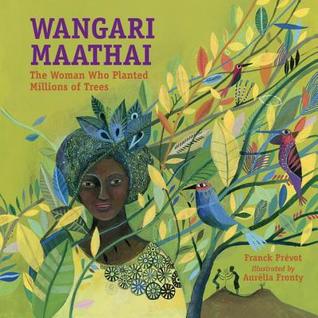
Wangari Maathi: The Woman Who Planted Millions of Trees by Franck Prevot, illustrated by Aurelia Fronty

Published by Charlesbridge

Summary:  While other picture book biographies about Wangari Maathi have focused on her tree planting, this book takes a broader look at her political activism.  She was fortunate to get a high school education in Kenya at a time when most girls didn’t go to school at all, and did so well that she was part of a group selected by President Kennedy to study in America.  Upon her return to Kenya, she observed how ravaged the land was from deforestation, and began her work to plant trees.  This work was in opposition to some of the plans of President Daniel arap Moi, and Maathai was imprisoned more than once.  In 2002, Moi was defeated, and Wangari Maathai was appointed assistant minister of the environment, natural resources, and wildlife.  In 2004, she was awarded the Nobel Peace Prize.  She died in 2011 at the age of 71.  End pages include an extensive timeline, information on Kenya today, quotes from Wangari Maathi, and further resources.  Grades 2-6.

Pros:  This French import is more extensive than other Maathi biographies, and would be appropriate for an older audience looking for more in-depth information.  The illustrations are striking, each one painted against a boldly colored background that fills the whole page.

Cons:  This is the fifth picture book biography of Wangari Maathi published since 2008, so some libraries may pass on purchasing this one, which would be too bad.

Dolley Madison: Parties Can Be Patriotic! By Kathleen Krull

Published by Bloomsbury USA Childrens

Summary:  When Dolley Madison died, her funeral was the largest ever seen in Washington, D.C. at that time.  It closed down the government, because so many people wanted to attend, including some of the twelve U.S. presidents she had known in her lifetime.  After a simple Quaker childhood and an arranged first marriage, Dolley, a widow at age 25, married James Madison, who later became the fourth U.S. President.  Dolley threw large parties every week, redecorated the White House, and famously rescued the portrait of George Washington just hours before the British burned down the White House during the War of 1812.  When Zachary Taylor referred to her as the First Lady, he coined a term that Dolley defined during her long, eventful life.  Ages 7-10.

Pros:  Veteran biographer Kathleen Krull has a new series, “Women Who Broke the Rules”.  This entry is fun, breezy, and informative.  At 46 pages, with illustrations on almost every page, it’s just the right length to give an enticing introduction to the life of a famous woman.

Cons:  The cover could be a bit more enticing.