And two final 2024 novels in verse

Black Star by Kwame Alexander (Little, Brown Books for Young Readers, 384 pages, grades 5-8). In this sequel to The Door of No Return, Kofi is now Nana Kofi, grandfather to Charlene, a.k.a. Charley, who dreams of being the first Black female baseball player. She and her best friend Willie Green get tricked into a bet with a local bully, forcing them to quickly organize a baseball team and play a game at the church picnic. When the picnic grounds are being used for other activities, the team sneaks over the bridge to the whites-only field, where an encounter with a group of white kids ends with Willie accidentally hitting one of the boys with a baseball. Back home, Charley can’t figure out what’s going on, but the adults start talking in hushed tones and seem to be preparing for a journey. In the final pages, the family flees in Uncle Albert’s car, except for Daddy who stays behind to defend their home, while Willie Green and his brother Johnnie run from their burning home to join them after the Klan has done something unspeakable to their father. Those in the car are heading north, with Charley wracked by guilt over her actions that have led to this moment. Readers will have to wait for the third book of the trilogy to find out what happens next in the family saga.

This incredibly rich novel has so many elements woven together: Nana Kofi’s stories that fill in some of the details between books 1 and 2, appearances by real-life people like Marcus Garvey and Mary McLeod Bethune, and everyday descriptions of the life of a Black family living on the 1920’s South. I do think most readers will need some guidance with this book, particularly with the historical context, and they will understand and appreciate it much more if they have read book 1.

Unsinkable Cayenne by Jessica Vitalis (Greenwillow Books, 304 pages, grades 4-7). It’s 1985, and 12-year-old Cayenne is excited at the prospect of finally settling down. She and her free-spirited parents have always l lived in a van, but with the addition of twins to the family, they’re feeling the need for a home and some money. Cayenne loves seventh grade, making a few new friends and developing a crush on the new boy Beau, but when there are layoffs at the local sawmill, her dad loses his job, and she learns that Beau’s father was responsible. As food gets leaner and her parents start fighting more, Cayenne fears that her days in a real home may be numbered. By the end of the story, her hunch proves correct, and the family takes to the road again, although Cayenne feels a bit wiser about appreciating herself and her family and about questioning the importance of “fitting in.” An ongoing school project about the Titanic offers additional insights about class, and the author includes additional information at the end, as well as the connections to her own family, and Cayenne’s dad’s PTSD from Vietnam which he self-medicates by smoking weed.

While not exactly an upbeat story, Cayenne is an endearing protagonist who learns some important life lessons, and the focus on class and poverty is one that’s often not explored much in children’s books. I was kind of surprised when Dad was smoking a joint on page 1, but the author’s note gave his marijuana use some good context.

National Book Award longlist

I’m nerdy enough to eagerly await the announcement of the National Book Award longlist, which this year happened on September 10 for young people’s literature. I read three of the books on the list and offer you my assessment of them here.

Kareem Between by Shifa Saltagi Safadi (G. P. Putnam’s Sons Books, 336 pages, grades 5-8). When this novel in verse opens, Kareem’s biggest concern is with making the middle school football team. He’s willing to cheat on homework and shun a new boy who’s a refugee from Syria in order to befriend the football coach’s son Austin. But when Kareem’s mother returns to Syria to help her ailing father, Kareem begins to question his actions. The 2017 Muslim ban throws Kareem’s life into chaos, and his issues with Austin start to feel petty. Kareem has to look deep within himself to do the right thing and start to make amends with some of the people he’s hurt. Like many immigrant kids, he has a foot in two different worlds, and by the end of the story, Kareem has learned to embrace his dual heritage.

I well remember Trump’s Muslim ban, but this book really made me understand the horrific effects it had on those who were directly impacted by it. The characters were well developed, and I liked that Kareem made some pretty bad–and quintessentially middle school–decisions, but that he was able to acknowledge them, working to make things right and growing over the course of the story. The book was so compelling that once I got about halfway through, I had to keep reading to find out how Kareem’s story turned out.

Free Period by Ali Terese (Scholastic Press, 272 pages, grades 5-8). Helen and Gracie alternate telling the story of how a prank gone wrong lands them in the principal’s office, where they’re sentenced to join the Community Action Club. At the first meeting, they learn about a project to get maxi pads in all the school bathrooms, something that club president and mean girl Madison wants to do as the final touch to her glittering middle school resume. After Helen has a period catastrophe, she becomes a huge advocate, leading the club in all kinds of pranks and civil disobedience to get the school board to fund the project. Helen’s a bit of an evil genius, while Gracie’s more of a quirky, artsy type, and while the two of them have been best friends and partners in crime for years, the period project shows them that they are developing their own identities and outside friendships. Combining their talents, they become an unstoppable force that brings the whole club–even Madison–together to get the job done.

It is a bit confounding to me why this book garnered NBA recognition. To me, it read like a run-of-the-mill Scholastic tween/teen story, albeit one that focuses and educates about an important topic that’s often not discussed. Helen and Gracie seemed so similar at the beginning of the story that it actually took me a couple of chapters to notice that they were alternating the narration. Their nonstop witty banter, confidence, and disregard of any kind of authority felt a bit unrealistic for middle school.

Mid-Air by Alicia D. Williams (Atheneum/Caitlyn Dlouhy Books, 320 pages, grades 5-8). Alicia Williams’ sophomore novel focuses on Isaiah, a Black eighth-grade boy whose two best friends are Drew and Darius. Together, they try to set world records and egg each other on to attempt daredevil stunts. When one of those stunts goes wrong and Darius is killed by a car, Isaiah blames himself. Both he and Drew withdraw into their separate grief at a time when they need each other the most. Isaiah’s attempt to find some healing by revisiting the scene of Darius’s death results in racial violence toward Isaiah that leaves him barely able to function. His worried parents send him to relatives in North Carolina where he basks in the easygoing warmth of his aunt and uncle’s home and develops his first crush on a girl who accepts all the things Isaiah has always tried to hide: his love of rock music, his fondness for painting his nails, and his fear of many of the stunts Drew and Darius pushed him to do. By the time summer’s over, Isaiah is starting to heal and is ready to start high school, and he and Drew finally find a way to begin to communicate.

Another novel in verse that could easily be a contender for a Newbery or Printz award. Like she did in Genesis Begins Again, Alicia Williams creates a memorable character who’s often afraid to let his true nature shine, slowly learning to be himself as the narrative unfolds. Both of the novels in verse would make excellent middle school book club books.

Since I started working on this post, the National Book Awards finalists have been named, and only one of these books made it. Which one? I will leave it to you to read all about it here (hint: it was my personal favorite). The winners will be named November 20, and yes, I have it on my calendar.

Lost boys

And Then, Boom! by Lisa Fipps (Nancy Paulsen Books, 256 pages, grades 4-7) and The Tenth Mistake of Hank Hooperman by Gennifer Choldenko (Knopf Books for Young Readers, 320 pages, grades 4-7). I read these two books back-to-back, and they are remarkably similar: both are written by Newbery Honor winners, and both feature sixth-grade boys with unreliable mothers, strong grandmothers who die, and a choice between trying to fend for themselves and going into the foster care system. Joe Oak, from the novel in verse And Then, Boom! experiences homelessness after his grandmother loses her home bailing out Joe’s mother when she gets arrested. After living in their car for a while, Joe’s best friend Nick finds a place in his mobile home park for them to live. Things are looking up until Grandmum suddenly passes away, and Joe is on his own, fearing that if he’s discovered, he’ll be at the mercy of Child Protection Services. The title comes from Joe’s love of comic books, where surprising turns of events are announced with a BOOM, and a final near-catastrophe results in Joe finally getting help from the caring people who have been around him all along.

Hank Hooperman lives with his mother and three-year-old sister Boo. When the story opens, their mom has been missing for a week, and Hank is desperately trying to figure out what to do. He reaches out to Lou Anne, the woman his mother listed as an emergency contact on a permission slip and finds temporary housing there. Lou Anne was one of his late grandmother’s closest friends, and while she provides housing for the kids, Hank reminds her of her own estranged teenage son, and she’s not particularly welcoming to him. Fortunately, a neighbor named Ray proves to be a caring friend and mentor, and Hank is getting along okay until his mother unexpectedly reappears, throwing everything into chaos. A few weeks in the foster care system reveals the bleakness of that path, but as with Joe, Hank learns that there are people around him who genuinely care and can help him get back on his feet again.

I loved both of these books, reading each in under 48 hours, and my fingers are crossed that they will both get Newbery consideration. There aren’t enough middle-grade books with boy protagonists, and both Joe and Hank are endearing narrators, both forced to grow up too fast, but still children, with a love of basketball and a need to be taken care of. There also aren’t enough stories of kids living in poverty, the unfortunate reality for way too many young readers. My one complaint about both books is that it really demonized the mothers, and the completely absent fathers pretty much got off scot-free.

One of these things is not like the other, take 2

Warrior on the Mound by Sandra W. Headen (Holiday House, 272 pages, grades 4-7). Cato loves baseball more than just about anything and aspires to join the Negro Leagues like his father, Daddy Mo, and his older brother Isaac. Daddy Mo died suddenly four years ago, and Cato is being raised by his grandparents, who have never told him the circumstances around his dad’s death. When white store owner Luke Blackburn builds a new baseball field for his son’s team, Cato and his friends sneak over to try it out themselves. When they’re caught, it’s the beginning of a chain of events that results in not only a baseball game between Cato’s team and the white team, but the revelation of Daddy Mo’s death, his friendship with Luke, and the guilt Luke carries about his role in the murder.

In the middle of all this, Isaac is brought home bloodied and unconscious, having been beaten as he tried to travel home during a break in the baseball season. As Isaac slowly recovers, he coaches Cato, not only in the finer points of baseball, but in surviving as a young Black man in the Jim Crow south of the 1930’s. There’s plenty of back matter to add historical context to this story, and readers will enjoy both the sports action and the history lessons. I did question if a friendship like Daddy Mo’s and Luke’s would have really survived to adulthood in that environment, but I’d like to think that it was possible.

One Big Open Sky by Lesa Cline-Ransome (Holiday House, 304 pages, grades 4-7). Just as I was finishing reading Warrior on the Mound, this book arrived for me at the library. It’s a novel in verse told by three female narrators: 11-year-old Lettie; her mother, Sylvia; and 18-year-old Philomena, an orphan with plans to be a teacher. They’re all traveling west, along with Lettie’s dad, who hopes to find a better life in Nebraska than the one they have in Mississippi. I know I would enjoy this book, but the font was tiny, and then I got distracted by another action-packed book.

And what was that book? I was looking through the most recent Scholastic flyer, and this book caught my eye: The Liars Society by Alyson Gerber (Scholastic, 304 pages, grades 4-7). Much of what is in Scholastic these days is pretty much trash, even in my low brow opinion, but this looked good, and I’ve enjoyed other books by Alyson Gerber. This one is a series opener featuring Weatherby and Jack, who take turns narrating the story. They meet at a sailing regatta, which Weatherby wins, gaining her a surprise scholarship to the prestigious Boston School, a private academy where her dad went and was part of the sailing team.

Weatherby has never met her dad, and as she gets involved with Boston and starts to learn more about her classmates, she begins to suspect that her mom has not been completely honest with her about her father. There’s a web of deception surrounding the school, and Weatherby is no exception. When she and her friends get recruited to join a powerful secret society, some of the lies begin to come to light. The twist at the end reveals an unexpected connection between Jack and Weatherby and leaves plenty of loose ends to investigate in book 2.

This book is a lot less likely to receive starred reviews or awards than One Big Open Sky, but it was a lot of fun! I did think Weatherby’s guilty secret was pretty lame, but she seemed tortured enough about it, and it got her admission into the Liars Society. It’s a promising opening for a series, with plenty of kid appeal for upper elementary and middle school readers.

Something Like Home by Andrea Beatriz Arango

Published by Random House Books for Young Readers

Summary:  Laura’s just arrived at her aunt’s house as this novel in verse opens.  Her parents are in rehab following Laura’s 911 call, and she’s trying to deal with the fallout, including guilt for having made that call.  Titi Silvia provides her with structure and a comfortable home but is emotionally distant.  When Laura finds an abandoned pit bull puppy, she resolves to train him as a therapy dog, believing this will be her ticket to getting to visit her parents.  A new friend, Benson, is struggling with sickle cell disease, but offers to help her with training as his health allows.  After Laura’s parents check themselves out of rehab, and her mom makes a disastrous unannounced visit to her school, Laura realizes that her path back home may be longer and more complicated than she first believed.  Some therapy and heart-to-heart talks with Titi Silvia help her find a greater acceptance of her new life and the new people who are trying to help her.  256 pages; grades 4-7.

Pros:  This follow-up to Andrea Beatriz Arango’s Newbery Honor book Iveliz Explains It All is a moving story narrated by a believable protagonist who has to navigate some pretty tough situations feeling like she is more or less on her own.  

Cons:  There was so much packed into this relatively short story–foster care, addiction, chronic illness, dysfunctional families, Laura’s Puerto Rican heritage, therapy dogs–that it felt like some of the topics didn’t get explored as fully as they could have.

Mascot by Charles Waters and Traci Sorell

Published by Charlesbridge

Summary:  Six eighth graders and their teacher take on the topic of racist mascots when they are assigned to a debate about their town’s Braves mascot, which often inspires face paint and tomahawk chopping at sports events.  At first, only the girls are opposed: Callie, a member of the Cherokee nation and Black; Priya, the Indian American editor of the school paper; and Tessa, a White girl who has been homeschooled through seventh grade.  The boys mostly just want to enjoy the local teams, but eventually Franklin, who is Black, joins the girls in their campaign and loses Luis’s friendship in the process.  Sean’s family is struggling with poverty but has long supported the Braves and opposes changing tradition.  As the school year draws to a close, tensions mount as the anti-mascot campaign kicks into gear and the kids learn more about what is most important to them and to their families.  Includes lists of Cherokee and Salvadoran Spanish words used in the text and additional information about mascots and taking action.  256 pages; grades 4-8.  

Pros:  A timely issue is explored through the voices of a diverse group of middle school kids, all of whom are presented sympathetically with realistic reasons for their various points of view.  A quick read that could easily inspire students to look around them to see what might need to change in their own communities.

Cons:  The story was extremely agenda-driven; the novel-in-verse format didn’t allow for much character or plot development outside of the mascot issue.

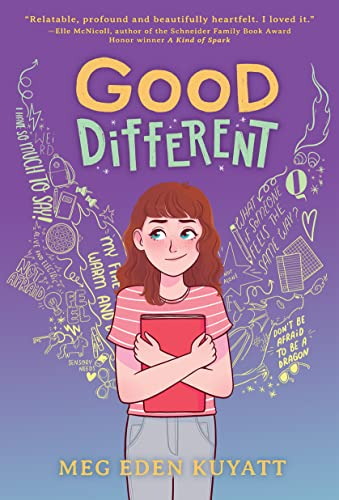
Good Different by Meg Eden Kuyatt

Published by Scholastic

Summary:  Selah works hard at being “normal”, making up rules to help her fit in at school and retreating to her room at the end of the day, exhausted from trying to hide her feelings.  When a friend tries to braid her hair in class one day, Selah explodes and hits the girl.  The incident puts her on probation at school and ostracizes her from most of her classmates.  As Selah tries to figure out what is going on with her, she begins to think that she, her mom, and grandfather may all have autism.  A sympathetic English teacher helps her to express herself through poetry, and Selah begins to share what she’s feeling, first to her family and later on to her school.  As she begins to feel more comfortable with who she is, Selah comes up with a new list of rules to help her be herself and to communicate with those around her.  Includes an author’s note about her own journey to an autism diagnosis and self-discovery as well as a list of resources.  288 pages; grades 4-7.

Pros:  This novel in verse will be helpful to anyone with autism, or who knows someone with autism, or who sometimes feels like they don’t fit in very well.  I was inspired by Selah’s powerful poems, her journey, and the ways she learned to advocate for herself.

Cons:  It made me sad that no one at Selah’s seemingly caring private school had picked up on her autism in her eight years of attendance there.

Aniana del Mar Jumps In by Jasminne Mendez

Published by Dial Books

Summary:  Aniana loves to swim, but her swim team is a secret between her and her Papi, since Mami has extreme anxiety about water, dating back to her brother’s drowning death in a hurricane during her childhood in the Dominican Republic.  When Aniana develops symptoms of what is later diagnosed as Juvenile Idiopathic Arthritis, she’s forced to tell the doctor about her swimming, and Mami is sure that God is punishing her for lying.  Slowly, Aniana comes to terms with her illness and begins to see herself as a new person–someone who has to deal with a chronic disease, but also someone who is no longer afraid to speak up for herself.  A crisis brings the need for some resolution, bringing Mami the help she needs and allowing Aniana to find her way back to swimming.  Includes an author’s note about her own life experiences, including a chronic illness, that inspired her to write this book.  384 pages; grades 4-8.

Pros:  I jumped into this beautiful novel in verse and found it hard to put down.  Aniana is an inspiring protagonist who is forced to learn to live with a pretty debilitating disease and manages to re-make herself into someone stronger.

Cons:  I got very frustrated by Mami.

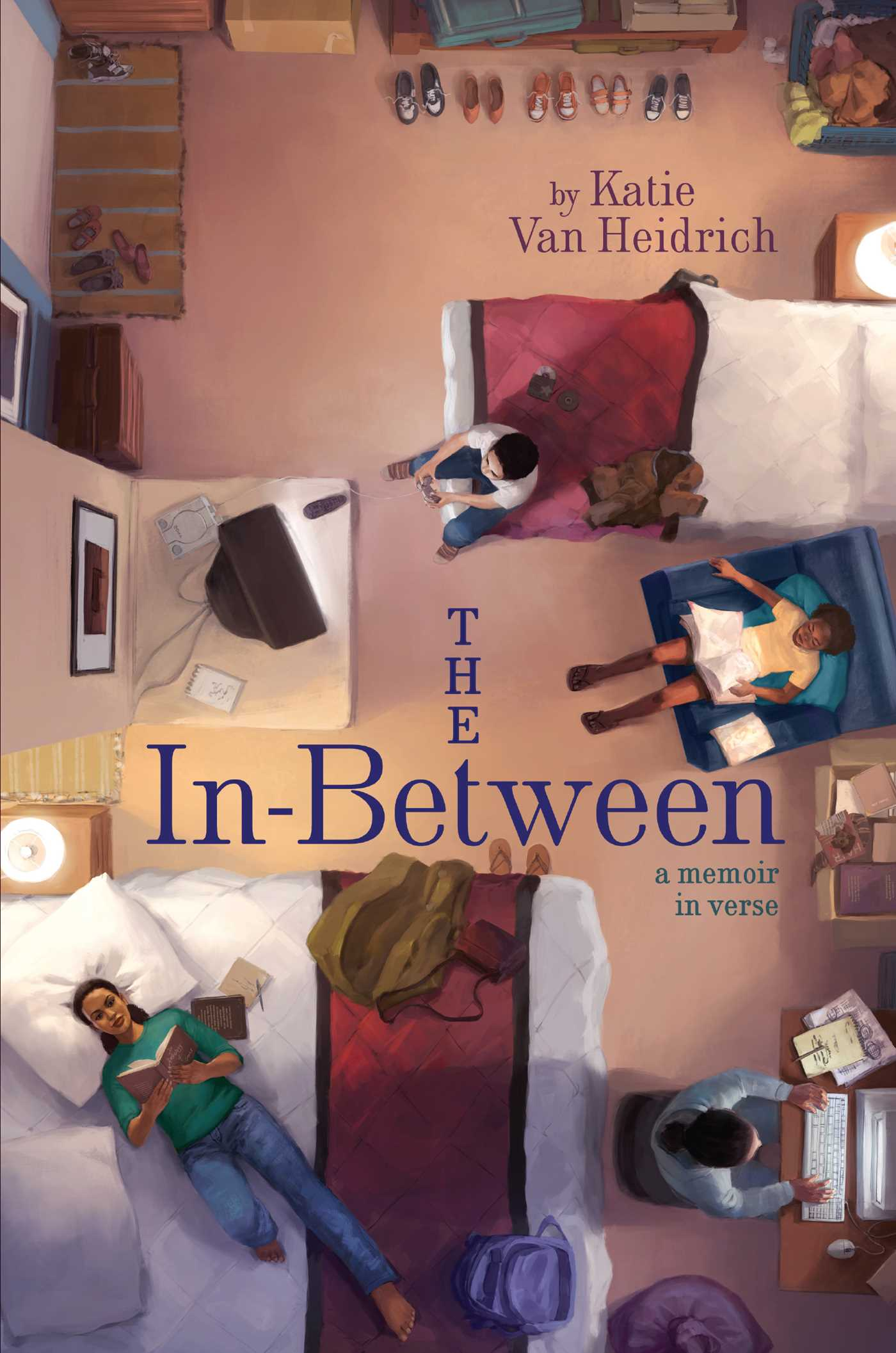
The In-Between: A Memoir in Verse by Katie Van Heidrich

Published by Aladdin

Summary:  In this debut memoir in verse, Katie Van Heidrich writes about a six-week period when she lived with her mother and two younger siblings in a motel room.  It’s an “in-between” time when her mom is between jobs and unable to keep their apartment.  As Katie tries to adjust to her circumstances while pretending everything is normal to her seventh-grade classmates and teachers, she reflects on the past and her relationship with the members of her family.  Her Black mother and white father have always worked to be in her life, even after they divorced, and she recognizes how her dad has provided structure while her mom has allowed her to dream.  The kids spend weekends with their dad, who’s recently remarried and living in the suburbs, but Katie slowly learns the reasons why they can’t live there all the time.  By the time a tenuous happy ending arrives, Katie’s learned that she can’t always please her parents and that her voice is an important part of the family.  Includes seven pages of photos.  304 pages; grades 5-8.

Pros:  Katie Van Heidrich has a masterful debut with verse that is both expressive and concise and beautiful pacing that slowly reveals each family member’s personality and how the past has brought them to the present moment.

Cons:  While there’s nothing in this book that makes it inappropriate for upper elementary, the emotions are so pitch-perfect for middle schoolers that it might be better appreciated by older readers.

Odder by Katherine Applegate, illustrated by Charles Santoso

Published by Feiwel and Friends

Summary:  Odder is a sea otter who loves to play in the ocean, frolicking with her friend Kairi off the coast of California.  She’s a lot more daring than Kairi, and one day her adventurousness leads them right into the path of a hungry shark.  Both are attacked, but Odder sustains the worst injuries, landing herself at an aquarium under the care of humans. It turns out she’s been there before, and the second part of the book goes back to her early days when she was separated from her mother, rehabilitated by the aquarium staff, and released back into the wild.  Her second time there ends differently, and both she and Kairi end up as permanent residents, becoming surrogate mothers to rescued pups.  Includes an author’s note about the Monterey Bay Aquarium and the real-life otters who were the inspiration for Odder and Kairi; also a bibliography and a list of additional resources.  288 pages; grades 3-7.  

Pros:  Katherine Applegate’s legion of fans will be pleased to see a new heartwarming animal book on the shelves.  The verse format makes for a quick read, with interesting additional information for budding marine biologists and cute illustrations.

Cons:  I wish there had been even more cute illustrations.