Some creatures that are great…and small

Towed by Toad by Jashar Awan (Tundra Books, 48 pages, ages 3-7). Toad loves to help others as he drives around in his tow truck, helping animals who are having car troubles. He’s so busy that he doesn’t have time to eat the breakfast or lunch that Pop makes for him. But when Toad’s own truck has a breakdown, Toad realizes something: he needs to ask for help. And Pop is only too happy to come to the rescue with his own truck. “Everyone needs help sometimes. Even the helpers.”

From the clever play on words in the title to the satisfying message at the end, this little book is a winner that will be enjoyed by young readers everywhere. There’s lots of humor in the illustrations, with funny animal names and various car-related situations that are sure to bring a laugh.

How to Draw a Brave Chicken by Ethan T. Berlin, illustrated by Jimbo Matison (Hippo Park, 40 pages, ages 4-9). After the narrator draws a chicken, he decides the chicken looks scared. Drawing her some friends, including a knight, makes her braver, but when a dragon is drawn, she gets nervous again. Drawing a rocket sends her to the moon, but she and her friends eventually decide they prefer life on Earth. A hand-drawn waterslide sends everyone back home again, where they celebrate with a party full of scary creatures…all drawn by you, of course!

This hilariously zany story is interspersed with step-by-step drawing instructions that will keep readers busy for hours. For more fun, get the first book, How to Draw A Happy Cat (2022)

How to Staycation Like a Snail by Naseem Hrab, illustrated by Kelly Collier (Owlkids, 40 pages, ages 4-7). Snail has tried traveling and decided he prefers to stay home. He and his friend Stump (a tree stump) decide to have a stay-at-home vacation…a staycation! They notice with a greater appreciation the sights and sounds around them. Just as they’re starting to think they’ve seen and heard it all, a couple of fluffy traveling seeds drop in. Snail and Stump enjoy sharing the sights with their new friends, convincing the seeds to put down roots and join them.

This is another second in a series; I missed How to Party Like a Snail (2022), and I’m glad I caught up with Snail for his staycation. The story is cute, with gentle humor and cartoon bubble dialogue, and it could serve as a prompt for kids to write about what they could do on their own staycations.

Stories of food and family

The Table by Winsome Bingham and Wiley Blevins, illustrated by Jason Griffin (Neal Porter Books, 56 pages, ages 4-8). A child tells the story of their family as they gather around the table to eat, dye eggs, and sew a dress. The narrator reads to Meemaw, who can’t read but is an excellent cook. When Papa loses his job in the mines, the family is forced to move to a place that’s too small to fit the table. Left by the side of the road, the table gets a new home when another family drives by. Daddy is a carpenter, so he’s able to fix it up. As they sit down to dinner, the narrator tries to imagine the stories that their new-old table could tell.

A poignant story about two families–one White and one Black–who share the mundane but loving details of their lives. It would make a good book to share around Thanksgiving, with its emphasis on food and family. I loved the illustrations, which only portray the hands of the characters as they gather around the table, but readers may need some inferencing skills to understand what is going on.

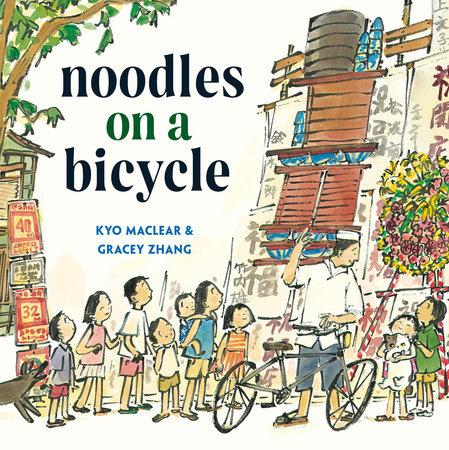
Noodles on a Bicycle by Kyo Maclear, illustrated by Gracey Zhang (Random House Studio, 40 pages, ages 4-8). The team that brought us The Big Bath House has created another story from Japan, this time about kids watching the amazing deliverymen who work for the noodle shops, carrying trays stacked high with china bowls full of steaming noodles. Zipping through traffic, they never lose their balance, setting up friendly rivals between deliverymen from different shops. The kids try to emulate them, stacking trays with bowls full of water, but inevitably suffer spills. At the end of the day, Mama calls the noodle shop, and a few minutes later the doorbell rings–Papa! Turns out he is one of the deliverymen, and he’s ready for a soak in a hot tub before wearily tucking in the kids and heading for bed. Includes an author’s note and photos on the front and back endpapers of Tokyo deliverymen in 1937 and 1959.

This slice-of-life story from the mid-twentieth century celebrates the workers who adroitly performed the hot, hard work of delivering noodles to the hungry residents of Tokyo. I’m glad they included two photos to help readers really appreciate the skill involved. The author’s note captures it perfectly when she says, “Of course, there are practices worth improving, but there are also things worth remembering and celebrating.”

Hair-raising stories

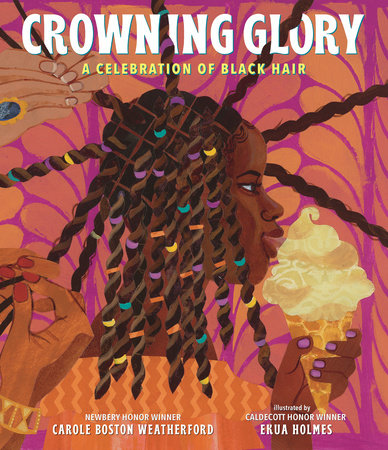
Crowning Glory: A Celebration of Black Hair by Carole Boston Weatherford, illustrated by Ekua Holmes (Candlewick, 32 pages, ages 4-8). Starting with “five queens” (five Black women, who, in 2019, won the titles of Miss America, Miss USA, Miss World, Miss Universe, and Miss Teen USA ), the rhyming text and vibrant illustrations celebrate Black hair. Cornrows, ‘fros, locs, puffs, ponytails, and more–all get their moment to shine. “To heed beliefs or cheer gray days,” women cover their hair with hijabs, geles, headwraps, and hats. “A ritual of hand and heart,/each stunning head a work of art./Each royal coil coaxed by kin./Each strand a story without end.” Includes a glossary.

I hope this beautiful book will be considered for both Coretta Scott King and Caldecott awards. I always love Ekua Holmes collage illustrations, and these are gorgeous. The focus is on female hair, so this could make a good companion to read with Crown: An Ode to the Fresh Cut by Derrick Barnes, which features a barbershop.

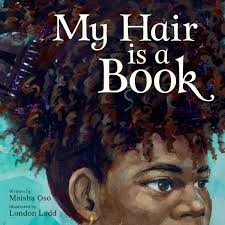
My Hair Is a Book by Maisha Oso, illustrated by London Ladd (HarperCollins, 32 pages, ages 4-8). This book looks similar to Crowning Glory, and it has gotten at least two starred reviews. I’ve had it on hold at the library for weeks now, but I haven’t been able to get a copy. Now that I’m finally giving up, it will probably be on its way to me tomorrow!

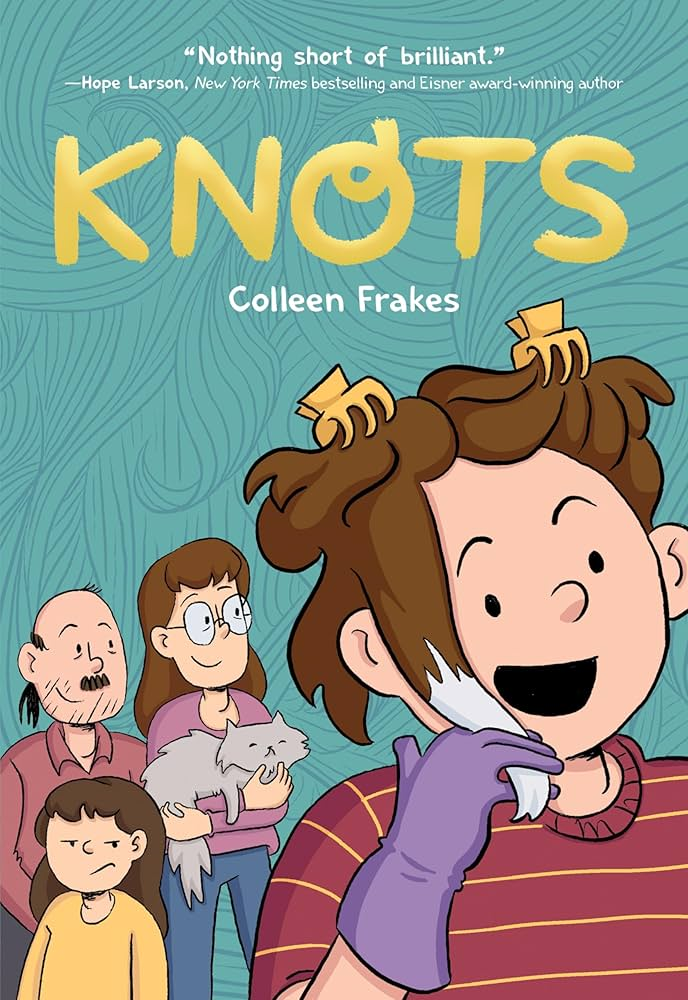
Knots by Colleen Frakes (HarperAlley, 240 pages, grades 4-7). Nervous about starting at a new school, Norah tries to give herself a new look by first bleaching her hair, then dyeing it blue. It turns out surprisingly well, and school gets off to a good start. But a few weeks in, a boy shares with the class that he is mostly responsible for his two younger sisters because his parents aren’t home much. Norah and some of the other kids get pulled out of class by the police as witnesses, and the boy and his sisters end up getting sent to live at their grandparents’ house. When Norah’s mom and younger sister move across the state for a new job, Norah finds herself feeling neglected by both parents and worries that something similar will happen in her family. Another attempt to change her hair turns out to be disastrous, and her disheveled appearance makes a caring teacher start questioning Norah’s home life. When the family is reunited for the holidays, they finally start communicating about what’s going on, and, while things are still far from perfect, some changes are made that help get them back on track. Includes an author’s note about incidents from her own life that inspired the story and the evolution of the book.

Raina Telgemeier fans will enjoy this fictionalized graphic novel memoir that explores family issues, as well as school and friendship concerns. The hair dyeing is somewhat symbolic of the changes Norah and her family are going through, but also includes a reassuring message that with hair and life, there are always chances for a do-over. The scene with the police pulling the kids out of class as witnesses was kind of jarring; yes, teachers are mandated reporters, but hopefully such methods are not used to find out what’s going on at kids’ homes.

A ballplayer who dared, a poet who cared, and a sanitation worker who repaired

Call Me Roberto! Roberto Clemente Goes to Bat for Latinos by Nathalie Alonso, illustrated by Rudy Gutierrez (Calkins Creek, 40 pages, grades 2-5). Roberto Clemente loved playing baseball as a boy in Puerto Rico and was thrilled to be scouted by the MLB. After a disappointing season in Montreal, he joined the Pittsburgh Pirates, where he became an All-Star and helped lead his team to the World Series in 1960 and 1971. He won twelve Gold Gloves, was the 1966 National League MVP, and the 1971 World Series MVP. Despite his success, Roberto often faced racism and discrimination. He corrected those who tried to call him Bob and spoke out against the segregation he endured during spring training in Florida. On September 30, 1972, Roberto became the 11th MLB player and the first Latino one to reach 3,000 hits. Includes notes from the author and illustrator, glossary, photos, bibliography, and timeline that tells about Roberto’s death in a plane crash on his way to deliver humanitarian aid to Nicaragua in December of 1972.

I’m ashamed to say that I thought Roberto Clemente was Dominican and that the only thing I knew about him was his death in a plane crash. This biography emphasizes his greatness in baseball, making clear the discrimination he faced and how he fought for justice for himself and other Black and Latino players. The illustrations by Caldecott honoree Rudy Gutierrez are beautiful and deserve a look from this year’s Caldecott committee. The author’s note adds a personal story, since she is a Cuban American sportswriter who has faced some of the same issues Roberto Clemente did.

The Soldier’s Friend: Walt Whitman’s Extraordinary Service in the American Civil War by Gary Golio, illustrated by E. B. Lewis (Calkins Creek, 40 pages, grades 2-5). A look at a lesser-known part of Walt Whitman’s life, when he served as a volunteer nurse in the Civil War. After his brother was wounded, Walt traveled from New York to Virginia to visit him in the hospital. He was so moved by the soldiers he saw that he decided to move to Washington, DC to devote himself to caring for them. Most of what he did was simple: bringing treats, helping men write letters, talking with them, or just listening. Although he was a fervent supporter of the Union cause, he cared equally for soldiers from both sides. Lines from Whitman’s “Leaves of Grass” are woven into the story. Includes photos and additional information about Walt Whitman and his Civil War experiences, along with a list of resources.

This touching story of Walt Whitman’s kindness and caring seems particularly relevant in today’s world when it’s easy to feel like it’s necessary to take sides or that one person can’t make a difference. The author notes at the end that Whitman may have visited as many as 25,000 soldiers, and while he couldn’t influence the outcome of the war, he found a way to express caring and kindness. Except for the lines from “Leaves of Grass,” there’s almost no mention of Walt Whitman’s poetry; it would have been nice to acknowledge his literary contributions in the story or back matter.

Gifts from the Garbage Truck: A True Story About the Things We (Don’t) Throw Away by Andrew Larsen, foreword by Nelson Molina, illustrated by Oriol Vidal (Sourcebooks Explorer, 40 pages, grades 1-4). Nelson Molina was always a collector. His mostly Puerto Rican neighborhood in East Harlem yielded all kinds of treasures. His mom showed him how to turn scrap wood into birdhouses, and Nelson enjoyed fixing up cast-off toys for his younger siblings. As an adult, Nelson became a New York City Sanitation Worker, where he continued to find and fix up things that he found in the trash. He started displaying them in the locker room of the sanitation garage, eventually expanding into other parts of the building. Since retirement, Nelson has opened a museum where he can display his treasures, showing the huge amount of stuff that we put into the trash. Includes tips for reducing, reusing, recycling, and rethinking, as well as photos of Nelson with some of the exhibits from his museum.

Kids will be inspired to look at trash differently, maybe thinking twice before they throw something away. I loved the scene at Christmas where young Nelson happily gives his siblings the toys he’s fixed up for them. Being something of a minimalist, though, the photos of his cluttered museum convinced me that his way of life is not for me.

Indigenous history

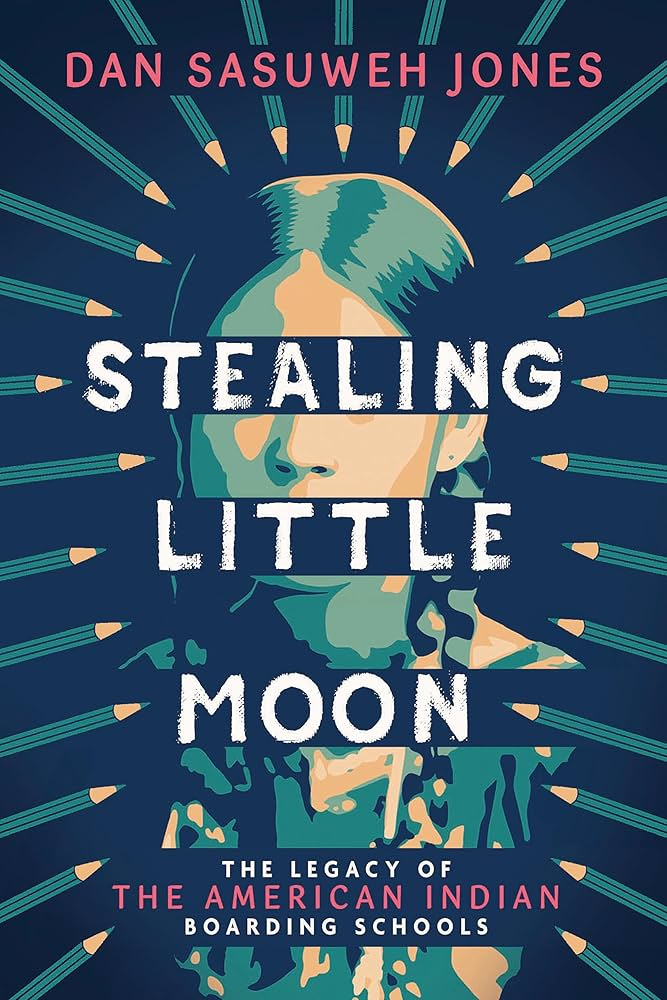
Stealing Little Moon: The Legacy of the American Indian Boarding Schools by Dan SaSuWeh Jones (Scholastic Focus, 304 Pages, grades 5-8). Dan SaSuWeh Jones tells the story of his family’s history with the Chilocco Indian Agricultural (boarding) School, beginning with the forcible capture of his grandmother Little Moon There Are No Stars from the Ponca reservation in 1885 at the age of four. The Chilocco school, run by Quakers, did not condone the physical abuse found at other Indian boarding schools, but it did use strict, military-inspired practices to force the students to assimilate to white culture. Little Moon There Are No Stars, renamed Elizabeth, stayed on for several years after her graduation to work as a school matron, and sent her own daughter there as well. By the time the author’s sister attended the school in the 1950’s, there had been many changes, becoming a vocational school that provided a positive experience for many (although certainly not all) of the students. The 1960’s and 1970’s saw political movements that helped the school and its students embrace their various cultures and languages. While the author didn’t attend the school, he worked there after it closed in 1985 as part of a maintenance crew trying to preserve the buildings and grounds. In his final chapter, he writes of the appropriateness that those buildings have crumbled, leaving the land to its natural state, a metaphor for the enduring nature of Indigenous cultures that have survived so much trauma yet still continue to live on. Includes an introduction by Denise K. Lajimodiere (Turtle Mountain Band, Chippewa), photos throughout the text, and a long list of additional resources.

Reading this book caused me to reflect on how much this blog has educated me and changed my views on American history. I’m not sure I knew anything about Indian boarding schools ten years ago, but I’ve learned from children’s books over the years, and this one added a lot to that knowledge. It’s masterfully written, weaving together a personal family memoir and the history of boarding schools in North America. The author writes unflinchingly about a multitude of abuses and deaths of children at many different schools, while at the same time acknowledging that some students had positive experiences and learned to embrace their heritage, particularly in the later years of the schools’ histories. The final chapters give hope that some of the many, many crimes and trauma committed against indigenous people are finally being at least brought to light and possibly, in some cases, addressed and healed. There are some horrific descriptions of child abuse, so be aware of that element when sharing this book with kids. I hope this book will be considered for awards, especially by the Sibert committee.

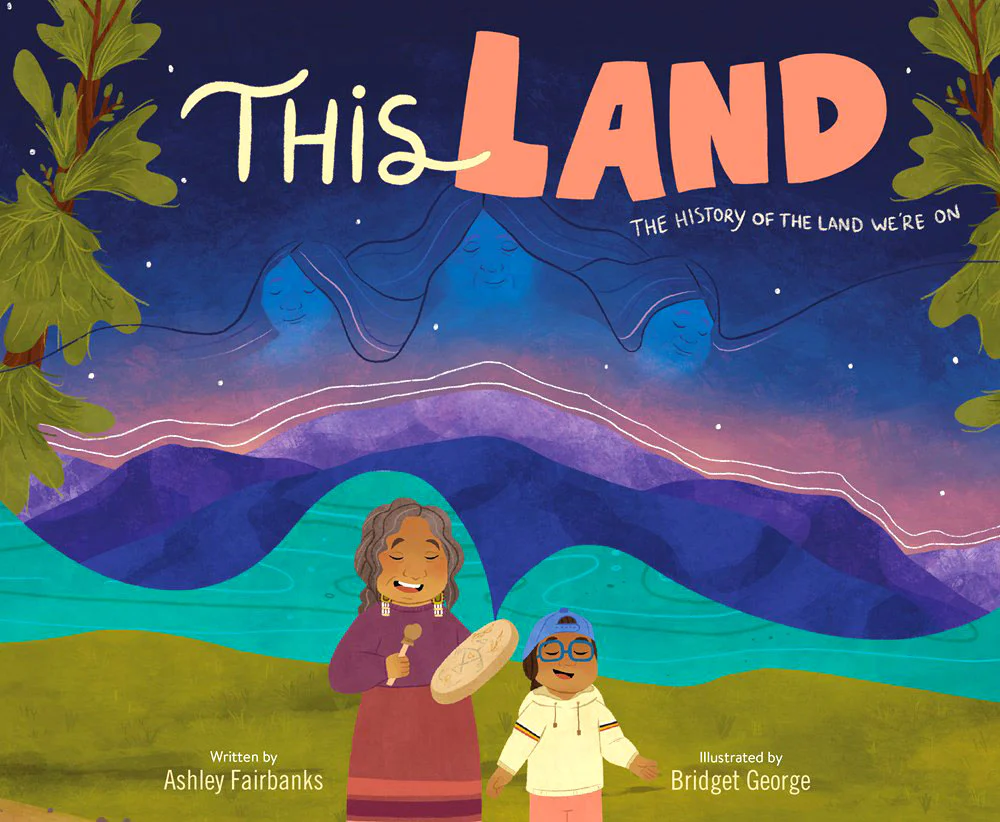
This Land: A History of the Land We’re On by Ashley Fairbanks, illustrated by Bridget George (Crown Books for Young Readers, 40 pages, ages 4-8). “This is my house. I live here with my family,” the narrator begins. “Before us, another family lived here.” Other families lived there, too, but further back in time, a whole community lived on the land before they were forced off by Europeans, something that happened all across the country. The narrator has a friend who is Anishinaabe (like the author and illustrator), and he and his grandma remind the boy of the Indigenous people who once lived there: their food, their songs, and mostly, the way they considered the land to be sacred. Now, as he travels around the U.S. with his family, the boy learns about different Indigenous groups who lived in those places and remembers how they once honored the land they were on. Includes additional information about land acknowledgement, discussion questions, and ideas for learning more about local Native people.

This straightforward story reminds readers to learn about the history of the land they now call home and recall that it once belonged to people who were forced to leave their homes. I really liked how the book acknowledges those who lived on the land of well-known sites like Mount Rushmore and New York City. I read in a review that the title calls to mind the controversy around the song “This Land Is Your Land,” a song that is considered problematic by many Indigenous people. I wasn’t aware of this and was reminded once again of how much I have learned from reading books for this blog.

Picture books to share

Mr. Fox’s Game of “No!” by David LaRochelle, illustrated by Mike Wohnoutka (Candlewick, 40 pages, ages 4-8). Here’s how Mr. Fox’s game works: every time he asks a question, you have to say “no,” or you will be sent back to the beginning of the book. Ready to play? Better not say yes! Do you want a taste of Mr. Fox’s scrumptious-looking sundae? A free trip to Hawaii with a million billion dollars thrown in? If you’re still in the game, how about this: are you stronger than a baby? Are you wearing underwear? What do the letters Y-E-S spell? If you make it all the way to the end of the book, there’s a final question: have you ever read a funnier, better written, more beautifully illustrated book than this one?

I’ve just been delighting first graders by reading them David LaRochelle and Mike Wohnoutka’s book, See the Cat: Three Stories About a Dog, and I look forward to trying this one out on them. It’s such a clever idea, and just the right humor for kids. I’m not sure about going back to the beginning of the book if they make a mistake…I might just make it a game where Mr. Fox gets points for the wrong answer.

First Day, Hooray! A Book of School Day Feelings by June Sobel, illustrated by Nabila Adani (Clarion Books, 40 pages, ages 4-8). Kids run into school on their first day with “backpacks filled with school supplies, but something else hides in disguise.” What’s hiding? Big feelings, shown with colored fonts in the text and colorful creatures surrounding different kids. Whether you’re feeling happy, scared, angry, or brave, it helps to name the feeling and to take a deep breath when needed. At the end of the day, kids pack up their backpacks–and their feelings–and head home with one more emotion: hooray! Includes a note from Yale early childhood professor Craig S. Bailey about ways to use this book to help kids explore their emotions.

I’m taking this book to school with me on Monday to share with our school counselors. It’s a simple but effective exploration of different emotions children (and adults) may experience, helping them to handle them better by identifying them. The illustrations of a diverse student body and fun magical creatures associated with the different feelings will appeal to kids as well.

War

A Star Shines Through by Anna Desnitskaya (Eerdmans Books for Young Readers, 40 pages, grades 1-5). “We used to live in a big city,” the narrator begins. Her family kept a star-shaped lamp in their apartment window, which would welcome her home at night. But then war came, and she and her mother (the father disappears without explanation) flee to another country. Everything is new: the language, the food, the apartment, even her mom and her. One night, Mom brings home a package with cardboard, scissors, and glue, and together they make a cardboard star with a light inside. Putting the lamp in the window marks a turning point, and soon their new country is feeling more like home. Includes an author’s note telling how a one-week family vacation in Cyprus turned into a refugee situation when Russia invaded Ukraine.

The author packs a big punch with just a few words on the beautifully illustrated pages of this book. It felt a little optimistic that making a lamp would turn things around so quickly, especially with the loss of the father, whether he was killed or had to stay behind. But the story offers hope to kids forced to move due to wars and other difficulties that make them and their families refugees.

The Night War by Kimberly Brubaker Bradley (Dial Books, 288 pages, grades 4-7). When there’s a roundup of Jews living in Paris, Miriam (Miri) is captured and separated from her parents. A neighbor helps her escape, on the condition the Miri take the woman’s two-year-old daughter Nora with her. Helped by a nun, Miri and Nora are sent to a town near Tours, where an old castle stands on the border of occupied France and Vichy France. En route to the town, Miriam falls asleep and awakens to find that Nora has been taken away and sent to live with another family. Miri is placed in a convent school, joining the nuns and a few students who have stayed for the summer, and is renamed Marie to hide her Jewish identity. While there, she gets involved in a secret operation to help escaping Jews cross the border, aided by a mysterious old woman who turns out to be the ghost of former castle owner Catherine de Medici. Miriam/Marie’s last mission is to save herself and Nora, which she is able to do with the help of the friends she has made at the convent, in an exciting and daring escape. Includes a lengthy author’s note with additional historical information.

I’m on a mission to read some of the Newbery contenders, so I finally got around to this one, written by the author of some of my favorite World War II historical fiction books, The War That Saved My Life and its sequel. While it’s currently at number 3 on the Goodreads Newbery list, I confess I did not much care for it. I’m sure the circumstances of 1942 France made kids grow up fast, but Miri and her friend Beatrice were way too wise beyond their years. Their other friend Jacqueline seemed to exist mostly to show how oblivious many French people were to the suffering of their Jewish neighbors. I had kind of mixed feelings about the ghost plot twist; it was cool in some ways and made for an interesting subplot, but also felt somewhat jarring. Finally, the epilogue wrapped things up WAY too neatly for a book about the Holocaust. This book has gotten glowing reviews, though, and the history is super interesting, so take a look for yourself!

Election Day

Leo’s First Vote by Christina Soontornvat, illustrated by Isabel Roxas (Knopf Books for Young Readers, 48 pages, ages 4-8). Leo’s excited that his dad has recently become a naturalized U.S. citizen, which means Dad gets to vote in the upcoming presidential election. Leo plans to go with him to the polls, but in the meantime, his class is having a mock presidential election. The kids learn about elections, and at home, Leo watches conventions and debates with his family. Everyone’s talking about the upcoming election, and when Leo hears a cousin say he’s not going to vote (“What’s the point?”), he feels deflated. But when his class’s mock election is determined by one vote, Leo finds his enthusiasm again. The last page shows Dad reading a newspaper with a headline declaring, “Historic turnout!” Also available in a Spanish language edition, ¡El primer voto de Leo!

Lots of facts about elections are woven into Leo’s story, and the excitement around voting will have kids eagerly anticipating Election Day. Personally, I am feeling so jaded about the day (Leo’s cousin really spoke to me) that I almost didn’t write this review, but good for Leo and his dad (and Christina Soontornvat) for having such enthusiasm about it.

Presidential Elections and Other Cool Facts: Understanding How Our Country Picks Its President by Syl Sobel, J.D. (Sourcebooks Explore, 5th edition, 48 pages, grades 2-5). This straightforward introduction to the presidency tells how elections work, as well as giving interesting facts about campaigns, the electoral college, First Ladies, and the order of succession should the President die or become disabled. There’s a list of all the U.S. Presidents, along with the years of their terms, and party affiliations. Includes a glossary, index, and lists of resources.

Rumor has it there’s an updated version of this book, but interlibrary loan has only been able to send me older ones, so I got to travel back to a time when Barack Obama was President, and Ronald Reagan was the oldest person to have been elected President at age 73. It’s a good introduction to the presidency and the election process, and although the writing and illustrations aren’t particularly exciting, it includes the kinds of facts and trivia kids (and adults) enjoy learning.

Some suggestions for the first weeks of school

Sometimes We Fall by Randall de Sève, illustrated by Kate Gardiner (Random House Studio, 40 pages, ages 3-8). A young bear looks worriedly at his mother enjoying plums up in a tree. “What if I try and I miss?” asks the cub as he contemplates leaping. “Sometimes we try and we miss. It’s okay,” his mother reassures him. This pattern repeats as the cub starts climbing the tree, voicing his anxieties, which are soothed by his mother. Finally, he crawls out onto a branch for the plum, the branch breaks, and the worst happens: he falls. But it really is okay, because the plum falls too, and one taste is enough to motivate the cub to try again. An excellent lesson for preschoolers or kindergarteners about persevering. The mother is a good model for letting her child try and fail and try again, and as a bonus, both bears are adorable.

We Are Definitely Human by X. Fang (Tundra Books, 48 pages, ages 4-8). When something crashes outside Mr. and Mrs. Li’s house one night, Mr. Li investigates and finds three strange creatures. “We are DEFINITELY human,” they tell him, despite evidence to the contrary. Mr. Li is a kind human, and he gives the creatures a place to sleep and a promise that he’ll help them repair their vehicle in the morning. When morning comes, the Lis take the visitors into town, where other kind humans help them get what they need. Before long, there’s a party at the Lis’ house, and Mr. and Mrs. Li explain about food and dancing to the creatures. Finally, the “car” is fixed, and the creatures head off to space. “But wherever they went, they would remember kind humans and do what kind humans do–offer help to those in need.” A fun way to start classroom discussions about kindness and community while keeping things light. For an out-of-this-world theme, you could follow up with reading Dalmartian and/or The First Week of School.

Round and Round the Year We Go by Carter Higgins (Neal Porter Books, 48 pages, ages 4-8). Rhyming text and collage illustrations take readers month by month through the year. Pages inserted after February, May, August, and November introduce the change of seasons (with the name of the season in a bold font) with a simple rhyme, “rainy waiting/shady spring/round and round the year we swing.” A final two page spread summarizes the year: “some things change/and some do not/let’s play with all the time we’ve got/summer, spring, and winter, fall/round and round for one and all.” Reminiscent of an Eric Carle book, but with catchier text, using collage illustrations to introduce a concept. Although it’s the calendar year and not the school year, this would be a nice book to share with kindergarteners or first graders in the early days of school.

I’m Sorry You Got Mad by Kyle Lukoff, illustrated by Julie Kwon (Dial Books, 32 pages, ages 4-8). The title of the book is also Jack’s first attempt at a note apologizing to Zoe for knocking over her block castle. Made up entirely of the drafts Jack writes with his teacher’s coaching, the story traces Jack’s gradual movement from an angry “I’m sorry,” to a more nuanced explanation of his behavior (a couple of other boys told him castles were for girls, so he didn’t get to help Zoe build hers). A few pages from the end, Jack finally gets his apology right and hands the note to Zoe. Zoe responds with one of her own, and by the last page, the two friends are working on a new castle together. Perfect for starting discussions about what makes a real apology, the letters and illustrations also capture the kids’ emotions and show how a teacher can make a difference in helping them sort out and express their feelings.

A pair of award contenders

Barrio Rising: The Protest That Built Chicano Park by María Dolores Águila, illustrated by Magdalena Mora (Dial Books, 40 pages, grades 1-4). The narrator lives in a neighborhood called Barrio Logan, one of San Diego’s oldest Chicano neighborhoods, where residents have been looking forward to finally getting the park they’ve been promised for years. When they find out that the new construction being done is for a police station, they’ve had enough. Neighbors band together to take over the land and protest, despite orders from the police to disperse. For twelve days, the crowd grows, drawing protesters from nearby barrios. Finally, the city council holds a meeting, led by Leon Williams, San Diego’s first Black councilman, and announces they’ve changed the plan from a police station to a park. Everyone celebrates and pitches in to create Chicano Park. Includes additional information about the park, which is now a National Historic Landmark. Also available in a Spanish language edition, El barrio se levanta: La protesta que construyó el Parque Chicano.

Keep this book in mind when Hispanic Heritage kicks off on September 15. The story about this 1970 event is inspiring, and the illustrations juxtapose birds, butterflies, and purple flowers with the gritty urban setting. I’d love to see it get some Belpré Award recognition for either the story or the illustrations.

Before the Ships: The Birth of Black Excellence by Maisha Oso, illustrated by Candice Bradley (Orchard Books, 40 pages, grades K-5). Instead of starting with the slave trade, as is often the case with Black history in America, this book begins “before the ships” when civilizations flourished across Africa. There were kings and queens, doctors, scribes, artisans, and merchants. Impressive buildings were created, as were stories and music, while scientists and mathematicians studied the world. A wordless page showing a slave ship sailing through the darkness divides the book between the past and the present, “after the ships.” The descendants of those Africans now live different lives, but they are still warriors, scholars, and leaders, or, as the final page says, “We are the light.” Includes an author’s note telling how her time in Africa showed her the cultures of Ethiopia, South Africa, Kenya, and Nigeria.

I’ll be surprised if this doesn’t get a Coretta Scott King award or honor. I love the focus, all too rare, on the civilizations that existed before African people were captured and sold into slavery, and I will definitely be sharing this book with teachers at my school. I would have enjoyed even more back matter, including a map or two.