The History of We by Nikkolas Smith (Kokila, 40 pages, grades K-5). Through poetic text and rich acrylic illustrations, Nikkolas Smith traces the history of the earliest humans in Africa from more than 200,000 years ago. The people are shown making music and dancing, created languages, built homes, growing crops, wondering at the stars, and eventually discovering ways to travel on the oceans. A world map at the end puts Africa at the center of civilization, from where humans traveled to settle other continents. The back matter includes information about each of the spreads, and the author’s note relates how he never learned about humanity’s roots in Africa, motivating him to create this book. Includes a timeline covering the period from 233,000 years ago to 5,000 years ago.
I’d love to see this book considered for a Caldecott or Coretta Scott King award. It would make a good companion to Before the Ships, introducing kids to the history of the people of Africa before American slavery. Both books use beautiful language and illustrations to draw readers of all ages into a fascinating history that has long been ignored.
So Many Years: A Juneteenth Story by Anne Wynter, illustrated by Jerome Pumphrey (Clarion Books, 32 pages, ages 4-8). “How would you dress after so many years of mending your clothes with rags?” This question is followed by others: how would you sing, dance, and eat after years of having to sing in code, painful work, and only having scraps for meals? “Oh, how you would dress!” shows off the fancy clothes worn in an emancipation celebration from 1920. The other questions are answered with illustrations of other Juneteenth celebrations through the years, as people dance, sing, and feast right up to the present. “Oh, how you would celebrate…so many years of a life…fully yours…fully free.” Includes information about the history of Juneteenth and the lyrics for “Lift Every Voice and Sing.”
Each spread just has a single sentence, but together they perfectly capture the sense of freedom and celebration that are part of Juneteenth. And the paintings by one of my favorite illustrators beautifully show that history, often combining the hardships of the past with the joy of the present in the same spread. Another award contender.
Hurricane by Jason Chin (Neal Porter Books, 48 pages, grades 2-5). The story of a hurricane is told over a 12-day period, from three different perspectives: the storm itself, the scientists who track it, and the residents of Cape Hatteras, North Carolina who prepare for it to hit their community. The more scientific material includes labeled diagrams and sidebars that give plenty of information. Particularly exciting are the pages showing the Hurricane Hunters who fly planes directly into the storm. Meanwhile, the people of Cape Hatteras are portrayed with cartoon bubbles showing their conversations as they board up windows, check generators, and in some cases, evacuate. There’s a sense of community as they help each other get ready and clean up in the aftermath on the last few pages. Includes lots of additional hurricane information, additional resources, and an author’s note.
Jason Chin brings his amazing artistic talents to this nonfiction book that can be enjoyed on a variety of different levels. Younger readers will be drawn into the story of the Cape Hatteras residents preparing for and experiencing (or evacuating from) the hurricane, while older ones will learn a lot from the more scientific text and labeled diagrams. Definitely a contender for a Sibert award.
Island Storm by Brian Floca, illustrated by Sydney Smith (Neal Porter Books, publication date July 22, 2025, 48 pages, ages 4-8). A couple of award winners team up to show two children exploring outside before a storm hits. First they head to the ocean, where waves are crashing on the beach under a darkening sky. Rain starts to fall as they run into town, where they see deserted streets and boarded-up windows. A loud clap of thunder scares them into going home: “Home to relief, and love. Home to trouble, too! And forgiveness.” They dry off, warm up, and eventually head to bed while the storm rages outside. In the morning, the sun is shining, the sea is calm, and the kids and their mother enjoy a day at the beach.
The lyrical text and mostly blue, gray, and green watercolors (with some red highlights) perfectly capture the feeling of an impending storm, followed by the storm itself and its aftermath. The kids’ repeated refrain, “Is this enough, or do we try for more?” sends them from one scary-but-exciting spot to another (although I was relieved that they got into some trouble when they got home, as I was wondering what parent would allow their kids out in that weather). The last sentence: “And you and I go on,” expands the meaning to the kids being together through other kinds of difficulties.
Thanks to Holiday House/Neal Porter Books for providing me with review copies of both of these books.
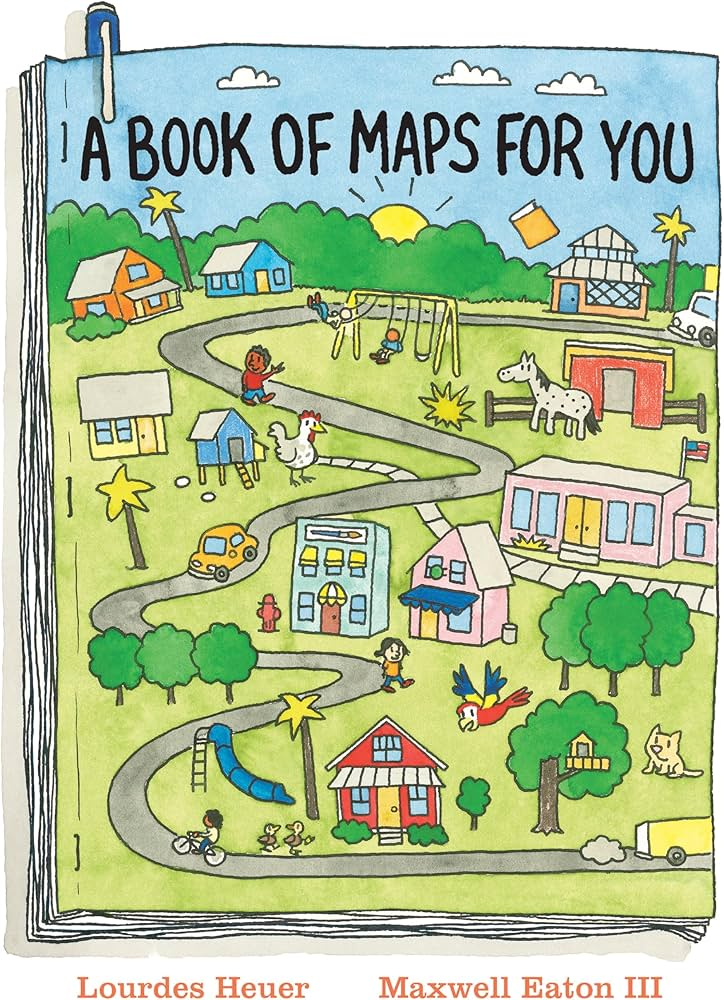
A Book of Maps for You by Lourdes Heuer, illustrated by Maxwell Eaton III (Neal Porter Books, 40 pages, grades K-3). “I made a book of maps,” the narrator explains, showing the cover which shares the title of this book. Inside there are maps of many places in the community: the narrator’s town, house, school, the library, the park behind the library, Main Street, a favorite art store. Helpful facts are included on each page, like the cafeteria lunch menu on Fridays and the best swing at the park. The purpose of this book of maps is made clear on the last two spreads, when the narrator leaves it on the front porch before climbing into a car behind a moving van, then a new kid sits on the porch, surrounded by boxes, and picks up the book.
This charming book will have readers thinking about what maps they could draw of different places in their communities and what facts to include about each. The ending is kind of poignant, although it could provide a helpful project for kids who are facing a move. My favorite book for teaching about maps remains What a Map Can Do, but this one is a close second and may have the edge for thinking about community and inspiring creative projects.
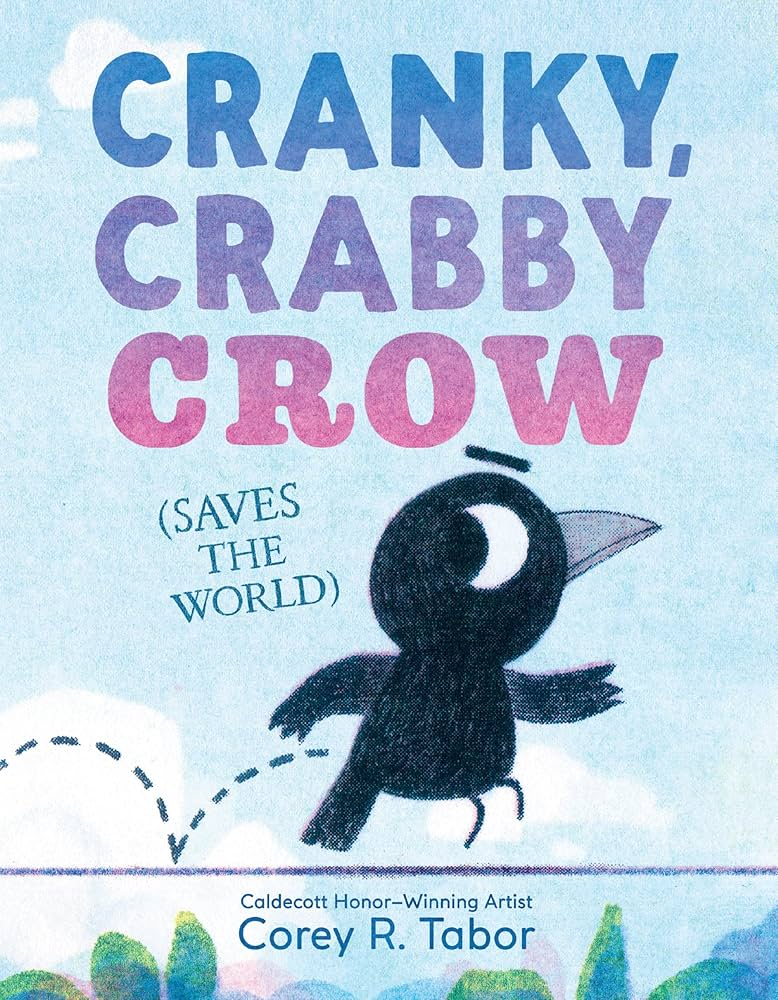
Cranky, Crabby Crow (Saves the World) by Corey R. Tabor (Greenwillow Books, 40 pages, ages 4-8). Crow greets each animal’s friendly overtures with a loud “Kaw!” which sends each one away, miffed at the bird’s rudeness. Finally alone, Crow gets a phone call from a red phone attached to a telephone pole. “Have you cleared the area?” asks a voice. “It’s time.” A door in the pole leads to an elevator, which Crow rides down to an underground bunker, where a bird-sized spacesuit and rocket are waiting. Crow flies into space to launch missiles and lasers that successfully destroy an asteroid threatening the Earth. Back home, Crow once again perches on the wire, where one by one the animals reappear, each clutching an invitation from Crow. Night falls, and there’s a spectacular display of shooting stars–or rather fragments of the asteroid traveling through space. Is Crow smiling?
I’m always delighted to learn that Corey Tabor has a new book out, and this one is sure to be a favorite. I found more details as I reread it, particularly in the clever illustrations that include visual humor like the buttons for cupcakes and bubbles alongside the missile and laser ones. The text is simple enough to make this a good choice for early readers, and also perhaps for a Geisel award, if not a Caldecott.
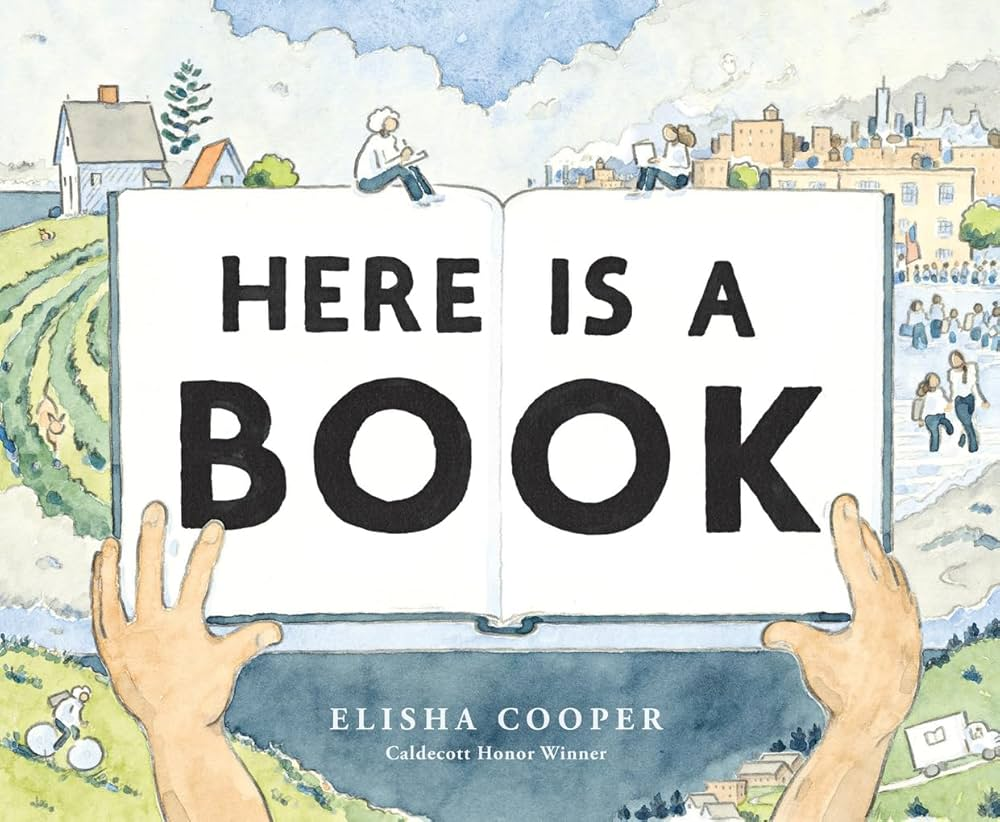
Here Is a Book by Elisha Cooper (Henry N. Abrams, 40 pages, ages 4-8). An artist is inspired by the nature around her and creates a book. She pedals her bicycle into town to deliver her work to her publisher. From there it goes to a printer, where it is turned into books. The books travel to the city, where one of them ends up in a school library. A child borrows the book and brings it home, where she is inspired by the illustrations to make a book of her own.
I was expecting this to be more of a “how a book is made” story, but I really loved the exploration of how one artist inspires another. Each step of the way includes a list of what is in that location: the artist’s garden has sun, rain, dirt, shovels, seeds, and love; the printer makes the book using paper, ink, printing presses, binding machines, glue, thread, and time; and the child’s room has paper, pencils, a desk,, a chair, stuffed bears, hot chocolate, days, nights, art, and wonder. The watercolor illustrations beautifully capture all of these things on each two page spread.
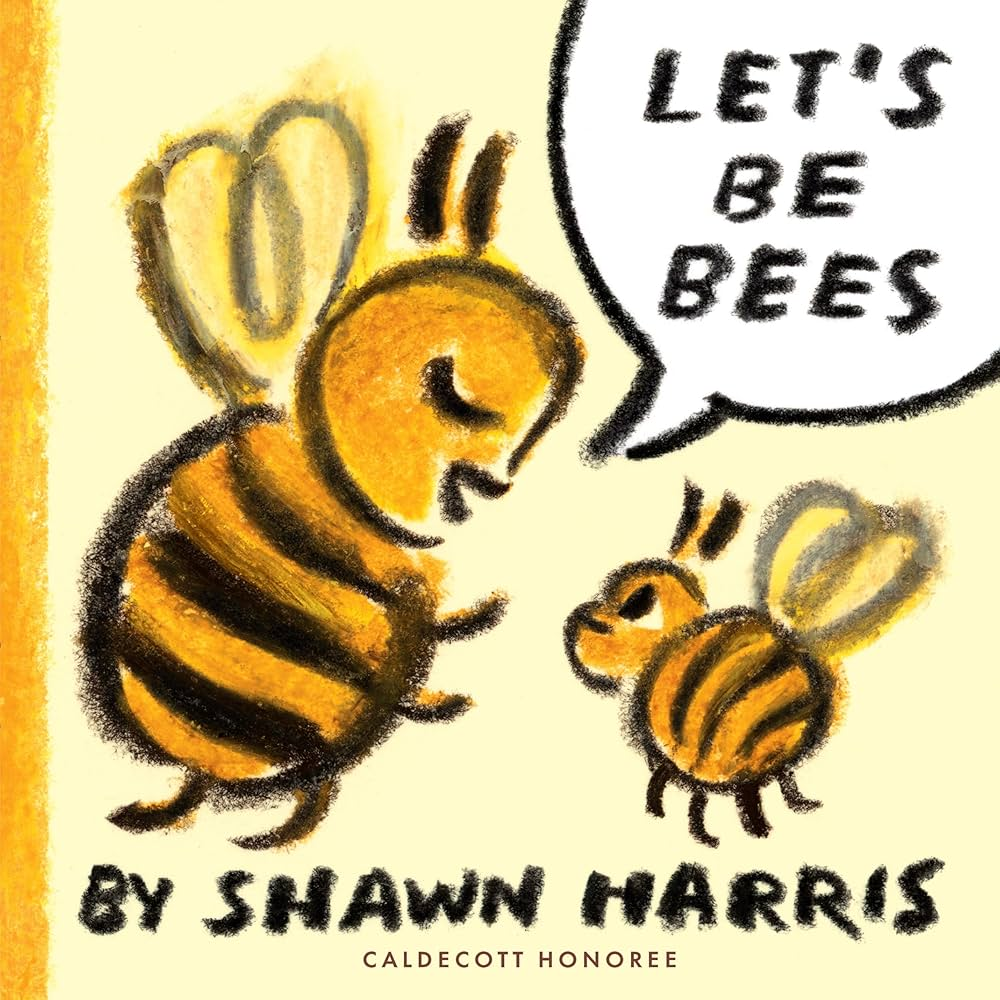
Let’s Be Bees by Shawn Harris (Neal Porter Books, 40 pages, ages 3-7). A man and a child are sharing a book; when the man says “Let’s be bees. Let’s buzz,” the two of them turn into bees, buzzing and popping right out of their human clothing. Similarly, they turn into birds, trees, a storm, and more, making the appropriate sounds and shape shifting into all sorts of things. Their final transformation is into the Earth, where they make every sound. The reader says, “Now let’s be me and say,” and the cartoon bubbles show both of them saying “The End,” each one sporting long hair and a beard like the reader. On the last page, they both turn into the child and say, “Again!!”
This simple but clever book celebrates the power of reading together and letting books unlock the imagination. The illustrations look like they were drawn by a child, and kids could use this book as a starting place for creating their own pictures based on its theme. Either one of these books could be considered for another Caldecott for their artists.
The Black Mambas: The World’s First All-Women Anti-Poaching Unit by Kelly Crull (Millbrook Press, 40 pages, grades 2-5). The Black Mambas are the first women park rangers in South Africa and the first women-led anti poaching unit in the world. They tell their story, explaining how they first got interested in protecting animals and describing some of the resistance they experienced from friends and family members who weren’t sure women could do this job traditionally held by men. They named themselves after the most feared snake in South Africa. Now they work out, train to survive in the wilderness, and patrol the reserve day and night, looking for signs of poachers and making arrests if they catch them. Their reserve, the Olifants West Nature Reserve, has become one of the most difficult reserves to poach animals, and the Black Mambas’ work has been recognized around the world. Includes more information about some of the animals on the reserve, the NATO Phonetic Alphabet that the rangers use, an author’s note, and a list of additional resources.
I loved this book, and I think a lot of kids will, too. Not only does it feature a lot of animals, but the Black Mambas are inspiring in their dedication, hard work, and success. The photos really capture the reserve the the women at work. I enjoyed the activities in a couple sidebars, like matching animal tracks and reading a map, which will keep kids engaged.
Marjory’s River of Grass: Marjory Stoneman Douglas, Fierce Protector of the Everglades by Josie James (Christy Ottaviano Books, 40 pages, grades 2-5). Marjory Stoneman Douglas moved to Florida soon after her graduation from Wellesley College, moving in with her journalist father whom she hadn’t seen since she was six. She joined him on the Miami Herald, starting as a society editor, but soon writing pieces about the Florida Everglades, a mysterious but beautiful ecosystem that her father had introduced her to. As real estate developers rushed to drain and reclaim the land, Marjory and other activists lobbied to make the Everglades a national park, protecting this wild area that provides the majority of southern Florida’s water. The publication of her book The Everglades: A River of Grass helped spread the word about this cause, and in 1947, Everglades National Park was officially dedicated. Despite this conservation effort, developers still sought to build in the Everglades, and Marjory was involved in a successful campaign to stop airport construction there in the 1970’s. Her activism and love for the Everglades continued until her death in 1998 at the age of 108. Includes an author’s note and photo of Marjory, additional information about the importance of clean water, a bibliography, and source notes.
This inspiring biography is an excellent starting point for learning about the life of this dedicated journalist and environmental activist. I appreciate the limitations of a picture book in telling the story of a woman who lived for more than a century, but I was sorry there wasn’t any information about Marjory’s childhood or marriage (both of which sounded pretty traumatic when I looked her up on Wikipedia). The bibliography will help those who want to more about Marjory’s life.
Lady of the Lines: How Maria Reiche Saved the Nazca Lines by Sweeping the Desert by Michaela MacColl, illustrated by Elisa Chavarri (Astra Young Readers, 48 pages, grades 2-5). Born in 1903 in Germany, Maria Reiche moved to Peru to be a nanny, but quickly became fascinated by the ancient Incan culture. When American anthropologist Paul Kosok showed her aerial photos of mysterious lines in the Nazca Desert, Maria was hired to investigate them. The Lines became her obsession, and Maria spent the rest of her life exploring and preserving them. She began by buying as many brooms as she could find to sweep away the dust that obscured them. Eventually, she realized that the Lines made shapes of enormous animals: a spider, a monkey, birds, and more. As she learned more about these ancient designs, Maria became an activist for their preservation, fighting off attempts to irrigate the the desert, then dealing with the tourists who came as a result of her publicity campaign. One thing Maria did not succeed at was figuring out the meaning of the designs in the desert, but she claimed to enjoy the mystery. “If everything were clear,” she said, “I would lose interest.” Includes additional information about the Nazca people, the Lines, and Maria, as well as a timeline and lists of additional resources.
Kids are sure to be fascinated by the Nazca Lines, which are now visible to everyone through Google Earth. Maria Reiche is almost as much of a mystery as the Lines are, completely dedicating her life to their study and preservation, to the exclusion, it would seem, of pretty much all else. She definitely is someone who lived life on her own terms and clearly did exactly what she wanted to do.
Tíos and Primos by Jacqueline Alcántara (Nancy Paulsen Books, 32 pages, ages 4-8). A girl is nervous about visiting her father’s relatives in Honduras, especially since she doesn’t speak much Spanish. As they go from one tío’s house to the next, she feels more and more shy as she sees things she wants to ask about but doesn’t know how. Finally, they get to the home of her abuela, who has invited all the relatives over for a party. Before long the girl is playing soccer with her primos, and they’re teaching each other words in English and Spanish. By the end of the trip, she is ready to say “Nos vemos, familia!” (“See you soon!”) to all of her family.
This warm family story shows the ways people can communicate that don’t necessarily involve language. Kids who sometimes feel torn between two cultures or countries will find a lot to connect with. Older readers can move from this book to the two graphic novels I reviewed just a few weeks ago.
Little Bird Laila by Kelly Yang, illustrated by Xindi Yan (Dial Books, 40 pages, ages 4-9). Laila’s mom calls her her little bird, because Laila is always whispering in her ear, telling her (and her dad) what people are saying in English. Laila enjoys having such an important job, but sometimes it’s exhausting, and she doesn’t like it when other kids make fun of her parents. Her parents want to take English classes, but they can’t afford them (“People say America is free, but it’s actually really expensive,” Laila explains). Finally, Laila comes up with a solution: she’ll teach them herself. Even though she is still learning English, she does the best she can, making flashcards and surprising them with pop quizzes. It’s an uphill battle, but in a few months, her parents are starting to learn. At a parent-teacher conference, when her teacher says that Laila is becoming a better speller and teaching other kids Chinese, she starts to translate, but her mom replies in English, “Laila is a wonderful teacher.”
This cheery picture book with its themes of perseverance and hard work makes an excellent complement to Kelly Yang’s chapter books about the immigrant experience. The story and illustrations incorporate both Chinese and English, showing examples of what a difficult language English can be to learn. Pair it with Olivia Abtahi’s The Interpreter, which covers similar themes. I was disappointed that there wasn’t an author’s note at the end tying this story to Kelly Yang’s own experiences of being an immigrant from China.
Whale Eyes: A Memoir About Seeing and Being Seen by James Robinson, illustrated by Brian Rea (Penguin Workshop, 304 pages, grades 6 and up). James Robinson was born with strabismus, or misaligned eyes. He shares with readers how this affected him in school, both his struggles with reading and the reactions of others, whom he addresses as “Starers.” He grew up to be a documentary filmmaker, and the book is based on a short film he created for the New York Times to help people understand how he perceives the world. The book has some visuals and activities from the film, giving kids an opportunity to get some idea of how James sees things. The last part is more of a memoir, telling how his mom creatively homeschooled him and his older brother who had dyslexia, helping them to pursue their passions and succeed. Includes a list of citations.
Readers will learn a lot about what it takes to succeed when you have a disability, and James (and his mom, who sounds amazing) offer inspiring lessons about persevering when it feels like there is little or no progress. The illustrations are very cool and an excellent aid in understanding James’s condition. The book felt a little disjointed, with the last part feeling quite different than the rest of the story.
We Are the Scrappy Ones by Rebekah Taussing, illustrated by Kirbi Fagan (Carolrhoda Books, 32 pages, ages 4-8). This celebration of people with disabilities portrays a diverse group of kids and adults with all kinds of disabilities. Whether they’re in a wheelchair, walking with a white cane or a guide dog, or getting some sort of medical treatment, they are shown dancing, playing, making art and music, and always surrounded by others, sharing a sense of belonging. They are celebrated for adapting and overcoming difficulties and accepting help without thinking of themselves as a burden. All of this can be exhausting, and resting and taking care of yourself are also encouraged. A two-page spread near the end portrays several inspiring disability activists, with information about each in the back matter. There are also notes from the author and illustrator, who both drew on their experiences growing up with disabilities to create this book.
I was glad to find this book just as I was finishing up Whale Eyes, and it seemed like it would have been super helpful to James Robinson after hearing of his struggles with the label “disability” to describe his vision. This beautiful poem will inspire and reassure kids with disabilities, as well as their peers, but I think they will be especially drawn to the illustrations that portray so many different types of people living life joyfully and in community. The notes at the end about the author’s and illustrator’s experiences add an extra dimension.
Catty Corner Lands on Her Feet (Catty Corner, book 1) by Julie Murphy (Union Square Kids, 128 pages, grades 1-4). Like her mother, Catty is half-cat, half-human (Dad’s just a regular person), and she’s been homeschooled all her life, never having to worry about containing her feline instincts. But when her mom gets a job, it’s time for Catty to try school. She’s nervous, but also excited about the possibility of making new friends. Her first day is something of a disaster, in which she shreds a map when her teacher uses a laser pointer and bites a potential new friend when someone steps on her tail. Back home, Mom shares her mother’s and her own childhood diaries, which show some of the cat-astrophes they experienced. Catty’s able to return to school the next day with new confidence and learns that she can fix her mistakes and contribute with her own unique talents. Book 2 was published simultaneously.
This may seem like a strange choice for this post–and honestly, it’s one of the more bizarre premises for a book series that I’ve come across–but I was struck when reading it how Catty is different from her classmates in ways that are similar to kids with disabilities. She faces stares and mean teasing and has to work extra hard to fit in with a body that’s different from her classmates’. It could make an excellent starting point for some interesting discussions with primary elementary kids.
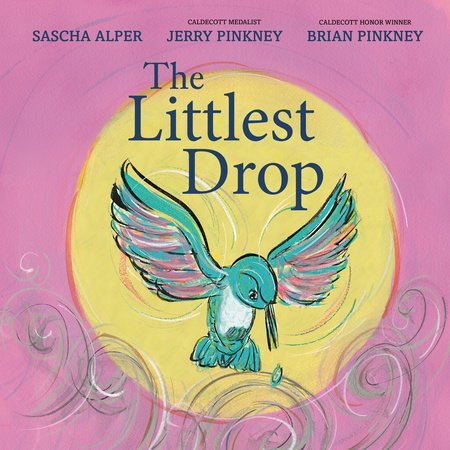
The Littlest Drop by Sascha Alper, illustrated by Jerry Pinkney and Brian Pinkney (Anne Schwartz Books, 40 pages, ages 4-9). Based on a story told by environmental activist and Nobel Peace Prize winner Wangari Maathai, this folktale features a hummingbird whose new nest is threatened by a wildfire. The other animals run to the river, too terrified to move, but the hummingbird takes action to put out the fire, even though she can only carry a single drop of water in her beak. As the others watch her tirelessly carrying drop after drop to the fire, they ask her what she’s doing. “I am doing what I can.” Inspired, the animals start to think of what they can do, and before long, elephants, monkeys, leopards, giraffes, and even tiny ants are working to fight the fire. When the sun rises, they are all exhausted, but the hummingbird lets one more drop of water fall…and the fire is gone. Includes an author’s note tracing the origins of this folktale, and an illustrator’s note in which Brian Pinkney describes how he used sketches left by his late father Jerry to create the finished illustrations.
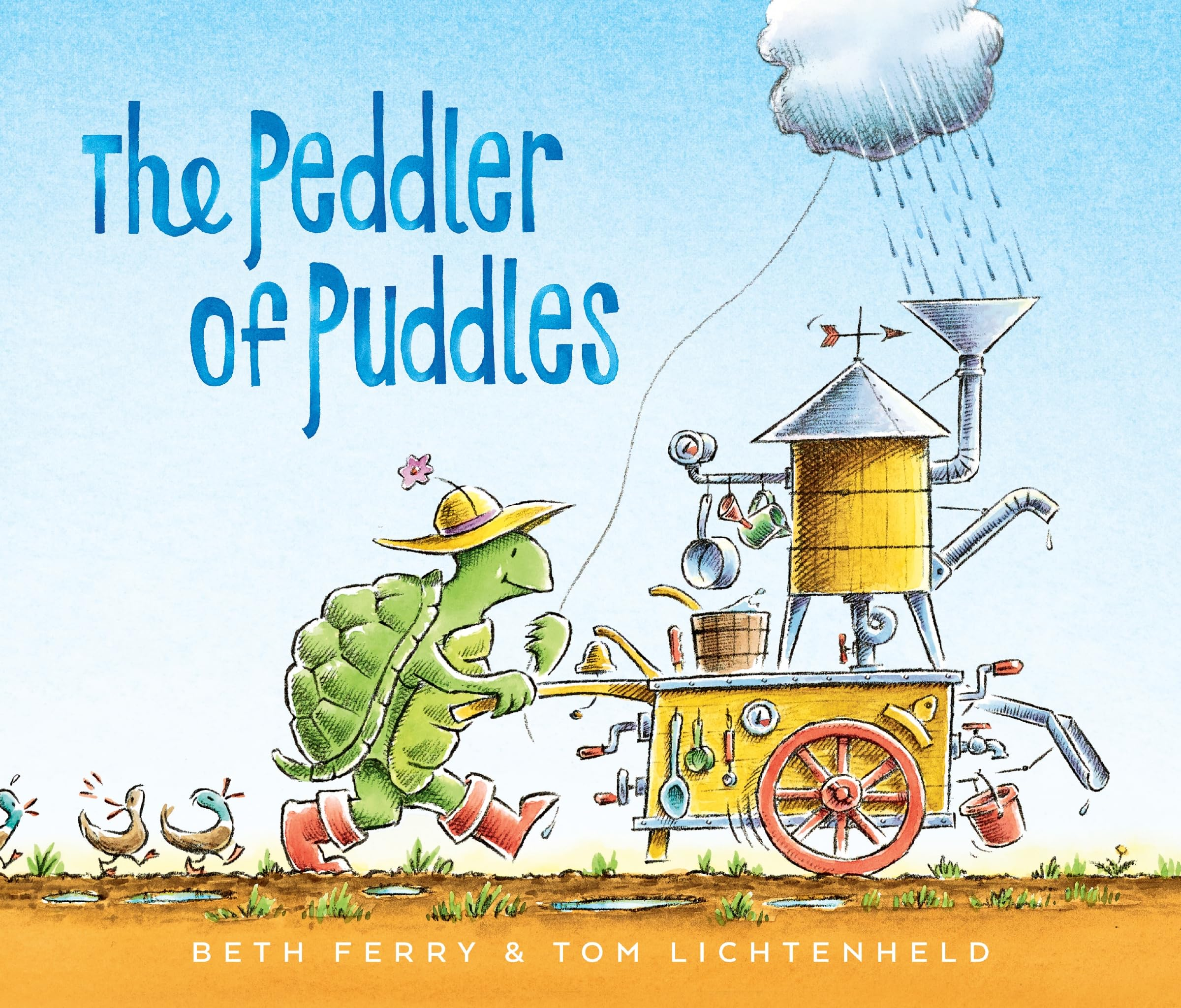
The Peddler of Puddles by Beth Ferry, illustrated by Tom Lichtenheld (Clarion Books, 48 pages, ages 4-8). The peddler is a turtle whose puddle-making machine (complete with a cloud on a string like a balloon) allows him to make custom puddles for his customers, from a tiny one for a hummingbird to ones large enough for hundreds of frogs or for a child to sail a boat across. Everyone loves the peddler, but he’s constantly on the move, never staying in one place for long. One day, he goes to the seashore where he sees the biggest puddle ever and befriends a girl who shows him how to play in the ocean. When she tells him she has to go home, the peddler feels sad because he realizes he doesn’t have a home. Over the horizon appear his friends, looking for him. They help him dig his cart out of the sand and lead him back to their forest. There, they’ve dug a huge hole, which the peddler fills with water, and they all work together to turn his cart into a new house. His house and the pond become a home for the turtle and all of his friends.
Both books will appeal to kids with their lively and colorful (although very different) illustrations of animal communities, and each one carries a simple but effective message for our time: friendship, community, and how even small actions can make a big difference to people and issues that you care about.
Whales in the City by Nancy F. Castaldo, illustrated by Chuck Groenink (Farrar, Straus and Giroux, 40 pages, grades K-4). “Before there were ships and streets and buildings and a city called New York, we were here.” Whales narrate the first half of this book, explaining how they were slowly driven out of the Hudson River by pollution. The few that survived headed for the cleaner waters of the North Atlantic. Humans take on the story from there, telling how they had finally had enough and started demanding clean water around the city. Starting with the first Earth Day, their activism eventually helped lead to the passage of the Clean Water Act. As time passed, the river grew cleaner, fish returned, and people could enjoy it once again. And finally, after a century, the whales came home to the waters around the city. Includes an author’s note, additional information about whales, a timeline of Hudson River history, profiles of a few of the people who led protests, a list of ways kids can help clean up rivers, and a list of sources.
I think we all could use a book right now that shows the positive effects of citizen action, and here is one that can be enjoyed by kids (and adults) of all ages. I liked how the narration was shared by the whales and the humans, and the back matter makes this an excellent resource that could lead to further research. The illustrations are amazing, as you can see from the cover.
Kaho’olawe: The True Story of an Island and Her People by Kamalani Hurley and Harinani Orme (Millbrook Press, 40 pages, grades 2-5). This history of Kaho’olawe, the smallest of the Hawaiian islands, begins with her birth from a volcano and continues with the arrival of the the first humans, Polynesian voyagers who settled there more than 1,000 years ago. Environmental devastation began when Europeans brought goats to the island and later used it for cattle ranching, but the total destruction began during World War II. The day after the attack on Pearl Harbor, the U.S. military took over Kaho’olawe and used it for bombing practices for the next 30 years. In 1976, activists began a campaign to stop the bombing, and finally, in 1992, the U.S. Congress officially ended the bombing and budgeted $400 million for clean-up efforts. Kaho’olawe is still suffering from the effects of all the damage, but today native Hawaiian groups, grassroots organizations, and scientists are working to restore the island and learn about its archaeological history. Includes notes from the author and illustrator (both Native Hawaiians), a timeline of Kaho’olawe’s history, a glossary, a paragraph about how to help, and additional resources and sources.
And here’s another tribute to activism in a fascinating history of a place I’m sure many of us (myself included) have never heard of. The history is sad, but the hard work of so many people in the face of seemingly insurmountable obstacles is inspiring. I loved the colorful illustrations which I’m guessing were inspired by Native Hawaiian art. Each page has a few sentences telling the story, with a paragraph giving additional information, making this a good resource for a wide range of ages.
Crack the Cascarón: An Eggcellent Not-Just-for-Easter Shellebration by Sara Andrea Fajardo, illustrated by Rocío Arreola Mendoza (Knopf Books for Young Readers, 40 pages, ages 4-8). Toti has declared himself the King of Cascarones and has big plans for the upcoming weekend celebration (presumably Easter). Not content with the traditional confetti cascarones, Toti makes tiny stealth ones as well as some that are filled with slime. The night before the big day, while Toti is sleeping, the rest of his family raids some of his hiding places. When Toti wakes up the next morning, no one’s in the house, and when he goes to look for them in the yard, it’s an ambush! His parents, sister, and abuela inform him that not only is his plan not all it was cracked up to be, but the yolk’s on him as they bombard him with his own creations. He finally hands over his crown to Abuela, who declares herself the Queen of Cascarones. Just wait ’til next year.
I loved meeting Tito and his family, who clearly enjoy each other and aren’t afraid to pull some good-natured pranks. Although Easter is never mentioned, this would make a great read-aloud for the holiday or any time in the spring. Spanish words are mixed in with the English text, celebrating Tito’s family’s heritage. I wish there had been some back matter telling more about the cascarón tradition and maybe giving instructions on how to make them.
A Purr-fect Passover by Jenna Waldman, illustrated by Erica J. Chen (Apples & Honey Press, 32 pages, ages 3-7). An adorable group of kitties gets ready for Passover, preparing special foods like matzah bread, gelfite fish, and matzah balls. When the seder begins, the kittens enjoy dinner as well as traditions like the Four Questions and a retelling of the story of Moses and Pharaoh. Then there’s dancing, sweets, and the search for the afikoman. When the guests leave, it’s time for clean-up, and then bedtime with sweet dreams of the holiday. Includes instructions for making a matzah cover like the one pictured in the story.
This cute rhyming story makes a good introduction to Passover for the youngest kids, covering many aspects of the holiday with fun and engaging text and illustrations. Again, a little more back matter would have been a nice addition, especially for those who don’t celebrate Passover.