There Might Be Lobsters by Carolyn Crimi, illustrated by Laurel Molk

Published by Candlewick

Summary:  Eleanor is ready for a fun day at the beach, but her little dog Sukie isn’t so sure.  For everything that Eleanor proposes–going to the beach, chasing a beach ball, swimming–Sukie has a long list of worries, always ending with a concern about lobsters.  When Eleanor jumps in the ocean, Sukie sits at the water’s edge with her favorite stuffed monkey, Chunka Munka, and watches.  But when a rogue wave catches Chunka Munka and carries him out to sea, Sukie forgets her fears and dives in after him.  She even swims past something that might be a lobster to make the rescue.  Back ashore, Eleanor tells Sukie she knew she could do it.  The friends spend the rest of the afternoon playing in the sand, eating ice cream, and watching for lobsters.  32 pages; ages 4-8.

Pros:  A fun summer story (sorry to be reviewing it in October) about overcoming your fears.  Sukie is adorable, and Chunka Munka is pretty cute too.

Cons:  Dogs aren’t allowed on the beach!

If you’d like to buy this book on Amazon, click here.

Full of Fall by April Pulley Sayre

Published by Beach Lane Books

Summary:  “September sun is low in the sky/So long summer/Green, goodbye!” So begins this homage to autumn.  Each page has a few lines of poetry, describing the colors as leaves change from green to red and gold to brown.  Large, colorful photographs show the stages in detail, as well as animals often associated with the season, like squirrels and geese.  “Goodbye, leaf show/Winter is coming/Oh, hello, snow!”  The last page provides a perfect transition to check out a similar book by the author, Best in Snow.  Includes two pages that give more scientific information about what is happening on each page of the book.  40 pages; ages 3-8.

Pros:  Another gorgeous book about the seasons from April Pulley Sayre (see also Raindrops Roll).  Combine this with In the Middle of Fall by Kevin Henkes (see my 9/22 review) for a perfect autumn story hour.

Cons:  All that raking.

If you’d like to buy this book on Amazon, click here.

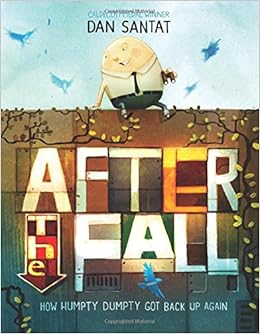
After the Fall (How Humpty Dumpty Got Back Up Again) by Dan Santat

Published by Roaring Brook Press

Summary:  Yes, Humpty Dumpty got put back together again, but “there were some parts that couldn’t be healed with bandages and glue.”  Humpty is now afraid of heights–he sleeps on the floor rather than in his top bunk, and is forced to buy Bo-Rings cereal rather than the enticing Sugar Bunny and Rainbow Bites that are stocked on the top shelves.  Worst of all, though, he misses the birds he used to watch from his perch atop the high wall.  Inspired by a paper airplane, Humpty creates a flying bird, but is dismayed when it lands on top of his old wall.  Determined, the egg overcomes his fear, and slowly climbs up the ladder on the side of the wall.  At the top, he cracks again…only this time, a beautiful bird emerges and soars into the air.  40 pages; ages 4-8.

Pros:  Dan Santat tells a remarkable story, making a fairy tale connection and using humor that preschoolers will enjoy, but conveying a message for all ages.  The illustrations may be worthy of another Caldecott for the illustrator.

Cons:  The “Sad Clown” cereal that is one of Humpty’s options on the grocery store’s lower shelf.

If you would like to buy this book from Amazon, click here.

How to Be an Elephant: Growing Up in the African Wild by Katherine Roy

Published by Roaring Brook Press

Summary:  When a baby elephant is born, she has a lot to learn; good thing she has a protective family and herd to teach her.  From walking to using her complex trunk to figuring out the different smells in her environment, the youngster will spend several years learning all the elephant ways.  Labelled diagrams and full-page illustrations complement the text to impart all the intricate knowledge the elephant needs to survive.  Includes a note from the author about her research and the endangered status of African elephants, and a list of resources for further information.  48 pages; grades 2-6.

Pros:  Readers will learn a ton of information about elephants, both through the text and the illustrations, which should be considered by the Caldecott committee.

Cons:  While the book has the look and feel of a picture book, the information and vocabulary is pretty advanced for primary grades.

If you would like to buy this book on Amazon, click here.

Rettie and the Ragamuffin Parade: A Thanksgiving Story by Trinka Hakes Noble, illustrated by David C. Gardner

Published by Sleeping Bear Press

Summary:  Rettie has to be mother and father to her three younger siblings, since their mother is sick with consumption and their father is fighting in World War I.  Life in their tenement building is difficult, all the more so when the influenza epidemic hits.  Their building is quarantined, and Rettie is worried that she won’t be able to get out for the Ragamuffin Parade on Thanksgiving.  This is an annual event for poor immigrant children to collect pennies from their more well-to-do neighbors.  Rettie works hard, helping to keep the apartment building clean and washing rags to earn some extra money.  Finally, the quarantine is lifted in time for Rettie to go to the parade.  Not only that, but the cold weather slows down the influenza epidemic, and the war comes to an end in early November.  Rettie joins the rest of America in celebrating Thanksgiving by using the pennies from the parade to buy her family apples and a pumpkin. Includes an author’s note about the Ragamuffin Parade, which may have been the inspiration for the Macy’s Thanksgiving parade.  32 pages; grade 1-4.

Pros:  Part of the “Tales of Young Americans” series, this is a heartwarming story of a young girl persevering under difficult circumstances.  Readers will learn a lot of history from Rettie’s story, and the illustrations show a great deal of historical detail as well.

Cons:  Rettie seems a little too good to be true.

If you would like to buy this book on Amazon, click here.

Imagine That: How Dr. Seuss Wrote the Cat in the Hat by Judy Sierra, illustrated by Kevin Hawkes

Published by Random House

Summary:  In 1954, there were lots of great new books for kids like Charlotte’s Web and Horton Hears a Who!.  Good books for those who already knew how to read; for children just learning, there wasn’t much.  Ted Geisel, a.k.a. Dr. Seuss, was hired to write a fun and interesting book for beginning readers, using an “official” list of approved words.  He thought it would take him a week or two, but he ended up spending over a year getting it just right.  The result, of course, was The Cat in the Hat, and it became an instant hit, leading Ted to write more books for beginning readers like The Cat in the Hat Comes Back and Hop on Pop.  When his friend Bennett Cerf challenged him to write a book with just 50 different words (The Cat in the Hat had 236), Geisel rose to the occasion once again with Green Eggs and Ham.  Includes writing and illustrating tips from Dr. Seuss, notes from the author and illustrator, and a list of books by Dr. Seuss. 48 pages; grades K-3.

Pros:  A fun look at creative genius, with a few pages of Seuss-inspired rhyming text and plenty of Seuss-inspired illustrations.  Messages about perseverance and hard work are subtly woven into the story.

Cons:  A brief biography or timeline at the end would have been a nice addition.

If you would like to buy this book on Amazon, click here.

The Bad Seed by Jory John, illustrated by Pete Oswald

Published by HarperCollins

Summary:  That is one bad seed.  He never puts things back where they belong.  He tells long jokes with no punch line.  And he’s late to everything.  Why?  Well, it’s kind of a long story.  He started out okay, growing  up in a big family on a sunflower.  When the flower wilted, though, he lost his home, and eventually ended up in a bag.  A giant started to eat him, but he got spit out at the last minute.  It was pretty much downhill from there.  But now he’s made a decision to try to be good.  It isn’t always easy, and sometimes he slips back into his old ways, but he keeps going, and eventually starts to think maybe he’s not such a bad seed after all.  40 pages; ages 4-8.

Pros:  Pretty funny stuff that could open up discussion about why people do “bad” things, and how to help them do better.  It can’t be easy to personify different seeds, but Pete Oswald does a charming job.

Cons:  I’ve done just about all the “bad” things listed by the seed.  The picture of the abandoned shopping cart in the parking lot really hit home for me.

If you’d like to buy this book on Amazon, click here.

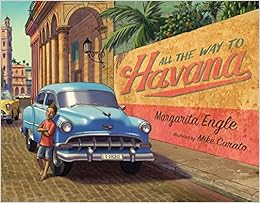
All the Way to Havana by Margarita Engle, illustrated by Mike Curato

Published by Henry Holt and Company

Summary:  A boy describes the trip he and his family are taking from the Cuban countryside to the city of Havana to visit relatives.  Their mode of transportation is an ancient sky-blue Chevy, whose nickname is “Cara Cara” because of the sound it makes when it runs.  The engine, the boy says, is held together with “wire, tape, and mixed-up scraps of dented metal”.  Nevertheless, they get it started and head out to the highway, joining the colorful parade of other pre-1959 cars.  There are many interesting sights along the way; the family gathering is a success; and Cara Cara gets everyone back home again as night is falling.  An author’s note explains how the cars are symbolic of the resourcefulness and ingenuity of the Cuban people; the illustrator’s note describes their trip to Cuba to create the book.  40 pages; ages 4-8.

Pros:  Car fans will love the illustrations and details of the many different automobiles, including labeled ones on the endpapers.  Readers will get a vivid taste of Cuban life with illustrations that may get a look from the Caldecott committee.

Cons:  Some additional photos from the trip to Cuba would have been a nice addition. (There’s one of the car that was used as a model for the book.)

If you would like to buy this book on Amazon, click here.

Baabwaa & Wooliam by David Elliott, illustrated by Melissa Sweet

Published by Candlewick Press

Summary:  Baabwaa and Wooliam are two sheep who like to knit and read, respectively.  One day, though, they realize that they are yearning to put down their books and needles and try something a bit more adventurous.  They head outside, and after a bit of exploration, cross paths with a wolf in sheep’s clothing.  When Wooliam mentions having read about him in a book, the wolf stops mid-chase, and asks to see the book.  His short attention span tips the two sheep off to the fact that he can’t read, and they set out to remedy that situation.  An unlikely friendship forms, and before long the three are hanging out together…knitting, reading, and occasionally indulging in a chase around the field.  40 pages; ages 4-8.

Pros:  Lots of sly humor, both in the text and the illustrations.  This would be a great companion to one of the many other wolf-in-sheep’s-clothing tales.

Cons:  I have trouble pronouncing the word “Wooliam”.

If you would like to buy this book from Amazon, click here.

Muddy: The Story of Blues Legend Muddy Waters by Michael Mahin, illustrated by Evan Turk

Published by Atheneum Books for Young Readers

Summary:  McKinley Morganfield was born into a family of sharecroppers on the Mississippi delta, and from a young age, he did his own thing.  He couldn’t stay out of the mud, resulting in his childhood nickname of Muddy.  He loved the blues; even though his grandmother didn’t love them, he taught himself to play guitar and played and sang whenever he could.  As a young man, he got into a fight with his boss, and was forced to leave town.  He headed for Chicago, hoping to make a living as a musician.  After playing in clubs for a while, he tried to make a record.  Producers wanted him to copy others’ music, but Muddy eventually found success with his own sound.  An author’s note gives more information about Muddy Waters’ life, music, and his influence on later musicians like the Beatles.  48 pages; grades 1-5.

Pros:  Evan Turk’s unique illustrations (Caldecott contender?) perfectly capture the spirit of Muddy Waters’ life and the blues music he created.  The text has a lyrical feel to it as well.

Cons:  More biographical information or a timeline would have been useful.