Circle by Jeannie Baker

Published by Candlewick Press 

Summary:  Before the title page, a boy lies on his bed, wishing he could fly.  A couple pages later, he’s in wheelchair on the beach, watching a bird called a godwit flying with his flock.  They’re heading north, on the longest migration any animal in the world makes, traveling 7,000 miles from Australia to Alaska.  It’s a perilous journey, but the godwit finally makes it.  He builds a nest and finds a mate.  Together they have four babies, only one of which survives to make the return trip with his parents.  The flock flies for nine days and nights without stopping, arriving back at the beach where the story started, and where the boy has now abandoned a set of crutches to run along the beach.  An author’s note tells more about godwits and some of the threats to their survival.  48 pages; grades K-3.

Pros:  Beautiful collage illustrations capture the various environments inhabited by this remarkable bird.

Cons:  A hungry fox eats the other three chicks.

Good Night, Baddies by Deborah Underwood, illustrated by Juli Kangas

Published by Beach Lane Books


Summary:  The title page shows three pigs cowering in their house, while the wolf leans against a tree, yawning.  Next up is Jack, chased by a sweating, exhausted giant.  Clearly it’s time for the villains to get some rest.  They gather together for the night, surprisingly kind for one another, to eat dinner and get ready for bed.  Rumpelstiltskin could go for a bedtime story; the three billy goats’ troll needs a long bath.  Finally, it’s time to crawl under the covers.  A witch checks under the giant’s bed to reassure him that there are no princesses hiding there.  Then finally, “Underneath a starry sky/sing a baddie lullaby.  Day will bring more evil schemes/Good night, baddies…sour dreams!”  32 pages; ages 4-8.

Pros:  The rhyming text, illustrations, and entire idea behind this book are all very funny and cleverly executed.  Kids will enjoy identifying the classic fairy tale associated with each villain, and may be reassured to see that the “baddies” are really not so bad after all.

Cons:  What evil role does the cute little mouse (rat?) play?

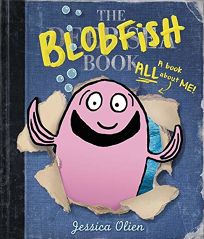
The Blobfish Book by Jessica Olien

Published by Balzer + Bray 

Summary:  Blobfish takes a book called The Deep Sea Book and turns it into The Blobfish Book.  The original is about the deepest part of the ocean, with photographs of some of the animals that live there.  Blobfish’s version has a pink cartoon of himself drawn onto the photographs, attempting to make it all about him.  Finally, the book gets to the page about blobfish, but the sentence “The blobfish was once voted the world’s ugliest animal” stops the narrator in his tracks.  Fortunately, the other sea creatures are paying attention, and they join forces to create a final page that celebrates Blobfish and cheers him up again.  Includes more facts about the deep sea and its creatures, plus a list of additional resources.   40 pages; ages 4-8.

Pros:  2016 is turning into The Year of the Blobfish…this is the second kids’ book featuring a blobfish in the last six months (see Pink is for Blobfish).  This one is a fun blend of fact and fiction, with some facts about the deepest parts of the ocean being snuck in around Blobfish’s slightly obnoxious, but always good-intentioned narration.

Cons:  The informational part is pretty slight.

City Shapes by Diana Murray, illustrated by Bryan Collier

Published by Little, Brown Books for Young Readers 

Summary:  Rhyming text follows a little girl around the city, finding different shapes in what she sees.  Shapes include a square, rectangle, triangle, circle, oval, diamond, and star.  The watercolor and collage illustrations are colorful and busy, making it a fun challenge to find the items mentioned in the text.  An author’s note tells of her love for New York City that inspired this book, and the illustrator’s note explains how he created the pictures (and that the girl in the book is his four-year-old daughter).  40 pages; ages 4-8.

Pros:  Award-winning illustrator Bryan Collier has created a bright visual feast on every page of a book that would make an excellent introduction to shapes.  Kids will be inspired to find shapes in their everyday lives.

Cons:  Only seven shapes are introduced.


Follow the Moon Home: A Tale of One Idea, Twenty Kids, and a Hundred Sea Turtles by Philippe Cousteau and Deborah Hopkinson, illustrated by Meilo So

Published by Chronicle Books

Summary:  Viv is new in town, and unsure how she feels about her new home.  On her first day of school, her new teacher encourages the class to look for a problem in their community that the kids can work to solve.  Walking on the beach, Viv learns that sea turtles nest there, and that the babies often get disoriented by beach house lights and can’t find their way to the ocean.  Her own difficulties finding her way in a new place makes Viv sympathetic for the turtles.  Soon her whole class is involved in researching the turtles’ plight and spreading the word to turn out lights and close curtains at night.  Their hard work pays off, and on a night patrol, Viv gets to see a line of loggerhead turtles heading for the sea.  Back matter includes a letter to young activists, a note to parents and teachers on how to help kids make a difference in their communities, and additional information about sea turtles.  48 pages; grades K-4.

Pros:  Environmental activist Cousteau (grandson of Jacques) and award-winning write Hopkinson join forces for an inspiring tale about young kids making a difference, backed up with information readers can use themselves.

Cons:  I was hoping this was based on a true story, but it seems to be fictional.

I Am Pan by Mordicai Gerstein

Published by Roaring Brook Press 

Summary: Which Greek god has the most kid appeal? Pan, of course, the fun-loving god of noise, confusion, sheep, shepherds, goats, goatherds, bees, and beekeepers. Mordicai Gerstein combed through Greek myths to find all the ones he could in which Pan played a role. So after recounting his own birth, Pan then goes on to tell different stories about himself, including his marriage to Echo (who knew?), how he invented his famous pipes, and his pivotal role in helping the Greeks at the Battle of Marathon. The ending suggests that Pan and his deity comrades are still living among us today, a “fact” Rick Riordan fans will appreciate. A brief author’s note explains how and why Gerstein came to write this book; a list of the mythology books he used for his research is included. 80 pages; grades 1-5.

Pros: Written in comic book form with illustrations by Caldecott Medalist Gerstein, this is a perfect introduction to mythology for elementary age kids. Those already familiar with the Greek pantheon will enjoy expanding on their knowledge.

Cons: Reading a book with a goofy goat-man on the cover, emblazoned with the large words, “I Am Pan!” may open you up to scorn and derision from offspring over the age of 10.

A Year of Borrowed Men by Michelle Barker, illustrated by Renne Benoit

Published by Pajama Press


Summary: In 1944, when Greta was 7 years old, she and her family were told by the German government that they were getting three French prisoners of war to live on their farm. They were “borrowed men”, only there for the duration of the war, which Greta likened to the way her father has been “borrowed” to serve in the war. The men had to live in the barn with the pigs; when Greta invited them in for dinner one night, her mother was called into town and threatened with imprisonment. But despite the difficult living situation and the lack of a common language, the family and the prisoners became friends. Greta found a way to help them decorate their tiny Christmas tree, and they helped her when she accidentally melted the hands and feet of her new Christmas doll. A year later, the war ended and the prisoners were liberated, but the memory of the friendship continued on. An author’s note gives more information about her mother, Greta. 40 pages; grades 1-4.

Pros: A gentle and touching introduction to World War II. Although a few wartime atrocities are alluded to, all the characters in this story are kind, wanting to help each other despite being on different sides.

Cons: Kids will need some historical context before reading or hearing the story.

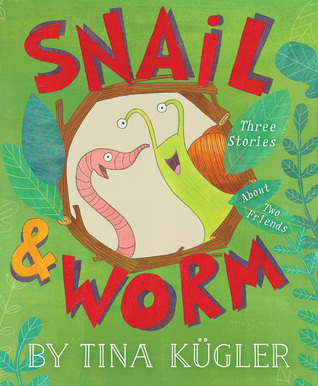
Snail & Worm: Three Stories About Two Friends by Tina Kugler

Published by Houghton Mifflin Harcourt

Summary:  As the title suggests, this book contains three brief stories about Snail and Worm, who find each other and become friends in the first tale.  The vocabulary and humor are perfect for beginning readers.  Each friend gets his/her own colored font to make it easy to keep track of the dialog.  The back cover says to look for more Snail & Worm adventures coming soon.  32 pages; grades PreK-1.

Pros:  An excellent choice for either a read-aloud or a first independent reader.  Kids will get a chuckle from both the cute, cartoon-style illustrations and the text.

Cons:  While five-year-olds will find the humor just right, it’s not quite up to Elephant & Piggie standards.

School’s First Day of School by Adam Rex, illustrated by Christian Robinson

Published by Roaring Brook Press

Summary:  There’s a new school in town.  Every day, the janitor comes to visit him, but the janitor assures him others will be there soon.  School’s not sure how he feels about this, and the first day of school brings both bad and good.  There are a few kids with attitude who say they hate school (School manages to squirt one of them in the nose with one of his water fountains), and a little girl with freckles who is scared of school.  School feels bad when his fire alarm accidentally goes off.  But School learns some interesting stuff, and at the end of the day, the girl with freckles makes a beautiful picture of him, complete with glitter.  As School and the janitor watch the sun go down, School is pretty sure he’s ready for another day with the kids. 40 pages; ages 4-8.

Pros:  Is this a brilliant idea, or what?  I’ve been looking forward to reading this book since I heard about it, and it didn’t disappoint.  There’s plenty of humor, yet a sensitivity to how different kids might feel on the first day of school.  Caldecott Honoree Christian Robinson’s illustrations perfectly capture the elementary school feel.  This would be a great read-aloud for the first day of school.

Cons:  Teachers, I apologize for reminding you on June 26 that there WILL be a first day of school.

Nadia: The Girl Who Couldn’t Sit Still by Karlin Gray, illustrated by Christine Davenier

Published by Houghton Mifflin Harcourt


Summary: Readers of a certain age will remember Romanian gymnast Nadia Comaneci,  one of the stars of the 1976 Summer Olympics. This picture book looks at Nadia’s life leading up to those Olympic performances. From an early age, Nadia was a daredevil, and her high energy level led her parents to enroll her in gymnastics. She was spotted by now-legendary coach Bela Karolyi who recruited Nadia to join the new gymnastics school he had opened with his wife Marta. Motivated by a disappointing performance at her first National Junior Championship, Nadia worked hard for many hours a day to make it to the Montreal Olympics when she was only 14. There she became the first female gymnast to earn a perfect 10…and went on to earn six more! The book ends there, but an afterword and timeline give more information about Nadia’s performance in the 1980 Olympics and her defection from Romania in 1989. 40 pages; Grades K-4.

Pros: An inspiring story of an amazing athlete, perfect for summer reading during this year’s Olympics. Nadia always seemed to me to be more serious than her predecessor Olga Korbut, but she comes across as ebullient and energetic in the illustrations here.

Cons: Because of the brevity of the story, making it to the Olympics comes across as about as difficult as snagging a spot on the high school gymnastics team.