The Concrete Garden by Bob Graham

Published by Candlewick

Summary:  “After a cold, hard winter, doors opened.”  Kids spill out of a high-rise apartment building, ready for some fresh air.  Amanda’s the last one out, lugging a box of sidewalk chalk.  She draws what looks like a huge virus with green chalk.  Jackson turns it into a dandelion, while Janet makes a mushroom, and the twins add flowers.  Other kids draw their own creations until the entire courtyard is a riot of color.  Nasrin takes a picture from her balcony and sends it to her mother in Isfahan, and her mom shares it with everyone she knows, sending the concrete garden around the world.  A few days later, rain washes it away.  The chalk is gone, but the kids use the box it was in to make cardboard boats which they sail in the rainbow-colored water.  32 pages; ages 4-8.

Pros:  The masks some of the characters are wearing and the dedication page that reads “Written in the time of Covid” mark this as a post-pandemic story, the kids celebrating their freedom with an explosion of creativity.  Setbacks (like a dog peeing on some of the chalk) and creative differences are gracefully handled by the children, and the story and pictures exude a feeling of joy and celebration.

Cons:  The ending felt a little disappointing; I was hoping the kids would do something a bit more creative for their second act.

Why Do Elephants Have Big Ears? Questions–and Surprising Answers–About Animals by Steve Jenkins and Robin Page

Published by Little, Brown Books for Young Readers

Summary:  Nineteen animals are profiled with the trademark Steve Jenkins cut-paper illustrations and a question and answer about each.  Why do hippos swish their tail when they poop?  Why are naked mole rats naked?  Why do red-eyed tree frogs have big red eyes?  Each question is answered with a short paragraph.  A small silhouette at the bottom shows the animal in comparison to a human or a human hand for smaller animals.  Includes additional information about each animal and a bibliography.  40 pages; ages 4-8.

Pros:  You can’t go wrong with a Steve Jenkins-Robin Page animal book.  This one is full of striking illustrations and fascinating information that will engage even the most reluctant readers.

Cons:  I was hoping for a format that would lend itself to guessing, like Jenkins’s Biggest, Strongest, Fastest, which is one of my all-time favorite books to share with kids.

Tomfoolery!: Randolph Caldecott and the Rambunctious Coming-of-Age Children’s Books by Michelle Markel, illustrated by Barbara McClintock

Published by Chronicle Books

Summary:  In this follow-up to Balderdash! John Newbery and the Birth of Children’s Books, Michelle Markel looks at the man who was the namesake for another famous children’s literature award.  Despite a weak heart, Randolph Caldecott loved being outdoors, hanging out with animals, and capturing what he saw on paper.  His father sought to quash his love of art with a career as a banker, but Randolph kept drawing.  When offered a chance to illustrate children’s books, he went against the prevailing fashion of stilted decorations and created art with plenty of action and animals.  Kids and adults loved his work, and Randolph became an international success, his work continuing to influence illustrators 150 years later.  Includes a list of the Caldecott reproductions included in the illustrations; a list of annotations; a picture of the Caldecott medal; additional information about illustrated Victorian periodicals and the big three toy book illustrators (Caldecott, Walter Crane, and Kate Greenaway); and a list of books by Randolph Caldecott.  44 pages; grades K-3.

Pros:  This exuberant book brings Randolph Caldecott to life with beautiful illustrations inspired by his art.  It seems only fitting for this to be considered for a Caldecott medal or honor.

Cons:  There’s a great illustration of several Caldecott medalists reading their own books; I wasn’t able to identify all of them, and I wish the back matter had included a list.

How This Book Got Red by Margaret Chiu Greanias, illustrated by Melissa Iwai

Published by Sourcebooks Jabberwocky

Summary:  Red and Gee are excited to find a book about pandas, but as they read it, Red realizes that it’s all about giant pandas like Gee, with nothing about red pandas like her.  She decides to write her own book, but when she looks at all the books about giant pandas, she concludes that no one will be interested in her story.  Tossing the half-finished manuscript in the trash, she and Gee go off for some bubble tea and forest bathing, but nothing cheers her up.  When they walk by the trash can later, a group of excited red pandas has retrieved her book, and they convince her to finish it.  The last few pages show the future: a bookstore window filled with red panda books, and Red inside signing copies of her book.  40 pages; ages 4-8.

Pros:  A fun way to let readers know that representation matters, with adorable illustrations and some interesting facts about red pandas.

Cons:  The message wasn’t exactly subtle.

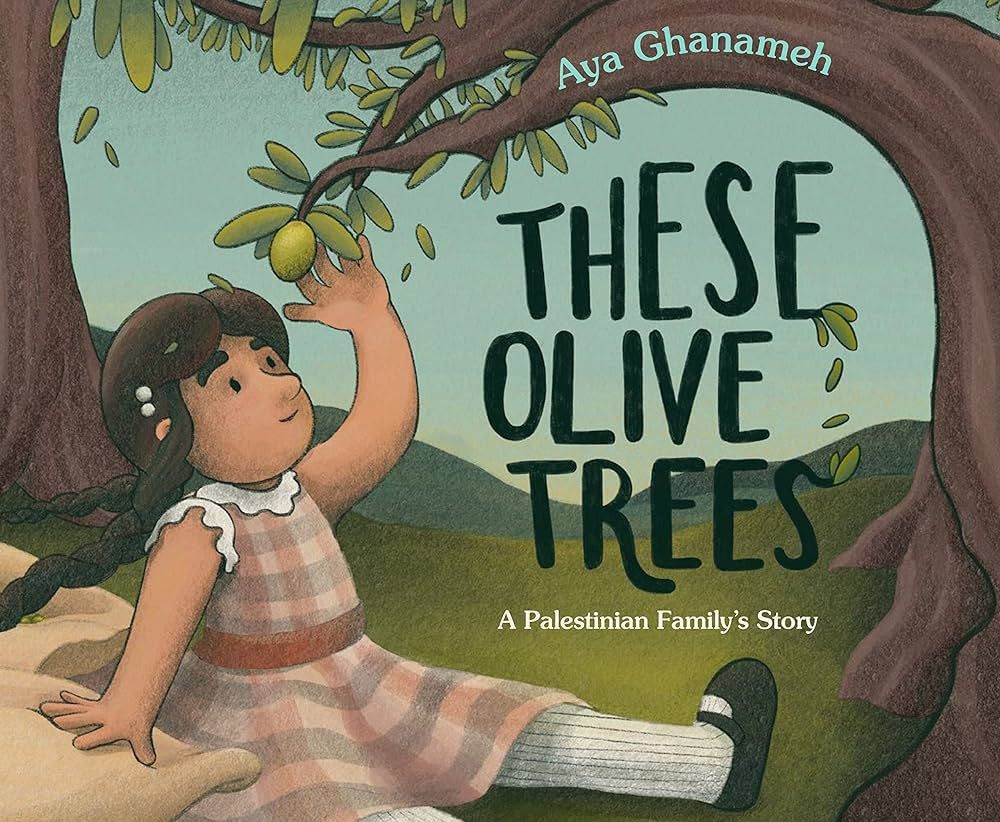
Eleven Words for Love: A Journey Through Arabic Expressions of Love by Randa Abdel-Fattah, illustrated by Maxine Beneba Clarke

Published by Candlewick

Summary:  The first few wordless pages show a family leaving their homeland with rainbow-colored suitcases.  In their new home, the girl opens one of the suitcases and leafs through a photo album.  The pictures depict different types of love, expressed through eleven Arabic words.  Each is described with a rhyming couplet: “There’s sunshine-warm friendship that glows and grows after two people meet (al-Wud)/And love that comes like a sudden breeze, sweeping you off your feet (al-Hawa).”  In between, the refrain is repeated, “There are eleven words for love, and my family knows them all,” with the last page reading, “There are eleven words for love, and I love that my family knows them all.”  40 pages; ages 5-9.

Pros:  Warm, colorful illustrations illuminate this celebration of love in its many forms of a Palestinian family that has fled home to start life in a new place.

Cons:  I wish there had been some context notes either at the beginning or the end.  The only reason I know this is a Palestinian family is from reading reviews.

Animals in Pants by Suzy Levinson, illustrated by Kristenand Kevin Howdeshell

Published by Harry N. Abrams

Summary:  “Don’t put a goat in overalls. Really. I mean it. They tend to eat their overalls. Trust me. I’ve seen it.”  Yet the goat and a couple dozen of her friends are rocking their pants, from jeans to lederhosen to slacks (for yaks).  Each poem is just a few lines long, accompanied by humorous illustrations, making this short enough to easily read in a single sitting.  Prepare yourself for the end: “The bad news? The tailor’s incredibly slow. It takes him forever to stitch and to sew. To let out a pant seam, it could be a year. To add a new zipper, the timeline’s unclear. He fusses and frets over each inch of cloth…The good news? He’s fast for a sloth.” 32 pages; ages 4-8.

Pros:  Kids will get a kick out of these animals in their pants with impeccably rhymed poems and fun illustrations.  These took me back to A. A. Milne poems of my early childhood.  A perfect introduction to poetry, and for what it’s worth, this is currently #15 on the Goodreads list of Newbery predictions.

Cons:  I almost missed the child saying, “What? You’ve never seen animals in pants?” on the front endpapers, due to the jacket flap covering up most of her.  The good news is, she’s on the back asking the same question about animals in hats, which bodes well for a sequel.

When Moon Became the Moon by Rob Hodgson

Published by Rise x Penguin Workshop

Summary:  In 11 very short chapters, readers learn about the moon–how it was created, its orbit, craters, phases of the moon, and its relationship to Earth.  Most chapters are just a few sentences, illustrated with colorful anthropomorphized celestial bodies that talk with cartoon bubbles.  Kids will gain a greater appreciation for the moon and its effects on Earth and may be inspired to dream of traveling there some day after reading the final chapter on space exploration.  64 pages; ages 4-8.

Pros:  Fans of Stacy McAnulty’s Our Universe series will enjoy this book with its colorful illustrations and humorous, easy-to-understand information.  

Cons:  No back matter? Lunacy.

Fungi Grow by Maria Gianferrari, illustrated by Diana Sudyka

Published by Beach Lane Books

Summary:  There are lots of books about plants’ life cycles, but this one focuses on fungi, which grow from spores, not seeds.  The text begins with how the spores travel and reproduce, then describes all kinds of fungi, showing readers a colorful array that they can see, as well as cutaways that show the underground fungal world.  Specific species are described in greater detail with a smaller font.  Fungi can be poisonous, but they can also help humans in a variety of ways.  Includes additional information and a glossary, list of sources, and additional resources.  48 pages; grades K-4.

Pros:  A fascinating and beautiful look at a wide range of species that many readers may have noticed in passing but will now have reason to examine more closely.  Diana Sudyka is one of my new favorite illustrators this year, illuminating the text with bursts of colorful mushrooms and other fungi.  

Cons:  The zombie ant fungus may give you nightmares.

Boyogi: How a Wounded Family Learned to Heal by David Barclay Moore, illustrated by Noa Denmon

Published by Candlewick

Summary:  A family is struggling after the father comes home from a stint in the military.  Dad is silent, prone to nightmares, and easily angered.  Mom explains PTSD to their young son (the narrator): “When Daddy was away, some bad things happened…Those bad things harmed his mind.”  One day, the family goes to the YMCA, where Mom and Dad take a yoga class while the boy watches.  Before long, father and son are going every week, gradually getting better at the poses in the class, and Dad makes up the name boyogi for his son.  He tells his son that between yoga and therapy, he’s doing a lot better, making the boy feel happier as well.  32 pages; ages 4-8.

Pros:  An excellent kid-friendly introduction to both yoga and PTSD, with great digital illustrations of lots of yoga poses that kids will want to try.  

Cons:  Some additional information on PTSD and the benefits of yoga would have been a good supplement.

On the Tip of a Wave: How Ai Weiwei’s Art Is Changing the Tide by Joanna Ho, illustrated by Catia Chien

Published by Orchard Books

Summary:  Chinese artist Ai Weiwei spent his childhood in a labor camp after his father, a renowned poet, was targeted by the government.  They lived in an underground hole, where Ai would create sculptures from the dirt.  He grew up to be an artist, studying in the US before returning to China where he was imprisoned for criticizing the government.  After his release, he moved to Germany where he uses his art to bring attention to the plight of refugees, people displaced from their homes the same way he was.  One of his most famous works was created from lifejackets left behind by refugees landing in Greece.  Ai’s art “challenged the world to see differently…[and] invited the world to take action.”  Includes four pages of additional information and photos.  48 pages; grades 3-8.

Pros:  A beautiful and moving tribute to Ai Weiwei’s work with illustrations in shades of blue and orange that incorporate photos of refugees and his art into the pictures.

Cons:  I think this would be a very difficult book for kids to understand without having a considerable amount of background knowledge.  I was pretty confused by the story until I read the information at the end.