A Planet Is a Poem by Amanda West Lewis, illustrated by Oliver Averill (Kids Can Press, 40 pages, grades 2-5). An introduction explains that a planet is a poem, and a poem is a planet, setting the stage for the integration of science and poetry. There’s a poem for each planet, as well as for the sun (but, surprisingly, not the moon), the Kuiper Belt, Arrokoth (an object located in the Kuiper Belt), and one for future astronomers. Each poem is on a page that unfolds to a gatefold that contains additional information on both the subject of the poem and the poetic form, with illustrations that expand as well. It’s a clever concept that educates about both planets and poetry, but I’m hesitant to get this for my library, knowing how even one gatefold page tends to get destroyed pretty quickly. Back matter includes information about writing your own poem, with facts about Planet X to serve as possible inspiration; a glossary of space terms; and a list of sources and resources.
The City Sings Green & Other Poems About Welcoming Wildlife by Erica Silverman, illustrated by Ginnie Hsu (Clarion Books, 40 pages, ages 4-8). In a dozen poems, Erica Silverman describes projects around the world where a single person or small group has made a difference with conservation. Each poem is spread over two or three pages, accompanied by colorful illustrations and a paragraph describing the project. From rewilding the playground in Los Angeles to cleaning a beach and restoring a sea turtle habitat in India to creating a bee “highway” in Norway, these projects will inspire kids to find ways to make a difference. With plenty of resources in the back, this would make a great starting place for a unit on ecology that might inspire hands-on projects.
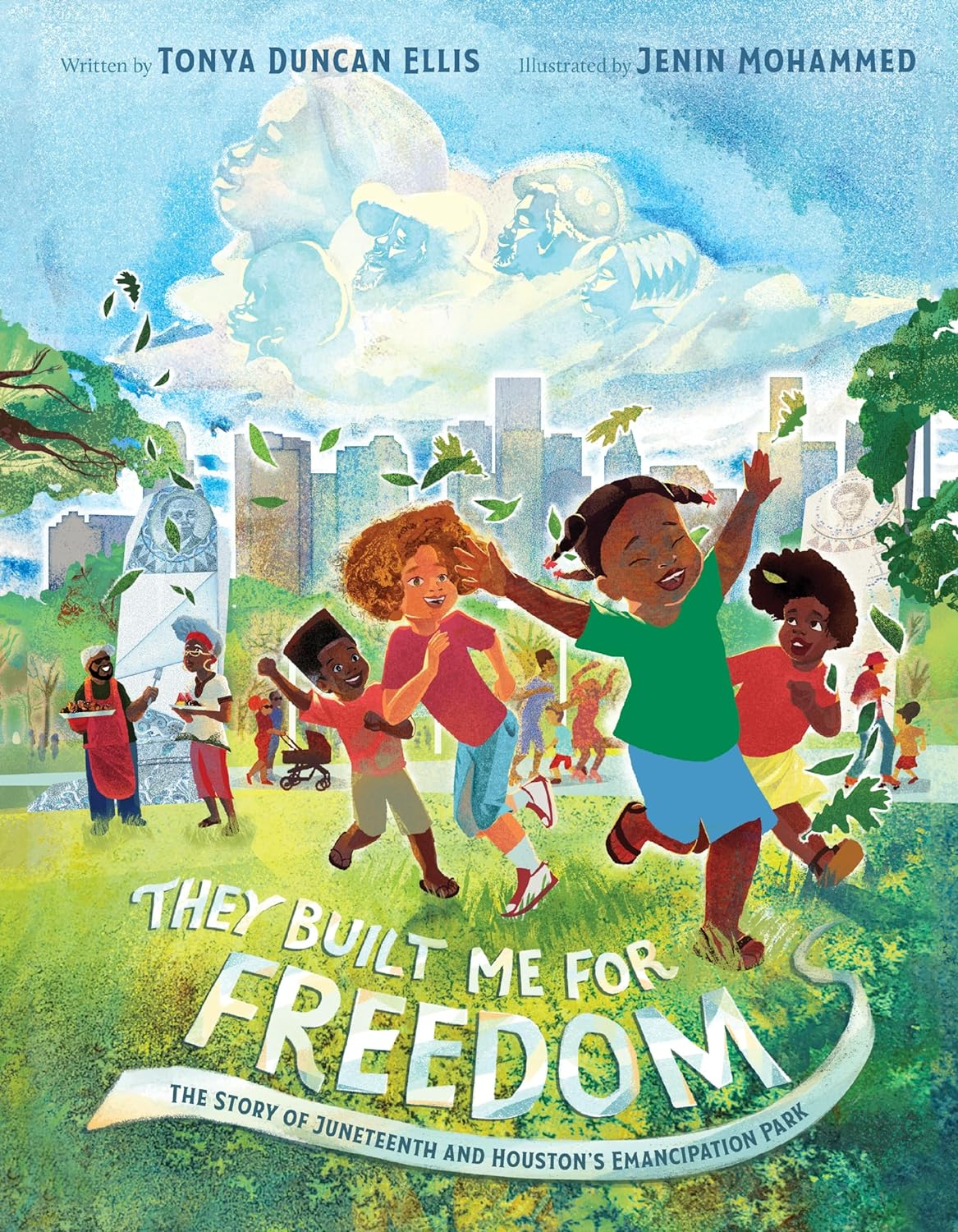
They Built Me for Freedom: The Story of Juneteenth and Houston’s Emancipation Park by Tonya Duncan Ellis, illustrated by Jenin Mohammed (Balzer + Bray, 32 pages, ages 4-8). Emancipation Park in Houston, Texas tells its history, beginning on June 19, 1865, when enslaved people in Texas learned that they were free. Most of the spreads begin with the words “they built me”: “They built me to celebrate,” “They built me to show they were strong,” “They built me to play.” Illustrations show Black people building a park on the ten acres they purchased, enjoying picnics and barbecues, swimming in a pool that allowed them access, and enjoying a baseball game. The park eventually fell into disrepair, but a new generation restored it and rededicated it in 2017. An afterword gives more information about the park, including a brief paragraph at the end about Juneteenth.
This lovely book celebrates Emancipation Park, and, to a slightly lesser extent, Juneteenth. Although the holiday provides the starting point, much of the book is dedicated to Black people persevering to create a beautiful park for themselves that allows them to experience joy, community, and celebration, which is captured in both the text and the illustrations. I wish the afterword were a foreword, as the book is more interesting with some background knowledge.
With Dad by Richard Jackson, illustrated by Brian Floca (Neal Porter Books, 40 pages, ages 4-8). A boy reminisces about a magical camping trip he took with his father, fishing, eating the fish cooked over the campfire, and sleeping in a tent from which they can hear the hoot of an owl. The last few pages fast forward to winter, when Tim and his mother are reading an airmail letter from Dad, who is overseas fighting in a war. “I want Dad home safe and soon and warm,” Tim says, planning to pick up where they left off with another camping trip.
Wow, the end of this book just about broke me! Good picture book memoirs aren’t easy to create, and this one is phenomenal, with so many details of the camping trip that show a loving father teaching his son without ever being overbearing, all enhanced by Brian Floca’s beautiful illustrations. While not explicitly about Father’s Day, this would make a perfect gift for the holiday.
Heatwave by Lauren Redniss (Random House Studio, 40 pages, ages 4-8). A child and dog seek relief from a brutally hot summer day, heading for the beach after a basketball game is cancelled. Even that doesn’t provide much respite, as a man reads a newspaper with the headline “Record heat across globe” in a nod to climate change. Then a wind blows, clouds roll in, and a single blue raindrop appears across the red page. A downpour changes the red to blue, as the sun sets, the moon rises, and the weather cools, just in time for sleeping.
I’ve been reading Doug Salati’s Hot Dog to classes recently, and this reminded me of that book, with its spare text and warm and cool colors that convey the heat of a summer day and the relief of finding coolness.
Summer Is Here by Renée Watson, illustrated by Bea Jackson (Bloomsbury Children’s Books, 40 pages, ages 3-7). A young girl takes readers through a typical summer day, personifying summer as she wakes the girl up with her early morning light. There’s swimming, double Dutch jump-roping, a cookout in the park that includes a water balloon fight, an ice cream truck, and bubbles. As the sun goes down, and the girl gets ready for bed, she whispers a wish to the moon that summer could stay.
The narrator reminded me of a young Ryan Hart from Renée Watson’s chapter book series. It’s a kinder, gentler introduction to summer than Heatwave, with both the text and illustrations capturing many joys of the season and could serve as a prompt for kids to write about their summer memories.
Everyone Gets a Turn by Marianne Dubuc (Princeton Architectural Press, 60 pages, ages 4-9). When friends Bear, Mouse, Turtle, and Hare discover an egg, each one wants to take it home. The egg provides the answer: “Everyone gets a turn!” Mouse found the egg, so he brings it home first, getting to know the egg and learning how to keep it comfortable. Next is Bear, who gets a surprise: the egg hatches, and Little Bird arrives. Hare and Turtle figure out how to feed and care for a young bird, and by the time the visit with Turtle ends, Little Bird has built her own home and is ready to take care of herself. There’s a housewarming party, at which time Little Bird declares she will henceforth be known as Clara, and the five friends and neighbors “continue to grow, each in their own way.” The story could hardly be any cozier or more heartwarming, and the longer page count and graphic novel format will make it appealing to older readers as well as younger kids. I’d love to know the story of how this came to be published by the Princeton Architectural Press.
The Bicycle: How an Act of Kindness Changed a Young Refugee’s Life by Patricia McCormick and Mevan Babakar, illustrated by Yas Imamura (Balzer + Bray, 40 pages, grades 1-4). Mevan tells the story of her childhood, beginning with idyllic early years surrounded by family in Kurdistan. When the Iraqi government begins persecuting the Kurdish people, Mevan and her family are forced to flee, first to Turkey, then to Russia, and finally to the Netherlands. Mevan learns to make herself as invisible as she can. In the Netherlands, she watches people outside her window riding bicycles, but she rarely leaves the apartment herself. It feels like no one sees her, but it turns out that Egbert, the building’s handyman, has noticed her, and one day he brings her a red bicycle. His gift makes Mevan feel “a hundred feet tall,” and before long, she’s outside riding with the rest of her neighbors. An epilogue describes the miraculous reunion she had with Egbert as an adult, including a photo of the two of them, and an author’s note describes her life as a refugee, how it has made her feel like an outsider, and the miraculous power of kindness. This is a touching if bittersweet memoir with an emphasis on the power of one person’s kindness to make a difference. I like how the epilogue ends, describing the ripple effect of her story of finding Egbert: “In a world where there are many people running from war, from hunger, from hatred, people everywhere, of every age, asked themselves: What’s one kind thing I can do?”
The Elephant and the Sea by Ed Vere (Doubleday Books for Young Readers, 32 pages, ages 4-8). Gabriel is an old elephant when we meet him on the first page, sitting in the harbor and remembering his younger days. Back then, he loved to visit the lifeboat crew and dreamed of helping sailors at sea, singing “Heave away, haul away, heave-HO!” But then Gabriel grows…and grows, and the other animals say he’s too big for the lifeboat. He refuses to give up his dream, though, and spends his days collecting driftwood and building. When a storm hits that’s too strong for the lifeboat crew, Gabriel is ready with his own boat that he uses to haul in the entire fleet. “Brave Gabriel, our hero!” the animals hail him. “Can we join you?” “Of course,” Gabriel replies. “But we might need a bigger boat.” And Gabriel enjoys a career of lifesaving, bringing us back to the old elephant remembering. It’s a cute story with a nice theme of perseverance and determination, with a fun “Heave away” repeating refrain. This would make a nice companion to read with Swashby and the Sea.
Being Home by Traci Sorell, illustrated by Michaela Goade (Kokila, 32 pages, ages 4-8). A family decides to move from the crowded city to the Cherokee reservation, where they can be close to nature, family, and community. The narrative begins on moving day in the city, continues through their journey, and finishes up in their new home, where they’re greeted with a feast and lots of children for the young narrator to play with. There are kid-drawn pictures showing a map of their trip, while other illustrations incorporate people, animals and symbols from the Cherokee Nation. Pink is the main color used to celebrate this family’s new life.
Both Traci Sorell’s (Cherokee) beautiful poetry and Michaela Goade’s (Tlingit) gorgeous illustrations celebrate indigenous communities that honor nature and help each other out through their connection. There’s always so much to see in Goade’s art, so be sure to take your time to appreciate how the colors she uses and shapes and figures she weaves into the main illustrations help tell the story.
Signs of Hope: The Revolutionary Art of Sister Corita Kent by Mara Rockliff, illustrated by Melissa Sweet (Harry N. Abrams, 40 pages, grades 2-5). A student narrator describes what it was like to study art with Sister Corita Kent, learning to pay attention, breaking the rules, making prints inspired by words and pictures from magazines. Sometimes the students would take field trips to museums to learn about Pop Art, or to protests, where Sister Corita’s signs spoke out about peace and justice. After studying with Sister Corita, her students were ready to go into the world to express themselves through their own art. Includes an author’s note with biographical information about Sister Corita Kent, an illustrator’s note, a timeline, and additional resources.
Melissa Stewart’s style is a natural fit to celebrate Sister Corita’s joyful, playful art. The first-person present-tense narration brings an immediacy to the story that’s as vibrant as the illustrations. The text may be a bit confusing to a reader not familiar with Sister Corita Kent, but the author’s note adds helpful details about her life. I was disappointed that Matthew Burgess’s excellent Make Meatballs Sing: The Life and Art of Corita Kent wasn’t included on the resource list.
Ursula Upside Down by Corey R. Tabor (Balzer + Bray, 40 pages, ages 4-8). Ursula is a catfish who happily enjoys the beauty of her undersea world. But her view gets flipped when a fish asks her why she’s upside-down. “Just look around,” says the fish, and when she does, Ursula realizes she’s the only creature swimming her way. She tries turning over but gets so disoriented that she leaves the water altogether. A bat comes along and rescues her, and back in the water, Ursula observes the bat hanging upside down from a tree. “Upside down?” says the bat. “Says who?” This gives Ursula the confidence to go back to her old ways, and she’s happy once again, seeing things her own way. An author’s note introduces the upside-down catfish of the Congo River Basin and asks readers to consider that we might be the ones who are upside down.
Another cute picture book by Corey Tabor that involves flipping the book around a couple of times like some of his other works. My favorite is still the Caldecott honor book Mel Fell, but I’m sure kids will enjoy getting to know Ursula (and Vern the bat), and the story delivers a nice message about doing your own thing.
Dog vs. Strawberry by Nelly Buchet, illustrated by Andrea Zuill (Random House Studio, 40 pages, ages 4-8). When a dog’s owner gives her a strawberry, it’s time for “the greatest race of all time!” With a sportscaster narration explaining what’s going on, the dog races around the living room, taking down a lamp and a plant before exhaustion takes over and she has to take a nap break. Meanwhile, the strawberry remains cool and collected on the living room floor. It’s anybody’s race right up until the very end when the owner returns, and–unwittingly–decides the winner.
Dalmartian: A Mars Rover’s Story by Lucy Ruth Cummins (Atheneum Books for Young Readers, 48 pages, ages 4-8). When some dog-shaped aliens visit Earth to collect specimens, one of them gets left behind. Stephen, the boy living in a nearby house, discovers the alien and invites him in. Although it resembles a dog, the creature has some clear and decidedly un-doglike preferences: no dog food (bacon is good), no leashes, no fetch, and no pooping in the dog park. Once they begin to understand each other, the two bond quickly. One night, while they’re both sleeping, the spacecraft returns, and Stephen’s guest gets on board to return to the home planet. But partway through the journey, the creature realizes its mistake and turns the ship around. In the morning, the two friends are reunited, this time for good.
Finding Things by Kevin Henkes, illustrated by Laura Dronzek (Greenwillow Books, 32 pages, ages 3-6). “If you found a ball on the grass and it was there for days, you could take it home.” Similarly, flowers growing in a sidewalk crack and a box by the curb on garbage day are other treasures that can be rescued. A kitten? If it’s crying, doesn’t belong to anyone, and you get permission from everyone, then it’s yours. And that lucky kitten will have a pretty flower to look at, a ball to play with, and a box to sleep in.
Here are three dog books that preschool and early elementary readers will enjoy. Finding Things isn’t really about the dog on the cover, but it perfectly captures the childhood joy of discovering unexpected treasures and is short and simple enough for the youngest readers. Slightly older readers will get a big kick out of Dog vs. Strawberry, both the action-packed illustrations and the sportscaster-style storytelling. And you can move right on to Dalmartian, with its cute doglike character, alien storyline, and a few good bathroom jokes.
Roar-Choo! by Charlotte Cheng, illustrated by Dan Santat (Rocky Pond Books, 40 pages, ages 4-8). When a dragon catches a cold, its phoenix friend wants to help it slow down and rest. But the dragon insists that dragons are strong and never quit. By the end, not only has the dragon come to understand that rest can be a good thing, but the phoenix realizes that being patient and cheering can also be exhausting. The last page sees them napping together. Includes an author’s note explaining that in the Chinese tradition, the dragon represents male strength and bravery, and the phoenix, female grace and generosity. She chose to write the story without pronouns to make these traits more universal.
Built to Last by Minh Lê, illustrated by Dan Santat (Knopf Books for Young Readers, 40 pages, ages 4-8). Two friends who resemble a young Minh Lê and Dan Santat meet when they’re about preschool age when they discover a mutual love of building things. As they get older their creations grow in size–and so do their failures. When they’re little, they can laugh these off, but as time goes by, that gets harder to do. When their biggest project of all doesn’t work out, they’re ready to call it quits on being friends. But remembering all their good times together leads to the reconciliation of a friendship that’s been built to last.
I wasn’t overly impressed by either one of these stories, which both seemed a bit didactic. I was a bit disappointed since one of my favorite read-alouds is the Minh Lê/Dan Santat creation Lift. But Santat’s illustrations in both books are gorgeous, and any dragon fan will be drawn to them immediately.
Water: Discovering the Precious Resource All Around Us by Olga Fadeeva, translated from Russian by Lena Traer (Eerdman’s Books for Young Readers, 56 pages, grades 2-5). Each spread in this book asks a question about water, covering a wide range of topics from weather to oceans to pollution. How much water is there on Earth? How do rivers form? How are seas and oceans different? How powerful is water? Each question is answered with a few straightforward, engaging paragraphs and illustrated with acrylics that emphasize the blues and browns of water. This is a fun book to browse and would make an excellent addition to any elementary unit on water, although there was a sad lack of additional resources at the end.
Dive! The Story of Breathing Underwater by Chris Gall (Roaring Brook Press, 48 pages, grades 1-5). As we learned in the first book, two-thirds of the Earth is covered in water, so it’s only natural that humans would seek out ways to explore the oceans. Beginning with the ancient Greeks who used hollow reeds that allowed them to breathe while harvesting undersea sponges, Chris Gall moves on to diving bells, the bathysphere, the Aqua-Lung, and robot-controlled submersibles. He also explains what happens when humans travel deep into the ocean, and the catastrophic effects returning to the surface too quickly can have. The narrative is told through a lens of problem-solving, as various inventors sought to overcome obstacles to allow divers to go deeper and explore longer. There’s more information at the end about the oceans, how to become a diver, and the author’s personal experience with diving, as well as a glossary and additional resources. Although this has the look of a picture book and is recommended by some reviewers for kids as young as 4, there’s a lot of somewhat technical information that would most likely be more interesting for older readers.
Ramadan Kareem by M. O. Yuksel, illustrated by Hatem Aly (HarperCollins, 40 pages, ages 4-8). Kids around the world celebrate Ramadan from the sighting of the crescent moon that marks the beginning to the next crescent a month later that signals that it’s time for the Eid celebration. In between, some of them fast for the first time, give money and food to neighbors, enjoy feasts before sunrise and after sunset, and attend mosque to pray and study the Qur’an. Eid means family gatherings, feasting, and gift giving, as the kids look forward to celebrating Ramadan again next year. Includes additional information, as well as a glossary and a list of three resources.
This book is packed with information, as well as colorful illustrations by Hatem Aly, for whom I’ve had a soft spot since The Inquisitor’s Tale. One fun feature is that 13 flags are hidden in the pictures, showing where in the world that celebration is taking place, although I wish this had been introduced at the beginning of the book instead of the end. I also wish I had seen this book in time for Ramadan this year, but file it away as one to purchase for 2025.
Juneteenth Is by Natasha Tripplett, illustrated by Daniel J. O’Brien (Chronicle Books, 40 pages, ages 4-8). A young girl shows readers how her family celebrates Juneteenth. The day starts with a parade, then continues to a big extended family gathering for a feast that features red food and drink. Grandparents remind everyone that red represents the color of suffering and give a quick synopsis of the history of the day, “the history lesson not taught in school.” At the end of the day, the family gathers for a photo, and the girl reminds readers, “Juneteenth is for all of us. We are America.” Includes information and resources on the significance of red in the celebration of Juneteenth.
Another beautifully illustrated book that serves as an excellent introduction to Juneteenth for younger readers. It’s a good mix of family fun and remembrance of the reasons for observing the day. Although the information about the significance of red is interesting, I would have liked more about the history of the holiday.
The Boy Who Said Wow by Todd Boss, illustrated by Rashin Kheiriyeh (Beach Lane Books, 40 pages, ages 4-8). Ronan is a boy who rarely speaks, and when Grandfather proposes a trip to the symphony, his parents are a bit skeptical. But Grandfather persists, and the two of them drive to the concert hall and find their seats. The lights go down, the music begins, and Ronan is swept away. In the moment of silence when the music ends, Ronan opens his mouth, and utters a loud, “Wow!” The audience laughs and claps, both for the orchestra and for Ronan. An author’s note shares that the story is based on an actual event that happened at Boston’s Symphony Hall in 2019. The illustrations look more like the 1950’s than 2019, but it’s a fun and interesting story with a sympathetic nonverbal main character.
Nothing: John Cage and 4′ 33″ by Nicholas Day, illustrated by Chris Raschka (Neal Porter Books, 40 pages, grades 1-5). The story opens with a 1952 performance at the Maverick Concert Hall in Woodstock, NY, where a pianist named David Tudor sits down at a piano and proceeds to do nothing for just over four and a half minutes. The word “nothing” is repeated a few times as the audience sits and wonders what is happening. The narrative then goes back 40 years to the birth of John Cage, a boy with unusually large ears and a penchant for inventing. Of all his radical compositions, his 4′ 33″ may be both the most unusual and the best-known. He wanted people to listen in the absence of sound to create their own music from what they heard around them. There’s an extensive author’s note, along with photos and a bibliography at the end.
The idea of this silent piece is fascinating and thought-provoking, stretching the boundaries of what can be considered music, and the subject is brought to life by Chris Raschka’s illustrations. The back matter seems more geared for older readers, and the concepts introduced may be a bit over the heads of the intended audience. Also, John Cage’s ears are described in a way that makes them sound freakishly large, but when I saw photos of him that seemed like an unnecessary exaggeration.
Piper Chen Sings by Philippa Soo and Maris Pasquale Doran, illustrated by Qin Leng (Random House Studio, 40 pages, ages 4-8). Piper loves to sing whenever she can, whether it’s joining the birds outside her bedroom window or performing for her stuffed animals. At school, she loves chorus, and when the teacher asks her to sing a solo in the spring concert, Piper offers an unequivocal “Yes!” But when it comes time to practice the solo, Piper gets stage fright and can’t do it. At home, she’s sad, no longer singing, until her grandmother Nai Nai has a talk with her, explaining that scary experiences can produce butterflies in the stomach, but so can exciting ones. Nai Nai is a pianist, and she tells Piper that the butterflies before a recital always settled once she started to play. Piper decides she will do the solo, and on the night of the concert, she welcomes the butterflies and feels them settle as she starts to sing. A lovely story by the Grammy-winning Hamilton actress that will show kids the importance of recognizing that fear and excitement often feel the same.