A Life of Service: The Story of Senator Tammy Duckworth by Christina Soontornvat, illustrated by Dow Phumiruk

Published by Candlewick

Summary:  Tammy Duckworth’s father worked for the UN, and she grew up all over southeast Asia.  She knew she was American, though, and dreamed of a life of service to her country.  After graduating from college, she joined the Illinois Army National Guard as a unit commander.  Her three-year commitment was up when the US declared war on Iraq.  Although Tammy opposed the war, she didn’t want to leave her unit, so she got permission to extend her service and went to Iraq.  While flying a helicopter there, she was hit by a grenade and lost both of her legs.  Her military career was over, but she wanted to continue to serve, particularly her fellow veterans.  In 2012, she was elected to the House of Representatives, and in 2016, to the Senate.  She became the first Thai American woman and the first female amputee in Congress, as well as the first Senator to give birth while in office.  And I’m happy to report that just a few days ago she became the first Illinois woman to be reelected to the Senate.  Includes a timeline, a list of projects Senator Duckworth has worked on, and additional resources.  48 pages; grades 1-5.

Pros:  In her fourth book this year, Christina Soontornvat relates the story of fellow Thai American Tammy Duckworth’s inspiring life of service.  The appealing illustrations help tell the story, and the back matter makes this an excellent book for research.

Cons:  I wish I had read this just a day early to get it on the blog for Veteran’s Day.
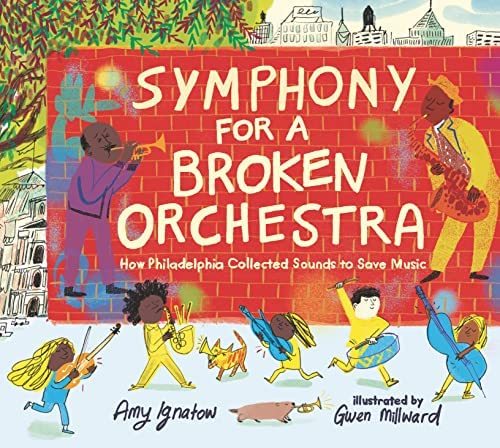
Symphony for a Broken Orchestra by Amy Ignatow, illustrated by Gwen Millward

Published by Walker Books US

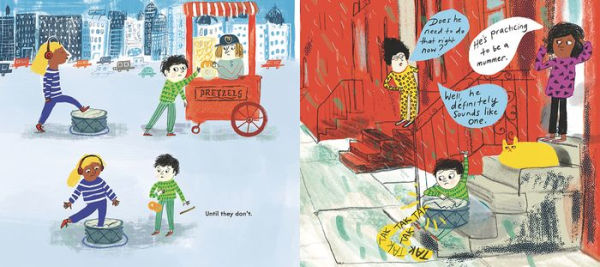
Summary:  Kids love to play music, but what happens if their instruments break and families can’t afford to fix them?  Unfortunately, they often get locked away, and the students have to put their music education on hold.  Robert Blackson, the artistic director of Philadelphia’s Temple Contemporary, discovered some of these broken instruments in a closed city school.  He had the idea to get musicians to see what kind of music they could create with them, and the Symphony for a Broken Orchestra was born, using the money raised from the performance to buy new instruments for kids.  Includes an author’s note with additional information and a link to hear the performance as well as a note from Robert Blackson.  40 pages; grades 1-4.

Pros:  This true-life story provides plenty of inspiration and humor (the kids torturing those around them trying to play their broken instruments) with cute and colorful illustrations.  The performance is worth a listen. 

Cons:  Those not familiar with Philly’s Mummer’s Parade may not understand the reference made to the boy playing a broken drum.

Murray Christmas by E. G. Keller and A Very Mercy Christmas by Kate DiCamillo, illustrated by Chris Van Dusen

Published by Harry N. Abrams

Published by Candlewick

Summary: Murray is a dog who takes his job as family protector very seriously. When the family starts doing odd things like bringing a tree into the house and hanging laundry by the fireplace, Murray tries to get things back to normal. He starts seeing a weird guy in a red suit everywhere, and then one night the guy appears in his house! Murray tries to get him out, and the ensuing chaos nearly ruins Christmas. But Santa turns out to be pretty helpful, and the two of them work to set things back to rights. Although Murray can’t figure out why this man doesn’t use the front door like everyone else, he’s happy to find a present waiting for him on Christmas morning…his own Santa hat. 40 pages; ages 4-8.

Many readers will be familiar with the characters and setting of A Very Mercy Christmas. Stella wants to go caroling, but the humans are all too busy. She heads down the street with Mercy and General Washington the cat and decides to try singing a solo carol. When the animals join in (in their own ways), they’re joined by Maybelline the horse. All the ruckus brings the humans out to join in, and then they all head back to the Watsons’ for some buttered toast. 32 pages; ages 4-8.

Pros: Kids are sure to get a chuckle out of both of these Christmas books featuring some pretty loveable animals and warm holiday spirit.

Cons: Those who haven’t read the Mercy Watson books may be a bit mystified by some of the characters and situations.

I Am Golden by Eva Chen, illustrated by Sophie Diao

Published by Feiwel and Friends

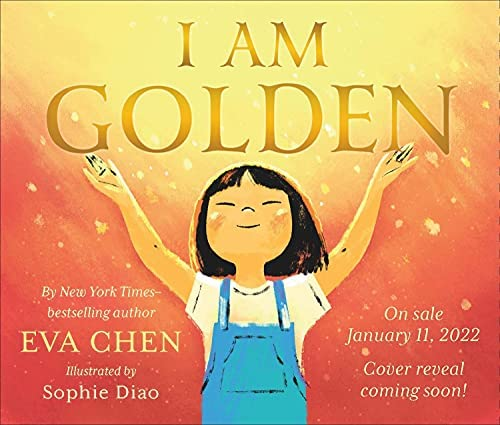
Summary:  Chinese parents address their beloved child, Mei, a name that means beautiful, telling her all the beautiful things they see when they look at her.  Not only are her physical features beautiful, but the hopes and dreams that they see when they look at her, hopes and dreams that their ancestors had and that sent them to America.  They acknowledge that people may be mean to her and treat her as though she’s different but encourage her to remember her heritage which gives her strength and power to be golden.  40 pages; ages 4-8.

Pros:  Beautiful illustrations and an empowering message make this a book that may be considered for some awards.

Cons:  Feels like a book that will appeal more to adults than to kids.

Twelve Dinging Doorbells: An Every-Holiday Carol by Tameka Fryer Brown, illustrated by Ebony Glenn

Published by Kokila

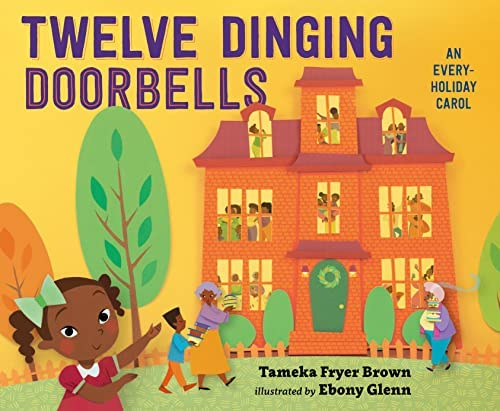
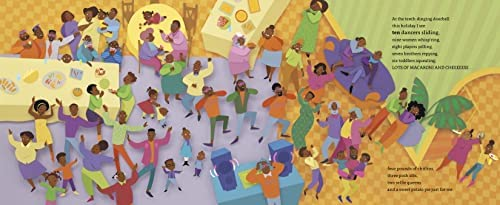
Summary:  As the subtitle suggests, this is a book that could be used for any large family gathering, although it’s based on “The Twelve Days of Christmas”.  The cumulative text begins with “a sweet potato pie just for me,” then goes on to two selfie queens, three posh sibs, all the way to eleven stinky sides (side dishes) and twelve crowded steps as an extended family gathers for a holiday meal.  Macaroni and cheese replace five golden rings with different variations as the day goes on (lots of mac and cheese, where’s my mac and cheese, and finally, who needs mac and cheese?).  The narrator and her grandmother share the sweet potato pie–just for her–on the final page.  32 pages; ages 3-8.

Pros:  A great holiday choice that features a joyful Black family’s gathering with colorful illustrations, all kinds of people, and plenty of yummy food.

Cons:  While I enjoyed the macaroni and cheese humor, I kind of missed the number five.

Wild Horses by Melissa Marr

Published by Nancy Paulsen Books

Summary:  Photographs and action words show the Salt River wild horses of Tonto National Forest in Arizona who quickly appear and disappear from the sight of humans.  In between, they are seen eating, drinking, playing or fighting (not sure which, and the text doesn’t make it clear), running, splashing, and standing with their families.  An author’s note tells a little bit about her personal contact with these horses and urges readers to preserve nature for these and all animals.  32 pages; ages 3-8.

Pros:  There really aren’t enough horse books in the world, and this one has striking photos that will appeal to the youngest equine fans.

Cons:  No additional resources or specific suggestions for preserving nature.

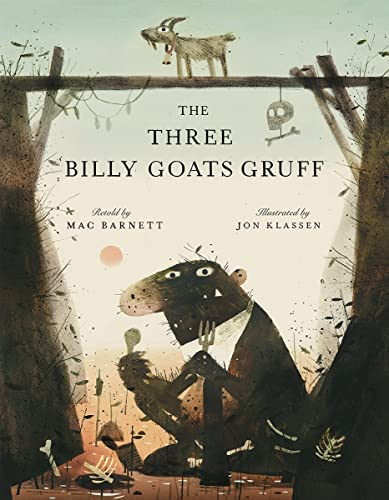
The Three Billy Goats Gruff retold by Mac Barnett, illustrated by Jon Klassen

Published by Orchard Books

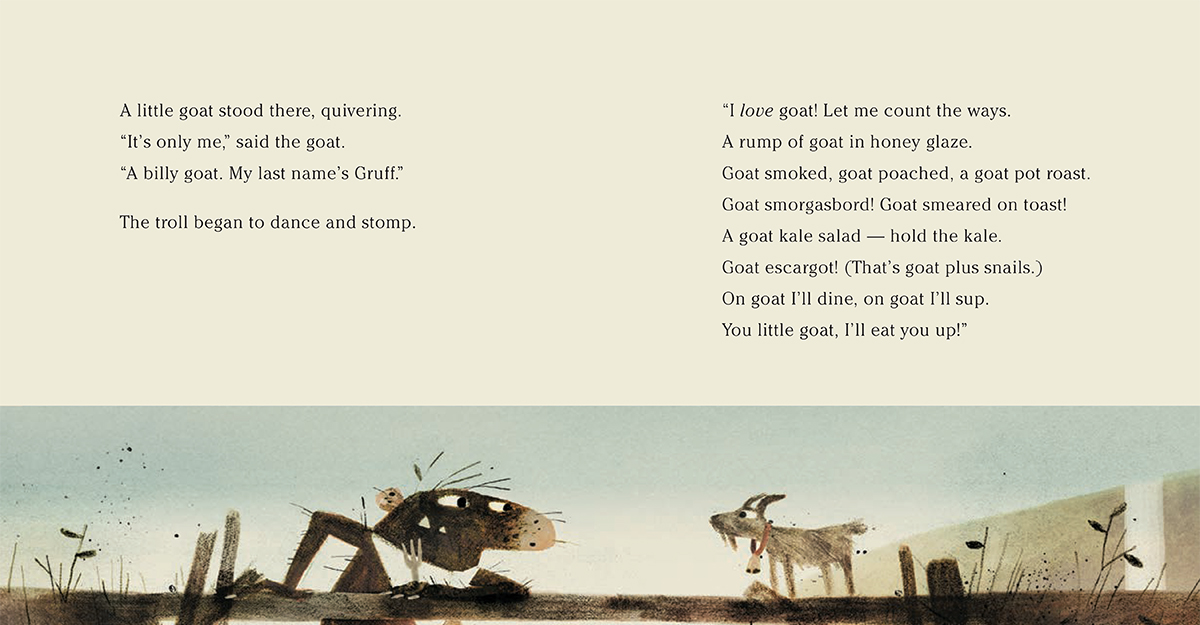
Summary:  Rumor has it that this is the first in a series of fairy tale retellings by the popular Barnett-Klassen duo.  The troll living under the bridge is nearly starving, living on earwax and belly button goop while waiting for the goats to cross over.  He’s a poetic sort of fellow, making up all sorts of rhymes to capture his excitement about the goats (“I love goat! Let me count the ways/A rump of goat in honey glaze.”)  The small and medium goats talk their way out of being eaten, and the big goat…well, readers are in for a surprise and will also enjoy seeing the fate of the troll.  48 pages; ages 4-8.

Pros:  One can never rule out a Caldecott for Jon Klassen, and I love how the illustrations grow from a small strip at the bottom of the first page to a full-page spread when the big goat does his thing.  Kids will love the story, too, with its funny troll and just enough disgusting details thrown in.

Cons:  Barnett and Klassen’s books never really grab me until I read them to actual children, which I haven’t had a chance to do with this one yet.  The kids’ delight makes me appreciate each book much more than when I read it on my own.

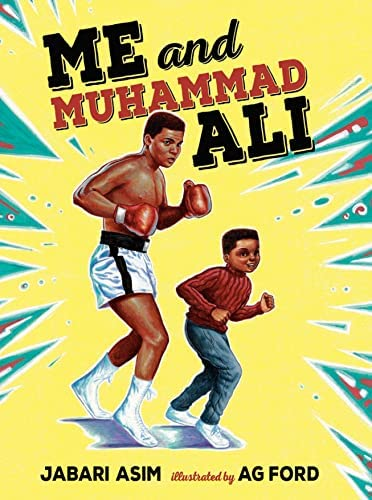
Me and Muhammad Ali by Jabari Asim, Illustrated by AG Ford

Published by Nancy Paulsen Books

Summary:  Langston is excited when he learns that Muhammad Ali is coming to his town. Langston admires Ali as much for his poetry as for his fighting, and his mom likes that the boxer is fighting to make the world a better place.  On the day of the big event, Langston gets his Afro shaped to look just like his hero’s, listening to the men in the barbershop talk about their own athletic exploits as well as their stories of Muhammad Ali.  Finally, Langston and his mom arrive at the high school, only to be stopped by a security guard who tells them the event is only for students.  No matter how much they plead with the guard, he refuses to let them inside.  “What’s the problem here?” asks a man, and when Langston looks up, Muhammad Ali is standing right in front of them.  Ali personally escorts them inside, and Langston’s dream comes true.  Includes an author’s note about the 1975 event that inspired this story.  32 pages; ages 4-8.

Pros:  It’s great to see so many Black history books for younger kids this year.  This one includes some of Muhammad Ali’s poetry, as well as poems that Langston makes up.  The illustrations do a great job of capturing the 1975 vibe.

Cons:  No list of additional resources on Ali.

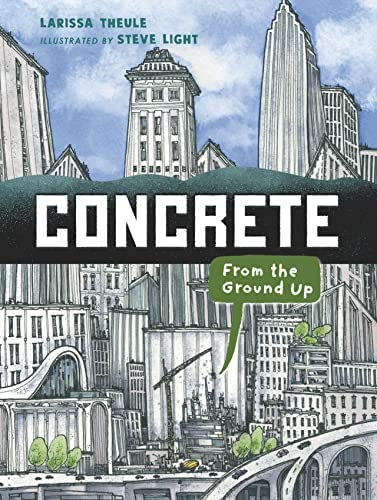
Concrete: From the Ground Up by Larissa Theule, illustrated by Steve Light

Published by Candlewick

Summary:  We may not think much about concrete (I know I don’t), but it’s an amazing material that has allowed engineers to design some pretty spectacular structures beginning with the Roman Colosseum and Pantheon.  The technology was lost for centuries after the fall of the Roman Empire, but an engineer named John Smeaton rediscovered it to construct a lighthouse in 1757.  Since then, engineers have learned how to reinforce concrete with steel that has allowed them to build bridges, dams, and skyscrapers.  The final page asks the question of what may come next for concrete as the needs of humans and the planet change in the future.  48 pages; grades 2-5.

Pros:  Answers the question “How could concrete possibly be interesting?” with engaging stories of different structures around the world and incredibly detailed drawings that feature various characters making funny comments about their circumstances and inventions.  Fans of David Macaulay books will enjoy poring over the details.  Amazon has this listed as part of a series called Material Marvels, so I am hoping there will be more books to come.

Cons:  Many readers may see the cover and think, “How could concrete possibly be interesting?”

The Perfect Tree by Corinne Demas, illustrated by Penelope Dullaghan

Published by Harry N. Abrams

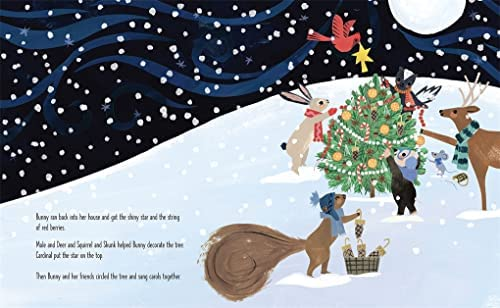
Summary:  Bunny goes out the day before Christmas looking for a tree that is just her size.  Along the way, she meets different animals who all have ideas about what makes the perfect tree: Squirrel says it should be bushy like his tail, Mole looks for a tree with a point like a mole’s nose, Cardinal thinks color is the most important ingredient, and Skunk says that it’s smell.  Each tree Bunny finds lacks one of those characteristics.  Finally, too cold to look any further, she heads for home.  To her surprise, she discovers the perfect tree not far from where she lives.  She runs to get her saw but can’t bring herself to cut the tree down.  The animals get together and decorate their outdoor tree, then gather around it to sing carols.  32 pages; ages 3-8.

Pros:  Kids will love this heartwarming Christmas story with its repeating text, adorable animals, and happy ending.

Cons:  The final tree doesn’t seem to fit Bunny’s criteria for being “just her size”.