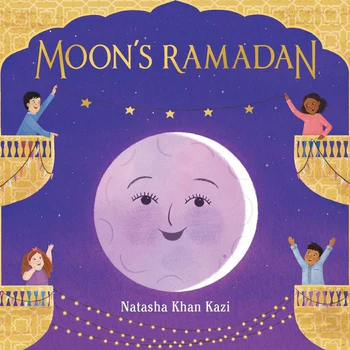
Moon’s Ramadan by Natasha Khan Kazi

Published by Versify

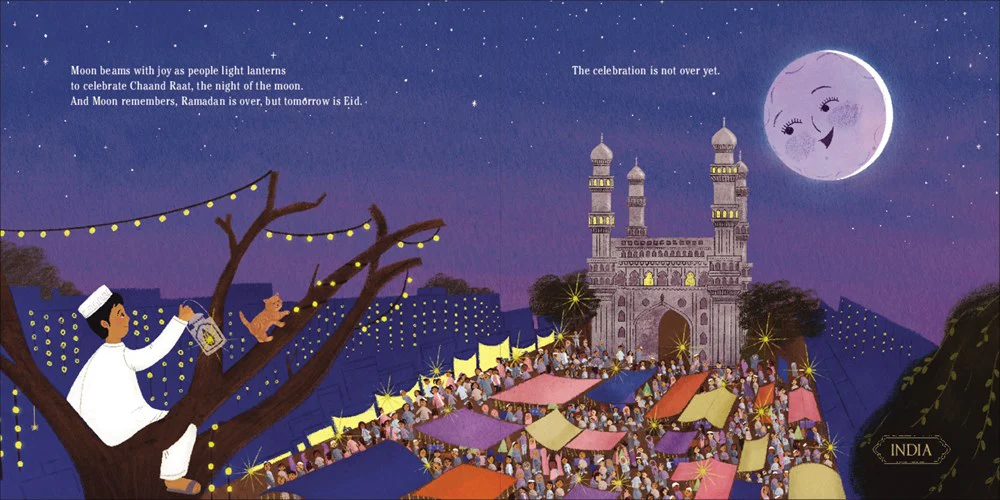
Summary:  Moon travels around the world during the month of Ramadan, as the part of her visible to Earth changes from the tiny crescent that signifies the beginning of the month to a full circle, and back to the sliver that heralds the end of the month and the Eid celebration.  She watches Muslims in countries around the world fasting, worshiping, and practicing kindness and charity.  As night falls on the Eid celebration, “a billion faces smile up at Moon.  Moon sees a world of love and kindness, and she glows with gratitude.”  Includes a brief author’s note with additional information about Ramadan, information about the lunar cycle with pictures of the phases of the moon, and a Ramadan glossary.  40 pages; ages 4-8.

Pros:  This is a much-needed introduction to Ramadan with beautiful illustrations that show Muslims from all around the world.  I love that it’s told from the perspective of the moon and includes some scientific information…check out the phases of the moon on the endpapers.

Cons:  The labels identifying the different countries were in a smallish font that didn’t show up well; it took me a few pages to notice them.

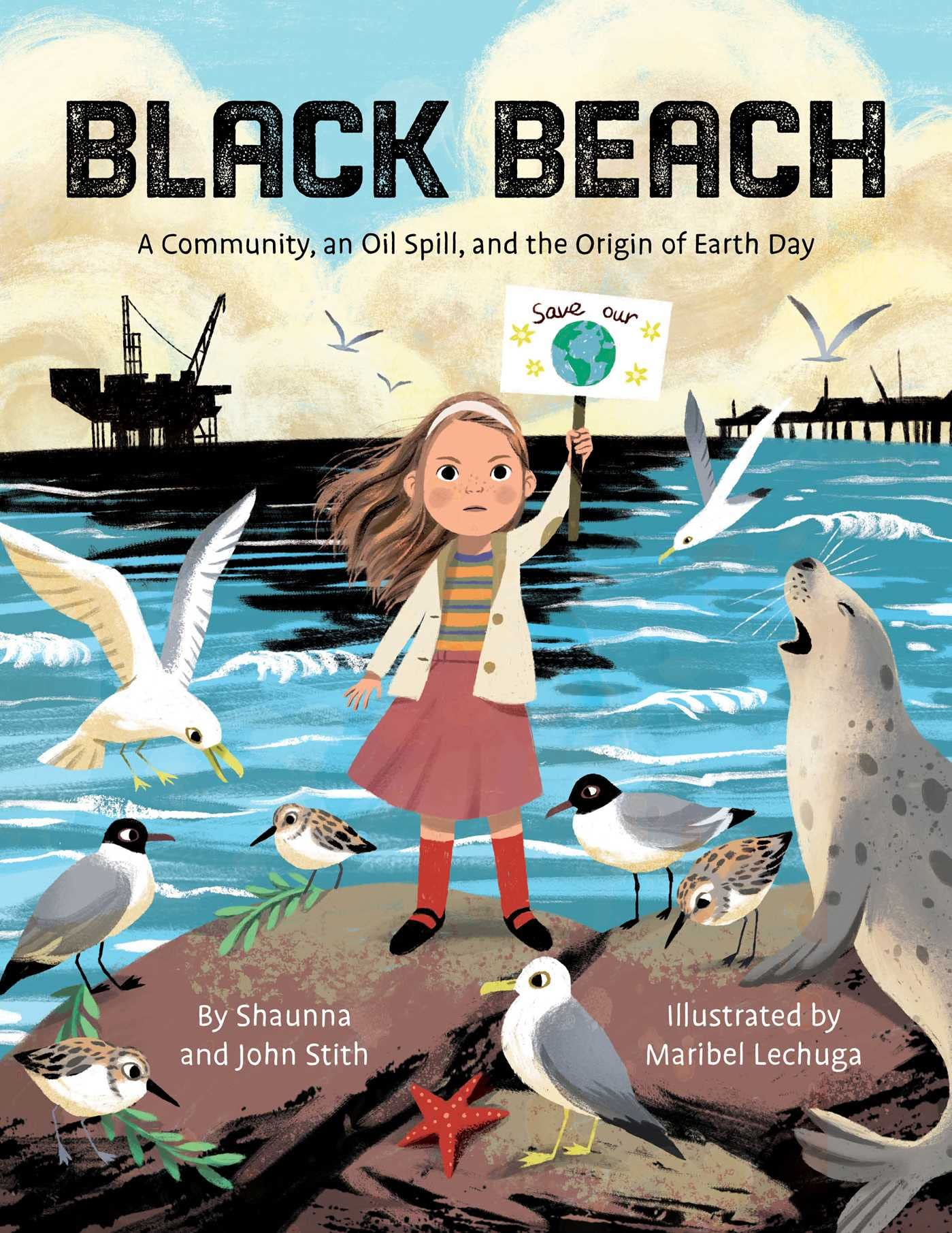
Black Beach: A Community, an Oil Spill, and the Origin of Earth Day by Shaunna and John Stith, illustrated by Maribel Lechuga

Published by little bee books

Summary:  Sam is in class drawing a picture of her favorite Santa Barbara beach when the principal walks in and whispers something to her teacher.  She finds out the news at home when her parents tell her about the oil spill that’s polluting her beloved beach.  As the oil starts to wash ashore, Sam feels sad, then angry, as she watches her parents and other volunteers try to clean up the damage.  She and her friends fill bottles with the oil and mail them to politicians.  News coverage increases, and several months later, U.S Senator and environmental activist Gaylord Nelson visits the beach, inspiring him to organize the first Earth Day.  On April 22, 1970, people around the world celebrated, protested, and taught about the environment, beginning a movement that continues today.  Includes an authors’ note, a bibliography, a timeline, additional information about Earth Day, and a list of ten ways to become an environmental activist.  40 pages; ages 4-8.

Pros:  An excellent read-aloud for Earth Day.  The perspective of the fictional Sam brings this true story to life for kids, and the additional information gives them concrete actions to take for the environment.

Cons:  Showing the damage wrought by the oil company, then urging kids to take shorter showers and turn off the lights feels like misplaced responsibility.

All Rise: The Story of Ketanji Brown Jackson by Carole Boston Weatherford, illustrated by Ashley Evans

Published by Crown Books for Young Readers

Summary:  Our newest Supreme Court Justice gets her own picture book biography with the repeating refrain of “she rose.”  Ketanji rose from a childhood filled with the love and support of parents and grandparents who took pride in their heritage and valued education.  She rose to overcome teachers who made fun of her name and discouraged her from applying to Harvard to follow her dream of becoming a lawyer and then a judge.  And ultimately, she rose to the challenge of four days of tough questions by the Senate Judiciary Committee to become the first Black woman Supreme Court justice.  Includes a letter from the author to her granddaughter and “all our daughters” and a timeline of Ketanji Brown Jackson’s life.  40 pages; grades K-4.

Pros:  This inspiring biography will help kids get to know Ketanji Brown Jackson.  Her own quotes are sprinkled throughout the text, adding her voice to her story. 

Cons:  No photos.

Beneath by Cori Doerrfeld

Published by Little, Brown Books for Young Readers

Summary:  Finn is in a horrible mood, sitting on his bed completely covered by a patchwork quilt.  Grandpa wants to talk, but Finn tells him that he won’t understand.  Finally, Finn agrees to go for a walk, but only if he can stay underneath his quilt.  “Don’t worry,” says Grandpa, “I’ll remember to think of what’s beneath.”  As they walk, Grandpa points out that beneath the trees, there are roots; beneath the still water, there are fishing swimming around; beneath appearances are experiences, and beneath what’s different is what’s the same.  “And sometimes,” says Grandpa, “Beneath someone who looks like they won’t understand…is someone who knows exactly how you feel.”  The illustrations reveal that both Finn and Grandpa have broken hearts, maybe from the loss of the person who made the patchwork quilt.  As night falls, the quilt is transferred from Finn’s head to Grandpa’s shoulders, and both of them are shown with hearts that are no longer broken.  40 pages; ages 4-8.

Pros:  There are many layers to this little story, and it will take an astute reader of both the words and the illustrations to catch them all.  Grandpa is truly a wise man who sees much more than meets the eye, and Finn is lucky to have him as they both process loss and grief.

Cons:  It would be difficult to get everything from this book with just one reading.

We Go Way Back: A Book About Life on Earth and How It All Began by Idan Ben-Barak, illustrated by Philip Bunting

Published by Roaring Brook Press

Summary:  Idan Ben-Barak and Philip Bunting have created a picture book about life on Earth and how it started.  Going back to a time when “there was a lot going on” on Earth (erupting volcanoes, raining meteors, lightning strikes), they explain how elements in Earth’s seas joined together to form molecules.  The molecules turned into bubbles until one day, a “special bubble” formed that could make copies of itself, each one just a little bit different.  From this process, all sorts of life forms began to evolve.  The final page is a three-part vertical gatefold that opens up to show the many branches on the tree of life.  40 pages; grades 1-4.

Pros:  This deceptively simple book takes on some enormously complex scientific concepts and manages to clearly explain them with the help of some pretty adorable illustrations.

Cons:  I would like to sit down and have a serious conversation with the editor who decided there was no need for back matter in this book.

In Every Life by Marla Frazee

Published by Beach Lane Books

Summary:  Based on a call-and-response version of a baby-naming blessing Marla Frazee heard at a church service, this book seeks to honor aspects of life that we all experience.  “In every birth, blessed is the wonder,” the book begins, showing two pages of newborn babies with their families.  The next wordless page depicts a family enjoying the wonder of a sunset, the sky filled with pink clouds.  That format continues with sentences that begin “In every…” and show a blessing, followed by a wordless page depicting the blessing.  Smiles, hope, sadness, comfort, mystery, tears, love, and life are all parts of life and parts of this book.  32 pages; ages 3+

Pros:  This beautiful book should be considered for a Caldecott and would make a lovely gift for a new baby, graduate, or anyone going through a life transition. Despite the serious topics, the illustrations add a light touch with plenty of humor.

Cons:  The author’s note at the beginning is in a gold font so light that I missed it the first time I read the book.

Just Like Grandma by Kim Rogers, illustrated by Julie Flett

Published by Heartdrum

Summary:  Becca loves watching her grandma bead and paint and dance.  “More than anything, Becca wants to be just like Grandma.”  She asks Grandma to let her try, and together they bead and paint and dance. After each activity, Grandpa calls them in to eat the foods that he’s prepared.  As Becca gets older, she tries basketball, and Grandma starts to learn from her.  “And Grandma knows that she is just like Becca.”  Includes a glossary, additional information about beadwork, and notes from the author and Cynthia Leitich Smith of Heartdrum.  32 pages; ages 4-8.

Pros:  Heartdrum continues their excellent work with this lovely picture book celebrating intergenerational bonds and grandparents who are raising their grandchildren.  The repeating text helps readers focus on the details of Becca’s life which includes many Native traditions and arts.

Cons:  I wish the back matter had included more information on Grandma’s dancing.

Finding Papa by Angela Pham Krans, illustrated by Thi Bui

Published by HarperCollins

Summary:  Mai loves to play with her father, whose favorite game is to make his hands into a chomping crocodile, but one day he says goodbye to her and her mother and leaves.  They start getting letters from him, and after a long wait, Mai’s mother tells her they are going to find Papa.  Their journey takes them to a small boat, where they face the dangers of stormy seas and little food and water until they’re rescued by a large ship.  In a refugee camp, Papa’s letters help the workers know where to send Mai and her mother, and they eventually make their way in America.  Mai doesn’t recognize the strange man who greets them there until he makes his chomping crocodile, and she and her parents have a joyful reunion.  Includes notes from the illustrator and the author, who wrote this story about her own family’s journey from Vietnam in 1983.  40 pages; ages 4-8.

Pros:  A beautiful story told through the eyes of the child narrator showing the courage needed to start a new life.  The mom is particularly heroic as she carries, comforts, and encourages her daughter, and the final reunion is perfect.

Cons:  I wish I could have read the illustrator’s note, but since it was printed on the back cover, the taped-down flap of the book jacket prevented me from doing so.

Evergreen by Matthew Cordell

Published by Feiwel and Friends

Summary:  Evergreen is a squirrel who is afraid of just about everything–everything except soup, that is.  So when her mother, whose specialty is making magic soup, asks her to take some soup to Granny Oak, Evergreen is scared.  And as it turns out, she has reason to be.  In the four sections of her journey, she encounters a soup-stealing rabbit, a hungry hawk, a toad with a mission, and a big, big bear.  As Evergreen figures out how to handle each situation, she grows more confident and courageous.  Back home, her mother greets her with some more soup that needs to be delivered, and Evergreen is more than ready to head back out again.  48 pages; grades K-2.

Pros:  Caldecott Medalist Matthew Cordell has created a real page-turner complete with scary sound effects that will have kids rooting for Evergreen and her brave deeds.  I thought this might be kind of long to read aloud, but it’s so engaging that I look forward to giving it a try.

Cons:  I prefer a brighter color palette.

That Flag by Tameka Fryer Brown illustrated by Nikkolas Smith

Published by HarperCollins

Summary:  Although Kiera considers Bianca her best friend, she’s not allowed to go over to Bianca’s because of the Confederate flag that flies outside their house.  While Kiera’s parents tell her that the flag is a symbol of violence and oppression, Bianca’s family describes it as a celebration of courage and pride.  Kiera is confused until a class trip to the Legacy Museum where she learns a history of racism that she didn’t know about. That night her family shares stories about their own experiences of racism that Kiera has never heard about before.  The stories leave her feeling scared and angry, and she finds that she no longer wants to be friends with Bianca, who seems unaffected by the museum trip.  A few days later, both girls see news reports of two Black people shot by three white men wielding a Confederate flag.  When Kiera and her parents go to a candlelight vigil, she’s surprised to see Bianca there with her family, and even more surprised on the drive home when she sees that they’ve taken down their flag.  The next day, Bianca passes Kiera a note saying, “You were right,” and Kiera wonders if they might be able to be friends after all.  Includes additional information about the Confederate flag, a list of sources, and notes from the author and illustrator.  40 pages; grades 1-4.

Pros:  This story addresses some difficult topics in a way that elementary students will understand, offering hope for friendship between the two girls while explaining why this is difficult for Kiera.  The additional information adds context to the story.  An excellent choice for teaching Black history and how it continues to affect us today.

Cons:  Be sure to block out plenty of time to share this book…there’s a lot to unpack.