Pigeon & Cat by Edward Hemingway

Published by Christy Ottaviano

Summary:  Cat lives alone in a box in a vacant lot, only leaving home to scavenge for food.  If another cat tries to enter the lot, Cat hisses and shows his claws.  One day, he finds an egg, which, much to his surprise, hatches into a pigeon.  For the first time, Cat cares about another animal, feeding her and letting her sleep with him in his box.  Pigeon grows up and starts flying around the city.  Cat worries about her leaving the safety of the lot, but when Pigeon brings back bits of chalk, Cat passes the time by creating art on the walls around him.  One day, though, Pigeon doesn’t come back.  Cat is so heartbroken that he decides to venture out into the city to find her.  He’s so anxious to track down his friend that he starts to reach out to other animals for help.  He draws pictures around the city, hoping Pigeon will recognize them and find him.  One day, a flock of birds unexpectedly leads him back to his own lot where Pigeon is waiting for him.  Pigeon has opened up the lot to other strays, and it becomes a beautiful place that is welcoming to everyone.  40 pages; ages 4-8.  

Pros:  A heartwarming story about the transformative powers of love, friendship, art, and community.

Cons:  Too bad humans aren’t better at learning some of those lessons.

I Forgive Alex: A Simple Story About Understanding by Kerascoët

Published by Random House Studio

Summary:  Recess begins with different groups of kids doing different things: running, stomping in puddles, and hanging out with friends.  One boy pulls out his artwork and displays it for his friends. Alex is bouncing a basketball around the playground, teasing other kids who are trying to get it away from him.  When he throws it, it bounces on the bench where the art is set up, sending the papers into a nearby puddle.  The artist is sad, and his friends take his side, ostracizing Alex.  This continues until the next recess, when Alex tentatively smiles and waves at the boy, who walks over to him.  The two of them talk, then shake hands, and everyone joins in a friendly game of basketball.  The next day, Alex greets his new friend and gives him a drawing of the boy dunking the basketball while Alex cheers him on.  Includes a page with tips for handling similar misunderstandings for kids who have hurt someone, kids who have been hurt, and adults who are helping them.  40 pages; ages 4-8.

Pros:  The creators of I Walk With Vanessa (look for Vanessa and her friend in the illustrations) have produced another wordless masterpiece perfect for SEL education.  Kids will enjoy figuring out what’s going on in the story, and the backmatter makes it a useful tool for parents and educators.

Cons:  The title is kind of didactic.

One Boy Watching by Grant Snider

Published by Chronicle Books

Summary:  At 7:00 a.m., one boy boards school bus number 4 to begin his 50-minute journey to school.  Along the way, he sees things out the window: one tree, three deer, four cars, seven sunflowers.  Gradually, the 28 seats in the bus fill up until there are 48 kids “packed like crayons in a crayon box.”  Finally, they arrive at school.  The day passes, and at 3:00 p.m. the boy stares out the classroom window, daydreaming about what he will see on his journey home.  60 pages; ages 4-8.

Pros:  A quiet story of kids not often represented in picture books–those who live in rural communities.  There are lots of numbers in the story, which would make it a fun one to read to children who are just learning how to count.  The beautiful colors make for eye-catching illustrations from orthodontist-by-day-artist-by-night Grant Snider.

Cons:  100 minutes on a school bus every day.

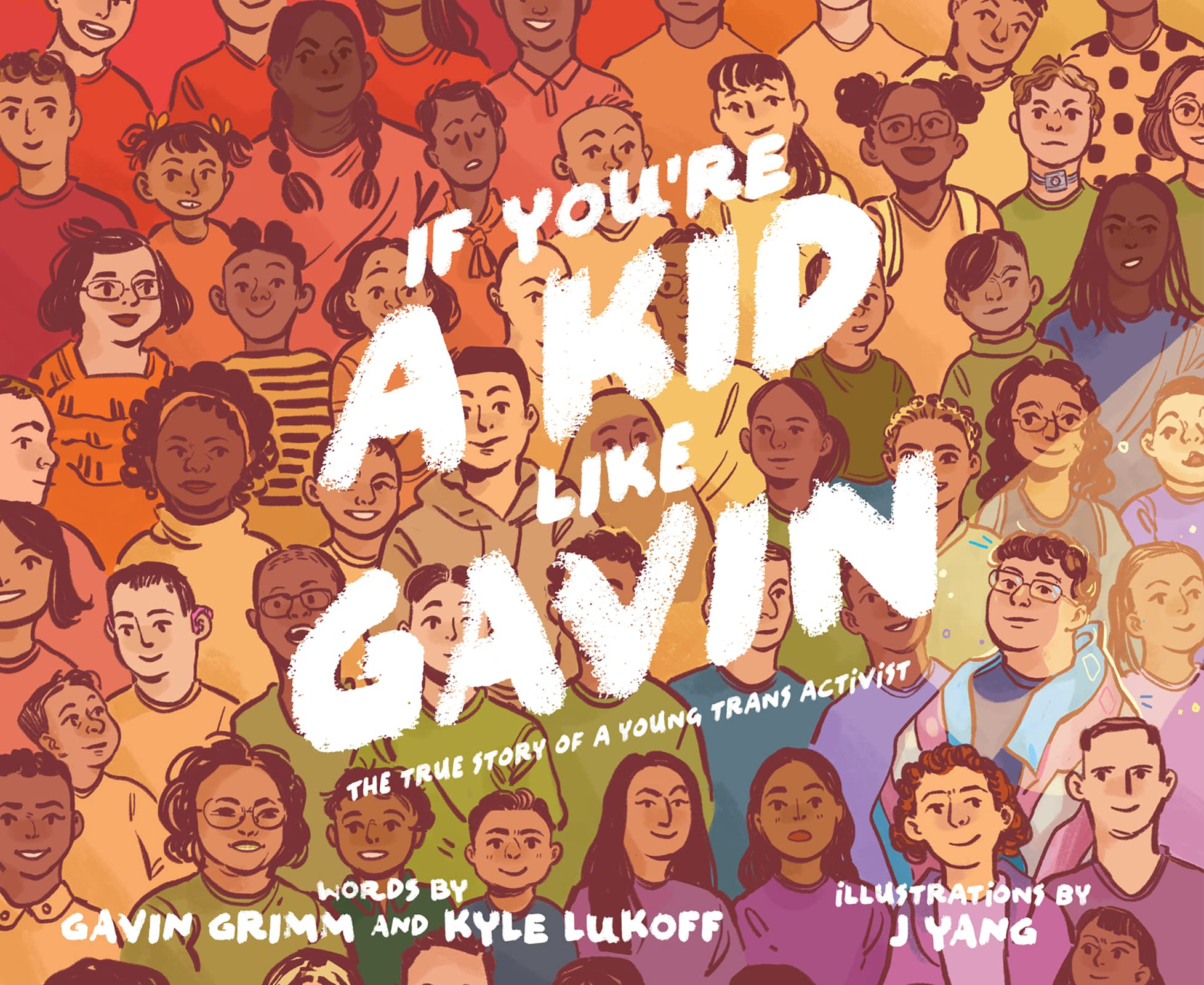
If You’re a Kid Like Gavin: The True Story of a Young Trans Activist by Gavin Grimm and Kyle Lukoff, illustrated by J Yang

Published by Katherine Tegen Books

Summary:  There are some choices kids get to make and others they don’t.  Gavin Grimm didn’t choose to be a boy or a girl, but as a transgender kid, he chose to talk about it, to tell his family he was a boy, and to start high school as a boy with a new name.  At school, though, he didn’t have a choice about what bathroom to use; he had to use the bathroom in the nurse’s office.  As months went by, and no one seemed to care, Gavin started to use the boys’ room.  A teacher objected, and kids started bullying.  So Gavin decided to speak up.  When this didn’t work at his school, he went on the news and to the ACLU and has continued to fight for his rights and those of other trans kids.  And “since you’re a kid like Gavin Grimm, you can always decide to believe in yourself and fight for what you believe in.”  Includes notes from both authors and a link to the ACLU’s webpage for students about their rights.  40 pages; grades 2-5.

Pros:  Kids will relate to Gavin’s personal story which lays out his choices in terms that are understandable for an elementary audience.  An excellent resource for trans kids and those who work or go to school with them.

Cons:  A list of resources (besides the ACLU site) would have been useful.

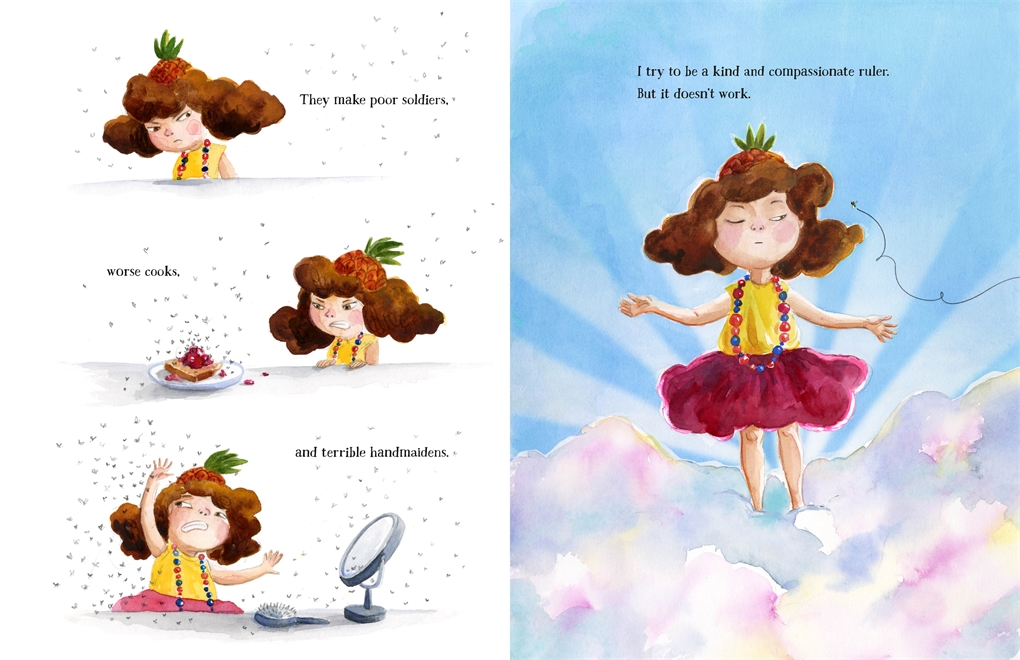
Pineapple Princess by Sabina Hahn

Published by Roaring Brook Press

Summary:  “I am deeply, deeply misunderstood,” says the narrator, standing in front of a wall “decorated” in red crayon.  “I know I am a princess, but no one believes me.”  A crown is in order, she decides, eyeing the top of a pineapple.  One messy kitchen later, she’s outside with her pineapple crown, which is soon surrounded by her subjects…flies.  She tries being kind and compassionate, then moves on to imprisoning some “subjects” with a glass jar and executing others with a flyswatter.  Finally, she gives up, tossing the crown into the garbage.  “I never wanted to be a princess anyway.”  Soon she has moved on to become a warrior queen, with her unsuspecting cat about to be lassoed.  “My queendom for a horse!”  40 pages; ages 4-8.

Pros:  Those who enjoy Fancy Nancy and Ladybug Girl will get a kick out of the pineapple princess and her attempts to rule her subjects.  I’d love to see another story about the warrior queen.

Cons:  Wearing part of a sticky pineapple and all those flies.

Ali and the Sea Stars by Ali Stroker, illustrated by Gillian Reid

Published by HarperCollins

Summary:  Ali is a young girl who dreams of someday singing and dancing on stage.  She shares her ambitions with others around Breezy Beach until one day Kate the lifeguard asks her why she’s waiting for “someday”.  That inspires Ali to organize a performance of Peter Pan, recruiting friends and family for different parts and casting herself in the lead.  On the day of the big show, everything is ready when a sudden rain shower drenches the sets and the cast.  Undeterred, Ali decides that the show must go on and improvises new sets and props.  The play is a smash hit, and the Sea Stars Theater Company is born.  Includes an author’s note about her real-life inspiration for the story. 40 pages; ages 4-8.

Pros:  Tony Award-winning actress Ali Stroker makes her picture book debut, once again showing that being in a wheelchair does not limit one’s possibilities.  The bright cartoon-style illustrations perfectly capture the high energy of the story.

Cons:  I think I would have chosen The Little Mermaid for a seaside production over Peter Pan, even though Ali dismisses it as “too obvious”.

Growing an Artist: The Story of a Landscaper and His Son/Cultivando a un artista: la historia de un jardinero paisajista y su hijo by John Parra

Published by Simon and Schuster/Paula Wiseman Books

Summary:  The narrator spends the day helping his father with his landscaping business.  It’s hard work, and one of his classmates snubs the boy when he sees him working in his yard.  But visiting the dump and choosing plants from the nursery is fun, and his dad’s enthusiasm about his business is contagious. Everywhere they go, the boy pulls out his sketchbook and draws what he sees.  Their last visit is to a couple who want to transform their overgrown yard.  When the boy gets home, he begins to create a design for the new yard.  His dad agrees to use his plans.  “You have a gift,” says his mother, as he looks at all the sketches he’s made of his day.  Includes an author’s note about his father’s landscape business and how he helped his dad as a child.  Available in English and Spanish. 40 pages; ages 4-8.

Pros:  This would make a great mentor text for memoir/narrative writing. Belpré honoree John Parra brings to life a story which is clearly close to his heart.

Cons:  I would have enjoyed seeing a side-by-side illustration of the boy’s blueprint and the finished yard he helped design.

A Seed Grows by Antoinette Portis

Published by Neal Porter Books

Summary:  A bird with a seed in its beak is on the title page, apparently the source for the seed that falls on page 1.  That seed settles into the soil, and sun and rain help it turn into a sprout, growing to at last become a sunflower (big enough to need a foldout page).  The flower is filled with seeds, which birds feed on when the plant droops to the ground.  When one bird drops the seed from the top of a tree, the cycle begins again.  Includes two pages of additional information and a list of resources.  40 pages; ages 3-7.

Pros:  I am already excited to read this book to preschoolers when they start learning about seeds next spring.  I like how key words like seed, sprout, and bud are written in a large colorful font to emphasize them, and kids always enjoy a foldout page.  Another great early science resource from Antoinette Portis to go with her award-winning Hey, Water!

Cons:  Those foldout pages get torn a lot in library books.

Building by Henry Cole

Published by Katherine Tegen Books

Summary:  “Building, building.  That is what beavers do best.”  This is the repeated refrain in a story that follows a pair of beavers through a year beginning in late winter.  They pick a spot to live by a stream and build a dam and a lodge.  The dam creates a pond, and the lodge provides a safe place for babies.  As the seasons progress, the beavers face a coyote and a heavy rainstorm, but their defenses protect them from these dangers.  They gather enough twigs and branches to survive the winter, then settle down in the lodge as the snow begins to fall.  Includes an author’s note with additional information about beavers.  40 pages; ages 4-8.

Pros:  As he did with robins in Nesting, Henry Cole tells a gentle story about beavers as they journey through the seasons.  The detailed illustrations are mostly in black and white with highlights of seasonal colors (green grass, red leaves).  The author’s note invites wonder by contemplating the beavers’ amazing engineering feats.

Cons:  The interaction with the coyote wasn’t quite as dramatic and exciting as the snake attack in Nesting.

My Hands Tell a Story by Kelly Starling Lyons, illustrated by Tonya Engel

Published by Reycraft

Summary:  As Zoe and her grandmother make bread together, the girl marvels at her grandmother’s hands and thinks of the stories they tell.  Grandma tells of her young adulthood working in an office and dancing on stage, later on getting married and creating a home and garden.  When Zoe looks at Grandma’s hands, she sees words on them like “mother”, “planter”, and “nurturer.”  She wonders what stories her own hands will tell someday, then realizes that she can already see some there: building, baking, playing clapping games with friends.  Back home, she uses her hands to tap out some of her stories on her computer.  Includes a recipe for Zoe and Grandma’s Cinnamon Bread.  32 pages; ages 4-8.

Pros:  This quiet intergenerational story invites contemplation and could lead to discussions or writings about the stories told by a child’s or an adult’s hands.  The vibrant illustrations perfectly capture the characters, their hands, and their stories.

Cons:  Be careful not to drool on the recipe page.