When Green Becomes Tomatoes: Poems for All Seasons by Julie Fogliano, illustrated by Julie Morstad

Published by Roaring Brook Press 

Summary:

march 22

just like a tiny, blue hello

a crocus blooming

in the snow

Starting with the spring solstice (March 20), these poems wind their way through the seasons, finishing up on March 20 of the following year.  In between are poems about flowers and strawberries, the beach, pumpkins, and frost and snow.  The title of each poem is a date, and all are illustrated with simple but evocative pictures.

Pros:  This year of poems would make an excellent introduction to poetry and may inspire young writers to try to capture the various seasons through their own words.

Cons:  There was no poem for my birthday.  Or for my half-birthday, for that matter, which happens to be today.


Jazz Day: The Making of a Famous Photograph by Roxanne Orgill, illustrated by Francis Vallejo

Published by Candlewick


Summary: In 1958, graphic designer Art Kane sold Esquire on the idea of taking a picture of as many jazz musicians as he could gather together. Looking for the perfect backdrop, he traveled to Harlem, where he spent a full day seeking the brownstone he wanted to use for the shot. Although he wasn’t a professional photographer, Kane got his photo of 57 jazz musicians, now known as Harlem 1958. This book tells the history of that day through poems about Kane and some of his subjects. Thelonius Monk was an hour late because he was picking out the perfect outfit to wear. Count Bassie explains many of the musicians’ nicknames, including his own. “There’s A Hole in the Picture” recounts the reason Duke Ellington is missing from the photo (he was on the road). Other poems are about lesser-known performers, as well as some of the Harlem kids who ended up in the photo, lining up in the front row or peeking out the windows of the house. An oversized page near the end unfolds to finally reveal the photograph. Back matter includes an extensive author’s note, an outline picture identifying all the musicians, thumbnail biographies of all the subjects of the poems, and a huge bibliography. 66 pages; grades 4-7.

Pros: This carefully researched, beautifully illustrated collection of poems requires a slow reading. Readers will find themselves flipping between the poems, the photo, and the back matter. 66 pages jam-packed with information, presented with enormous artistic flair.

Cons: It’s difficult to know who the audience would be for this book. Most kids in grades 4-7 won’t have the context to really appreciate it, yet clearly it’s written for an upper elementary/middle school reader.


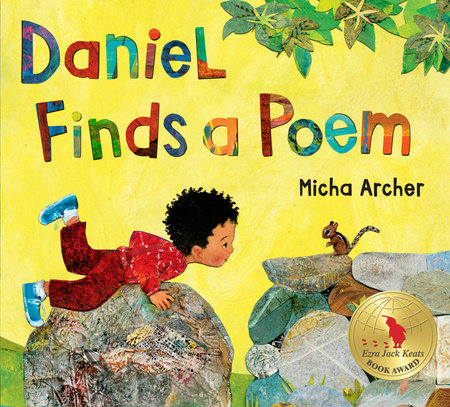
Daniel Finds a Poem by Micha Archer

Published by Nancy Paulsen Books 

Summary:  Daniel is an observant boy.  He knows all the rocks, trees, and animals in the park.  One day he sees a sign advertising “Poetry in the Park” for the following Sunday.  Unsure about what poetry is, Daniel starts to ask his animal friends.  The spider says poetry is when the morning dew glistens.  Squirrel’s answer is it’s when crispy leaves crunch.  Frog tells him poetry is a cool pool to dive into.  By the time Sunday arrives, Daniel has enough answers to be able to put them all together into one poem.  On the way home, he sees the sunset reflected in the pond, and knows he has the seed for a new poem.  32 pages; grades K-3.

Pros:  A simple and beautiful introduction to poetic language and the creation of poetry.  The colorful illustrations are pretty poetic themselves.

Cons:  The concept may be a bit abstract for the intended audience.


Wet Cement: A Mix of Concrete Poems by Bob Raczka

Published by Roaring Brook Press 


Summary:  “A poet uses words like colors to paint pictures inside your head,” says Bob Raczka in his introduction.  “In concrete poems, or shape poems, the words also paint pictures on the page.”  In each of these 21 concrete poems, the title is a single word, and the poem is only a few more lines.  Together they create an image, both concretely on the page, and more abstractly, in the reader’s mind.  For example, “Clock” is written with a capital L superimposed over the O to make it look like a clock.  The poem, “The clock on the wall says it’s five ‘til three, but the kids in my class say it’s five ‘til free” is written in lines going out from a center point, also resembling a clock.  Even the table of contents and copyright information are written in new ways for readers to enjoy.  48 pages; grades 2-6

Pros:  These poems make fun use of wordplay.  Kids will enjoy reading them and maybe even trying their own.

Cons:  You’ll need to be able to read backwards and upside down for some of the poems.

Little Cat’s Luck by Marion Dane Bauer, illustrated by Jennifer A. Bell

Published by Simon and Schuster 

Summary: One day Patches feels an urge to find a special place just for her. An indoor cat, she escapes the house and goes off to explore the outside world.  She ends up at a yard dominated by Gus, the meanest dog in the neighborhood.  Undeterred, she finds her way inside his doghouse, where a surprising series of events unfolds.  Finding herself in a difficult situation far from home, Patches must call on the animals around her for help, including, much to everyone’s astonishment, Gus.  Everyone rallies round, and, after a few false starts, a happy ending is in store for all.  224 pages; grades 1-4.

Pros:  This sweet story is told in verse, with many words moving up, down, and in various directions to illustrate the idea they are trying to convey.  The poetic , form makes it a quick read, but one that is filled with endearing animal characters and a satisfying plot.

Cons:  It took a few tries for me to get beyond the first couple of pages.  A little perseverance might be needed for readers to get engaged in the story.

What Are You Glad About? What Are You Mad About? by Judith Viorst, with art by Lee White

Published by Atheneum Books for Young Readers 

Summary:  These mostly humorous poems are divided into eleven sections, such as How Are You Feeling Today?; School Stuff; About the Family; Home and Away;  and Friends and Other People. As the title suggests, there are poems about glad topics, like a perfect day, home, and a fun “arithmetrick”, and others about mad/sad topics, like divorce or an ex-best friend.  Black, white, and blue illustrations are on every page.  112 pages; grades 1-4.

Pros:  Published a week after Judith Viorst’s 85th birthday, this fun collection shows she still excels at writing for an elementary audience.  The subjects are perfect for kids, and the poems have a good blend of humor and poignancy.

Cons:  Some of the lines of poetry were a little uneven, so the poems didn’t flow quite as smoothly as they could have.


Echo Echo: Reverso Poems About Greek Myths by Marilyn Singer, illustrated by Josee Masse

Published by Dial Books for Young Readers 

Summary:  Reverso is an amazing poetic form invented by Marilyn Singer, in which the second half of the poem is the first half in reverse, with changes in punctuation that make the meaning very different.  Each of these reverse poems is based on a Greek myth that features two main characters, with each verse told from the point of view of one of those characters.  For example, Perseus’s verse goes:

“There is no man who wouldn’t be

Scared stiff.

Petrified indeed.

I must have your head,

stone-hearted monster!

I am the chosen

one to rid the world of you nasty creatures.

It is my curse to be the hero.

Look away.

You cannot

shield yourself from me.”


And here’s Medusa’s:

“Shield yourself from me?

You cannot

look away,

hero.

It is my curse to be the

one to rid the world of you nasty creatures.

I am the chosen

stone-hearted monster.

I must have your head,

petrified indeed—

scared stiff.

There is no man who wouldn’t be.”

The poems are laid out side by side, with an illustration on the facing page. The last page gives further information about Greek mythology and a few sources of myths to read. 32 pages; grades 2-6.

Pros:  These poems are so, so cool.  They would be a fantastic supplement to a mythology unit.  See the author’s Follow, Follow and Mirror, Mirror for reverso poems based on fairy tales.

Cons:  It would be great to write reverso poems with kids, but it seems like a pretty daunting format.  Maybe an enrichment group?

American Ace by Marilyn Nelson

Published by Dial Books 

Summary: When Connor’s grandmother Lucia dies, she leaves a letter for his father, revealing that Connor’s grandfather wasn’t the Italian man his father grew up with; instead, he was an American pilot who was in Italy during World War II. Connor’s father was raised in a tight-knit Italian family, and the news is devastating to him at first.  Along with the letter, Lucia left a school ring that belonged to the pilot.  Connor uses the ring to research his grandfather.  Eventually, he learns that this man was African American, one of the famed Tuskegee Airmen.  Just as the mystery is about to be solved, Dad has a stroke and is hospitalized.  Connor helps him heal, both physically and emotionally, by learning and sharing more and more of the courageous history of the Airmen.  117 pages; grades 7-10.

Pros:  In an author’s note, Marilyn Nelson writes how she wanted to tell the story of the Tuskegee Airmen, and eventually had the idea to write a book in which the main character gradually learns their history.  She achieves this brilliantly in just 45 poems told in Connor’s voice.  The history is fascinating, and so is the story of this family who must rethink their entire identity in the light of revelations about their cultural heritage.

Cons:  The structure of Part 7, in which Connor tells his father the story of the Tuskegee Airmen while his dad is convalescing in the hospital, is a little bit confusing.

Beastly Verse by Johee Yoon

Published by Enchanted Lion Books 

Summary:   16 poems about animals are presented, illustrated with vividly colored prints.  Some poets, such as Lewis Carroll and Ogden Nash, will be familiar to many readers, while others, such as Arthur Waugh and Carolyn Wells, are less well-known.  Some of the pages unfold to reveal even larger illustrations.  48 pages; grades K-4.

Pros: The large square design and brightly colored, busy illustrations will provide an enticing introduction to poetry for young readers.

Cons:  I always enjoy an author’s note explaining the selection of poems, and maybe a description of how the art was produced to complement them.  Other than acknowledgements, there was none of this sort of information.

The National Geographic Book of Nature Poetry edited by J. Patrick Lewis

Published by National Geographic 

Summary: Over 200 poems are paired with nature photographs, arranged in sections about animals, seasons, specific places, and natural disasters. J. Patrick Lewis, former U.S. Children’s Poet Laureate, edited the collection and wrote an introduction about looking at nature and responding to it poetically.  He includes six of his own poems in post-it note form at the end, and an essay on “Who is Mother Nature?” that invites kids to write their own poetic answer to that question.  Also included at the end: a bibliography of children’s books on wordplay in poetry arrange by category (acrostics, anagrams, epitaphs, etc.), and indices by title, poet, first line, and subject.  192 pages; grades K-6.

Pros:  This is a rich collection of poetry by many different writers that invites children to engage in the creative processes of enjoying poetry and creating their own.  Readers will be drawn in by the beautiful, National Geographic quality photographs on every page.

Cons:  It would have been interesting to know a little more about some of the lesser-known poets; at the very least, the year they wrote their poems.