Rocks of ages

A Gift of Dust: How Saharan Plumes Feed the Planet by Martha Breckenbrough, illustrated by Juana Martinez-Neal (Knopf Books for Young Readers, 40 pages, grades 1-5). A sunbeam shining through a window illuminates the dust in the air. Where does this dust come from? The author traces it back to a fish in an African lake that dies, eventually becoming a fossil, which the wind then breaks down into dust. This dust travels around the earth, providing nutrients to plankton, plants, and other living creatures in the water and on land. Dust can change the color of sunsets, dampen the speed of hurricanes, and be seen from outer space. Includes additional information and resources about dust.

I Rock: A Geology Tale by Kate Slivensky, illustrated by Steph Stilwell (Beach Lane Books, 40 pages, grades 1-5). Luis is presenting his senior citizen interview to the class when a rock stuck to the bottom of his shoe interrupts to ask the kids if they want to hear about someone who is REALLY old. The rock takes them on a journey going back four billion years where it started life deep inside the Earth. It has traveled all over the planet and experienced life in igneous, metamorphic, and sedimentary states. Concepts and vocabulary like plate tectonics, tsunamis, and erosion are introduced, as a small version of the rock narrates a timeline along the bottom of each page. The story concludes with Luis stepping on the rock, and the narrator declaring, “after four billion years, I’m proud to say that I’m here and I rock!” Includes more geology facts, a geology pop quiz, and a list of sources.

Although their styles are very different, both of these books do an outstanding job of instilling wonder by placing ordinary objects–dust and rocks–in the context of the vast expanses of time it has taken to create them. I Rock is filled with fun, humorous cartoons, while A Gift of Dust has sparkly dust-infused illustrations that could be worth of Caldecott consideration.

Animal humor

The Bear Out There by Jess Hannigan (Quill Tree Books, 48 pages, ages 4-8). A jumpy girl narrator tells readers why she was scared by their knock: there is a bear out there! She shares the three signs of how to tell when a bear is nearby: raised arm hair, a feeling of being watched, and super itchy feet. Readers see the bear from the window, but the girl doesn’t see it until it’s at the door! She runs away screaming , while the bear explains, “This is literally my house.” While making a cup of tea, the bear relates that break-ins happen all the time, showing a book lying on the table called “Goldilocks, Friend of Foe?” It’s ridiculous, the bear complains, because guests are always welcome as long as they ask first. “I would be pleased to offer you a warm bed to stay the night, should you need it.”

Kids will get a big kick out of the over-the-top reactions from the girl narrator, as well as her less than accurate know-it-all attitude. The illustrations of the girl’s freak-outs, as well as those showing the bear that she doesn’t see, are sure to bring some laughs. This would make a great addition to a fractured fairy tale unit.

We Are the Wibbly! A Tadpole’s Tale by Sarah Tagholm, illustrated byJane McGuinness (Published by Bloomsbury Children’s Books, 32 pages, ages 3-7). A frog narrates its life cycle, from egg to full-grown frog, using its own unique terms like “Wibbly” (the tadpole still inside the egg), “water-flying” (swimming), and “air-flying” (jumping). Just as it gets used to one stage, it notices its friends are onto the next one. Life inside the egg is comfortable, but suddenly the others are hatching and water-flying. By the time water-flying has become second nature, the other tadpoles are growing legs. And so it goes, until finally, the wibbly have all become full-grown frogs and gaze fondly at some eggs in the pond, asking each other, “Do you remember when we were the Wibbly? Includes additional information about the life cycle of a frog.

This is a fun introduction to a frog’s life cycle, told in way that kind of reminded me of Elmo with slightly quirky sentence structure, made-up words, and the repeated refrain of “OH MY CRIKEYS!” which kids will enjoy saying. Kids may relate to the narrator noticing when others seem to be growing and changing faster than it does and reassured by the fact that eventually everyone gets to the same place.

Stormy weather

Hurricane by Jason Chin (Neal Porter Books, 48 pages, grades 2-5). The story of a hurricane is told over a 12-day period, from three different perspectives: the storm itself, the scientists who track it, and the residents of Cape Hatteras, North Carolina who prepare for it to hit their community. The more scientific material includes labeled diagrams and sidebars that give plenty of information. Particularly exciting are the pages showing the Hurricane Hunters who fly planes directly into the storm. Meanwhile, the people of Cape Hatteras are portrayed with cartoon bubbles showing their conversations as they board up windows, check generators, and in some cases, evacuate. There’s a sense of community as they help each other get ready and clean up in the aftermath on the last few pages. Includes lots of additional hurricane information, additional resources, and an author’s note.

Jason Chin brings his amazing artistic talents to this nonfiction book that can be enjoyed on a variety of different levels. Younger readers will be drawn into the story of the Cape Hatteras residents preparing for and experiencing (or evacuating from) the hurricane, while older ones will learn a lot from the more scientific text and labeled diagrams. Definitely a contender for a Sibert award.

Island Storm by Brian Floca, illustrated by Sydney Smith (Neal Porter Books, publication date July 22, 2025, 48 pages, ages 4-8). A couple of award winners team up to show two children exploring outside before a storm hits. First they head to the ocean, where waves are crashing on the beach under a darkening sky. Rain starts to fall as they run into town, where they see deserted streets and boarded-up windows. A loud clap of thunder scares them into going home: “Home to relief, and love. Home to trouble, too! And forgiveness.” They dry off, warm up, and eventually head to bed while the storm rages outside. In the morning, the sun is shining, the sea is calm, and the kids and their mother enjoy a day at the beach.

The lyrical text and mostly blue, gray, and green watercolors (with some red highlights) perfectly capture the feeling of an impending storm, followed by the storm itself and its aftermath. The kids’ repeated refrain, “Is this enough, or do we try for more?” sends them from one scary-but-exciting spot to another (although I was relieved that they got into some trouble when they got home, as I was wondering what parent would allow their kids out in that weather). The last sentence: “And you and I go on,” expands the meaning to the kids being together through other kinds of difficulties.

Thanks to Holiday House/Neal Porter Books for providing me with review copies of both of these books.

Women environmentalists

The Black Mambas: The World’s First All-Women Anti-Poaching Unit by Kelly Crull (Millbrook Press, 40 pages, grades 2-5). The Black Mambas are the first women park rangers in South Africa and the first women-led anti poaching unit in the world. They tell their story, explaining how they first got interested in protecting animals and describing some of the resistance they experienced from friends and family members who weren’t sure women could do this job traditionally held by men. They named themselves after the most feared snake in South Africa. Now they work out, train to survive in the wilderness, and patrol the reserve day and night, looking for signs of poachers and making arrests if they catch them. Their reserve, the Olifants West Nature Reserve, has become one of the most difficult reserves to poach animals, and the Black Mambas’ work has been recognized around the world. Includes more information about some of the animals on the reserve, the NATO Phonetic Alphabet that the rangers use, an author’s note, and a list of additional resources.

I loved this book, and I think a lot of kids will, too. Not only does it feature a lot of animals, but the Black Mambas are inspiring in their dedication, hard work, and success. The photos really capture the reserve the the women at work. I enjoyed the activities in a couple sidebars, like matching animal tracks and reading a map, which will keep kids engaged.

Marjory’s River of Grass: Marjory Stoneman Douglas, Fierce Protector of the Everglades by Josie James (Christy Ottaviano Books, 40 pages, grades 2-5). Marjory Stoneman Douglas moved to Florida soon after her graduation from Wellesley College, moving in with her journalist father whom she hadn’t seen since she was six. She joined him on the Miami Herald, starting as a society editor, but soon writing pieces about the Florida Everglades, a mysterious but beautiful ecosystem that her father had introduced her to. As real estate developers rushed to drain and reclaim the land, Marjory and other activists lobbied to make the Everglades a national park, protecting this wild area that provides the majority of southern Florida’s water. The publication of her book The Everglades: A River of Grass helped spread the word about this cause, and in 1947, Everglades National Park was officially dedicated. Despite this conservation effort, developers still sought to build in the Everglades, and Marjory was involved in a successful campaign to stop airport construction there in the 1970’s. Her activism and love for the Everglades continued until her death in 1998 at the age of 108. Includes an author’s note and photo of Marjory, additional information about the importance of clean water, a bibliography, and source notes.

This inspiring biography is an excellent starting point for learning about the life of this dedicated journalist and environmental activist. I appreciate the limitations of a picture book in telling the story of a woman who lived for more than a century, but I was sorry there wasn’t any information about Marjory’s childhood or marriage (both of which sounded pretty traumatic when I looked her up on Wikipedia). The bibliography will help those who want to more about Marjory’s life.

Lady of the Lines: How Maria Reiche Saved the Nazca Lines by Sweeping the Desert by Michaela MacColl, illustrated by Elisa Chavarri (Astra Young Readers, 48 pages, grades 2-5). Born in 1903 in Germany, Maria Reiche moved to Peru to be a nanny, but quickly became fascinated by the ancient Incan culture. When American anthropologist Paul Kosok showed her aerial photos of mysterious lines in the Nazca Desert, Maria was hired to investigate them. The Lines became her obsession, and Maria spent the rest of her life exploring and preserving them. She began by buying as many brooms as she could find to sweep away the dust that obscured them. Eventually, she realized that the Lines made shapes of enormous animals: a spider, a monkey, birds, and more. As she learned more about these ancient designs, Maria became an activist for their preservation, fighting off attempts to irrigate the the desert, then dealing with the tourists who came as a result of her publicity campaign. One thing Maria did not succeed at was figuring out the meaning of the designs in the desert, but she claimed to enjoy the mystery. “If everything were clear,” she said, “I would lose interest.” Includes additional information about the Nazca people, the Lines, and Maria, as well as a timeline and lists of additional resources.

Kids are sure to be fascinated by the Nazca Lines, which are now visible to everyone through Google Earth. Maria Reiche is almost as much of a mystery as the Lines are, completely dedicating her life to their study and preservation, to the exclusion, it would seem, of pretty much all else. She definitely is someone who lived life on her own terms and clearly did exactly what she wanted to do.

Graphic novels for budding scientists

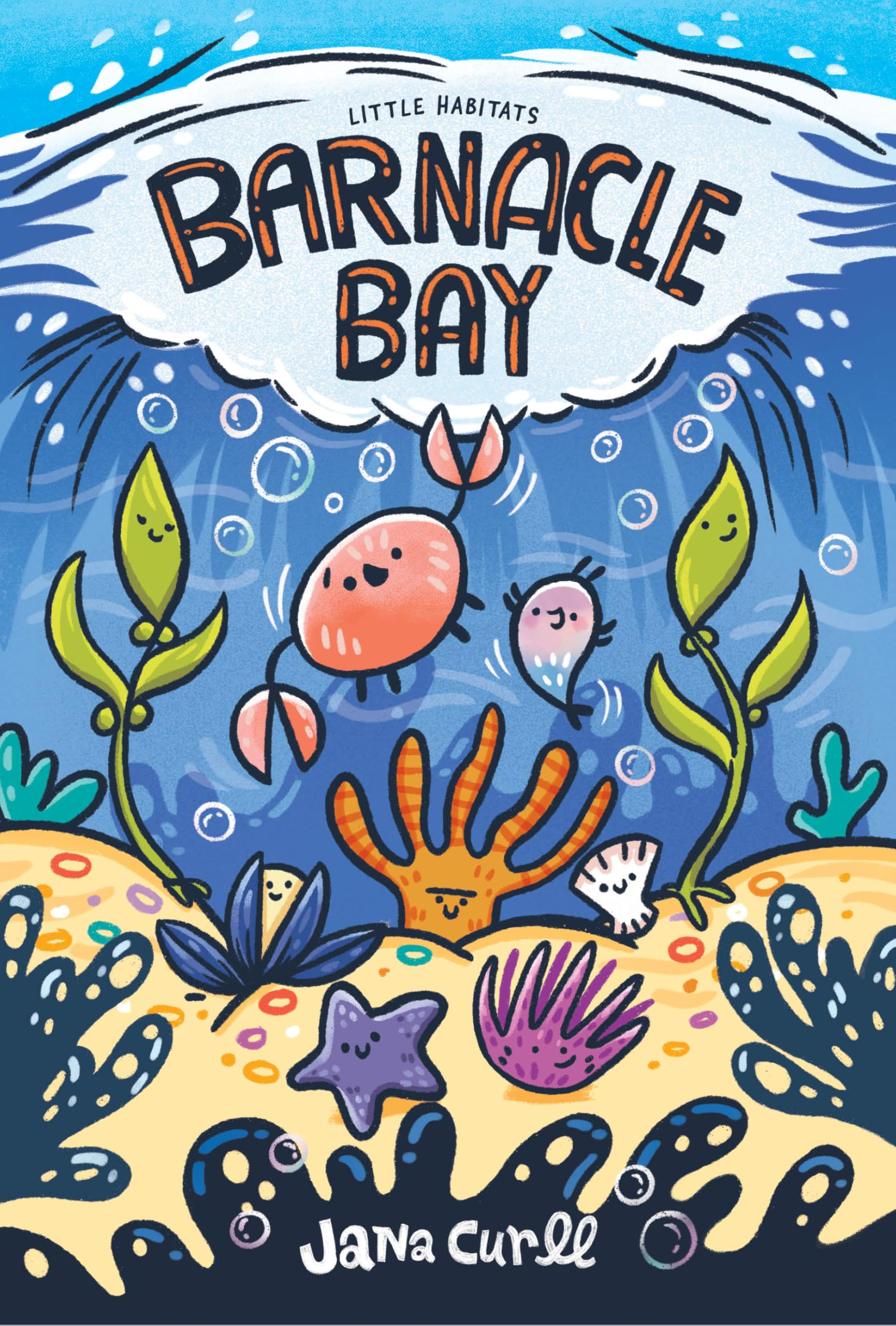
Barnacle Bay by Jana Curll (Greystone Kids, 76 pages, grades 1-4). When a slightly crabby crab meets a slightly lost larva, Crab reluctantly becomes Larva’s tour guide around the bay. As they travel and meet all kinds of different sea creatures, readers will effortlessly learn plenty of interesting facts about marine life. Packed with both information and clever marine-related wordplay that was appreciated and enjoyed by this reviewer, the story winds up with Larva transforming overnight. I won’t spoil the surprise, but the two creatures decide that life in the bay is a good fit for both of them, and it appears to be the beginning of a beautiful friendship.

Although I would love to see another adventure with these two, I’m equally delighted that the next book in this series is about a fern forest. Like Remy Lai’s Surviving the Wild series, this graphic novel seamlessly weaves together a story of cute animals and a lot of factual information.

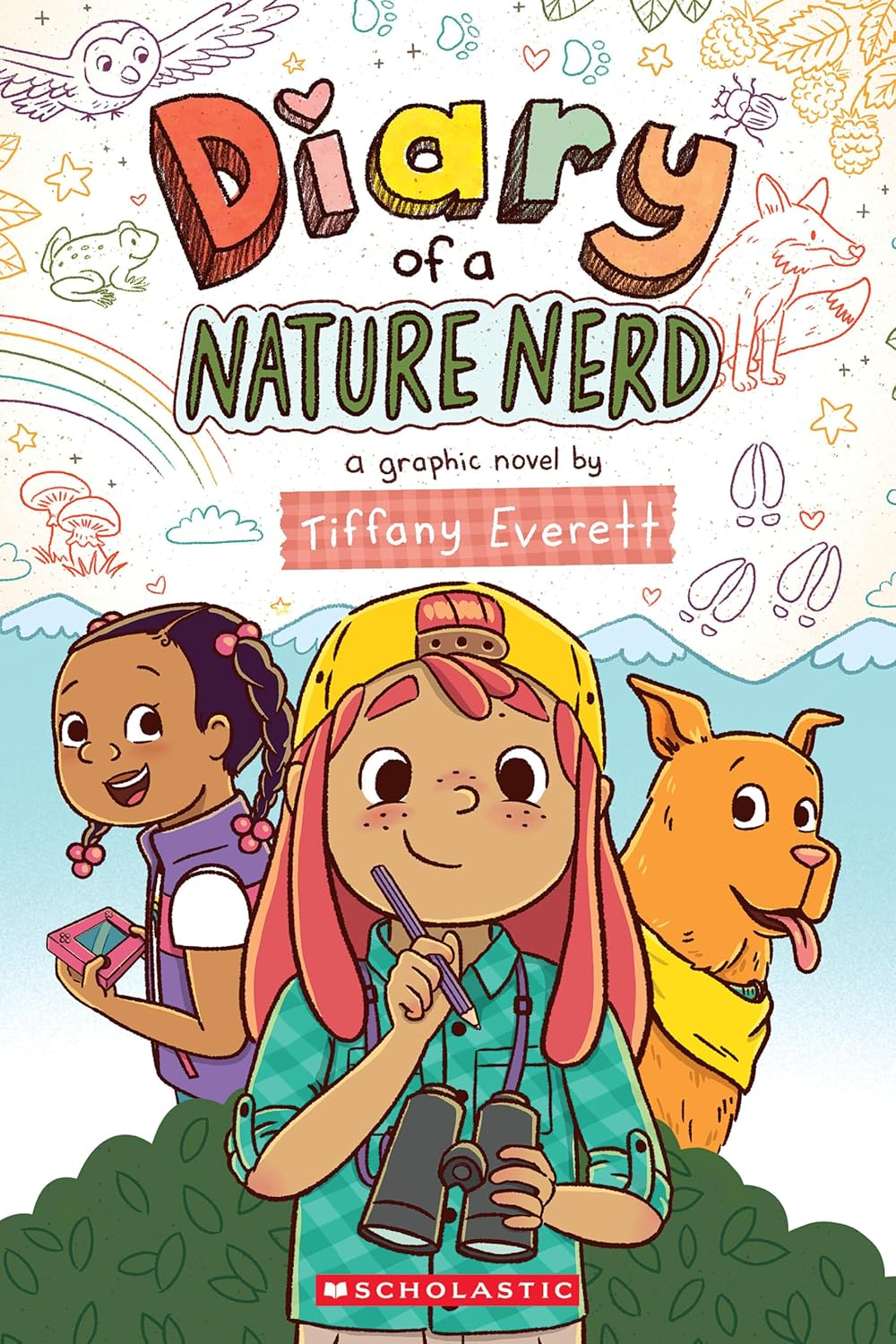
Diary of a Nature Nerd by Tiffany Everett (Graphix, release date August 19, 128 pages, grades 2-5). Brooke and her scientist mother live in an RV, traveling for her mom’s research. Brooke loves nature and keeps a detailed notebook with all of her observations. She’s seen many, many animals, but she’s still missing one: a moose. Her mom recently remarried; Brooke loves her new stepsister Jayla and shows her how to safely explore the woods. The two of them enjoy many adventures until one day when Jayla and her dad head off to explore a river. Brooke opts to stay home and update her notebook, and wouldn’t you know it, Jayla sees a moose. Brooke is jealous and becomes obsessed with finding a moose herself, leaving Jayla behind and forgetting many safety rules as she explores every inch of the woods. When her negligence puts both girls in danger, Brooke realizes that her relationship with Jayla is more important than any moose. The two talk things out, and just as Brooke has accepted that Jayla was fortunate enough to have an experience she hasn’t had, she turns around and sees…a moose!

This cute graphic novel about two animal-loving girls will appeal to fans of the PAWS and Animal Rescue Friends series. Brooke occasionally comes off as an annoying know-it-all, but her enthusiasm is contagious, and Jayla seems like a good friend for her. I hope this will be book one of a new series. Thanks to Scholastic for providing me with a free advance copy.

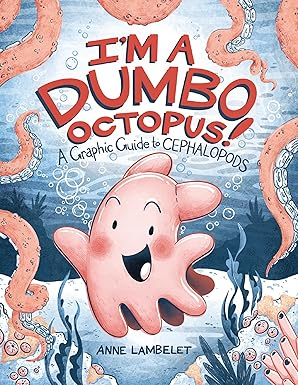
I’m a Dumbo Octopus! A Graphic Guide to Cephalopods by Anne Lambelet (Graphic Universe, 72 pages, grades 2-5). Grimpy–short for Grimpoteuthis–is a dumbo octopus who lives deep in the ocean. He gives readers an introduction to other cephalopods, a class of animals that includes octopuses, nautiluses, squids, and cuttlefish. Although they look quite different, they share common traits like blue blood, no backbone, and tentacles or arms. Many species have unique abilities, such as squirting ink amazing hiding skills, which make Grimpy a bit envious. Just as he’s starting to feel bad about himself, some of the others come along to tell him what his talents are, many of which are related to living in the deepest water of any octopus (over four miles deep). Feeling better, Grimpy says goodbye to his new friends and heads for his home in the depths. Includes an illustrated glossary, a photo and facts about the real-life Grimpy, a bibliography, and a list of books for further reading.

Grimpy is an endearing narrator in a relatively short graphic nonfiction book that’s packed with information about cephalopods. There are all kinds of the sorts of fun facts that kids love learning and sharing, and the illustrations really bring those facts to life. This is Anne Lambelet’s first books, but I hope it won’t be her last…readers will definitely be looking for more after meeting Grimpy.

Nonfiction: deadly and full of crap

Cute Animals That Could Kill You Dead by Brooke Hartman, illustrated by María García (Sourcebooks Explore, 48 pages, grades 2-5). Seventeen deceptively cute animals are introduced, each one starting with an illustration, a description that emphasizes its cuteness, and a fact box that includes size, favorite food, habitat, and conservation status. Turn the page, and you’ll learn about that adorable creature’s fearsome hunting prowess and/or dangerous defenses. Each animal gets a 1-10 rating for its aww-dorable and aaaah!-some levels. A two-page spread of photos at the end confirms the cuteness of each of the animals.

Kids love books about cute animals and they also go for books about deadly animals, so here we have a winning combination. The lighthearted, funny text and illustrations make this an appealing read. The title is a bit deceptive for human readers since, for instance, a ladybug will only kill you dead if you happen to be an aphid, and you’ll only need to watch out for a flying gecko if you’re a salamander or snake. A table of contents and some back matter like a reading list would have made this a more useful resource.

Poo Pile on the Prairie by Amy Hevron (Beach Lane Books, 48 pages, ages 4-9). Majestic bison thunder across the plains, mowing down miles of meadows, and producing…a pile of poo. Over the next year, this “bison pie” proves a life-giving bonanza for all sorts of creatures. Insects like dung beetles make their home there, which attracts the birds who eat them. Prairie violets and other flowers blossom, feeding butterflies. Prairie dogs and earthworms enjoy burrowing into the rich soil that the poo has created. The last remnants fertilize the new grass in the early springtime, which in turn feeds the bison and starts the cycle once again. Includes “The Scoop on Bison Poop” with additional information, a book list, and a list of sources.

The title of this book is sure to attract readers like flies to…well, you get the idea. It’s full of interesting facts that are presented with plenty of humor, and the illustrations with bug-eyed creatures and lots of cartoon bubbles add to the fun. This is part of a series called Tiny Habitats that so far includes books about life on a log and a sunken ship, with a new one out in September on a rainforest pool.

Celebrating citizen activism for Earth Day

Whales in the City by Nancy F. Castaldo, illustrated by Chuck Groenik (Farrar, Straus and Giroux, 40 pages, grades K-4). “Before there were ships and streets and buildings and a city called New York, we were here.” Whales narrate the first half of this book, explaining how they were slowly driven out of the Hudson River by pollution. The few that survived headed for the cleaner waters of the North Atlantic. Humans take on the story from there, telling how they had finally had enough and started demanding clean water around the city. Starting with the first Earth Day, their activism eventually helped lead to the passage of the Clean Water Act. As time passed, the river grew cleaner, fish returned, and people could enjoy it once again. And finally, after a century, the whales came home to the waters around the city. Includes an author’s note, additional information about whales, a timeline of Hudson River history, profiles of a few of the people who led protests, a list of ways kids can help clean up rivers, and a list of sources.

I think we all could use a book right now that shows the positive effects of citizen action, and here is one that can be enjoyed by kids (and adults) of all ages. I liked how the narration was shared by the whales and the humans, and the back matter makes this an excellent resource that could lead to further research. The illustrations are amazing, as you can see from the cover.

Kaho’olawe: The True Story of an Island and Her People by Kamalani Hurley and Harinani Orme (Millbrook Press, 40 pages, grades 2-5). This history of Kaho’olawe, the smallest of the Hawaiian islands, begins with her birth from a volcano and continues with the arrival of the the first humans, Polynesian voyagers who settled there more than 1,000 years ago. Environmental devastation began when Europeans brought goats to the island and later used it for cattle ranching, but the total destruction began during World War II. The day after the attack on Pearl Harbor, the U.S. military took over Kaho’olawe and used it for bombing practices for the next 30 years. In 1976, activists began a campaign to stop the bombing, and finally, in 1992, the U.S. Congress officially ended the bombing and budgeted $400 million for clean-up efforts. Kaho’olawe is still suffering from the effects of all the damage, but today native Hawaiian groups, grassroots organizations, and scientists are working to restore the island and learn about its archaeological history. Includes notes from the author and illustrator (both Native Hawaiians), a timeline of Kaho’olawe’s history, a glossary, a paragraph about how to help, and additional resources and sources.

And here’s another tribute to activism in a fascinating history of a place I’m sure many of us (myself included) have never heard of. The history is sad, but the hard work of so many people in the face of seemingly insurmountable obstacles is inspiring. I loved the colorful illustrations which I’m guessing were inspired by Native Hawaiian art. Each page has a few sentences telling the story, with a paragraph giving additional information, making this a good resource for a wide range of ages.

Hook, line, and sinker

Sharks Unhooked: The Adventures of Cristina Zenato, Underwater Ranger by Patricia Newman, illustrated by Becca Hall (Millbrook Press, 40 pages, grades 1-5). Although Cristina Zenato grew up in Zaire (now the Democratic Republic of Congo), she and her family were Italian and returned to Italy every summer. There, Cristina grew to love swimming in the sea and was especially fascinated by sharks. She longed to learn how to scuba dive, and she finally got her chance after college on a trip to the Bahamas. Cristina decided to move there and spent hours in the water, getting to know the world underwater. Clad in a chain suit, with mackerel treats, she soon earned the trust of many of the sharks. She learned that sharks often get fishing hooks stuck in their bodies, and soon she was removing them from sharks’ gills, fins, tails, and even their throats. At first, she threw the hooks away, but eventually she collected them to use as an educational tool for humans to learn about their dangers to sharks. Includes additional information about sharks and Cristina Zenato, including a note from Cristina with a photo, and a list of books about sharks.

A Line Can Go Anywhere: The Brilliant, Resilient Life of Artist Ruth Asawa by Caroline McAlister, illustrated by Jamie Green (Roaring Brook Press, 40 pages, grades 2-5). Ruth Asawa first became aware of lines when she drew them in the dirt on her family’s farm in California. The middle of seven children, she had plenty of chores to do on the farm, but she still found time to create art, whether it was practicing calligraphy at Japanese school on Saturdays, making bracelets from discarded wire, or painting a prize-winning poster of the Statue of Liberty. When World War II broke out, an invisible line divided the Japanese and American parts of Ruth’s life. Her father was taken away, and the rest of the family was sent to a camp. Ruth practiced her art there, getting lessons from professional artists who had worked for Disney, and eventually was able to leave camp to go to college. Even after she got married and had six children of her own, she continued to create art, first making wire sculptures with thousands of intersecting lines and later getting commissions to sculpt fountains and a memorial for families imprisoned during World War II. Includes a lengthy author’s note with additional information, a couple of photos of Ruth with her art, and a bibliography.

Both Cristina and Ruth followed their unique dreams, despite the obstacles, and although both have had success in their chosen fields, it’s obvious that their joy in life came from following their passions rather than the external rewards. I was happy to read about a Ruth Asawa retrospective opening at the San Francisco Museum of Modern Art on the very same day that I read this book.

Mathemagical

Zero! The Number That Almost Wasn’t by Sarah Albee, illustrated by Chris Hu (Charlesbridge, 40 pages, grades 3 and up). It’s hard to imagine a world without zero, but for much of human history, calculations were made without it. This book begins with a look at some of the earliest people to use the concept that came to be zero: Babylonians, Mayans, and Indians. Zero came to be accepted in the Arabic world, and European traders to that area brought the idea back to Europe, where it was met with…derision and scorn. While some mathematicians enthusiastically embraced zero, other Europeans mistrusted something that came from a different part of the world and continued to use Roman numerals. The invention of the printing press helped spread the word about zero, and when it was finally universally accepted, it opened the door up up to the complex ideas of modern calculus and physics. Includes additional information about zero and some of the other words we use for the concept, a map of places mentioned in the book, a bibliography, a list of math books for younger readers, a “blurry” timeline of zero, and some notes about the art.

This is a fascinating story of something most of us don’t think about, but which has been a key to scientific and technological advancement. The history of its evolution shows the dangers of not being open to the contributions of other cultures. There’s a lot of information and a huge span of history covered, making me wonder exactly what ages to recommend it for. I can see some older elementary students finding it interesting, but I think it could also be used in middle school or high school STEM classes.

The Five Sides of Marjorie Rice: How to Discover a Shape by Amy Alznauer, illustrated by Anna Bron (Candlewick, 40 pages, grades 2-5). As a child, Marjorie Rice was fascinated by shapes and arts. She learned to read at an early age, starting second grade at the age of five. Despite her interests and intelligence, her parents encouraged her to pursue a career as a secretary, and she didn’t go to college. Marjorie married and had five children. As they grew up, she started reading her son’s Scientific American and particularly enjoyed Martin Gardner’s “Mathematical Games” column. She was intrigued by one column about the problem of finding pentagons that could be tessellated infinitely without gaps. Gardner stated that all such pentagons had been discovered, but a month later, a reader discovered a new one. This inspired Marjorie to look for new ones on her own, and she eventually found four more. In 1995, she was recognized at a Mathematical Association of America meeting with a standing ovation, a true amateur who was motivated solely by her own interests and passion for shapes and art. Includes an author’s note about her personal connections to Marjorie Rice; additional information about the problem Marjorie worked on; information on how to discover a shape; a bibliography; and a couple of photos.

This engaging biography is an inspiration to follow your passions, no matter where you are in life. The storytelling is lively, and I particularly enjoyed the illustrations that do a great job of bringing Marjorie’s work to life. I struggled a little to understand exactly what she was working on, and like the previous book, this is one that may be enjoyed more by older readers with more of a mathematical background.

Be the change

Stalactite and Stalagmite: A Big Tale from a Little Cave by Drew Beckmeyer (Atheneum Books for Young Readers, 40 pages, ages 4-8). Two nubs of rock in a cave greet each other as the one above drips a steady stream of water drops onto the one below. They’re friends from the start and enjoy the company of other more transient creatures as they witness the history of life on Earth. First a trilobite, next an Ichtyostega with some new legs, then a triceratops who enjoys a dazzling light display before disappearing. Ice Age creatures give way to early humans, and finally, contemporary human tourists marvel at the stalactite and stalagmite that are almost touching each other. A futuristic city appears outside the cave, then darkness as the two fuse together into a column of stone. Includes additional information about some of the creatures and a timeline of the time period covered in the story.

Enjoy a warm, fuzzy friendship story while simultaneously feeling insignificant as you follow this rocky relationship over millions of years. Drew Beckmeyer makes it look easy to create an amazing picture book with plenty of humor that introduces the entire history of life on earth.

Papilio by Ben Clanton, Corey R. Tabor, and Andy Chou Musser (Viking Books for Young Readers, 48 pages, ages 3-7). Three friends and beloved author-illustrators have created a story in three parts about Papilio, a black swallowtail butterfly. In the first, by Clanton, Papilio hatches from an egg and explores life as a caterpillar before creating a chrysalis. Tabor takes the story from there, narrating from inside a chrysalis that is almost eaten by a bird. Having safely survived, the newly emerged butterfly’s tale is told by Musser, as she learns from other flying insects how to use her wings. The stories are tied together by Papilio’s interactions with a mouse, and readers will enjoy seeing the different depictions of it by the three different artists. Includes additional information about butterfly metamorphosis, as well as notes from each of the creators about how they came up with their stories and illustrations.

I was excited to see this book by Ben Clanton and Corey R. Tabor, who are well-loved in my library (I’m not yet familiar with Musser’s work), and it did not disappoint. Kudos to them for taking on the well-worn tale of butterfly metamorphosis and finding something new. It’s fun to compare the illustrations, which are similar but have distinctive differences from the three different artists.

Caboose by Travis Jonker, illustrated by Ruth Chan (Harry N. Abrams, 40 pages, ages 4-8). Hippo loves being first in line, and he’s learned all kinds of tricks to get there: running, sneaking, even slingshotting to the head of the line. But one day, Hippo takes it too far, and Fish gets hurt. “You may not be first anymore!” declares the teacher, and Hippo is banished to the end of the line. It takes a little adjustment, but before long, Hippo has a series of strategies to make sure he’s always the caboose: walking like a turtle, politely letting everyone go ahead, pretending his sneaker has a giant knot. But “caboosin’ it up” causes Hippo to go too far once again, and now his assigned place is in the middle of the line. And the middle proves to be the best place for him, right in the center of all his classmates.

Hippo definitely cracked me up, and there are lessons to be learned about working with others. Kids may recognize themselves or a classmate as Hippo slowly learns line etiquette and how to be respectful of his classmates. The illustrations are adorable, with a huge variety of animals, but I have to say I struggled a little to grasp the lesson Hippo learned at the end.