Nonfiction: deadly and full of crap

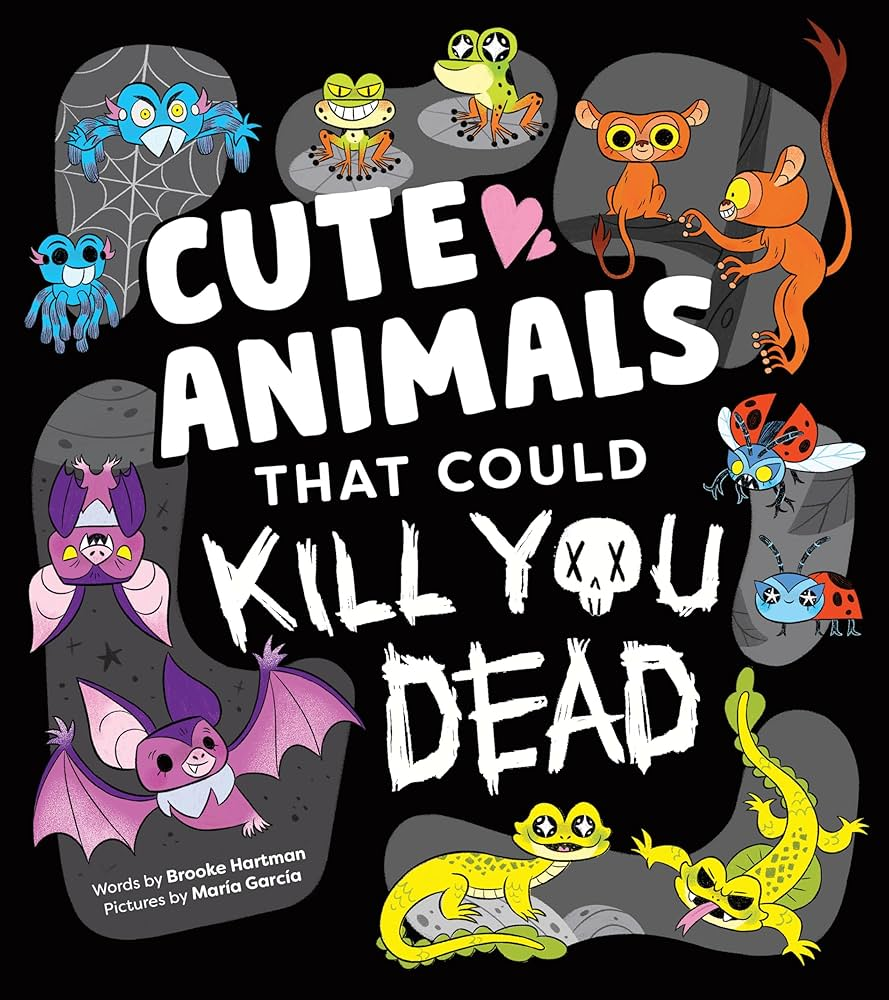
Cute Animals That Could Kill You Dead by Brooke Hartman, illustrated by María García (Sourcebooks Explore, 48 pages, grades 2-5). Seventeen deceptively cute animals are introduced, each one starting with an illustration, a description that emphasizes its cuteness, and a fact box that includes size, favorite food, habitat, and conservation status. Turn the page, and you’ll learn about that adorable creature’s fearsome hunting prowess and/or dangerous defenses. Each animal gets a 1-10 rating for its aww-dorable and aaaah!-some levels. A two-page spread of photos at the end confirms the cuteness of each of the animals.

Kids love books about cute animals and they also go for books about deadly animals, so here we have a winning combination. The lighthearted, funny text and illustrations make this an appealing read. The title is a bit deceptive for human readers since, for instance, a ladybug will only kill you dead if you happen to be an aphid, and you’ll only need to watch out for a flying gecko if you’re a salamander or snake. A table of contents and some back matter like a reading list would have made this a more useful resource.

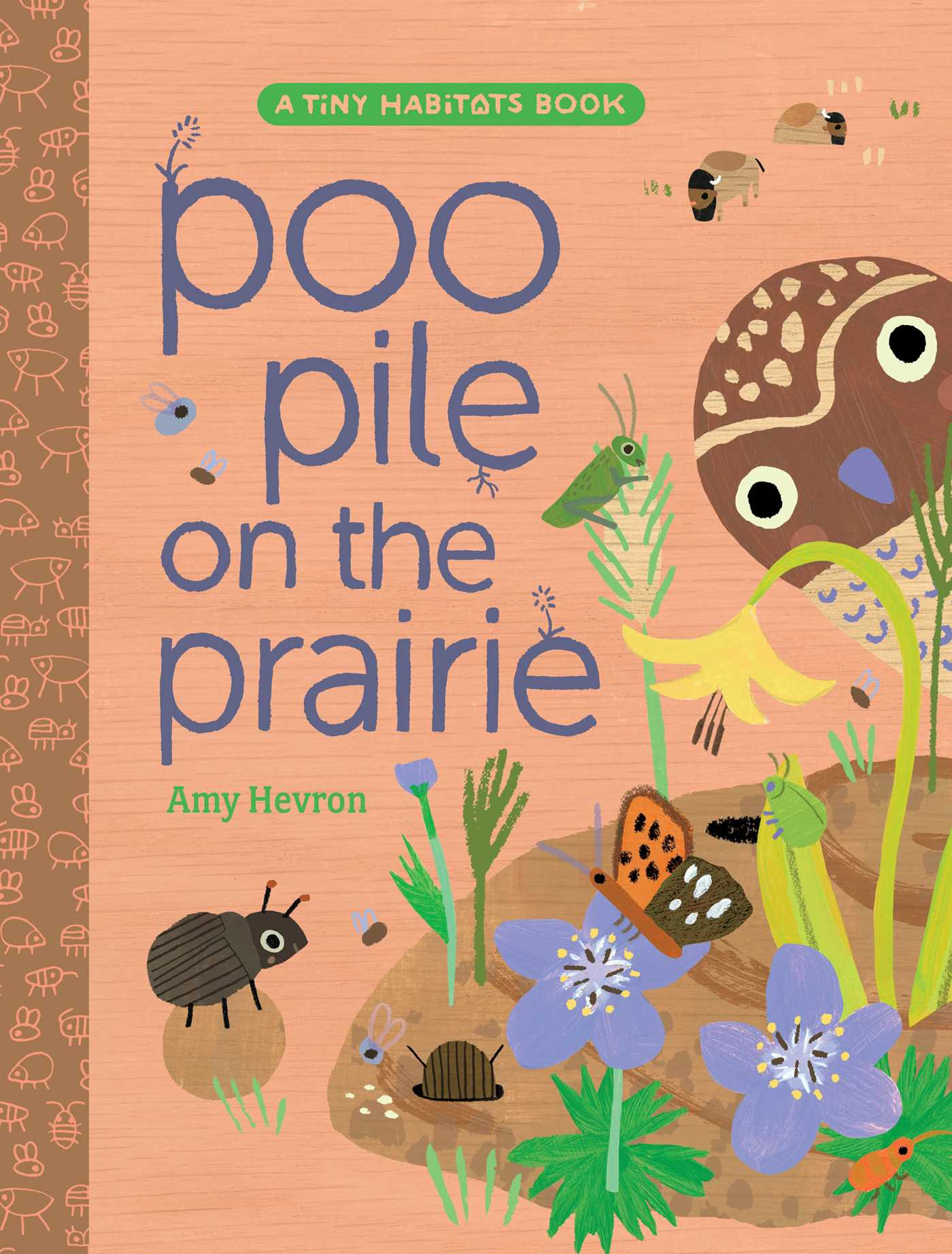
Poo Pile on the Prairie by Amy Hevron (Beach Lane Books, 48 pages, ages 4-9). Majestic bison thunder across the plains, mowing down miles of meadows, and producing…a pile of poo. Over the next year, this “bison pie” proves a life-giving bonanza for all sorts of creatures. Insects like dung beetles make their home there, which attracts the birds who eat them. Prairie violets and other flowers blossom, feeding butterflies. Prairie dogs and earthworms enjoy burrowing into the rich soil that the poo has created. The last remnants fertilize the new grass in the early springtime, which in turn feeds the bison and starts the cycle once again. Includes “The Scoop on Bison Poop” with additional information, a book list, and a list of sources.

The title of this book is sure to attract readers like flies to…well, you get the idea. It’s full of interesting facts that are presented with plenty of humor, and the illustrations with bug-eyed creatures and lots of cartoon bubbles add to the fun. This is part of a series called Tiny Habitats that so far includes books about life on a log and a sunken ship, with a new one out in September on a rainforest pool.

Celebrating citizen activism for Earth Day

Whales in the City by Nancy F. Castaldo, illustrated by Chuck Groenink (Farrar, Straus and Giroux, 40 pages, grades K-4). “Before there were ships and streets and buildings and a city called New York, we were here.” Whales narrate the first half of this book, explaining how they were slowly driven out of the Hudson River by pollution. The few that survived headed for the cleaner waters of the North Atlantic. Humans take on the story from there, telling how they had finally had enough and started demanding clean water around the city. Starting with the first Earth Day, their activism eventually helped lead to the passage of the Clean Water Act. As time passed, the river grew cleaner, fish returned, and people could enjoy it once again. And finally, after a century, the whales came home to the waters around the city. Includes an author’s note, additional information about whales, a timeline of Hudson River history, profiles of a few of the people who led protests, a list of ways kids can help clean up rivers, and a list of sources.

I think we all could use a book right now that shows the positive effects of citizen action, and here is one that can be enjoyed by kids (and adults) of all ages. I liked how the narration was shared by the whales and the humans, and the back matter makes this an excellent resource that could lead to further research. The illustrations are amazing, as you can see from the cover.

Kaho’olawe: The True Story of an Island and Her People by Kamalani Hurley and Harinani Orme (Millbrook Press, 40 pages, grades 2-5). This history of Kaho’olawe, the smallest of the Hawaiian islands, begins with her birth from a volcano and continues with the arrival of the the first humans, Polynesian voyagers who settled there more than 1,000 years ago. Environmental devastation began when Europeans brought goats to the island and later used it for cattle ranching, but the total destruction began during World War II. The day after the attack on Pearl Harbor, the U.S. military took over Kaho’olawe and used it for bombing practices for the next 30 years. In 1976, activists began a campaign to stop the bombing, and finally, in 1992, the U.S. Congress officially ended the bombing and budgeted $400 million for clean-up efforts. Kaho’olawe is still suffering from the effects of all the damage, but today native Hawaiian groups, grassroots organizations, and scientists are working to restore the island and learn about its archaeological history. Includes notes from the author and illustrator (both Native Hawaiians), a timeline of Kaho’olawe’s history, a glossary, a paragraph about how to help, and additional resources and sources.

And here’s another tribute to activism in a fascinating history of a place I’m sure many of us (myself included) have never heard of. The history is sad, but the hard work of so many people in the face of seemingly insurmountable obstacles is inspiring. I loved the colorful illustrations which I’m guessing were inspired by Native Hawaiian art. Each page has a few sentences telling the story, with a paragraph giving additional information, making this a good resource for a wide range of ages.

Hook, line, and sinker

Sharks Unhooked: The Adventures of Cristina Zenato, Underwater Ranger by Patricia Newman, illustrated by Becca Hall (Millbrook Press, 40 pages, grades 1-5). Although Cristina Zenato grew up in Zaire (now the Democratic Republic of Congo), she and her family were Italian and returned to Italy every summer. There, Cristina grew to love swimming in the sea and was especially fascinated by sharks. She longed to learn how to scuba dive, and she finally got her chance after college on a trip to the Bahamas. Cristina decided to move there and spent hours in the water, getting to know the world underwater. Clad in a chain suit, with mackerel treats, she soon earned the trust of many of the sharks. She learned that sharks often get fishing hooks stuck in their bodies, and soon she was removing them from sharks’ gills, fins, tails, and even their throats. At first, she threw the hooks away, but eventually she collected them to use as an educational tool for humans to learn about their dangers to sharks. Includes additional information about sharks and Cristina Zenato, including a note from Cristina with a photo, and a list of books about sharks.

A Line Can Go Anywhere: The Brilliant, Resilient Life of Artist Ruth Asawa by Caroline McAlister, illustrated by Jamie Green (Roaring Brook Press, 40 pages, grades 2-5). Ruth Asawa first became aware of lines when she drew them in the dirt on her family’s farm in California. The middle of seven children, she had plenty of chores to do on the farm, but she still found time to create art, whether it was practicing calligraphy at Japanese school on Saturdays, making bracelets from discarded wire, or painting a prize-winning poster of the Statue of Liberty. When World War II broke out, an invisible line divided the Japanese and American parts of Ruth’s life. Her father was taken away, and the rest of the family was sent to a camp. Ruth practiced her art there, getting lessons from professional artists who had worked for Disney, and eventually was able to leave camp to go to college. Even after she got married and had six children of her own, she continued to create art, first making wire sculptures with thousands of intersecting lines and later getting commissions to sculpt fountains and a memorial for families imprisoned during World War II. Includes a lengthy author’s note with additional information, a couple of photos of Ruth with her art, and a bibliography.

Both Cristina and Ruth followed their unique dreams, despite the obstacles, and although both have had success in their chosen fields, it’s obvious that their joy in life came from following their passions rather than the external rewards. I was happy to read about a Ruth Asawa retrospective opening at the San Francisco Museum of Modern Art on the very same day that I read this book.

Mathemagical

Zero! The Number That Almost Wasn’t by Sarah Albee, illustrated by Chris Hu (Charlesbridge, 40 pages, grades 3 and up). It’s hard to imagine a world without zero, but for much of human history, calculations were made without it. This book begins with a look at some of the earliest people to use the concept that came to be zero: Babylonians, Mayans, and Indians. Zero came to be accepted in the Arabic world, and European traders to that area brought the idea back to Europe, where it was met with…derision and scorn. While some mathematicians enthusiastically embraced zero, other Europeans mistrusted something that came from a different part of the world and continued to use Roman numerals. The invention of the printing press helped spread the word about zero, and when it was finally universally accepted, it opened the door up up to the complex ideas of modern calculus and physics. Includes additional information about zero and some of the other words we use for the concept, a map of places mentioned in the book, a bibliography, a list of math books for younger readers, a “blurry” timeline of zero, and some notes about the art.

This is a fascinating story of something most of us don’t think about, but which has been a key to scientific and technological advancement. The history of its evolution shows the dangers of not being open to the contributions of other cultures. There’s a lot of information and a huge span of history covered, making me wonder exactly what ages to recommend it for. I can see some older elementary students finding it interesting, but I think it could also be used in middle school or high school STEM classes.

The Five Sides of Marjorie Rice: How to Discover a Shape by Amy Alznauer, illustrated by Anna Bron (Candlewick, 40 pages, grades 2-5). As a child, Marjorie Rice was fascinated by shapes and arts. She learned to read at an early age, starting second grade at the age of five. Despite her interests and intelligence, her parents encouraged her to pursue a career as a secretary, and she didn’t go to college. Marjorie married and had five children. As they grew up, she started reading her son’s Scientific American and particularly enjoyed Martin Gardner’s “Mathematical Games” column. She was intrigued by one column about the problem of finding pentagons that could be tessellated infinitely without gaps. Gardner stated that all such pentagons had been discovered, but a month later, a reader discovered a new one. This inspired Marjorie to look for new ones on her own, and she eventually found four more. In 1995, she was recognized at a Mathematical Association of America meeting with a standing ovation, a true amateur who was motivated solely by her own interests and passion for shapes and art. Includes an author’s note about her personal connections to Marjorie Rice; additional information about the problem Marjorie worked on; information on how to discover a shape; a bibliography; and a couple of photos.

This engaging biography is an inspiration to follow your passions, no matter where you are in life. The storytelling is lively, and I particularly enjoyed the illustrations that do a great job of bringing Marjorie’s work to life. I struggled a little to understand exactly what she was working on, and like the previous book, this is one that may be enjoyed more by older readers with more of a mathematical background.

Be the change

Stalactite and Stalagmite: A Big Tale from a Little Cave by Drew Beckmeyer (Atheneum Books for Young Readers, 40 pages, ages 4-8). Two nubs of rock in a cave greet each other as the one above drips a steady stream of water drops onto the one below. They’re friends from the start and enjoy the company of other more transient creatures as they witness the history of life on Earth. First a trilobite, next an Ichtyostega with some new legs, then a triceratops who enjoys a dazzling light display before disappearing. Ice Age creatures give way to early humans, and finally, contemporary human tourists marvel at the stalactite and stalagmite that are almost touching each other. A futuristic city appears outside the cave, then darkness as the two fuse together into a column of stone. Includes additional information about some of the creatures and a timeline of the time period covered in the story.

Enjoy a warm, fuzzy friendship story while simultaneously feeling insignificant as you follow this rocky relationship over millions of years. Drew Beckmeyer makes it look easy to create an amazing picture book with plenty of humor that introduces the entire history of life on earth.

Papilio by Ben Clanton, Corey R. Tabor, and Andy Chou Musser (Viking Books for Young Readers, 48 pages, ages 3-7). Three friends and beloved author-illustrators have created a story in three parts about Papilio, a black swallowtail butterfly. In the first, by Clanton, Papilio hatches from an egg and explores life as a caterpillar before creating a chrysalis. Tabor takes the story from there, narrating from inside a chrysalis that is almost eaten by a bird. Having safely survived, the newly emerged butterfly’s tale is told by Musser, as she learns from other flying insects how to use her wings. The stories are tied together by Papilio’s interactions with a mouse, and readers will enjoy seeing the different depictions of it by the three different artists. Includes additional information about butterfly metamorphosis, as well as notes from each of the creators about how they came up with their stories and illustrations.

I was excited to see this book by Ben Clanton and Corey R. Tabor, who are well-loved in my library (I’m not yet familiar with Musser’s work), and it did not disappoint. Kudos to them for taking on the well-worn tale of butterfly metamorphosis and finding something new. It’s fun to compare the illustrations, which are similar but have distinctive differences from the three different artists.

Caboose by Travis Jonker, illustrated by Ruth Chan (Harry N. Abrams, 40 pages, ages 4-8). Hippo loves being first in line, and he’s learned all kinds of tricks to get there: running, sneaking, even slingshotting to the head of the line. But one day, Hippo takes it too far, and Fish gets hurt. “You may not be first anymore!” declares the teacher, and Hippo is banished to the end of the line. It takes a little adjustment, but before long, Hippo has a series of strategies to make sure he’s always the caboose: walking like a turtle, politely letting everyone go ahead, pretending his sneaker has a giant knot. But “caboosin’ it up” causes Hippo to go too far once again, and now his assigned place is in the middle of the line. And the middle proves to be the best place for him, right in the center of all his classmates.

Hippo definitely cracked me up, and there are lessons to be learned about working with others. Kids may recognize themselves or a classmate as Hippo slowly learns line etiquette and how to be respectful of his classmates. The illustrations are adorable, with a huge variety of animals, but I have to say I struggled a little to grasp the lesson Hippo learned at the end.

Tern around, bright eyes

Sun Bird: The Amazing Journey of the Arctic Tern by Lindsay Moore (Greenwillow Books, 40 pages, ages 4-9). Baby Arctic terns begin life during the Arctic summer, their parents hunting for fish to feed their voracious appetites. The chicks grow and learn to fly as the Arctic days grow shorter. By late summer, they’re ready to begin their migration across the globe to Antarctica. By the time they reach their destination, it’s springtime there, and the terns spend the Antarctic summer resting and growing new feathers for their long journey back north to the Arctic. Includes additional information about the Arctic tern, which has the longest known migration of any animal on Earth and is believed to experience more hours of sunlight, as well as additional resources and a list of references.

Lindsay Moore, author and illustrator of Yoshi and the Ocean and Sea Bear has created another beautiful and fascinating animal book, this one about the Arctic tern. The predominantly blue and white watercolor illustration capture the graceful movements of the birds through the sky and sea, and the poetic text describes their journey with captivating details.

Meet the Mini-Mammals: A Night at the Natural History Museum by Melissa Stewart, illustrated by Brian Lies (Beach Lane Books, 40 pages, ages 4-8). Which mammal is the smallest? After introducing readers to what a mammal is, the ferret museum docent takes them on a tour of an exhibit of ten small mammals, descending in size. Each one is shown in the same size exhibit box to allow for size comparison, and each is accompanied by a paragraph of information, a “tiny tidbit” that compares its weight to a common object, and another illustration showing the animal in action. Kitti’s hog-nosed bat is the tiniest, and after its introduction, the mini mammals are pictured together as they enter a mapparium showing where each one lives in the world. Includes statistics on each mammal and a list of sources.

This award-winning team has created an appealing picture book filled with cute mammals and interesting information about each one. The illustrations are outstanding, and the museum presentation showing the animals in descending order of size is clever and keeps the interest high. Personally, I find mini mammals kind of creepy and rat-like, but putting my biases aside, I must concede that this is an excellent nonfiction picture book.

O Is for Owl. And Octopus.

To See an Owl by Matthew Cordell (Random House Studio, 40 pages, ages 4-8). Janie is a birder whose ultimate quest is to see an owl. Her patient mother (“Mama doesn’t look for birds the way I do”) takes Janie on trips to meadows and forests where she can look for birds. This year, Janie has a teacher who shares her passion. Mr. Koji shows the class pictures from his birding expeditions and maps he made as a child and tells the class, “To see an owl is magic.” When Janie shares her owl drawings, journal, and maps with the class, Mr. Koji is impressed by her determination and tells her where he’s recently seen a pair of great horned owls. Back home, Janie convinces her mother to take her on one more outing, and when they get to the place Mr. Koji described…there are the owls. Magic.

Caldecott Medalist Matthew Cordell clearly shares Janie’s passion for owls (read about it on the book jacket’s back flap), and he conveys that passion, as well as the persistence needed and the amazing rewards that come from finally seeing that owl. His illustrations capture the beauty and majesty of nature, and show readers how to use art to record their outdoor adventures like Janie does. As someone who shares Mama’s indifference to birding, I admired her for being willing to keep taking her daughter out on various excursions. This book would go well with Owl Moon by Jane Yolen or Night Owl Night by Susan Edwards Richmond

Octopus Ocean: Geniuses of the Deep by Mark Leiren-Young (Orca Book Publishers, 104 pages, grades 4-7). The author introduces octopuses with the story of his first meeting with an octopus named Storm at the Salish Sea Centre in British Columbia. From there, he moves on to five chapters describing many aspects of octopuses’ lives: anatomy, reproduction, intelligence, food, defenses, and homes in the ocean. The second half of the book includes stories of amazing “octopus celebrities” who carried out elaborate escapes or predicted the outcome of soccer games with amazing accuracy. There’s a chapter about the effect of the documentary The Octopus Teacher on educating the public on this amazing animal, which has led to a decrease in human consumption of octopus meat. The final chapter gives readers suggestions for helping octopuses survive in the wild and keeping oceans cleaner and healthier. Includes a glossary, an index, and a list of resources.

I learned a ton about the octopus from reading this book, and anyone doing research will not have to go much further to get everything they need on the topic. I found the second half of the book a bit more engaging than the first half, particularly the chapter on octopus celebrities. The book is pretty text-heavy, and It would be nice to have a companion picture book, which I think would find a wider audience.

Blinded with science

Thomas Jefferson’s Battle for Science: Bias, Truth, and a Mighty Moose! by Beth Anderson, illustrated by Jeremy Holmes (Calkins Creek, 48 pages, grades 2-5). Thomas Jefferson loved science, and one of his favorite books was Count Georges-Louis Leclerc de Buffon’s encyclopedia of the natural world. But he was incensed by Buffon’s descriptions of American wildlife, comparing it unfavorably to the animals found in Europe. Thomas decided to measure as many American animals as he could, and recruited friends from different parts of the country to assist him, eventually putting together his own book that he showed Buffon when he became minister to France. So committed to the truth about American fauna was Jefferson, that he actually had friends hunt a moose and ship it to France (you can read more about that here). When Buffon saw (and smelled) the enormous moose, he promised to revise his book, but unfortunately passed away a few months later. Jefferson’s book became well-known, and people started sending him information and artifacts to add to it, helping him to promote the idea that the New World was not inferior to the old one…just measurably different. Includes an author’s note, a list of five steps to use for a scientific inquiry process, a timeline of Jefferson’s life, and a bibliography.

A Dangerous Idea: The Scopes Trial, the Original Fight Over Science in Schools by Debbie Levy (Bloomsbury Children’s Books, 288 pages, grades 6 and up). This account of the 1925 trial of John Scopes, a young high school teacher accused of teaching evolution, gives background information on evolution, the law that banned teaching it in Tennessee, and the two great orators, Clarence Darrow and William Jennings Bryan, who served as prosecuting and defense attorneys. The trial itself is described in detail, capturing both the serious debates about religion and the circus-like atmosphere. The story concludes with information about Susan Epperson, a biology teacher who challenged a similar law in Arkansas, leading to a 1968 Supreme Court ruling striking down the law and allowing evolution to be taught in high schools. There’s also information about the play and movie Inherit the Wind, which took some pretty big liberties with the truth about the Scopes trial. Includes an epilogue tying the case to current events, a detailed timeline from 1831-2005, and an extensive bibliography, index, and list of sources notes.

These books could not be more timely with their reminders that attacking science is a tale as old as time. Both are told with a lighthearted, humorous tone, but the back matter shows how extensively researched they are. I enjoyed the Jefferson illustrations that resemble a naturalist’s notebook, with lots of cartoon bubbles and captions. The authors’ notes will give readers plenty to think about, and I thought Debbie Levy did an especially good job of connecting the events of the Scopes trial to current news stories. Beth Anderson delves into the scientific method and explains how Jefferson made mistakes, too, lest any of us think we have any sort of monopoly on the truth.

Creature features

Narwhal: Unicorn of the Arctic by Candace Fleming, illustrated by Deena So’Oteh (Anne Schwartz Books, 48 pages, grades 1-5). Narrated in second person (“Scientists call you unicorn of the Arctic”), the text tells the story of a narwhal, starting in the Arctic, where he and another male joust with their tusks before slipping under the ice into the sea. When the weather turns warm, the narwhal pod migrates to summer grounds; by September, it’s time to return to the Arctic. Dangers lurk, with orcas and polar bears hunting the narwhals and a sudden blizzard blocking the air hole in the ice. If the narwhal survives, he will make the journey back and forth for fifty years. Includes two pages of additional information and a bibliography.

As she did in Giant Squid, Honeybee, and Polar Bear, Candace Fleming has crafted an exciting nonfiction narrative that teaches kids a lot about a fascinating animal, while keeping the pages turning with plenty of adventure. I was disappointed at first that Eric Rohmann didn’t do the illustrations, but debut illustrator Deena So’Oteh did a magnificent job that deserves both Caldecott and Sibert consideration.

Beware the Dragon and the Nozzlewock: A Graphic Novel Poetry Collection Full of Suprising Characters! by Vikram Madan (Wordsong, 128 pages, grades 2-5). This madcap collection of poems features a wild and crazy cast of characters, such as ghost guppies, squishosaurs, and the salesmoose. Making multiple appearances throughout the book is the fearsome Nozzlewock, about whom a group of children is repeatedly warned, and from whom they have to ultimately save their teacher. There’s a bunch of crazy science going on, too, from laboratory shenanigans to wormholes, which in the end helps the kids rescue the teacher. Many of the characters reappear from time to time, adding to the fun and continuity of this poetry collection.

This would be a great introduction to poetry for those who may not consider themselves fans of the genre. The poems are hilarious, and the graphic novel format will appeal to all kinds of readers.

Persistence, resistance, and a fight for existence

Ernö Rubik and His Magic Cube by Kerry Aradhya, illustrated by Kara Kramer (Peachtree, 32 pages, grades K-4). Ernö Rubik was a solitary kid who enjoyed reading and solving puzzles in his Budapest home. He grew up to be a teacher who would build models to teach his students about three-dimensional objects. His curiosity about cubes led him to try making a big cube out of small ones that could move around but stay connected. His first attempts failed, but he finally found the secret: 26 cubes in three rows, with a round mechanical core. And the rest is history as Ernö’s invention, the Rubik’s Cube, went on to become one of the most popular puzzles of all time. Includes additional information about Rubik and his cube, an author’s note, and a list of three books about the cube.

Although there are some details about Ernö Rubik’s life, the focus is on the Rubik’s cube and the perseverance needed to solve a difficult problem. If kids haven’t tried the cube, they will definitely get their hands on one and start searching YouTube for various solutions.

They Call Me Teach: Lessons in Freedom by Lesa Cline-Ransome, illustrated by James E. Ransome (Candlewick, 40 pages, grades 1-5). A young enslaved man is known as Teach, due to his abilities to read and write that he learned growing up with the master’s son. By day he works as a clerk in the master’s store, but at night he teaches other enslaved people to read. He secretly helps people by reading their letters and, in one case, writing a receipt to help a woman escape. Just looking at a newspaper in public results in punishment, leaving readers to infer that there could be much more serious consequences for teaching literacy to other Black people. An author’s note gives more information about Black people’s quest for education throughout history. Includes a list entitled “More Books on Resistance.”

This husband and wife team has created a fascinating story that focuses on the large majority of enslaved people for whom escape was impossible and who tried to resist and improve themselves in the ways that were available to them, despite the risk of cruel punishments. Sure to be a Coretta Scott King award contender.

Wild Places: The Life of Naturalist David Attenborough by Hayley Rocco, illustrated by John Rocco (G. P. Putnam’s Sons Books for Young Readers, 48 pages, grades K-3). The story of David Attenborough’s life is told by another husband and wife team. Young David loved exploring the natural world around his English home, and he continued those studies as a university student. When he graduated, television was just becoming popular, and he got a job introducing viewers to the world of nature. Before long, he was traveling all over the world to show people plants and animals of different ecosystems. His travels made him more aware of the ways that wild places were shrinking and living creatures were losing their habitats. David shifted his focus to helping people understand what was happening and giving them information to help them make better choices for the planet, work that he continues today in at the age of 98. Includes an author’s note with additional information about David Attenborough and rewilding, a couple of photos, and a bibliography.

Like the Ernö Rubik biography, this is an engaging read that’s a little light on biographical information. Most pages only contain a sentence or two of text, along with award-winning illustrator’s John Rocco’s beautiful depictions of the natural world. Quotes from David Attenborough are scattered throughout the book, and the end matter fleshes out his life a bit more.