Two books about mindfulness

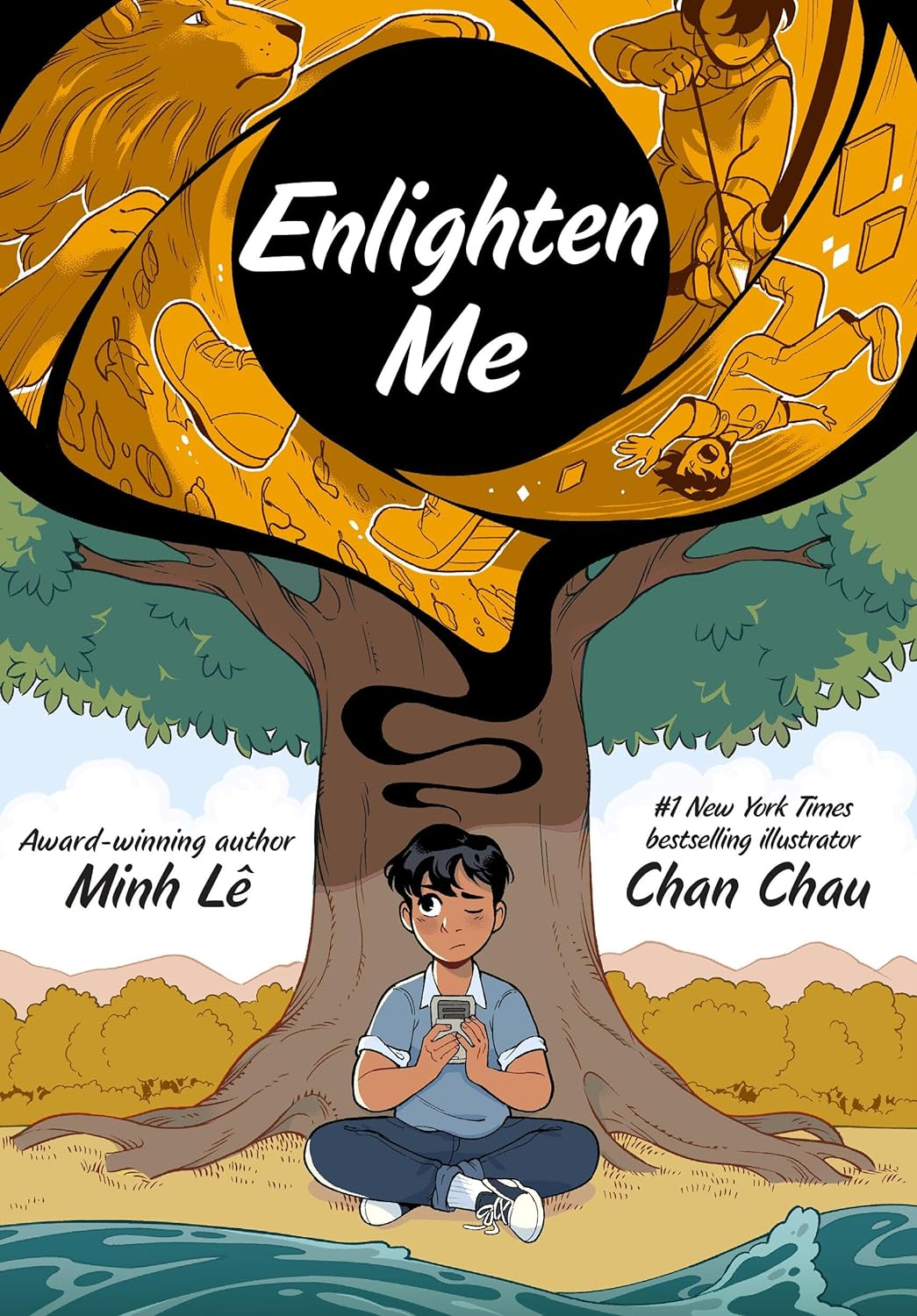
Enlighten Me by Minh Lê, illustrated by Chan Chau

Published by Little Brown Ink

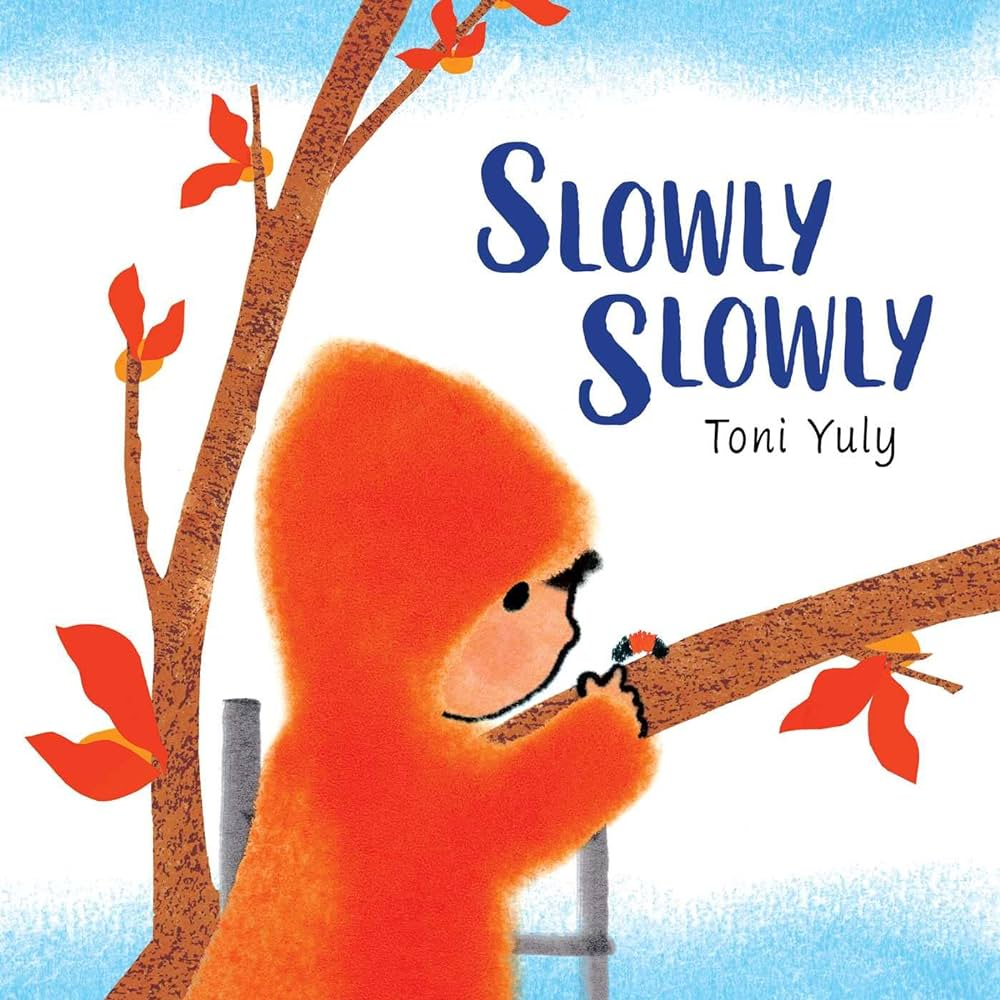
Slowly Slowly by Toni Yuly

Published by Atheneum Books for Young Readers

Summary: Binh and his family are off to a silent Buddhist retreat in Enlighten Me. During meditation times, Binh struggles with a recent memory of racist bullying at school. When he fought back, he ended up being the one to get in trouble. In between meditation sessions, a monk named Sister Peace shares stories about the Buddha with the kids that teach Binh some lessons about dealing with his issues. Those issues don’t get resolved, but by the time the family is heading for home, it’s clear that Binh is seeing things in a new light.

“When you slow down…you see more,” begins Slowly Slowly, as a child and dog explore the natural world. They observe winter turning to spring, and a persimmon tree slowly, slowly, slowly, slowly, slowly, slowly, slowly, slowly makes persimmons. With each page of “slowly”, readers can look for other changes going on in the child’s world. Enlighten Me is 140 pages; grades 4-7; Slowly Slowly is 40 pages; ages 4-8.

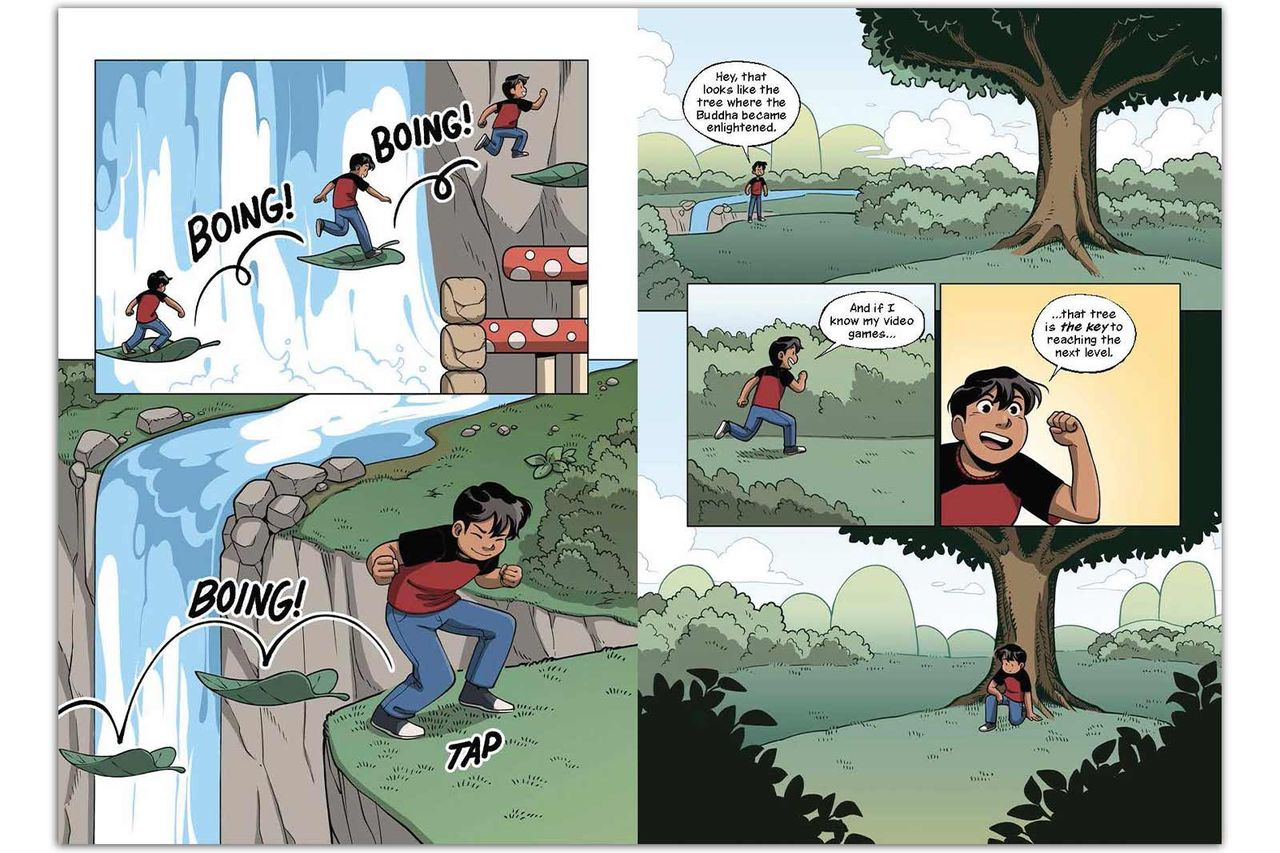
Pros: Both books focus on mindfulness through beautiful artwork and kids’ experiences. Minh Lê uses Binh’s story and love of video games to tell some tales of the Buddha while offering some kid-friendly insights Binh has about meditation and enlightenment. Readers of Slowly Slowly will want to take the time to notice all that is happening in the busy yet peaceful illustrations and to reflect on how slowing down can help us notice the world around us.

Cons: Both books are pretty spare, offering more of an opportunity for reflection than a fleshed-out story.

An Ofrenda for Perro by Judith Valdés B., illustrated by Carlos Veléz Aguilera

Published by little bee books

Summary:  Benito is devastated to lose his dog Perro, who has been his companion since he was born.  As his family gets ready to celebrate Día de Los Muertos, Benito is slowly drawn into the preparations.  His father explains that the holiday isn’t a celebration of the dead, but of the love they have for those who have passed.  His mother shows him that her memories of her great-grandfather mean that he’s not really gone.  When Benito finds Perro’s ball, he is able to smile at his memories of his beloved dog, realizing that his memories will always be with him.  Includes an author’s note with additional information about Día de Los Muertos and a glossary. 32 pages; ages 4-8.

Pros:  A great resource for Día de Los Muertos, or for anyone who has lost a pet, with explanations that kids will understand and relate to, and beautiful illustrations inspired by the holiday.

Cons:  I couldn’t help thinking that Perro (Spanish for dog) deserved a slightly more imaginative name.

Remembering by Xelena González, illustrated by Adriana M. Garcia

Published by Simon and Schuster Books for Young Readers

Summary:  The narrator is grieving the loss of her dog.  As she and her family remember him, she gathers his favorite things to create an ofrenda, or offering, for him.  Each photo she looks at reminds her of a time she and her beloved pet shared. She makes his favorite meal and pours him a bowl of water.  When everything is ready, the family celebrates their dog together on Día de Muertos.  Includes notes from the author and illustrator about the loss of their pets and additional information about Día de Muertos and how to make an ofrenda.  40 pages; ages 4-8.

Pros:  I’m adding this beautiful book to my list about grief and loss.  The simple text and realistic illustrations capture the bittersweet experience of grieving the loss of a pet and provide an excellent introduction to Día de Muertos.

Cons:  Keep the Kleenexes handy.

Ways to Play by Lyn Miller-Lachmann, illustrated by Gabriel Alborozo

Published by Levine Querido

Summary:  When Bossy Older Cousin Violet comes over, she doesn’t hold back in her opinion: Riley is playing with toys the wrong way and needs to be shown the right way.  Riley can play all day with a pile of newspapers, and instead of having dolls and stuffies to a tea party like Violet does, Riley likes to line them up by size.  Riley creates art by sharpening crayons and making little spirals with them.  Fortunately, Riley’s dog Charlie is more understanding than Violet is, and all the kids enjoy playing fetch and running around the yard with him.  “See,” Riley tells Violet, “There are lots of ways to play with toys.  And everyone’s way is the right way.”  Includes an author’s note about her personal childhood experiences, similar to Riley’s, and how she got some answers when she was diagnosed with autism as an adult.  32 pages; ages 4-8.

Pros:  A charming story that will appeal to many kids, both those who are neurodivergent and those who simply enjoy doing their own thing.

Cons:  Cousin Violet.

Two books about self-acceptance

Greenlight by Breanna Carzoo

Published by HarperCollins

Hidden Gem by Linda Liu

Published by Henry Holt

Summary: Two unconventional narrators discover their own value. Greenlight doesn’t like the fact that the cars slow down for Yellowlight, stop for Redlight, but speed through Greenlight, seeming to ignore it. Taking a break for a few minutes, with closed eyes and some affirmations repeated, Greenlight starts to see its own value and is ready to shine bright. In Hidden Gem, an ordinary rock can’t help comparing itself unfavorably when it goes to a museum exhibit of gems. But with the help of a spectacular diamond, the narrator comes to realize that every rock is special in its own way. 32 pages (Greenlight) and 40 pages (Hidden Gem); both ages 4-8.

Pros: With school starting up again, teachers and counselors will be looking for books like these that incorporate humor and striking illustrations (especially in Hidden Gem) to give kids some strategies for feeling good about themselves and accepting others for what they are.

Cons: Both books seemed to prioritize the message over the story.

The Red Jacket by Bob Holt

Published by HarperCollins

Summary:  The first few wordless pages show Bob the seagull watching other sea creatures having fun together while he feels left out and alone.  Another bird comes along and offers Bob her red jacket (with fries in the pockets!), saying that she no longer needs it.  The jacket gives Bob the confidence to talk to the other animals.  Their responses reveal that they’ve always liked Bob but never had the chance to get to know him (“I didn’t know Bob could talk”).  When a huge wave causes Bob to lose his beloved jacket, his friends pitch in and help him recover it.  Bob spots a lonely turtle and offers the jacket to her, saying that he no longer needs it.  The turtle walks away happily, fries spilling from the pockets of her new red jacket.  40 pages; ages 4-8.

Pros:  A cute story with appealing comic-style illustrations that could open up some interesting conversations about where self-confidence comes from.

Cons:  Those have to be some soggy fries.

Mine! by Candace Fleming, illustrated by Eric Rohmann

Published by Anne Schwartz Books

Summary:  A red apple hangs from a tree, ready to drop to the ground.  One by one, animals plan to grab that apple when it falls, each one imagining how delicious it will be, shown with a cartoon bubble and the word “MINE!”  Finally, the wind blows the apple from the tree, and Mouse, Hare, Fox, Deer, and Bear all pounce, resulting in a free-for-all that pushes the apple away.  It lands at the feet of Possum, who eyes it curiously: “Mine?”  A worm pops out, and the two say in unison, “Ours!”  40 pages; ages 3-6.

Pros:  With illustrations reminiscent of Eric Rohmann’s Caldecott book My Friend Rabbit, this story uses catchy rhymes and adorable (if greedy) animals to impart a fun lesson about sharing.

Cons:  Generally, apple trees produce more than one apple at a time, so it seemed like the animals could have just chilled and waited for more apples to fall.

Like Lava in My Veins by Derrick Barnes, illustrated by Shawn Martinbrough

Published by Nancy Paulsen Books

Summary:  Bobby Beacon has a superhero’s name (“beacons lead people and show them the way”), and now he’s off to a superhero’s school, Academy of Kids With Awesome Abilities, or AKWAA.  His superpower is light and fire, but sometimes if he gets angry, his powers overwhelm him, and he ends up destroying things.  His first teacher, Ms. Flores, doesn’t always treat him respectfully, and Bobby ends up melting his chair.  Having witnessed another student, Pause, get expelled and sent to the Institute of Superpowers for misusing her superpowers, Bobby is afraid he’s headed in that direction.  But a smaller class and a more understanding teacher, Miss Brooklyn, make him feel welcome at school and give him strategies for channeling his powers.  He needs those strategies when the head of the Institute and Pause come looking for him.  He manages to defeat the head and puts in a good word for Pause to get her readmitted to AKWAA.  It’s a happy ending, and the final page hints that a sequel may be in store.  40 pages; grades 1-4.

Pros:  Fun comic book meets Black empowerment in this story of superhero kids learning to channel their powers for goods.  Miss Brooklyn provides a great model for a compassionate teacher, showing the importance of listening and using empathy to reach kids.  The cover and illustrations make this a book that will fly off the library shelves.

Cons:  This felt like it would have worked better as a longer graphic novel with more character and plot development.

The Together Tree by Aisha Saeed, illustrated by LeUyen Pham

Published by Salaam Reads

Summary:  When Rumi joins the class in early spring, he’s quiet and keeps to himself.  At recess, a couple of the other kids, Ella and Asher, make fun of Rumi’s shoes, which he decorated with his friends back in California.  Han doesn’t think their teasing is funny, but he doesn’t say anything.  The bullying gets worse, and Rumi withdraws under a tree at recess, drawing with a stick in the dirt.  When Asher throws a pebble at Rumi and cuts his knee, Han finally speaks up, asking Rumi to play, then noticing the beautiful world Rumi has created in the dirt under the tree.  Soon the other kids are joining them, and Rumi finds himself in the middle of a happy group of kids.  When he sees Asher sitting by himself indoors the next day, though, Rumi tells the kids he wants to go inside.  The last page shows all the kids, including Asher, drawing together under the tree.  Includes an author’s note about her son’s experiences with bullying in kindergarten that inspired this book.  40 pages; ages 4-8.

Pros:  A moving story of how both a victim and a bystander use kindness to defuse a bullying situation, illustrated with Caldecott honoree LeUyen Pham’s bright, appealing pictures.

Cons:  There was a disturbing lack of adult supervision on the playground.

Big by Vashti Harrison

Published by Little, Brown Books for Young Readers

Summary:  At first the little girl with a big heart, big laugh, and big dreams loves being big.  “What a big girl you are!” adults say happily.  But as she gets older, being big is no longer considered a good thing.  “Don’t you think you’re too big for that?” a teacher scolds when she gets stuck in a swing, surrounded by classmates who moo and call out other hurtful comments.  She tries to blend in, trading her pink ballet costume for a gray one and becoming part of the scenery on stage.  She grows bigger and bigger on each page until she is crammed, curled up and crying, on the two-page spread.  Her tears turn into words: gray words like “too big” and “big cow” are mixed with pink words like “beautiful” and “creative.”  Finally, she gathers up the pink words for herself and hands the gray ones back to the people who said them.  Those people don’t always understand, but the girl is good, as she dances in her pink tutu off the final page.  Includes an author’s note sharing her own experiences that inspired this book.  60 pages; ages 4-8.

Pros:  An important book that addresses anti-fat bias and gives girls, especially Black girls, some tools for self-love and acceptance. The beautiful illustrations are a perfect complement to the text.

Cons:  I have mixed feelings about gatefold pages like the one in this book.  They are cool, but just don’t hold up well to repeated library use. The Knuffle Bunnies have been driving me crazy this year.