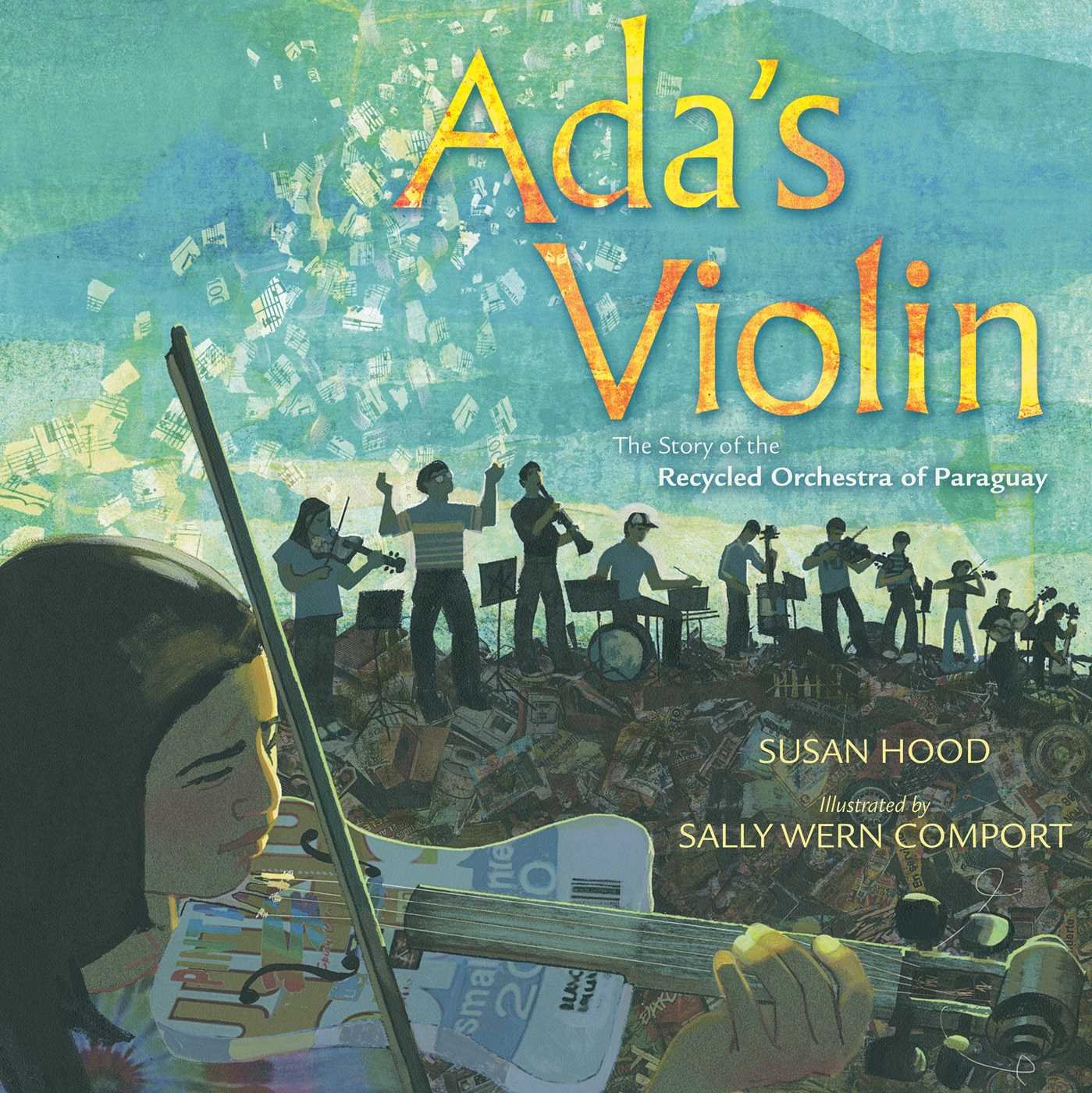
Ada’s Violin: The Story of the Recycled Orchestra of Paraguay by Susan Hood, illustrated by Sally Ward Comport

Published by Simon & Schuster Books for Young Readers

Summary:  Ada lived in one of the poorest places on earth, Cateura, Paraguay, home of the garbage dump for the capital city of Asuncion.  Most adults there survive by picking through trash, finding items they can recycle and resell to make a bare subsistence living.  Ada and her classmates appeared to be heading for the same lives as their parents, until a man named Favio Chavez came to town and offered music lessons.  The problem was, he only has a few instruments, and they were so valuable that the kids were afraid to carry them home.  So Chavez got to work making instruments from objects he found in the trash.  Before long, there were enough kids playing to form an orchestra.  Ada loved music and worked so hard that she became first violin.  The orchestra has traveled all over the world, and even opened for a Metallica concert.  Back matter includes an author’s note, sources, and photos of the orchestra and some of their instruments.  40 pages; grades 1-4.

Pros:  An inspiring story of how one man has made an amazing difference in the lives of an entire community. The illustrations do a great job of capturing the designs of the different instruments, as well as the emotions of their players.

Cons:  I wanted to hear the music!  Fortunately, YouTube helped me out.  Just search for “Recycled Orchestra of Paraguay” to learn more and to see and hear these amazing instruments in action.

The Mummy Makers of Egypt written and illustrated by Tamara Bower

Published by Seven Stories Press 

Summary:  Paneb is the head of a family of embalmers; his young son Ipy is being trained to follow in his footsteps.  When Yuya, father of Queen Tiye, dies, Paneb and Ipy oversee a lengthy process of embalming and burial.  Each step is important in preserving the body for the afterlife, and there are many rituals that go with each part of the process.  The Egyptian religion is described, with beliefs about what happened to people after they died.  There’s also a section on the embalming process, with pictures of the tools and the people performing their jobs drawn in ancient Egyptian style.  A lengthy endnote describes the discovery of Yuya’s tomb in the early 20th century; there are also a few photos and drawings of items found in the tomb.  40 pages; grades 3-8.

Pros:  Written and illustrated by an expert on ancient Egypt, this book is clearly a labor of love designed to impart a great deal of information about many aspects of Egyptian culture, both through the text and the illustrations.  The end note, three pages of small type, is a bit daunting, but very interesting and informative.

Cons:  The section on the embalming process (e.g., brain removal through the nose) may not be everyone’s cup of tea.

An Armadillo in New York by Julie Kraulis

Published by Tundra Books 

Summary: Arlo, an armadillo based in Brazil, knows that when he feels a twitch in his left claw, it’s time for him to start planning an adventure. His grandfather Augustin gave him a set of travel journals about all his favorite places, and the one about New York City guides Arlo on his journey. Making stops at the Brooklyn Bridge, Yankee Stadium, Central Park, and many other well-known landmarks in the Big Apple, Arlo marvels at all that he sees. He’s also puzzled by his grandfather’s many references to Lady Liberty. It isn’t until his last stop, a trip on the ferry to Liberty Island, that he finally figures out who Lady Liberty really is. Arlo looks forward to return visits to the Statue of Liberty and other places in New York City. The last page gives additional facts about the Statue of Liberty. 32 pages; grades K-3.

Pros: The beautiful, slightly dreamy illustrations and the adorable armadillo will make readers want to take a trip to NYC. This is a sequel to An Armadillo in Paris; we can hope that Arlo will be doing more traveling in the future.

Cons: The story line is pretty thin.

On the Farm, At the Market by G. Brian Karas

Published by Henry Holt and Company

Summary:  Where does all that yummy food at the farmers’ market come from?  This book goes behind the scenes to a farm, a dairy, and a mushroom grower to see what happens the night before market day.  Everyone is busy into the night, harvesting, cooking, and packing.  Early in the morning, the food is transported and unpacked, and then the fun begins.  Chef Amy from the Busy Bee Cafe makes her usual rounds, selecting fresh food for the evening’s special.  At the end of the day, all of the farmers and their helpers head over to the cafe to relax and enjoy the fruits (and veggies) of their labors.  40 pages; grades K-3.

Pros:  Kids who have never gone to a farmers’ market will want to check one out after reading this book; those who are regulars will want to thank the farmers for their hard work creating all that delicious food.

Cons:  The Amazing Cheese Dairy Farm seems to be flirting with some child labor law violations.

Green City: How One Community Survived a Tornado and Rebuilt for a Sustainable Future by Allan Drummond

Published by Farrar Straus Giroux 

Summary: When a tornado hit Greensburg, Kansas in 2007, so much of the city was destroyed that  townspeople questioned whether it should be rebuilt at all.  But some forward-thinking residents decided to create a new community.  Not only would the houses and commercial buildings be tornado-proof, but they would be as energy efficient and green as possible.  Donations came in from all across the country, and people in neighboring communities helped design and build the new town.  It took a few years, and some former residents didn’t want to wait, or couldn’t afford to.  But about 800 of the 1400 townspeople stuck it out, and today they live in one of America’s greenest cities.  Back matter includes an author’s note and tips for going green.  40 pages; grades K-4.

Pros:  Busy, colorful illustrations show the many steps of planning and creating a new town.  The anonymous child narrator tells the story in a chatty, optimistic voice.  Sidebars give more information on green living and construction.

Cons:  The idea of an entire town being destroyed in just a few minutes.

Fearless Flyer: Ruth Law and Her Flying Machine by Heather Lang, illustrated by Raul Colon

Published by Calkins Creek


Summary:  Ruth Law loved to entertain crowds with her daredevil flying, but after four years of shows, she was ready for a new challenge.  In 1916, she decided to fly from Chicago to New York City, which would set a new American record for nonstop flight.  Although she had never flown more than 25 miles, Ruth was a mechanical whiz, and set about modifying her plane to get it ready for the journey.  She also cut a map into strips and put it on a roller.  She had to have both hands on the controls at all times, but managed to maneuver one control with her knee when she had to turn the roller and find her way.  (Kind of like those drivers who talk on their phones with one hand and hold their Slurpees in the other)  Flying in a 50-mile-per-hour late November wind, she made it as far as Haskell, NY before she ran out of gas.  That was enough for a new record, though, and the next day she landed in New York City, gliding past the Statue of Liberty before landing in the midst of a cheering crowd.  Grades 1-4.

Pros:  Heather Lang tells a fascinating story of an early aviation pioneer, with relevant quotes from Law interspersed throughout the text.  The illustrations capture the feel of flying in a primitive airplane, low enough to the ground to be able to navigate with a map.

Cons:  This is mostly the story of a single flight, not a complete biography of Ruth Law.

The Wrong Wrights (Secret Smithsonian Adventures) by Steve Hockensmith and Chris Kientz, illustrated by Lee Nielsen

Published by Smithsonian Books 

Summary:  Four kids are awarded a trip to the Smithsonian’s Air and Space Museum for winning the district science fair.  When they get there, they discover that, instead of airplanes, the exhibit halls are filled with hot air balloons and dirigibles.  They’ve accidentally stumbled into an alternate reality, and before you can say “Kitty Hawk”, they are whisked back in time to a crucial point in aviation history.  On a windy day in 1909, the Wright brothers, Glenn Curtiss, and Thomas Scott Baldwin demonstrated their flying machines.  Only the Wright brothers were successful, and this led to greater financial support for the airplane, and less for the other types of aircraft.  The kids, with the help of Katherine Wright (Orville and Wilbur’s sister) are able to defeat other time travelers who are trying to help Curtiss and Baldwin, and secure the Wrights’ place in history.  When they return to the present, the airplanes are back in place at the Air and Space Museum.  64 pages; grades 3-6

Pros:  History, time travel, and science are pleasantly mingled in this graphic novel, which is apparently the first in a series published by the Smithsonian.

Cons:  Some of the time travel seemed a little too “Scooby Doo” and not particularly well thought-out.

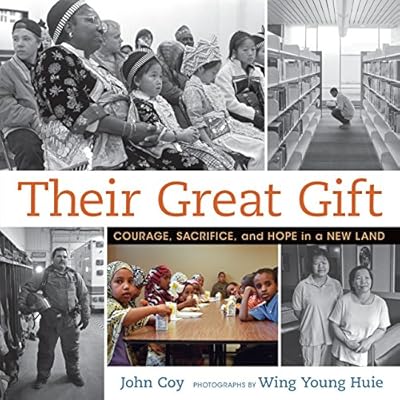
Their Great Gift: Courage, Sacrifice, and Hope in a New Land by John Coy, photographs by Wing Young Huie

Published by Carolrhoda Books

Image result for their great gift amazon 

Summary:  Each page has 3-6 photographs of 21st-century immigrants. The brief text explains how people have come to the United States from many countries.  They may not speak English, they may make embarrassing mistakes, but they work hard and often do the jobs that no one else wants.  They push their children to also work hard and to never give up, with the hope that those children will have opportunities they never knew.  The final page asks, “What will we do with their great gift?”  Back matter includes photos of the author’s and illustrator’s ancestors and their stories of how those families came to America, as well as a description of how they came to work together on this book.  32 pages; grades 1-5.

Pros:  Although the text is brief, almost like a poem, the photographs are captivating and will make readers want to spend a lot of time with this book, imagining what life is like for the subjects of those photos.  This would be a perfect introduction to a unit on immigration, demonstrating that seeking a new life in the United States has been, and continues to be, an ongoing theme in American history.

Cons:  I wanted to know more about every single photograph.

Whose Hands Are These? A Community Helper Guessing Book by Miranda Paul, illustrations by Luciana Navarro Powell

Published by Millbrook Press 

Summary: Each page shows a different worker and describes in rhyming text what his or her hands do; turn the page to see who that person is. The answers get a little more difficult through the book, starting with farmers and cooks and moving up to architects and physicians (which may not be a word preschoolers are as familiar with as doctors).  The book ends by asking the reader what your hands could do; the last four pages give thumbnail profiles of all the professions illustrated.  32 pages; ages 4-7.

Pros:  Having done a unit on community helpers, I know there aren’t a lot of good picture books that introduce many different kinds of jobs.  This one is particularly fun and interactive with bright, interesting illustrations.

Cons:  Those of us who hail from northern New Jersey do not believe that “water” rhymes with “potter”.


First Step: How One Girl Put Segregation on Trial by Susan E. Goodman, illustrated by E. B. Lewis

Published by Bloomsbury 

Summary: In 1847, at the age of four, Sarah Roberts started at the Otis School in Boston, just a few blocks from her home. Soon, though, she was told by the police that she had to leave. The Otis was for white children, and Sarah was African American.  The school she could attend was further from her house, had no place to play, and owned a single book.  Sarah’s parents decided to fight the decision.  They took their case to the Massachusetts Supreme Court, where it became the first case in the nation in which a white lawyer and an African American lawyer worked together, and the first in which an African American lawyer argued a case in a supreme court.  They lost the case, but Sarah’s father didn’t give up.  He traveled around the state to gain support, and in 1855, Massachusetts became the first state to outlaw school segregation.  Goodman writes that the fight for justice is often like that, a few steps backward, then a few more forward. She concludes with the story of Linda Brown and how her experience with segregated schools, similar to Sarah Roberts’, led to the 1954 Supreme Court decision banning all segregated schools in the U.S.  Back matter includes a timeline, a follow-up on some of the people in the story, resources, and how a nonfiction book is researched and written.  40 pages; grades 1-4.

Pros:  This little-known story is an important and inspirational part of American history.  It’s told well, with beautiful illustrations.  The last two pages do a fabulous job of outlining the work and research that go into the creation of a nonfiction book.

Cons:  The coloring in the illustrations sometimes make it difficult to differentiate skin tones.  Maybe that was intentional, but I found it a little confusing.