Fearless Flyer: Ruth Law and Her Flying Machine by Heather Lang, illustrated by Raul Colon

Published by Calkins Creek


Summary:  Ruth Law loved to entertain crowds with her daredevil flying, but after four years of shows, she was ready for a new challenge.  In 1916, she decided to fly from Chicago to New York City, which would set a new American record for nonstop flight.  Although she had never flown more than 25 miles, Ruth was a mechanical whiz, and set about modifying her plane to get it ready for the journey.  She also cut a map into strips and put it on a roller.  She had to have both hands on the controls at all times, but managed to maneuver one control with her knee when she had to turn the roller and find her way.  (Kind of like those drivers who talk on their phones with one hand and hold their Slurpees in the other)  Flying in a 50-mile-per-hour late November wind, she made it as far as Haskell, NY before she ran out of gas.  That was enough for a new record, though, and the next day she landed in New York City, gliding past the Statue of Liberty before landing in the midst of a cheering crowd.  Grades 1-4.

Pros:  Heather Lang tells a fascinating story of an early aviation pioneer, with relevant quotes from Law interspersed throughout the text.  The illustrations capture the feel of flying in a primitive airplane, low enough to the ground to be able to navigate with a map.

Cons:  This is mostly the story of a single flight, not a complete biography of Ruth Law.

The Wrong Wrights (Secret Smithsonian Adventures) by Steve Hockensmith and Chris Kientz, illustrated by Lee Nielsen

Published by Smithsonian Books 

Summary:  Four kids are awarded a trip to the Smithsonian’s Air and Space Museum for winning the district science fair.  When they get there, they discover that, instead of airplanes, the exhibit halls are filled with hot air balloons and dirigibles.  They’ve accidentally stumbled into an alternate reality, and before you can say “Kitty Hawk”, they are whisked back in time to a crucial point in aviation history.  On a windy day in 1909, the Wright brothers, Glenn Curtiss, and Thomas Scott Baldwin demonstrated their flying machines.  Only the Wright brothers were successful, and this led to greater financial support for the airplane, and less for the other types of aircraft.  The kids, with the help of Katherine Wright (Orville and Wilbur’s sister) are able to defeat other time travelers who are trying to help Curtiss and Baldwin, and secure the Wrights’ place in history.  When they return to the present, the airplanes are back in place at the Air and Space Museum.  64 pages; grades 3-6

Pros:  History, time travel, and science are pleasantly mingled in this graphic novel, which is apparently the first in a series published by the Smithsonian.

Cons:  Some of the time travel seemed a little too “Scooby Doo” and not particularly well thought-out.

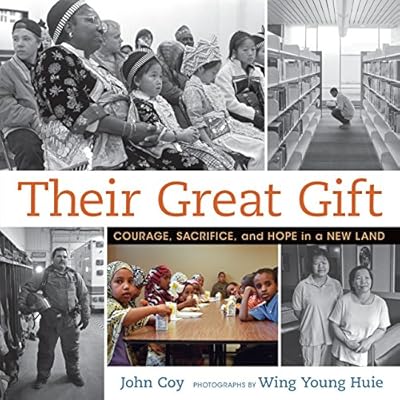
Their Great Gift: Courage, Sacrifice, and Hope in a New Land by John Coy, photographs by Wing Young Huie

Published by Carolrhoda Books

Image result for their great gift amazon 

Summary:  Each page has 3-6 photographs of 21st-century immigrants. The brief text explains how people have come to the United States from many countries.  They may not speak English, they may make embarrassing mistakes, but they work hard and often do the jobs that no one else wants.  They push their children to also work hard and to never give up, with the hope that those children will have opportunities they never knew.  The final page asks, “What will we do with their great gift?”  Back matter includes photos of the author’s and illustrator’s ancestors and their stories of how those families came to America, as well as a description of how they came to work together on this book.  32 pages; grades 1-5.

Pros:  Although the text is brief, almost like a poem, the photographs are captivating and will make readers want to spend a lot of time with this book, imagining what life is like for the subjects of those photos.  This would be a perfect introduction to a unit on immigration, demonstrating that seeking a new life in the United States has been, and continues to be, an ongoing theme in American history.

Cons:  I wanted to know more about every single photograph.

Whose Hands Are These? A Community Helper Guessing Book by Miranda Paul, illustrations by Luciana Navarro Powell

Published by Millbrook Press 

Summary: Each page shows a different worker and describes in rhyming text what his or her hands do; turn the page to see who that person is. The answers get a little more difficult through the book, starting with farmers and cooks and moving up to architects and physicians (which may not be a word preschoolers are as familiar with as doctors).  The book ends by asking the reader what your hands could do; the last four pages give thumbnail profiles of all the professions illustrated.  32 pages; ages 4-7.

Pros:  Having done a unit on community helpers, I know there aren’t a lot of good picture books that introduce many different kinds of jobs.  This one is particularly fun and interactive with bright, interesting illustrations.

Cons:  Those of us who hail from northern New Jersey do not believe that “water” rhymes with “potter”.


First Step: How One Girl Put Segregation on Trial by Susan E. Goodman, illustrated by E. B. Lewis

Published by Bloomsbury 

Summary: In 1847, at the age of four, Sarah Roberts started at the Otis School in Boston, just a few blocks from her home. Soon, though, she was told by the police that she had to leave. The Otis was for white children, and Sarah was African American.  The school she could attend was further from her house, had no place to play, and owned a single book.  Sarah’s parents decided to fight the decision.  They took their case to the Massachusetts Supreme Court, where it became the first case in the nation in which a white lawyer and an African American lawyer worked together, and the first in which an African American lawyer argued a case in a supreme court.  They lost the case, but Sarah’s father didn’t give up.  He traveled around the state to gain support, and in 1855, Massachusetts became the first state to outlaw school segregation.  Goodman writes that the fight for justice is often like that, a few steps backward, then a few more forward. She concludes with the story of Linda Brown and how her experience with segregated schools, similar to Sarah Roberts’, led to the 1954 Supreme Court decision banning all segregated schools in the U.S.  Back matter includes a timeline, a follow-up on some of the people in the story, resources, and how a nonfiction book is researched and written.  40 pages; grades 1-4.

Pros:  This little-known story is an important and inspirational part of American history.  It’s told well, with beautiful illustrations.  The last two pages do a fabulous job of outlining the work and research that go into the creation of a nonfiction book.

Cons:  The coloring in the illustrations sometimes make it difficult to differentiate skin tones.  Maybe that was intentional, but I found it a little confusing.

Freedom in Congo Square by Carole Boston Weatherford and R. Gregory Christie

Published by little bee books

Summary:  Both slaves and free gathered each Sunday in Congo Square, the only place in New Orleans where slaves were allowed to meet.  After working all week, Sunday afternoons were a celebration, with music and dance that reflected the participants’ African heritage.  The story of Congo Square is told in rhyming couplets, illustrated with folk art style paintings.  A foreword by historian and Congo Square expert Freddi Williams Evans and an author’s note both explain the history behind this book.  40 pages; grades 1-3.

Pros:  The grueling work of slavery is depicted in both the text and the illustrations, with allusions to beatings and escape attempts.  In contrast, the Congo Square scenes radiate joy and celebration.

Cons:  The foreword and author’s note seem somewhat redundant.

Nice Work, Franklin! by Suzanne Tripp Jurmain, illustrations by Larry Day

 Published by Dial Books for Young Readers 

Summary:  Some presidents have faced personal challenges, some have faced national challenges, and some, as the author describes on the first page, have faced both.  She then goes on to a light-hearted introduction to Franklin Roosevelt, and how he aspired to be like his famous cousin Theodore.  He got off to a good start—young Franklin was rich, smart, and determined.  He soon was making a name for himself in the New York legislature and as Assistant Secretary of the Navy.  But shortly after his 39th birthday, he was struck with polio and paralyzed from the waist down.  Although he never recovered use of his legs, he learned to stand with braces and went on to become NY governor, then President of the United States.  And there he was faced with a national challenge, the Great Depression.  Using the same determination that helped him overcome polio, he worked hard to improve Americans’ lives.  The book ends with Roosevelt’s second term inauguration.  An author’s note gives more information about Roosevelt’s life and some of the programs he started during the Great Depression.  32 pages; ages 6-10.

Pros: This is the third book of U.S. history by this author-illustrator team (George Did It and The Worst of Friends are their other two).  Although the subject matter is serious, both the text and the illustrations are upbeat and humorous.  While Franklin Roosevelt comes off in a positive light, there is some balance in describing why some Americans didn’t like him as President.

Cons:  The book begins when Roosevelt is a young man and ends in early 1937, so this is not a complete biography.

The Wheels on the Tuk Tuk by Kabir Sehgal and Surishtha Sehgal, illustrated by Jess Golden

Published by Beach Lane Books


Summary:  The familiar “Wheels on the Bus” gets an Indian spin as a somewhat wild and crazy tuk tuk driver (wala) weaves his way through a busy Indian town, transporting all kinds of people in his three-wheeled vehicle.  Readers (and singers) are introduced to Indian rupees, poppa-doppa-doms, chai tea, Diwali, and elephants and cows in the streets.  The authors’ note relates their own experiences on a tuk tuk, and a glossary explains some of the unfamiliar words from the song.  40 pages; ages 3-6.

Pros:  A familiar song is used as a vehicle (pardon the pun) for a fun introduction to the sights and sounds of India.  The busy illustrations give kids plenty to look at, and everyone on and around the tuk tuk seems to be having a wonderful time.

Cons:  Tuk tuk seatbelt laws seem a bit lax.

Forgotten Bones: Uncovering a Slave Cemetery by Lois Miner Huey

Published by Millbrook Press


Summary: When construction workers near Albany, New York, dug up a human skull, police, town officials, and archaeologists were all called in. The skull was determined to be over a century old.  Construction was halted, and an archaeological site was set up.  More skeletons were found, indicating a cemetery had been there.  Since there were no markers and it was far away from the main house of the farm that had been there in the 1800’s, the archaeologists were fairly certain it had been a slave cemetery.  This book looks at how scientists, historians, and artists worked together to learn the history of the people who had been buried there, as well as in two other slave cemeteries in New York City and Portsmouth, New Hampshire.  Using clues from the bones, DNA, and artifacts found on or near the bodies, much could be learned about the people, where they came from, what their lives were like, and even what their faces looked like.  Back matter includes an author’s note, glossary, bibliography, and places to visit to learn more.  112 pages; grades 5-7. 

Pros:  A fascinating blend of science and history, covering both the history of slavery in the northern United States, and the science of how the skeletons contributed to this knowledge.

Cons: A picture of a slave being burned alive near the end of the book could be disturbing to some readers.

Most Dangerous: Daniel Ellsberg and the Secret History of the Vietnam War by Steve Sheinkin

Published by Roaring Brook Press 

Summary:  Many strands of U.S. history from the 1960’s and 1970’s are woven together here.  The main focus is Daniel Ellsburg, who started working at the Pentagon the same day as the Gulf of Tonkin incident that escalated the Vietnam War.  The history of Vietnam is detailed, starting from the country’s last days as a French colony, to the division of North Vietnam and South Vietnam and the Cold War struggle over Communism in each part of the country.  As Ellsburg learned more about this history and the lies told to the American people about it by each U.S. President going back to Eisenhower, he became more disillusioned with the United States government.  This culminated in his theft of the Pentagon Papers, a report prepared by former Defense Secretary Robert McNamara documenting the secret history of the Vietnam War.  McNamara was hoping to use this report to help future politicians avoid the mistakes of the past; instead, it was leaked by Ellsburg to the press.  An infuriated Richard Nixon tried to destroy Ellsburg’s credibility by arranging a break-in at his psychiatrist’s office.  The team in charge bungled the job, then tried to make up for it a few weeks later with a covert operation at the Democratic National Committee’s headquarters at the Watergate Hotel.  The book ends with Nixon’s resignation; an epilogue includes Daniel Ellsburg’s positive commentary on a contemporary case: Edward Snowden’s leaks about the NSA’s domestic spying.  Back matter includes extensive works cited, source notes, and an index.  360 pages; grades 6-9.

Pros: Liberally interspersed with black and white photos, this book lays out an incredibly complex web of events in an understandable and engaging manner. Although I lived through this period of history, I wasn’t aware of many of the events and how they all fit together, connecting the Vietnam War, the Pentagon Papers, Watergate, and Nixon’s resignation.

Cons:  This will not be of interest to every middle school reader.  Get it into the hands of the history buffs.