The Red Bicycle: The Extraordinary Story of One Ordinary Bicycle by Jude Isabella, illustrated by Simone Shin

Published by Kids Can Press

Summary: Leo works hard to save money to buy himself a red bicycle. When he outgrows it, he doesn’t want to just throw it away. The owner of the bike shop tells Leo about an organization that sends bikes to Africa. Leo puts in a full day packing bikes into a shipping crate, finishing with his own. The crate is shipped to Burkina Faso, where a girl named Alisetta uses it to help her family move goods to market and make more money. A few years later, a pig tramples the spokes of one of the wheels, and Alisetta must get a new bike. Fortunately, a man from a health clinic rescues the bike and fixes it up to use as an ambulance. At the end of the story, the bike has come to the end of that journey as well, but we can hope it will find a new incarnation. The last couple pages tell readers about organizations that will use their old bikes in this way, and gives some information about Burkina Faso. Grades 3-7.

Pros: This book is part of the Citizen Kid series of books, which claims to “inform children about the world and inspire them to be better global citizens”.  The Red Bicycle succeeds on both counts by showing kids how the simple act of donating a bike can make a big difference in the lives of many people around the world.

Cons: Okay, this is the third book this month whose font seemed too small to me. Guess it’s time to get that bifocal prescription taken care of.

One Plastic Bag: Isatou Ceesay and the Recycling Women of Gambia by Miranda Paul, illustrations by Elizabeth Zunon

 Published by Millbrook Press

Summary: When Isatou Ceesay first discovers a plastic bag lying on the ground of her Gambian village, she is impressed with how light and strong it is for carrying things. Years later, she learns that goats are dying from eating plastic bags, and she starts noticing the bags are creating piles of nasty-smelling trash that collect water and attract mosquitoes. When she sees her sister crocheting, Isatou gets an idea. Before long, she’s assembled a team of Gambian women to crochet plastic from the bags into purses that they sell at the market. Proceeds from the sales can be used to improve life for all in Isatou’s village. Includes an author’s note about the real Isatou, a glossary and pronunciation guide of Gambian words, a timeline, and additional resources. Grades 1-4.

Pros: An inspiring, true-life story about the power of an ordinary person to make a difference. The illustrations are a mix of paintings and collage, and every African woman’s dress is a gorgeous print.

Cons:  Ceesay (Isatou’s last name) and the name of her village, Njau, aren’t included in the pronunciation guide.

Lost in NYC: A Subway Adventure by Nadja Spiegelman and Sergio Garcia Sanchez

Published by TOON Graphics

Summary:  It’s the first day at a new school for Pablo; his sixth, and he’s decided it’s just too hard to keep trying to make new friends.  Alicia has other ideas, though, and volunteers to be his partner on the field trip to the Empire State Building.  Before they leave, their teacher, Mr. Bartle, gives them an engaging lesson on the history and layout of New York’s subway system.  In spite of this, Pablo and Alicia manage to get themselves on the wrong train, and eventually the two of them get separated.  Armed with his new knowledge, Pablo manages to negotiate the subway system to get to the Empire State Building, where he’s reunited with the rest of the class and his new friend Alicia.  Grades 3-6.

Pros:  This is an engaging story of friendship with a lot of interesting information about NYC and its subway woven in.  But the real treasure of this book is the artwork.  When Mr. Bartle teaches about the subway, a map springs to life in their classroom, allowing kids to perch on New Jersey and Queens, surrounded by historical photos.  When the kids are lost in NYC, readers could spend an hour poring over the details of each page, with its dozens of diverse characters. There’s even a Where’s Waldo-type challenge, as Mr. Sanchez included pictures of himself and a police officer in every spread.  You will definitely want to visit New York and ride the subway after seeing these marvelous illustrations.

Cons:  There may be a bit too much technical detail for non-engineering types.

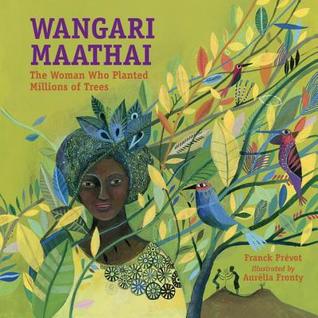
Wangari Maathi: The Woman Who Planted Millions of Trees by Franck Prevot, illustrated by Aurelia Fronty

Published by Charlesbridge

Summary:  While other picture book biographies about Wangari Maathi have focused on her tree planting, this book takes a broader look at her political activism.  She was fortunate to get a high school education in Kenya at a time when most girls didn’t go to school at all, and did so well that she was part of a group selected by President Kennedy to study in America.  Upon her return to Kenya, she observed how ravaged the land was from deforestation, and began her work to plant trees.  This work was in opposition to some of the plans of President Daniel arap Moi, and Maathai was imprisoned more than once.  In 2002, Moi was defeated, and Wangari Maathai was appointed assistant minister of the environment, natural resources, and wildlife.  In 2004, she was awarded the Nobel Peace Prize.  She died in 2011 at the age of 71.  End pages include an extensive timeline, information on Kenya today, quotes from Wangari Maathi, and further resources.  Grades 2-6.

Pros:  This French import is more extensive than other Maathi biographies, and would be appropriate for an older audience looking for more in-depth information.  The illustrations are striking, each one painted against a boldly colored background that fills the whole page.

Cons:  This is the fifth picture book biography of Wangari Maathi published since 2008, so some libraries may pass on purchasing this one, which would be too bad.

Dolley Madison: Parties Can Be Patriotic! By Kathleen Krull

Published by Bloomsbury USA Childrens

Summary:  When Dolley Madison died, her funeral was the largest ever seen in Washington, D.C. at that time.  It closed down the government, because so many people wanted to attend, including some of the twelve U.S. presidents she had known in her lifetime.  After a simple Quaker childhood and an arranged first marriage, Dolley, a widow at age 25, married James Madison, who later became the fourth U.S. President.  Dolley threw large parties every week, redecorated the White House, and famously rescued the portrait of George Washington just hours before the British burned down the White House during the War of 1812.  When Zachary Taylor referred to her as the First Lady, he coined a term that Dolley defined during her long, eventful life.  Ages 7-10.

Pros:  Veteran biographer Kathleen Krull has a new series, “Women Who Broke the Rules”.  This entry is fun, breezy, and informative.  At 46 pages, with illustrations on almost every page, it’s just the right length to give an enticing introduction to the life of a famous woman.

Cons:  The cover could be a bit more enticing.

Founding Fathers: Those Horse-Ridin’, Fiddle-Playin’, Book-Readin’, Gun-Totin’ Gentlemen Who Started America by Jonah Winter, illustrated by Barry Blitt

Atheneum Books for Young Readers

Summary:  Who were the men who helped start America, and what exactly did it mean to be a Founding Father?  Jonah Winter takes an irreverent look at fourteen of them, giving each one a page of information that includes height, weight, shoe size, career and wealth, slaveholding status, position on the Boston Tea Party, famous quotes, and a few other facts and anecdotes.  Each page is accompanied by a full-page portrait.  The introduction or “Preamble” tells a little about this group and draws some comparisons to present-day politics and arguing over issues.  The final few pages take a closer look at some of the issues including the Declaration of Independence, the U.S. Constitution, religion, slavery, government, foreign wars, and taxes, then concludes with a full page of additional resources.  Grades 2-5.

Pros:  The writing is heavy on humor and kid-friendly facts.  Yet this is a great introduction to the whole concept of “Founding Fathers” (a term coined by Warren G. Harding in 1918, in case you were wondering).  It might also make you feel better about today’s Congress to learn that so much was accomplished in spite of 18th-century partisan bickering.

Cons:  There’s not much depth.  The additional resources will be needed to cover the history of the period more thoroughly.

Juneteenth for Mazie by Floyd Cooper

Published by Capstone Young Readers

Summary:  When Mazie is mad at being told no, her father tells her about her great-great-great grandfather Mose who was a slave and heard “no” even more.  He learned about the Emancipation Proclamation on June 19, 1865, and now Mazie and her family celebrate Juneteenth every year.  Her father talks about others who worked and fought for civil rights after they got their freedom, all the way to the present.  The last page includes a paragraph of information about the origins of the Juneteenth celebration.

Pros:  This is a great introduction to Juneteenth and the Civil Rights Movement for primary grades. The 150th anniversary is coming up on June 19. Mazie looks to be about six years old, and the facts are presented appropriately for her age.  The illustrations are very appealing.

Cons:  The information is pretty simple and basic.  Pairing this with another book like Angela Johnson’s All Different Now will give a broader perspective.

The Underground Abductor (An Abolitionist Tale About Harriet Tubman) by Nathan Hale

Published by Harry N. Abrams

Summary:  Nathaniel Hale is about to be executed, but his executioners want to hear another one of his tales.  One of them accuses him of always making America sound perfect.  So Nathaniel tells the story of Harriet Tubman, which is also the story of slavery and the Underground Railroad.  Told in graphic novel format, the story spans the years from Harriet’s (or Minty’s, as she was known as a child) birth through the end of the Civil War.  Brief stories of Frederick Douglass and John Brown are woven into Harriet’s tale, and additional resources are listed at the end.  Ages 9 and up.

Pros:  This is the fifth installment in Nathan Hale’s Hazardous Tales. (It’s a little confusing. Nathan Hale is the real name of the author, but Nathaniel Hale of Revolutionary War fame narrates the stories). These books do an amazing job of teaching history through an appealing graphic novel format.  I learned a lot from reading this book, and it reads like a great story from start to finish.  I have a small but dedicated group of fifth grade boys in my school who have read all these books, and I can’t wait to give them a copy of this one.

Cons:  It’s impossible to tell Harriet Tubman’s stories without relating some of the horrors of slavery, so make sure readers are prepared.

Yard Sale by Eve Bunting illustrated by Lauren Castillo

Published by Candlewick

Summary:  Callie’s family is about to move into an apartment, and they are having a yard sale to sell what they can’t take with them.  Callie’s bed is sold, because the new apartment has a bed that pulls out of the wall, and her bicycle because the family will be living on a busy street with no sidewalk.  Her best friend comes to see how it’s going, and asks Callie to remind her why they’re moving.  “It’s something to do with money,” says Callie.  A woman tells Callie she’s “the cutest thing” and asks if she’s for sale, which scares Callie.  Her dad hugs her and assures her that he would never sell her for any price.  She realizes that as long as her family is together in her new apartment, it will feel like home.

Pros:  A heartwarming story which could also serve as bibliotherapy for children in a similar difficult situation.

Cons:  You may get a lump in your throat on more than one page.

Chasing Freedom: the Life Journeys of Harriet Tubman and Susan B. Anthony Inspired by Historical Facts by Nikki Grimes, illustrated by Michele Wood

Published by Orchard Books

Summary:  This book imagines a conversation between these two women who were friends and worked tirelessly their whole adult lives to improve the lives of women and African-Americans.  They tell each other true stories about themselves and some of the other people they worked with, like John Brown, Elizabeth Cady Stanton, and Frederick Douglass.  The women relate their stories in alternating pages, just like a real conversation, and each page is illustrated with a folk art style painting.  The end pages includes brief biographies of the two women and fourteen other people who were involved with similar work; additional notes about some of the events of the period; a bibliography; and an author’s note about how she came to write the book.  56 pages, grades 2-5.

Pros:  This is a unique and engaging way to learn about these two very interesting women who blazed their own trails and made a difference in many lives.

Cons:  Kids will need some historical context to fully appreciate this book.