Early chapter books

Sweet Magic (Witchycakes #1) by Kara LaReau, illustrated by Ariane Moreira (Random House Books for Young Readers, 80 pages, grades 1-4). Young witch Blue is still working on their magical powers, but they love being involved of all aspects of their mother’s bakery. When they’re sent out on a delivery mission, accompanied by their seagull familiar Gully, they encounter a series of opportunities to practice magic. For the most part, the magic fails, but Blue is able to help people anyway, using their own natural instincts to figure out what’s needed in each situation. Returning home, Blue’s mother assures them that imagination and kindness are just as important and magic, and that Blue is on their way to becoming a great witch. Includes a recipe for Mama Moon’s Beach Crumble.

This enchanting early chapter book by the author of The Infamous Ratsos portrays a cozy beach town and an enchanting cast of characters that will have readers heading right for book 2. Just like with the Ratsos, LaReau weaves an uplifting message into a fun story.

Hut! Hut! Hike! (Sports Zone! #1) by Andrew Maraniss, illustrated by Aishwarya Tandon (Scholastic, 96 pages, grades 1-4). Jasper and his two best friends Mo and Ruby decide to try out for their town’s flag football team. Jasper is a dedicated fan of the game and is confident that he’ll not only make the team but be one of the best players. Tryouts go pretty well, but Jasper makes a few mistakes, and he realizes that he still has a lot to learn. The three kids are thrilled to make the team, which names themselves the Frogs. The Frogs look forward to their first game against the Beagles, but when the big day arrives, the kids learn they still need some lessons in teamwork to be able to pull out a win.

The newest addition to Scholastic’s branches series is a pretty straightforward sports story interspersed with sidebars giving additional information about topics like the game of football, the specifics of flag football, and some of the greatest players from the NFL. With plenty of illustrations, including a few comic book style panels, and a fast-paced story, this is a good choice for early chapter book readers. Having said that, I still think Branches does best with fantasy books like The Last Firehawk, Dragon Masters, and Kwame’s Magic Quest. Thanks to Scholastic for providing me with a free review copy of this book.

Family: it’s complicated

Danilo Was Here by Tamika Burgess (HarperCollins, 304 pages, grades 5-8). Danilo’s family has gone through tough times since his beloved Papá left for the United States to try to find work, shortly before the U.S. bombed his Panamanian neighborhood in December, 1989. Papá has stopped writing and sending money, and Danilo is determined to find out what’s happened to him. When he gets recruited for a California baseball clinic shortly after his family has been forced to move into a refugee camp, he decides to go and try to find his father. Danilo inherited his baseball talent from Papá, and when he discovers his dad lives less than an hour away, he writes a letter inviting him to come watch the team play. But things don’t go as planned, and Danilo finds himself in the unfamiliar position of being the worst player on the team, with PTSD and worries about his mother and sister distracting him from the game. When he finally does connect with Papá, he learns that his dad has moved on, and Danilo and his family can’t count on him for support. Fortunately, Danilo finds caring friends and adults in the U.S., and with their help he’s able to figure out what his dreams are and how best to support his family when he returns to Panamá.

In her second middle-grade novel, Tamika Burgess takes a look at the recent history of Panamá, and the effects the U.S. involvement there had on ordinary Panamanians. Readers will relate to Danilo and his struggles with family, friends, and uncertainty about what he wants to do with his life, even though his experiences are likely to be very different from theirs. I hope this will be considered for a Belpré Award.

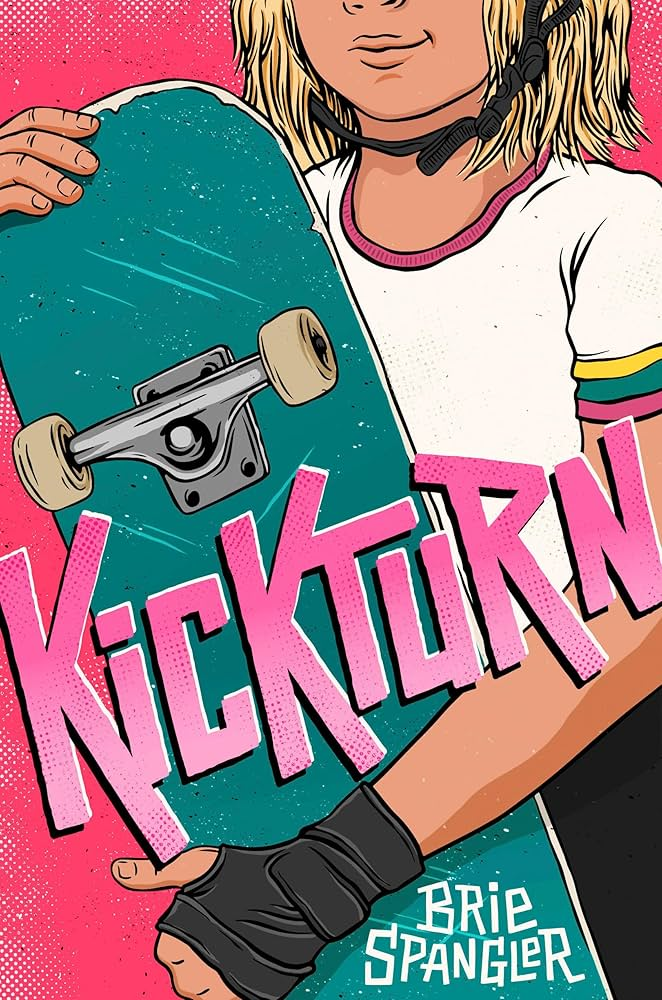
Kickturn by Brie Spangler (Knopf Books for Young Readers, 192 pages, grades 3-6). Ten-year-old Lindy is worn out and jaded after spending two years on a converted school bus, posing for photo shoots for her wellness influencer mom and watching her dad grow increasingly frustrated with the issues of the rundown bus that he quit his tech job for. When the bus completely gives out in San Jose, Lindy is excited to have a place to stay for a while and thrilled to meet some other kids who share her passion for skateboarding. Her hopes for putting down roots are dashed when the local garage is able to miraculously patch the bus together. When her parents start making plans for going back on the road, ignoring their daughter’s pleas, Lindy decides the only way to get their attention is to sabotage the bus. Although they’re furious with her, Lindy’s parents eventually calm down long enough to listen to her concerns (which include failing her fifth-grade homeschool curriculum) and to make a plan that allows them to settle down long enough to make a new plan. Includes sketches and Instagram usernames of real-life kids who love skateboarding.

With its appealing journal format that includes lined pages and lots of sketches and doodles, Lindy provides a behind-the-scenes look at what it’s really like to embrace van life and influencer culture. Although she occasionally sounds a little jaded and world-weary for a fifth grader, her voice is genuine and funny. Even kids who have lived in the same place all their lives will relate to her desires to fit in with friends as well as her struggles to get her parents to listen to what she needs.

Science acclaim, a mouse’s name, and the G.O.A.T. of the game

Jellyfish Scientist: Maude Delap and Her Mesmerizing Medusas by Michelle Cusolito, illustrated by Ellen Rooney (Charlesbridge, 32 pages, grades 1-5). Maude Delap never left home or went to school, but she became a scientist by studying the ocean life around her home on Valencia Island, Ireland. This story takes place from June, 1899 until September, 1900, a time when Maude made important discoveries about the compass jellyfish’s life cycle through careful observations in the Department, her name for her home lab. After unlocking the mysteries of this jellyfish, she’s shown on the last page scooping up a blue jellyfish, beginning the process all over again. Includes additional information about Maude, jellyfish (including an illustrated guide to their life cycle on the endpapers), notes from the author and illustrator, and some additional resources.

Told in the present tense, with dates shown on each page, this story conveys an air of you-are-there excitement about the scientific process. Maude had to overcome some very unfair obstacles to have a scientific career, but the main theme in the book is perseverance and the joy of new discoveries. The back matter reveals that she made significant contributions to marine science. The illustrations do a great job of capturing that joy, showing Maude with a young niece assisting her, her lab, and the jellyfish.

The Woman Behind the Magic: How Lillian B. Disney Shaped the Disney Legacy by Brittany Richman, illustrated by Joanie Stone (Beach Lane Books, 40 pages, grades 1-5). As the youngest of ten children, Lilly Bounds never had much, but she always enjoyed the magical moments that she shared with her warm, loving family. After her older siblings left home and her dad passed away, Lilly moved out to California to be near one of her sisters. She got a job at the fledgling Disney Brothers Cartoon Studio, where she inked and colored cartoons, eventually impressing her boss Walt enough that she became his secretary and then his wife. The studio almost went out of business a few times, but Lilly helped behind the scenes, most notably naming Mickey Mouse after Walt proposed the name Mortimer. From Snow White to the opening of Disneyland, Lilly gave her opinions and feedback that shaped the Disney empire. When Walt died shortly before the opening of Walt Disney World, Lilly pushed herself to step into the spotlight for the grand opening. Includes a three-page author’s note with additional information and a timeline of Lillian’s life.

It was fascinating to learn more about the early days of the Disney empire, particularly this quiet unassuming woman who liked to work behind the scenes, but who had a big impact on the Disney we know today and who saved us from Mortimer Mouse. This illustrations are charming, calling to mind some of the older animated Disney movies.

Messi’s Magic: How Lionel Messi Became the G.O.A.T. by Caroline L. Perry, illustrated by Luciano Lozano (Scholastic, 48 pages, grades 1-5). Lionel “Leo” Messi grew up in a loving, soccer-obsessed family in Argentina. From an early age, his talent was obvious, and his Grandma Celia was his biggest fan. As he got older, though, Leo faced obstacles to his soccer career. His grandma passed away, and he was diagnosed with a growth disorder. Without daily injections, he wouldn’t grow big enough to play professional soccer, but his family couldn’t afford the medicine. At the age of 13, he was signed to FC Barcelona, who also agreed to pay for his medical treatment. Leo struggled to fit in at Barcelona’s youth academy, but his soccer skills helped him find his place. He’s gone on to become one of the greatest soccer players of all times, and if you see him pointing to the sky when he makes a spectacular goal, you’ll know that he’s dedicating it to Grandma Celia. Includes a timeline, additional information about Messi, and notes from the author and illustrator.

Thanks to Scholastic for providing me with a copy of this book, which will be released September 2. I know it will be a huge hit in my library, where I have many football/soccer fans. Leo’s story is inspiring, as he never gave up his dreams despite some pretty difficult setbacks, and went on to succeed beyond the wildest of those dreams. The additional information about Messi’s family life and charity work portray him an excellent role model.

Two books for LGBTQ+ collections

Trans History: A Graphic Novel: From Ancient Times to the Present Day by Alex L. Combs and Andrew Eakett (Candlewick, 384 pages, grades 8 and up). The title gives a pretty good idea of what this book is: a graphic novel of trans history, starting in ancient times and going to the present, with an emphasis on western cultures. Much of the history is told through the stories of individuals, from ancient Egyptian pharaoh Maatkare Hatshepsut, “a person who was raised to be a queen but instead became a king” to Adelaide/Alexina/Camille/Herculine Barbin, a French intersex woman from the 19th century to trans activists of the twentieth century like Marsha P. Johnson and Sylvia Rivera. Their stories give some idea about beliefs and treatments of trans people were like at that time. The final chapter profiles present-day activists, each of which is written in their own voice. Includes many pages of source notes and a lengthy index.

I often reflect on how much I’ve learned from the thousands of books I’ve read for this blog, and nowhere is this more apparent than in my greater understanding of trans people. Authors like Alex Gino and Kyle Lukoff have helped me understand what it’s like to be a trans kid, and now Alex Combs and Andrew Eakett have added a whole new level of understanding with this outstanding graphic history. Focusing on individuals makes for a fascinating read, and the interviews with contemporary activists are compelling. It’s a huge amount of information, occasionally a bit overwhelming, but definitely an important book to educate readers in such an engaging format.

Athlete Is Agender: True Stories of LGBTQ+ People in Sports edited by Katherine Locke and Nicole Melleby (Christy Ottaviano Books, 224 pages, grades 5-8). In 22 essays, LGBTQ+ people tell the stories of their athletic experiences. Most of the narratives lift up supportive teammates, but there are also examples of bullying and prejudice encountered in sports. Interspersed with personal essays are brief biographies of successful LGBTQ+ athletes like tennis player Billie Jean King, WNBA players (and married couple) Courtney Vandersloot and Allie Quigley, and Olympic gold medalist rugby player and trans activist Ellia Green. The sports are varied: sled dog racing, water fitness, longboarding, and sailing, among others, and each athlete’s experience is equally unique. Introductory material includes a note on pronouns and the history of Title IX, and in the back you’ll find profiles and photos of all the contributors, information on how to be a good teammate and ally, steps to take to form a Queer Athletics Alliance or Gender and Sexuality Alliance at your school, and source notes.

I loved this positive presentation of sports, an area that has been particularly fraught for LGBTQ+ participants, especially trans athletes. The writers are honest about their experiences, and the way gender divisions in sports often made them feel uncomfortable. Each essay could stand on its own as a powerful argument for inclusion in sports, but taken all together that argument becomes all the more compelling.

Beach reading

Meet Me at Sunset by Lee Heart (Simon Spotlight, 145 pages, grades 3-7). Julie’s told all her friends at school about James, the cute boy she knows from her summer vacations. Although she’s only talked to him once, she may have led the other kids believe he’s her boyfriend, which is why it’s incredibly awkward when her mom invites Sophia to join them for this year’s vacation. Sophia proves understanding, though, and is on board to help Julie with her Love Plan. Sophia confides in Julie about the boy from her old school in California whom she’s been texting, and before long the two girls are on their way to becoming BFF’s. But when Sophia starts to gently point out that James is kind of a jerk, and that his friend Liam is a lot nicer, Julie is sure there’s something going on between Sophia and James. A little communication goes a long way, though, and by the last page, both Sophia and Julie have dumped James and each has found the beginnings of a kinder, gentler summer romance.

This is a perfect beach read for tweens who are starting to be curious about romances but who may not be quite ready for YA. The steamiest action is exchanging phone numbers and making plans to get together during the school year, and the insane sixth-grade insecurity-fueled drama that it takes to get there is spot on. I love the short length, which should really be more common with books for this demographic. Enthusiastic readers can look for other titles in this new Spotlight Sprinkles series.

The Best Worst Summer of Esme Sun by Wendy Wan-Long Shang (Scholastic Press, 224 pages, grades 3-7). Esme’s ready to chill out at the local pool after another disappointing year of unsuccessfully competing with her three accomplished older sisters for their mother’s attention. Swim team has been a fun part of Esme’s summer for years, but this year she discovers that her growth spurt has made her a real contender, particularly in freestyle. She still enjoys the social aspect of the team, though, particularly a new friendship with Kaya, a girl whom Esme enjoys helping with her flip turns. When Esme’s mom gets wind of Esme’s successes at the pool, she starts showing up for meets. At first, Esme is thrilled, but when Mom starts making derogatory–and in the case of Kaya, racist–comments about her teammates, Esme’s not sure what to think. She enjoys winning and would love to set a pool record, but she also likes being part of a team and helping her friends succeed. Slowly, Esme starts to realize that being the best doesn’t always bring happiness and begins to seek out her own way of competing.

This book drew me in right away, and anyone who has spent time at the pool in the summer will find a sense of familiarity in the descriptions. Esme’s struggles with finding a balance between personal success and cheering on teammates are also very relatable, and I liked how the ending was ambiguous, leaving those questions still somewhat open. Although there were some hints to explain her mom’s behavior (her Chinese culture, her husband deserting her), she was a bit too much of a tiger mom stereotype and just came off as mean. I wish that portrayal had been softened a bit, but it’s also perhaps somewhat accurate coming from a 12-year-old narrator.

Novels in verse by award-winning authors

It’s All or Nothing, Vale by Andrea Beatriz Arango (Random House Readers, 272 pages, grades 4-8). Vale is trying to get back to fencing after a serious motorbike accident that damaged one of her legs, possibly permanently. Despite the pain and weakness, Vale is driven to return to the one thing she feels like she is good at. Her quest to be the best before the accident was fueled by her parents and cost her at least one friendship, but now she feels alone and uncertain about what her parents really want for her. When she finally does get back to fencing class, she discovers that she’s been unseated by a new girl named Myrka. Despite Vale’s anger at Myrka for being a better fencer, she can’t help noticing she admires and likes Myrka in a way that may be more than just as a friend. When a hard-won victory over her rival results in intense physical pain, Vale has to come to terms with the fact that she is not the same person she was before the accident. By the end of the book, she has opened up honest communication with her parents and started to lean more on the people who care about her.

I was a little put off at first by Vale, who comes across as somewhat unlikable, pushing away the people who are trying to help her and focusing only on her return to fencing and her quest to be the best. But as the story went on, I started to sympathize more with what she was going through, not only the painful recovery from a serious accident, but grieving that she is no longer the same person and wondering if she’s now disabled. Kudos to Andrea Beatriz Arango for creating such a real and memorable character for whom you will be cheering by the end as she comes to terms with the new person she is becoming.

All the Blues in the Sky by Renée Watson (Bloomsbury Children’s Books, 208 pages, grades 5-8). Sage is dealing with the intense grief of losing her best friend in a hit-and-run accident on her birthday. She’s back at school, trying to cope with the help of a support group, but each day presents new challenges as she navigates feelings of sadness, guilt, and anger. Sometimes she lashes out at those who are trying to help her, and she has to figure out ways to make amends during calmer moments. One element of grief that surprises her is that there is still room for joy and laughter, and Sage finds herself making new friends and slowly moving toward her first romance. For most of the story, she refers to the deceased as “my best friend,” but by the end of the story, she is able to say her name, Angel Rodriguez, and she creates a poster with that name to put at a makeshift memorial that’s been created in the place where Angel died. An author’s note tells of her own experiences with grief, losing fifteen loved ones from 2020 to 2022, and how those experiences and the Covid pandemic led to her writing this book.

As I read the list of Renée Watson’s books on the back flap, I realized what a truly gifted writer she is who has given us an amazing collection of works in all different genres for both children and young adults. This book is no exception, tracing Sage’s experiences with grief in a very realistic yet beautifully written way that will help other kids who are dealing with the emotions of loss.

A couple last graphic novels from 2024

The Squad by Christina Soontornvat, illustrated by Joanna Cacao. (Graphix, 288 pages, grades 4-8). Christina continues the memoir she began in The Tryout. Now an eighth grader, she feels like her life is good, with close friends, interesting classes, and a fun group of fellow artists who are working on a group project. But she and her friends Megan and Leanne still watch the cheerleaders longingly, and when they learn that there will be spots available in the ninth grade squad, they decide to try out once again. In the midst of their preparations, Christina gets the devastating news that her parents are divorcing. She’s determined to put on a happy face and continue with her cheering, and she and Megan–but not Leanne–make the squad. Her sadness and anger catch up with her eventually, but heart-to-heart talks with her parents and her friends help her to be more honest about how she’s feeling. “I didn’t need my life to be perfect,” Christina concludes. “I just needed my squad.” Includes a three-page author’s note in which Soontornvat talks more about her eighth grade life and several photographs from her and some of the friends and family members in the book.

I’m a big fan of The Tryout, so I was excited to see this sequel, and it did not disappoint. It does feel a bit heavier than the first book, with its explorations of divorce and the emotions it brings, as well as some scenes in which Christina deals with casual racism from her classmates and the way being biracial can make her feel like she doesn’t belong anywhere. Definitely for fans of Raina Telgemeier’s memoirs who may be ready for something a little meatier, as well as, of course, fans of The Tryout.

Warriors Graphic Novel: The Prophecies Begin by Erin Hunter, adapted and illustrated by Natalie Riess and Sara Goetter (HarperAlley, 272 pages, grades 3-7). Anyone who works in a school or children’s library knows that this series about warring cat clans has a devoted fan base, and no doubt the graphic adaptation will add to that. Book 1 tells the story of a young cat who starts life as a domesticated “kittypet” named Rusty but becomes a promising young warrior called Firestar. I only read the first 40 pages, but it’s well done, capturing the spirit of the chapter books with both the storytelling and the art. Book 2 is due out in April.

Nonfiction that will make you question humanity

Glenn Burke, Game Changer: The Man Who Invented the High Five by Phil Bildner, illustrated by Daniel J. O’Brien (Farrar, Straus, and Giroux, 32 pages, grades 2-5). As a kid, Glenn Burke was a five-tool talent: fast runner, powerful and accurate hitter, good catcher, and strong pitcher. So it was no surprise that he got called up to play for the Los Angeles Dodgers. He made a name for himself there, and was an enthusiastic teammate, greeting runners at home plate by putting up his right hand, which the player would then smack. The high-fiving team made it to the World Series in 1977, but the next year Glenn was traded to the Oakland Athletics, a team at the bottom of the baseball standing. Why? Glenn Burke was gay, and homophobic manager Tommy Lasorda didn’t want him on the team. The trade led Glenn to quit baseball altogether. He enjoyed success playing in the San Francisco Gay Softball League and winning gold in the Gay Olympics, but struggled with drug use and unemployment, shattering his leg in a car accident and dying of AIDS at the age of 42. He lived long enough to see his high five become a universal greeting, but not to see the open acceptance of gay players in the MLB. Includes an author’s note, bibliography, and timeline.

Phil Bildner writes in the author’s note how he originally envisioned Glenn Burke’s story as a picture book, but his editor wanted a middle grade novel, which became A High Five for Glenn Burke, published in 2020. While the origin story of the high five may seem like a perfect choice for younger readers, the MLB’s homophobia and Burke’s death from AIDS may make this a better choice for older kids. It’s a moving and well-told story, ending on a note that is both sad and hopeful.

It Happened in Salem by Jonah Winter, illustrated by Brad Holland (Creative Editions, 32 pages, grades 6 and up). “You know what I’m talking about. You start whispering things about a person–hurtful things you know will get that person in trouble, untrue things you may have convinced yourself are actually true.” This second-person introduction to the Salem Witch Trials situates readers right in the middle of the action. The text is spare, relating the basic events and facts, and illustrated with haunting paintings of people in stocks and hanging from nooses. An author’s note gives more information, including the fact that it took 325 years–until 2017–for Salem to put up a plaque commemorating the individuals who were executed.

I found this book disturbing from the cover to the author’s note, which seems appropriate for the subject. You can generally count on Jonah Winter to put a unique and relevant spin on history that will have readers thinking about their own lives. I saw recommendations for this book starting in fourth grade, but I personally would not get this for an elementary library. It would be an excellent supplement for middle school or high school students learning about this period of American history, no doubt initiating some interesting conversations on gossip and bullying. I wish there had been some additional resources given at the end.

A ballplayer who dared, a poet who cared, and a sanitation worker who repaired

Call Me Roberto! Roberto Clemente Goes to Bat for Latinos by Nathalie Alonso, illustrated by Rudy Gutierrez (Calkins Creek, 40 pages, grades 2-5). Roberto Clemente loved playing baseball as a boy in Puerto Rico and was thrilled to be scouted by the MLB. After a disappointing season in Montreal, he joined the Pittsburgh Pirates, where he became an All-Star and helped lead his team to the World Series in 1960 and 1971. He won twelve Gold Gloves, was the 1966 National League MVP, and the 1971 World Series MVP. Despite his success, Roberto often faced racism and discrimination. He corrected those who tried to call him Bob and spoke out against the segregation he endured during spring training in Florida. On September 30, 1972, Roberto became the 11th MLB player and the first Latino one to reach 3,000 hits. Includes notes from the author and illustrator, glossary, photos, bibliography, and timeline that tells about Roberto’s death in a plane crash on his way to deliver humanitarian aid to Nicaragua in December of 1972.

I’m ashamed to say that I thought Roberto Clemente was Dominican and that the only thing I knew about him was his death in a plane crash. This biography emphasizes his greatness in baseball, making clear the discrimination he faced and how he fought for justice for himself and other Black and Latino players. The illustrations by Caldecott honoree Rudy Gutierrez are beautiful and deserve a look from this year’s Caldecott committee. The author’s note adds a personal story, since she is a Cuban American sportswriter who has faced some of the same issues Roberto Clemente did.

The Soldier’s Friend: Walt Whitman’s Extraordinary Service in the American Civil War by Gary Golio, illustrated by E. B. Lewis (Calkins Creek, 40 pages, grades 2-5). A look at a lesser-known part of Walt Whitman’s life, when he served as a volunteer nurse in the Civil War. After his brother was wounded, Walt traveled from New York to Virginia to visit him in the hospital. He was so moved by the soldiers he saw that he decided to move to Washington, DC to devote himself to caring for them. Most of what he did was simple: bringing treats, helping men write letters, talking with them, or just listening. Although he was a fervent supporter of the Union cause, he cared equally for soldiers from both sides. Lines from Whitman’s “Leaves of Grass” are woven into the story. Includes photos and additional information about Walt Whitman and his Civil War experiences, along with a list of resources.

This touching story of Walt Whitman’s kindness and caring seems particularly relevant in today’s world when it’s easy to feel like it’s necessary to take sides or that one person can’t make a difference. The author notes at the end that Whitman may have visited as many as 25,000 soldiers, and while he couldn’t influence the outcome of the war, he found a way to express caring and kindness. Except for the lines from “Leaves of Grass,” there’s almost no mention of Walt Whitman’s poetry; it would have been nice to acknowledge his literary contributions in the story or back matter.

Gifts from the Garbage Truck: A True Story About the Things We (Don’t) Throw Away by Andrew Larsen, foreword by Nelson Molina, illustrated by Oriol Vidal (Sourcebooks Explorer, 40 pages, grades 1-4). Nelson Molina was always a collector. His mostly Puerto Rican neighborhood in East Harlem yielded all kinds of treasures. His mom showed him how to turn scrap wood into birdhouses, and Nelson enjoyed fixing up cast-off toys for his younger siblings. As an adult, Nelson became a New York City Sanitation Worker, where he continued to find and fix up things that he found in the trash. He started displaying them in the locker room of the sanitation garage, eventually expanding into other parts of the building. Since retirement, Nelson has opened a museum where he can display his treasures, showing the huge amount of stuff that we put into the trash. Includes tips for reducing, reusing, recycling, and rethinking, as well as photos of Nelson with some of the exhibits from his museum.

Kids will be inspired to look at trash differently, maybe thinking twice before they throw something away. I loved the scene at Christmas where young Nelson happily gives his siblings the toys he’s fixed up for them. Being something of a minimalist, though, the photos of his cluttered museum convinced me that his way of life is not for me.

Graphic novels that root for the underdogs

We Are Big Time by Hena Khan, illustrated by Safiya Zerrougui (Knopf Books for Young Readers, 240 pages, grades 3-7). Aliya’s not happy that her family is moving from Tampa to Milwaukee just as she’s about to start high school. Although it’s nice to be close to her grandparents, she misses the Florida weather and her basketball friends. Her new Islamic school has a girls’ basketball team, but they’re not very good. A new coach arrives at the school at the same time Aliya does, and before long the girls are working harder than ever on their conditioning and teamwork. Slowly, huge losses turn into smaller losses, then wins. As the team improves, they start attracting some media attention, which more often than not focuses more on their clothing and religion than on their basketball playing. The girls learn to navigate all kinds of new situations as they slowly build a winning season and make their way to the big end-of-the-year tournament. When the season finally comes to an end, the team and their families have plenty to celebrate. Include’s an author’s note about the real-life team that inspired this book and a behind-the-scenes look at the development of some of the artwork.

This is sure to be a big hit with fans of Raina Telgemeier-inspired graphic novels. The story reminded me a little bit of Hoops, with its team of scrappy underdogs breaking barriers for girls’ sports. Their turnaround from huge losses to wins seemed to happen very quickly, reminding me of the storytelling limitations of graphic novels.

Lion Dancers by Cai Tse (Simon and Schuster Books for Young Readers, 304 pages, grades 4-7). Wei is trying to find his place in middle school, but despite academic success, he hasn’t found a place where he feels he belongs. When he literally runs into a teenager wearing a lion dance t-shirt, Wei begs him for a chance to join his team. Wei’s late father was a championship lion dancer, and Wei danced a few years back, but he quit when he had some conflicts with another boy named Hung. Hung is part of the new team as well, and Wei struggles to work with him. When Lunar New Year comes around, the team is booked solid with performances all over the city, and everyone has to pitch in to make things work. When Wei and Hung’s rivalry gets in the way of one of their dances, it threatens everything the team has worked for. Wei has to decide if he’s going to work through his problems to continue with the dance form he loves or once again walk away from it.

I struggled a little at the beginning trying to keep the various characters straight and get up to speed with lion dancing, but once I figured things out, I very much enjoyed learning more about the dance and seeing how all the interpersonal drama played out. After reading this and Lunar New Year Love Story, I am ready to attend my first lion dance performance.