A basketball ace, a designer of space, and an ultramarathon race

Wat Takes His Shot: The Life & Legacy of Basketball Hero Wataru Misaka by Cheryl Kim, illustrated by Nat Iwata (Lee & Low Books, 40 pages, grades 2-5). Wataru Misaka was an active child, growing up in Utah as a second-generation Japanese American, or Nisei. His father taught him the Japanese word gambatte, meaning to do your best, and Wat took the lesson to heart, pushing himself to work hard in school, on the basketball court, and later, after his father died, to help support his family. During World War II, Wat’s family escaped being sent to concentration camps, since they didn’t live on the coast, but they still faced discrimination. At the University of Utah, Wat slept under the bleachers in the gym when the segregated dorms were full. He made the college basketball team, but at first didn’t get to play and was barred from away games. When he did get on the court, spectators yelled racist slurs at him. Keeping in mind gambatte, Wat never gave up, eventually leading his team to a national championship. He was recruited by the Knicks, becoming the first player of color in the BAA (later the NBA). After being released from his contract, Wat returned to school and got his engineering degree. He excelled throughout his life, at work, in the community, and on the golf course and bowling alley. The last page shows him exchanging jerseys at a meeting with Asian American NBA star Jeremy Lin. Includes a lengthy author’s note, a photo of Wat in 2008, and a list of sources.

Basketball fans will enjoy this biography, although it’s a bit lengthy with quite a bit of historical context, making it perhaps a better choice for older kids. The history is fascinating, though, with lots of action-packed illustrations, and the lesson in perseverance is an inspiring one.

Mr. Pei’s Perfect Shapes: The Story of Architect I. M. Pei by Julie Leung, illustrated by Yifan Wu (Quill Tree Books, 40 pages, grades 1-5). As a boy in China, Ioeh Ming Pei was fascinated by the volcanic rock statues in his grandfather’s hometown of Suzhou that took shape over many years from water falling on them. His love of structure continued as he grew up, sketching buildings he saw being built in Shanghai before coming to America at the age of 18 to study architecture. He rose to fame in 1964 when Jackie Kennedy selected him to design the John F. Kennedy Presidential Library and Museum. His innovative designs and ways of seeing shapes led to other famous buildings like the Louvre Pyramid and the Rock and Roll Hall of Fame. He returned to Suzhou at the age of 90 for the installation of an art museum he had designed for the city, admiring once again the rock statues he had seen as a child. Includes a timeline and additional resources.

Although I’ve heard of I. M. Pei I didn’t know the many famous buildings he designed. His innovative way of thinking and problem solving is emphasized in the text and especially the illustrations, which show of the beauty of the modernistic architecture Pei helped create.

Daughter of the Light-Footed People: The Story of Indigenous Marathon Champion Lorena Ramírez by Belen Medina, illustrated by Natalia Rojas Castro (Atheneum Books for Young Readers, 40 pages, grades K-4). Lorena Ramírez has become an unlikely ultramarathon champion, competing in races wearing the traditional clothing of her Rarámuri (meaning “light-footed”) people: a skirt and rubber-soled huarache sandals. The story takes place over the course of sixty-mile race, during which she reflects on her past that has brought her to this point. Growing up in a remote corner of Mexico, she became a strong runner by herding goats and cows, playing ball games with her siblings, and walking for hours to buy food. At the end of the race, she is the first to cross the finish line. Includes a two-page note with additional information about Lorena and a list of sources.

Lorena Ramírez’s story is fascinating, the way she has become a champion in an unconventional way, holding onto her people’s traditions and honoring them in the way she dresses. The beautiful illustrations show the people, animals, and landscape of her home. I do wish books like this would give the introductory information at the beginning so the reader (at least this reader) isn’t trying to figure out what is going on throughout the whole story.

Games people play

The Life-Changing Magic of Chess by Maurice Ashley, illustrated by Denis Angelov (Harry N. Abrams, 40 pages, grades 2-6). Maurice Ashley, the first Black Chess Grandmaster, weaves together his own story with some basics of playing chess. The book is divided into ten tips from Ashley (#1 – It’s like being a magician, #2 – Everyone starts as a beginner), which he elaborates on in a series of two-page spreads. In addition to introducing the pieces and explaining how they move, he includes a few suggested series of plays. It’s clear that becoming a good chess player involves a lot of hard work and research, and Maurice talks about some of the setbacks he experienced on the road to Grandmaster, encouraging kids to persevere and hold onto their dreams. The last few pages include more information about him, along with several photos, and there’s also a glossary.

This new series includes The Life-Changing Magic of Skateboarding, with drumming and baking due out at the end of the summer. Although I have never understood chess nor had the inclination to play it, I found this book very engaging, and I like the way Maurice Ashley tells his own story as he explains the fundamentals of the game. The illustrations add a lot and are essential for showing how to move the pieces to start or end a game. I hope there will be many more additions to this series.

Curveball by Pablo Cartaya, illustrated by Miguel Diaz Rivas (Disney Hyperion, 192 pages, grades 3-7). Elena is an excellent baseball player, the only girl on the boys’ team, with a mother whose support borders on helicopter parenting. When Elena hurts her knee at the beginning of the summer, she’s a bit relieved to have to give up her planned baseball clinic, but she soon realizes that she has no friends outside of baseball. With nothing else to do, she starts hanging out with her younger brother and his live action role-playing (LARP) pals. Elena’s kind of forgotten how to use her imagination and have fun, but the other kids talk her through it, and before long she’s not only figured out a way to combine baseball and LARP, but she’s met a couple of sporty girls her age who have learned how to strike a balance between athletic competition and fun. Their example helps Elena find the courage to talk to her mom, who reveals how her own early disappointments have fueled her passion for Elena’s baseball playing and agrees to let Elena have more autonomy over her own life.

Part Roller Girl, part Cardboard Kingdom, this colorful graphic novel has something for everyone, with a strong Latina character (Spanish is expertly woven into the dialog), and a nice message about finding a balance in life.

Lucky Scramble by Peter Raymundo (Dial Books, 192 pages, grades 3-7). The story of the national Rubik’s Cube championship focuses on 12-year-old Tyler Gooden, an up-and-coming cuber who got his start after his dad died three years ago. The Rubik’s cube was a gift from his father, and although Tyler had never solved it, focusing on it after his dad’s death helped him with his grief. Other competitors are profiled, including egotistical champion Dirk Speedman, 8-year-old prodigy Eli Newton and his obnoxious dad who will stop at nothing to see his son win, twins Izzy and Lizzy who are learning to establish their own identities, and 1980’s great Miles Wizzinski, who’s hoping for a comeback despite his carpal tunnel syndrome. The national championship competition brings out the worst–and eventually the best–in many of the characters, as they all learn and grow on their way to fighting it out for the title.

This hybrid mix of illustrated chapter book and graphic novel is sure to be a hit with its colorful cartoon-style illustrations and intriguing, if slightly one-dimensional, characters. Watching the competitors solve the cube in record-breaking times will surely have readers seeking out winning strategies on YouTube.

One of these things is not like the other, take 2

Warrior on the Mound by Sandra W. Headen (Holiday House, 272 pages, grades 4-7). Cato loves baseball more than just about anything and aspires to join the Negro Leagues like his father, Daddy Mo, and his older brother Isaac. Daddy Mo died suddenly four years ago, and Cato is being raised by his grandparents, who have never told him the circumstances around his dad’s death. When white store owner Luke Blackburn builds a new baseball field for his son’s team, Cato and his friends sneak over to try it out themselves. When they’re caught, it’s the beginning of a chain of events that results in not only a baseball game between Cato’s team and the white team, but the revelation of Daddy Mo’s death, his friendship with Luke, and the guilt Luke carries about his role in the murder.

In the middle of all this, Isaac is brought home bloodied and unconscious, having been beaten as he tried to travel home during a break in the baseball season. As Isaac slowly recovers, he coaches Cato, not only in the finer points of baseball, but in surviving as a young Black man in the Jim Crow south of the 1930’s. There’s plenty of back matter to add historical context to this story, and readers will enjoy both the sports action and the history lessons. I did question if a friendship like Daddy Mo’s and Luke’s would have really survived to adulthood in that environment, but I’d like to think that it was possible.

One Big Open Sky by Lesa Cline-Ransome (Holiday House, 304 pages, grades 4-7). Just as I was finishing reading Warrior on the Mound, this book arrived for me at the library. It’s a novel in verse told by three female narrators: 11-year-old Lettie; her mother, Sylvia; and 18-year-old Philomena, an orphan with plans to be a teacher. They’re all traveling west, along with Lettie’s dad, who hopes to find a better life in Nebraska than the one they have in Mississippi. I know I would enjoy this book, but the font was tiny, and then I got distracted by another action-packed book.

And what was that book? I was looking through the most recent Scholastic flyer, and this book caught my eye: The Liars Society by Alyson Gerber (Scholastic, 304 pages, grades 4-7). Much of what is in Scholastic these days is pretty much trash, even in my low brow opinion, but this looked good, and I’ve enjoyed other books by Alyson Gerber. This one is a series opener featuring Weatherby and Jack, who take turns narrating the story. They meet at a sailing regatta, which Weatherby wins, gaining her a surprise scholarship to the prestigious Boston School, a private academy where her dad went and was part of the sailing team.

Weatherby has never met her dad, and as she gets involved with Boston and starts to learn more about her classmates, she begins to suspect that her mom has not been completely honest with her about her father. There’s a web of deception surrounding the school, and Weatherby is no exception. When she and her friends get recruited to join a powerful secret society, some of the lies begin to come to light. The twist at the end reveals an unexpected connection between Jack and Weatherby and leaves plenty of loose ends to investigate in book 2.

This book is a lot less likely to receive starred reviews or awards than One Big Open Sky, but it was a lot of fun! I did think Weatherby’s guilty secret was pretty lame, but she seemed tortured enough about it, and it got her admission into the Liars Society. It’s a promising opening for a series, with plenty of kid appeal for upper elementary and middle school readers.

On the Line: My Story of Becoming the First African American Rockette by Jennifer Jones and Lissette Norman, illustrated by Robert Paul Jr.

Published by HarperCollins

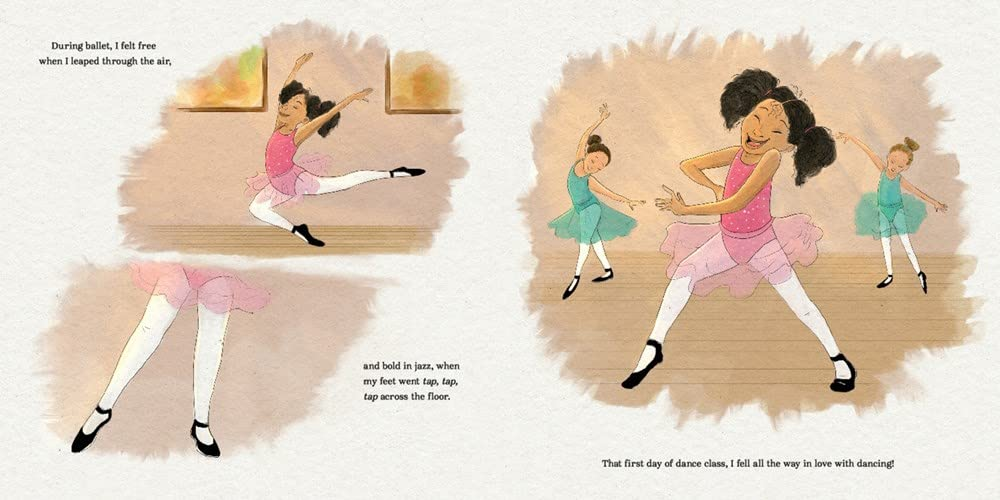
Summary: Jennifer Jones fell in love with dance in her first class at age nine. Dance was a way to express herself when she felt shy, which was often. With a white mother and a Black father, Jennifer felt conspicuous and out of place in her New Jersey hometown. When a supermarket clerk made racist remarks and told her that “girls like you don’t become dancers,” Jennifer’s mom set up a dance studio in their basement. Seeing The Wiz on Broadway showed her that people like her could be dancers, and Jennifer auditioned for the Rockettes at age 19. As there had never been a Black Rockette since the group’s start in 1925, she was up against tough odds, but in 1987, Jennifer became the first African American Rockette. She ends the book by acknowledging her family’s support of her dreams and encouraging readers to figure out what they love to do and pursue it. Includes additional information about Jennifer Jones and the Rockettes. 40 pages; grades K-4.

Pros: An inspiring story of a woman whose passion led her to break down barriers and open doors for others. The conversational tone of the story makes Jennifer feel like an old friend, encouraging kids to follow their dreams as she did hers.

Cons: A few photos would have made a nice addition.

Game of Freedom: Mestre Bimba and the Art of Capoeira by Duncan Tonatiuh

Published by Harry N. Abrams

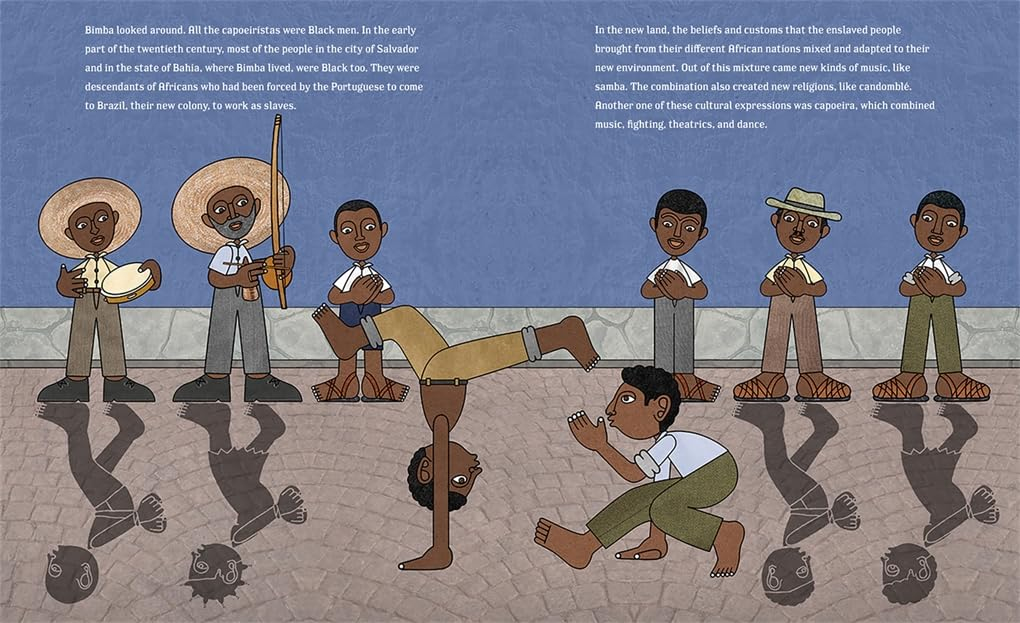
Summary:  Manoel dos Reis Machado, a.k.a. Bimba, loved capoeira, a sport involving martial arts-like moves done to musical accompaniment.  Involving predominantly Black players, the sport had been banned in Brazil by the all-White government who considered it barbaric.  In 1932, Bimba became Mestre Bimba when he opened a school to teach the art of capoeira, introducing a rigor and discipline that eventually made it appealing to a wealthier clientele.  It took twenty years of hard work, but in 1953, Mestre Bimba and his students were invited to do a demonstration for the president of Brazil.  This removed the last of the discrimination against capoeira, and although Mestre Bimba passed away in 1974, the sport is widely popular throughout Brazil today.  Includes a glossary, an author’s note, photos, and a bibliography.  48 pages; grades 3-6.

Pros:  Illustrated in Duncan Tonatiuh’s trademark folk-art style, this fascinating biography will have readers heading over to YouTube to see some live demonstrations of capoeira.  Tonatiuh has won both the Pura Belpré Award and Robert F. Sibert Medal, and this book could be a contender for both.

Cons:  I saw some recommendations for as young as preschool, but I would say this is definitely for upper elementary and middle school kids.

When You Can Swim by Jack Wong

Published by Orchard Books

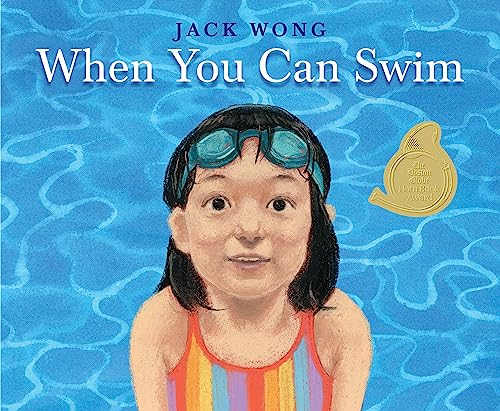
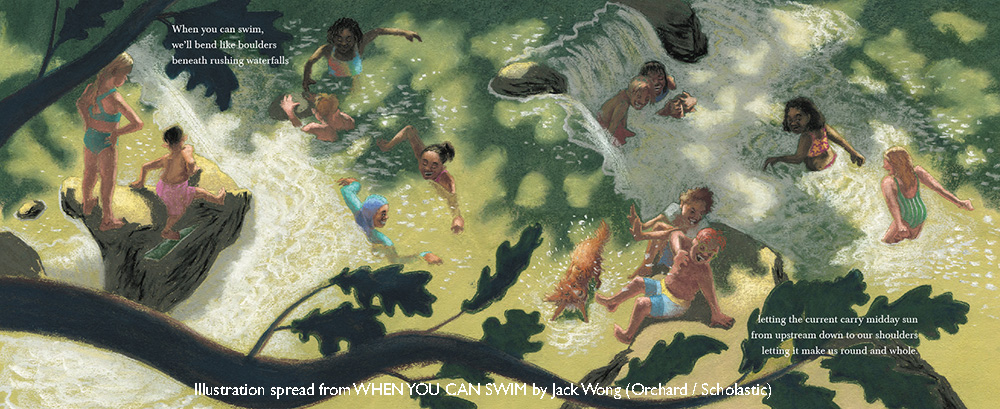
Summary:  Adults show children the wonders of what awaits them once they learn how to swim.  Oceans and lakes beckon, with the beauty of nature and the adventures of jumping into the water and diving beneath the surface.  There’s diversity in the types of water and landscapes, the swimming experiences, and the people who are enjoying the water.  “When you can swim I’ll take you there,” a parent tells a child standing by the side of the pool.  “So swim, little one!”  Includes an author’s note about his own mixed experiences with learning to swim that were influenced by the experiences of his parents and grandparents.  48 pages; ages 4-8.

Pros:  I learned about this book when I saw that it won the Boston Globe-Horn Book Award for best picture book.  It’s a beautiful meditation on the glories of swimming, perfectly complemented with gorgeous illustrations that capture the light and shadows of the water.  You could pair it with one of the other books about swimming from this summer: Our Pool or Together We Swim.

Cons:  Because it is more of a meditation than a story, it may not hold the attention of every child.

Together We Swim by Valerie Bolling, illustrated by Kaylani Juanita

Published by Chronicle Books

Summary:  A family is enjoying some time at the pool.  Mom, Dad, and the sister are all accomplished swimmers, but the youngest is still learning.  Short rhymes describe the action (“Toe dip/Side grip”) as he tentatively explores the water.  The other family members are encouraging, showing him the basics and staying nearby with a kickboard and noodle to keep him safe.  By the end, he’s learned how to move his arms and legs and is thrilled to be starting to swim.  They towel off, have a family hug, and “filled with pride/off I stride.”  40 pages; ages 3-6.

Pros:  A perfect summer book and an empowering one that shows a Black family that loves swimming and is making sure their kids know how to swim too.  I missed last year’s Together We Ride, which features the same family teaching the daughter how to ride a bike.

Cons:  Seems like June 15 would have been a better release date for this book than August 15.

Half Moon Summer by Elaine Vickers

Published by Peachtree

Summary:  Drew and Mia were born on the same day at the same hospital in Half Moon Bay, California.  When Drew wouldn’t stop crying, the two babies were put in the same bassinet, which calmed Drew down.  Mia and her family moved to Sacramento, but the summer after sixth grade, her family is back for a few months, and she and Drew, initially not knowing their history, become friends.  Their story is told in chapters that alternate between Drew’s prose journal entries and Mia’s verse ones as each one faces family difficulties: Drew’s father’s mysterious illness seems to be worsening, while Mia is dealing with the heartbreaking loss of a home that the family has dreamed of for years.  When they decide to train together for a half marathon, each one has individual reasons for running, but they support each other to keep going, both during their early morning runs and on the day of the race itself.  The end of the summer means Mia is moving back home, but the friendship promises to keep going through potentially difficult days ahead.  288 pages; grades 4-7.

Pros:  A compelling story of two kids dealing with some pretty serious family difficulties who show readers how to cope with courage and grace.  Their two distinctive voices, with the alternating prose and poetry narratives, keep the story moving along at a good pace.

Cons:  The story about the two kids meeting as babies was cute but felt like a bit of an unlikely coincidence.

Select by Christie Matheson

Published by Random House Books for Young Readers

Summary:  Alex has loved soccer since she was five, improving her game with her rec league teammates and their coach Jayda, who has always supported and inspired her.  When Alex gets recruited by the elite Select team, she’s excited about the possibility of winning a national title and getting on a path to playing college soccer.  But things are different on the Select team. Not only does Alex have to figure out a way to get to games in far-away towns, not easy with a somewhat irresponsible mother who works two jobs, but the coach turns out to be a bully.  He favors the girls whose parents contribute financially to the team and unfairly punishes Alex, who’s on a scholarship.  Alex isn’t afraid to stand up for herself, though, and as she slowly befriends some of her teammates, they begin to help each other in the face of Coach’s abuses.  As the team piles up wins, their coach becomes more and more demanding, and a showdown between him and the team feels inevitable.  Includes an author’s note about abusive coaches in youth sports a list of resources. 224 pages; grades 4-7.

Pros:  This fast-paced sports story brings the issue of abusive coaches to light, with a courageous protagonist who must deal with difficult issues both at home and on the field.  Her coach Jayda provides an example of good coaching while also serving as something of a stand-in parent.  

Cons:  There wasn’t a lot of subtlety in portraying who was good and who was bad.  It would have made a more interesting story to give the coach a charming side rather than making him an abusive bully right off the bat.

Contenders: Two Native Baseball Players, One World Series by Traci Sorell, illustrated by Arigon Starr

Published by Kokila

Summary:  The story opens with a key moment of the 1911 World Series: Charles Bender of the Philadelphia Athletics pitching to John Meyers of the New York Giants, who hits a double, then goes on to score the winning run of Game One.  Both Charles and John were from Native Nations, and the book goes back to trace the stories of how each one got to play in the World Series.  Charles grew up on the White Earth Reservation in Minnesota before being sent to an Indian boarding school in Philadelphia.  John’s childhood was spent on the Cahuila reservation in California.  Each endured poverty and racism as they pursued their love of baseball and eventually wound up in the major leagues.  Together, they played in nine World Series; Charles was elected to the Baseball Hall of Fame in 1953, and both were inducted into the American Indian Hall of Fame when it opened in 1972.  The book ends with a list of Native MLB players today, and the racism that’s still present with racist team mascots.  Includes an author’s note, timeline, and list of sources.  48 pages; grades 1-5.

Pros:  A fascinating look at two men who faced hardship and racism throughout their lives but rose above it to become excellent athletes who exemplified sportsmanship and teamwork.

Cons:  Kids I work with seem to have no interest in professional baseball these days.