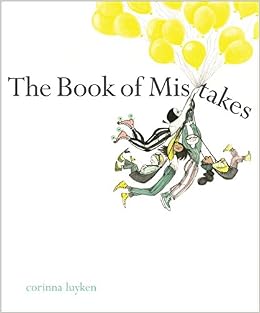
The Book of Mistakes by Corinna Luyken

Published by Dial Books

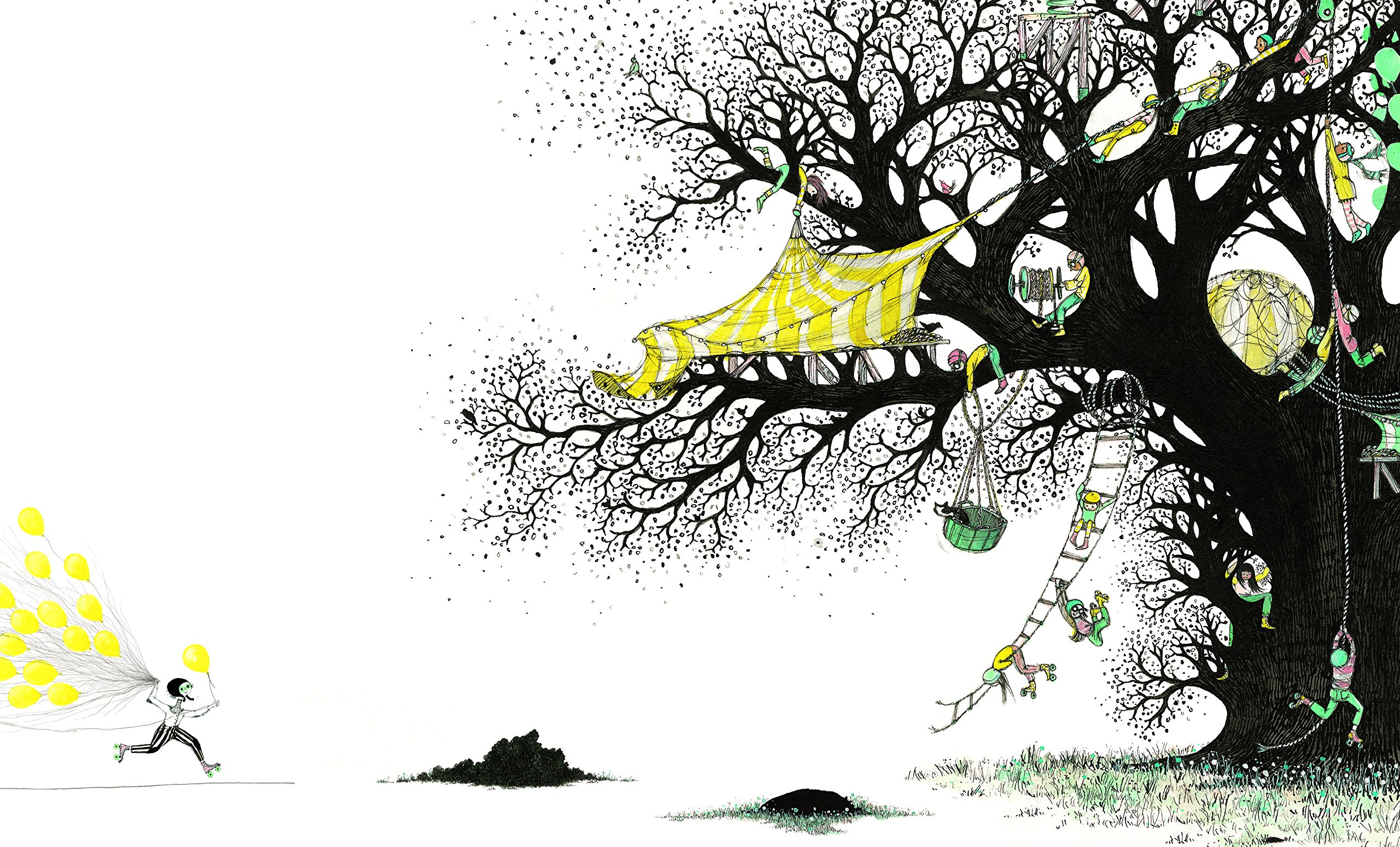
Summary:  Is it a mistake or an opportunity to be creative?  When an artist draws a girl with two different-sized eyes, glasses fix the problem.  When her feet don’t quite meet the ground in the picture, the addition of a pair of roller skates makes it look better.  A strange frog-cat-cow animal becomes a nice-looking bush.  Before long, the page is filled with an imaginative collection of people and animals doing all kinds of activities in a gigantic tree house.  Gradually, the artist moves away from the scene until it appears to be incorporated into the glasses girl’s head…and that girl is starting all over with a new picture.  56 pages; ages 4-8.

Pros:  The beautiful and intricate illustrations convey the message that it’s okay to make mistakes.  There is always a way to fix them, often making the new product better than the original.

Cons:  I found the last few pages confusing.

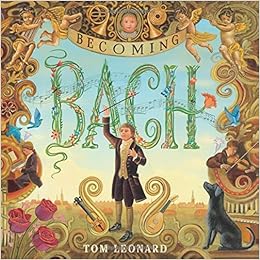
Becoming Bach by Tom Leonard

Published by Roaring Brook Press

Summary:  From the time he was born, Johann Sebastian Bach was surrounded by music (and also, apparently, by people named Johann).  His whole family–many of whom, incidentally, were named Johann–made music, so much so that in his part of Germany, musicians were called bachs.  His parents died when he was young, and he went to live with his oldest brother, Johann Christoph (traveling with another brother, Johann Jacob).  There, he learned by copying music and playing a great variety of instruments, until he was able to express his many deep emotions through his own compositions.  The final two pages of the book show the music coming from his organ as beautifully colored floating designs, traveling through time to contemporary listeners.  An author’s note gives additional biographical information.  40 pages; grades 1-5.

Pros:  Spare text, told in Bach’s voice, is gorgeously accompanied by illustrations which also convey information about his life.

Cons:  Too many characters named Johann.

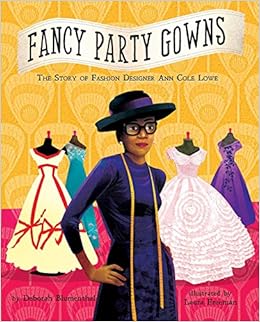
Fancy Party Gowns: The Story of Fashion Designer Ann Cole Lowe by Deborah Blumenthal, illustrated by Laura Freeman


Published by Bonnier Publishing

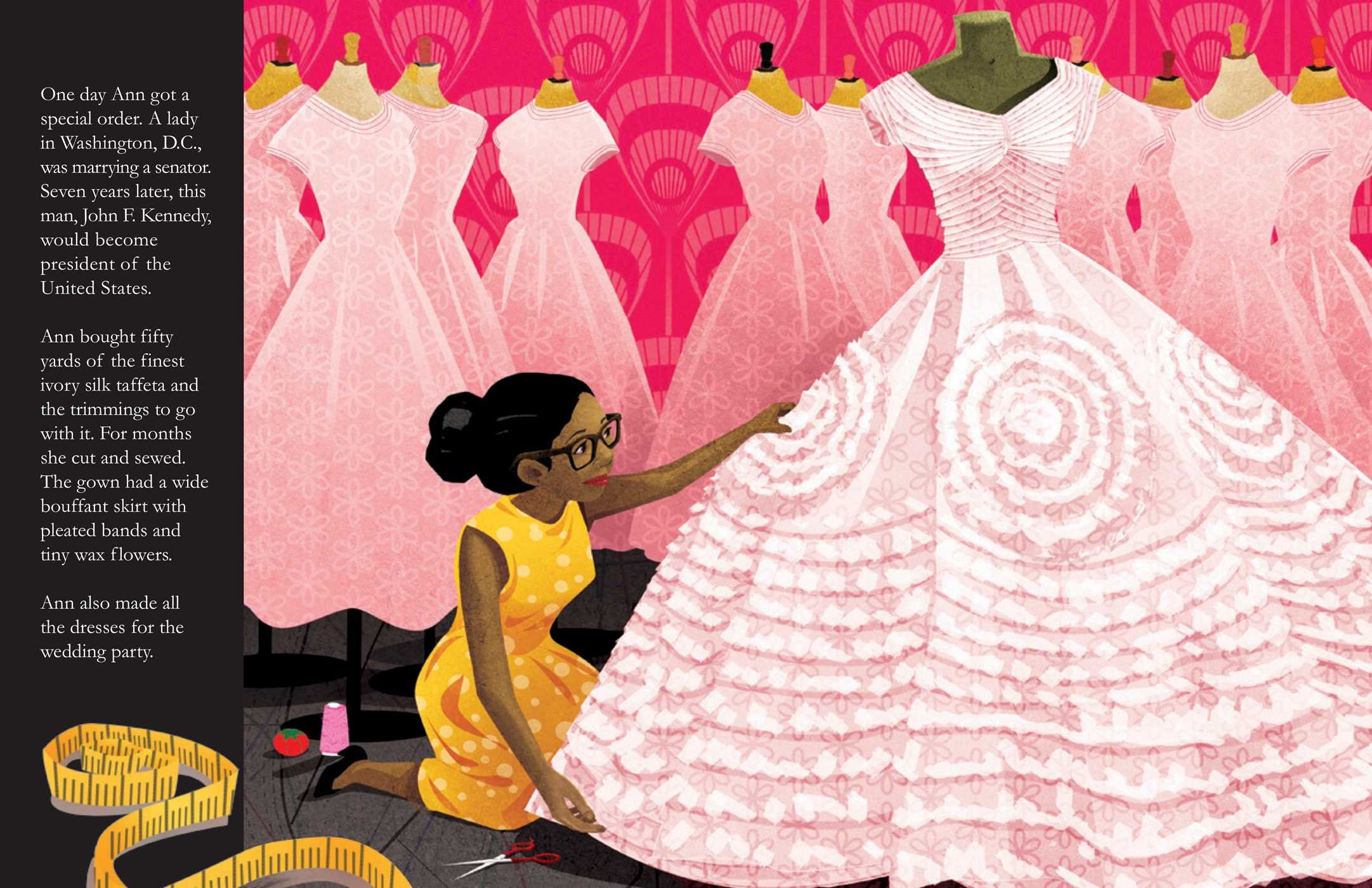
Summary:  Growing up in Alabama, Ann Cole Lowe loved to watch her mother sew beautiful dresses for women to wear to fancy parties.  When Ann was 16, her mother died, and Ann took over the business.  A few years later, a customer from Florida sent her to design school, where Ann had to study in a separate classroom, due to segregation.  After graduation, she moved to New York and opened her own shop.  Although she never made a lot of money, her gowns became well-known.  Her most famous design was Jacqueline Kennedy’s wedding dress and bridesmaid gowns.  Less than two weeks before the wedding, a pipe in Ann’s shop burst, and ten of the sixteen dresses were ruined.  She rallied, hired extra help, and got the job done, even though she lost any profit.  She continued designing and sewing well into her 70’s, her primary motivation, “to prove that a Negro can become a major dress designer.”  40 pages; grades 1-4.

Pros:  An inspiring story of a little-known woman.  The repeating refrain of the story is, “Ann thought about what she could do, not what she couldn’t change.”  Beautifully illustrated, with some of Ann’s designs gracing the endpapers.

Cons:  My constant search to find Tim Gunn and Heidi Klum lurking in the illustrations indicates I have been watching too much “Project Runway”.

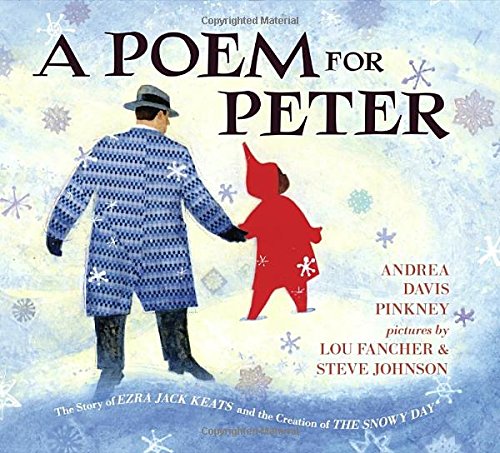
A Poem for Peter: The Story of Ezra Jack Keats and the Creation of The Snowy Day by Andrea Davis Pinkney, pictures by Lou Fancher & Steve Johnson

Published by Viking

Summary:  Andrea Davis Pinkney’s poetic homage weaves together biographical information about Keats with the story of the creation of his most famous book.  Born Jacob Ezra Katz, the son of Polish immigrants, the artist grew up in a poor Brooklyn neighborhood with a father who faced job discrimination and a mother whose secret dreams of becoming an artist never came to fruition.  Young Ezra loved art and won an art school scholarship, but when his father died of a heart attack the day before his high school graduation, his school days were over.  He was helped by the New Deal’s WPA, and went on to become a comic book artist before moving to children’s book illustration.  When he was asked to write and illustrate his own book, he thought of a little African-American boy whose picture in Life magazine had hung on Keats’s wall for many years.  This boy became Peter and the book was The Snowy Day.  Back matter includes “Ezra’s Legacy” with more information about the books that celebrated city life and the people from different cultures who lived there, and “Keats, the Collage Poet”, explaining how the verse narrative used for this book reflects Keats’ collage style of art.  60 pages; grades 2-5.

Pros:  A beautiful celebration of a life and a book, illuminated with illustrations inspired by Ezra Jack Keats’s art.

Cons:  I find the poetic biographies are a hard sell with the elementary crowd.


Radiant Child: The Story of Young Artist Jean-Michel Basquiat by Javaka Steptoe

Published by Little, Brown, and Company 

Summary:  Jean-Michel Basquiat grew up in Brooklyn with a mother from Puerto Rico and a father from Haiti.  His childhood was filled with art, both his own works and what he saw around him.  His mother was artistic and regularly took him to art museums.  There were also difficult times for Jean-Michel.  He was in a serious car accident at the age of eight, and spent months recovering.  During that time, his mother brought him a copy of Gray’s Anatomy, which helped him learn to draw the human figure.  A few years later, his mother’s mental illness drove her to leave the family.  Jean-Michel left school and moved to New York City, where he continued to pursue his art in a number of unconventional mediums, including graffiti.  He lived his dream of being a famous artist until his tragic death in 1988 at the age of 27 from a heroin overdose. An author’s note gives more biographical information. 40 pages; grades 1-5. 

Pros:  The story of Basquiat’s life is told in brief, lyrical text, illustrated with beautiful collages inspired by the artist’s work.  The artwork is sure to receive some Caldecott consideration.

Cons:  There are some pretty adult topics covered in this book targeted for elementary students.  Also Basquiat’s work isn’t included anywhere in the book.

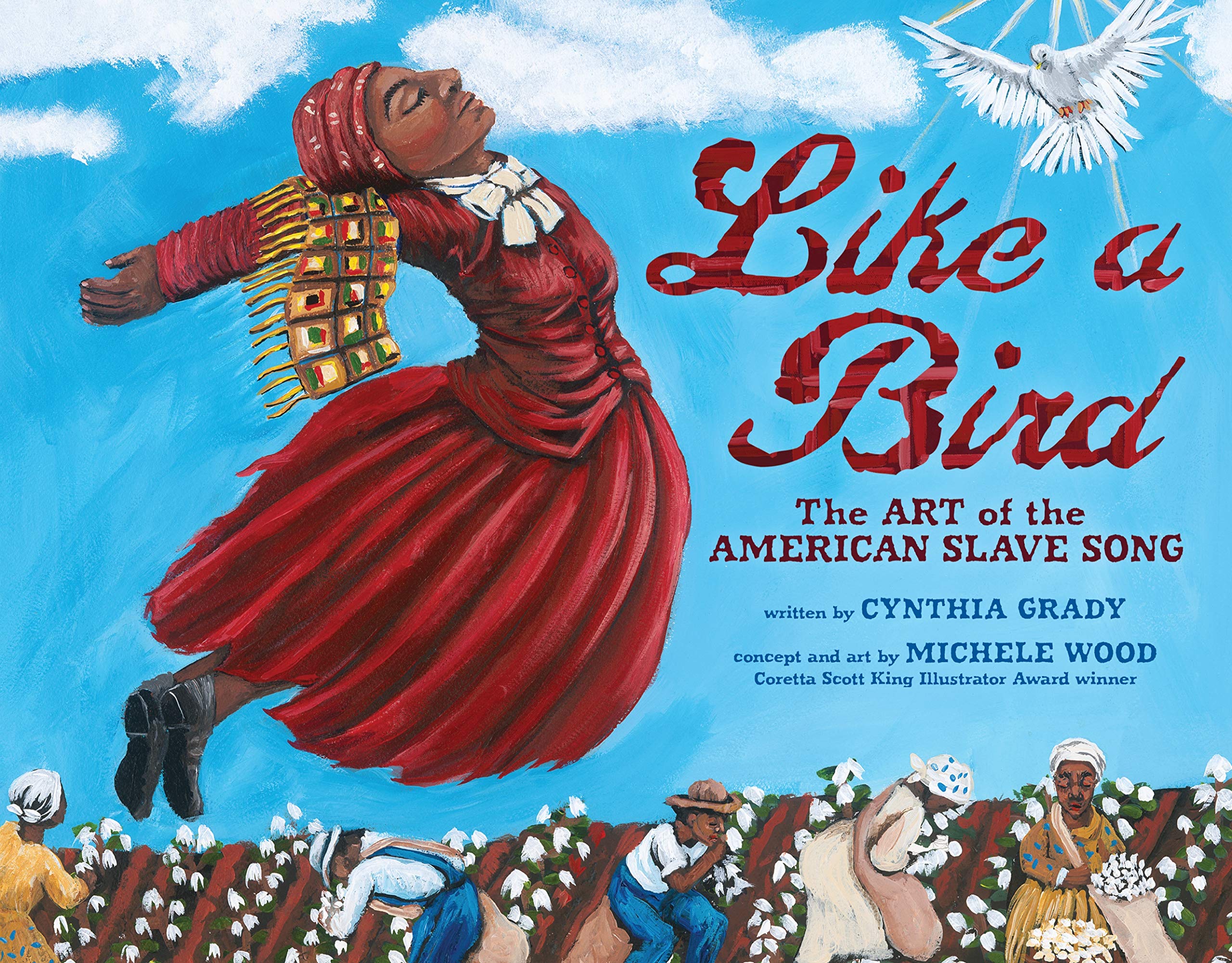
Like a Bird: The Art of the American Slave Song written by Cynthia Grady, concept and art by Michele Wood

Published by Millbrook Press

Like a Bird: The Art of the American Slave Song (Millbrook Picture Books):  Grady, Cynthia, Wood, Michele: 9781467785501: Amazon.com: Books

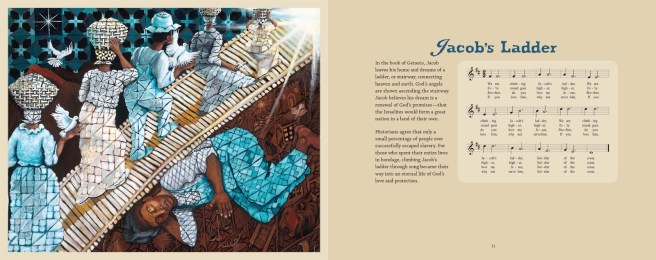
Summary:  Coretta Scott King Award winner Michele Wood has created beautiful paintings inspired by thirteen African American slave songs, such as “Jacob’s Ladder” and “Go Down, Moses”.  There is a one-page introduction that begins with the question, “What does a bird have to do with American slave songs?”  Each two page spread includes the song with music, a painting, and a paragraph or two of text giving some background about the song.  The bird motif in the title and introduction is carried out through the book, with a white dove appearing in every painting.  The last several pages include lyrics to all the songs, a glossary, bibliography, and a list of books and websites for additional reading.  40 pages; grades 3-6.

Pros:  This unique book would make an excellent addition to music and art libraries.  The beautiful paintings express both pain and hope, and contain interesting and symbolic details.  The words and music make the songs accessible to all readers.

Cons:  Listening to way too many “Wee Sing” cassettes in my children’s early years caused those versions to spring into my mind as soon as I saw many of these song titles.

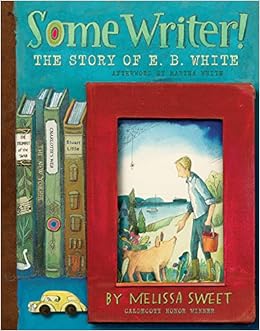
Some Writer! The Story of E. B. White by Melissa Sweet

Published by Houghton Mifflin Harcourt 

Summary:  Caldecott honoree Melissa Sweet presents the life of E. B. White through her words, his words, illustrations, and photographs.  Beginning with the cleverly decorated endpapers and continuing through the fascinating timeline at the end, readers will learn about the life and loves of the author of (among many other things) Stuart Little, Charlotte’s Web, and The Trumpet of the Swan.  There are 13 chapters, many of them given the name of one of White’s essays, including a chapter each on his three children’s books.  In addition to the timeline, this meticulously researched biography includes 162 source notes, a five-page bibliography, and an afterword by E. B. White’s granddaughter, Martha White. 176 pages; grades 2-6.

Pros:  Let’s hope this will be that rare biography that is recognized by Newbery committee.  Or the Caldecott committee.  Or both.  As Eudora Welty wrote about Charlotte’s Web: “As a piece of work it is just about perfect.”

Cons:  By the time I reached page 176, I wanted to be E. B. White.  Or maybe Melissa Sweet.


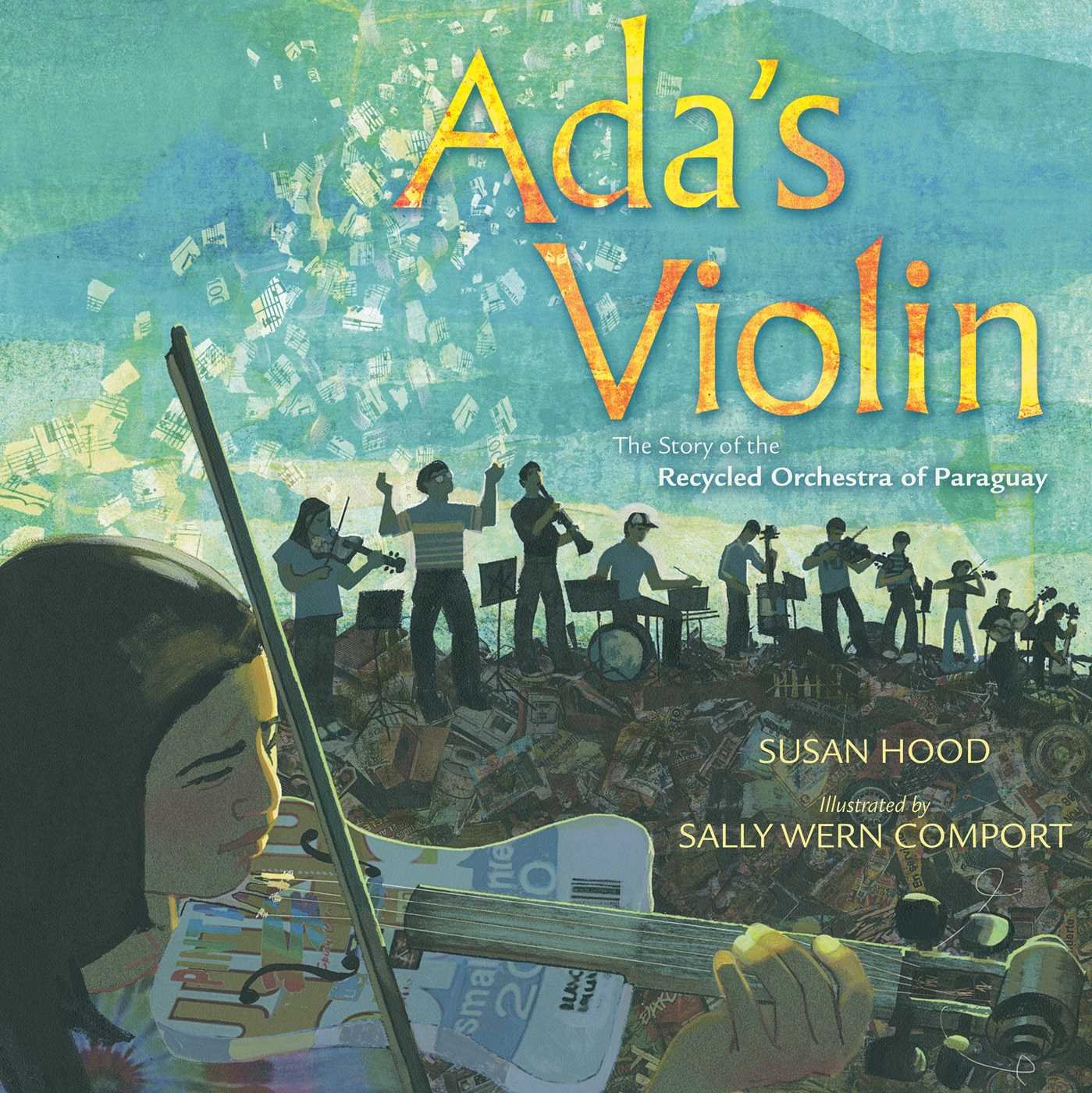
Ada’s Violin: The Story of the Recycled Orchestra of Paraguay by Susan Hood, illustrated by Sally Ward Comport

Published by Simon & Schuster Books for Young Readers

Summary:  Ada lived in one of the poorest places on earth, Cateura, Paraguay, home of the garbage dump for the capital city of Asuncion.  Most adults there survive by picking through trash, finding items they can recycle and resell to make a bare subsistence living.  Ada and her classmates appeared to be heading for the same lives as their parents, until a man named Favio Chavez came to town and offered music lessons.  The problem was, he only has a few instruments, and they were so valuable that the kids were afraid to carry them home.  So Chavez got to work making instruments from objects he found in the trash.  Before long, there were enough kids playing to form an orchestra.  Ada loved music and worked so hard that she became first violin.  The orchestra has traveled all over the world, and even opened for a Metallica concert.  Back matter includes an author’s note, sources, and photos of the orchestra and some of their instruments.  40 pages; grades 1-4.

Pros:  An inspiring story of how one man has made an amazing difference in the lives of an entire community. The illustrations do a great job of capturing the designs of the different instruments, as well as the emotions of their players.

Cons:  I wanted to hear the music!  Fortunately, YouTube helped me out.  Just search for “Recycled Orchestra of Paraguay” to learn more and to see and hear these amazing instruments in action.

Cloth Lullaby: The Woven Life of Louise Bourgeois by Amy Novesky, pictures by Isabelle Aresenault

Published by Abrams Books for Young Readers 

Summary:  Louise Bourgeois (1911-2010) spent her childhood along the banks of a river in France.  Her mother repaired tapestries, and Louise learned the art of weaving from her.  Although she studied math at the Sorbonne, Louise ultimately became an artist.  After her mother died, she made a giant sculpture of a spider, famous for its weaving, and spiders appeared in a lot of her other works.  Later in life, she gathered fabric from many different people and places in her past and created works of art with the different textiles.  She continued to create art right up until the time of her death at age 98.  End matter includes additional biographical information.  40 pages; grades 2-6.

Pros:  The illustrations are exquisite and really capture Louise’s life and art.  The text is almost poetic.

Cons:  This is not a straightforward biography, and kids may find some of the text difficult to understand.  The biographical information at the end is helpful; it may be useful to present it before reading the story.

Maybe Something Beautiful: How Art Transformed a Neighborhood by F. Isabel Campoy and Theresa Howell, illustrated by Rafael Lopez

Published by Houghton Mifflin Harcourt 

Summary: Mira is an artist. She loves to draw what she sees around her, and give her pictures to family, friends, and neighbors. One day, a man comes to her neighborhood who loves art as much as she does. He starts to paint murals around the community, and he invites Mira and her neighbors to join him. The bright colors are like magic, and when the murals are done, the painters don’t stop. They paint sidewalks, utility boxes, and benches. The man who started it all unites everyone with a wave of his paintbrush. Pages at the end tell about Rafael Lopez, who is both the man in the story and the illustrator of this book, and how he transformed San Diego’s East Village, and has since moved on to other communities around the world. 40 pages; ages 4-8.

Pros: An inspiring true story about one man who made a difference. Not only did he beautify his own community, but his work has raised money to help talented artists get more education, and his movement has spread around the world. His illustrations convey the magical transformations of his art, and should put Lopez in contention (again) for some Caldecott recognition.

Cons: I would have loved to have seen more photos of the real murals and other artwork.