Perceiving the world around us

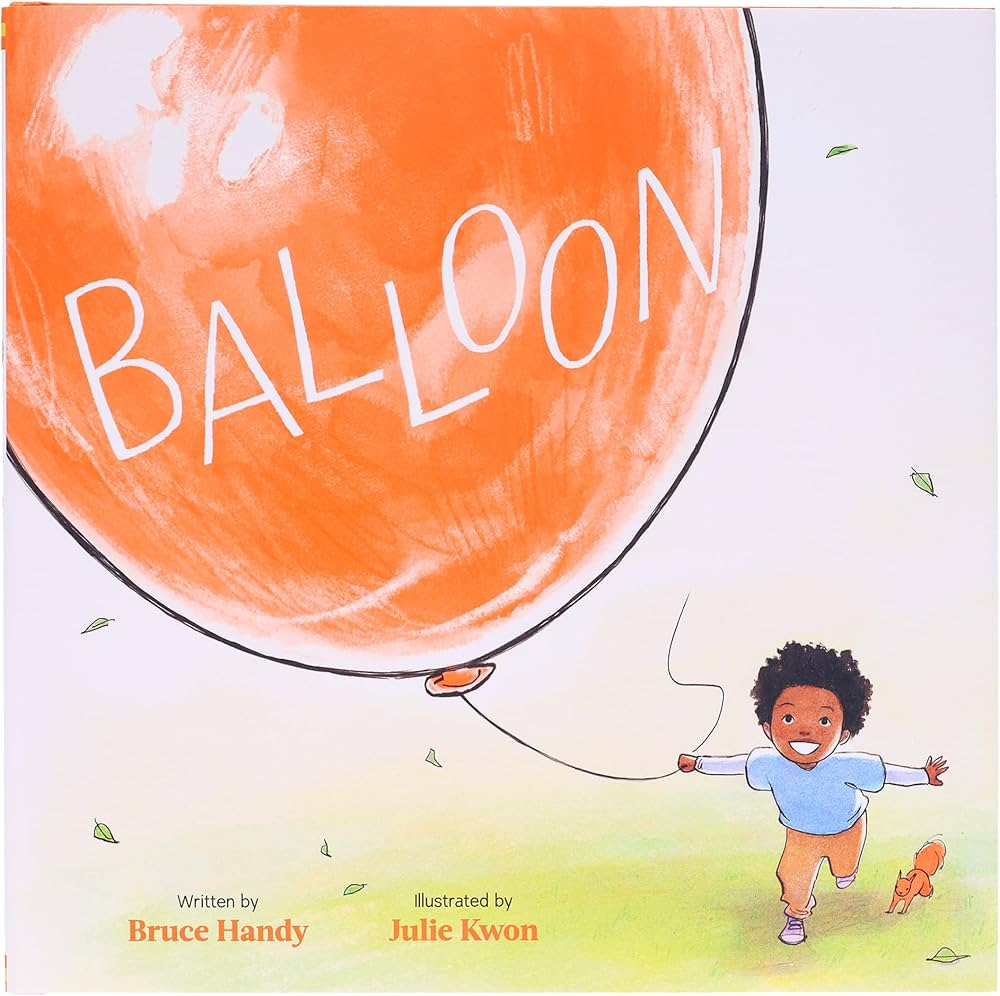
Balloon by Bruce Handy, illustrated by Julie Kwon (Chronicle Books, 44 pages, ages 3-7). A young child is devastated when a flock of pigeons causes him to let go of his orange balloon. Refusing a replacement, he goes on a search for the balloon through the city park. Illustrations show different objects that appear to be the balloon–a bit of an orange frisbee hidden by a picnic blanket, an orange cap on the head of a musician obscured by a crowd–but when the full picture is revealed, it’s never the balloon. Finally, the boy spots something else orange: a kitten for sale. He and his mom adopt the kitten, and the boy tells it, “Balloon. That’s your name.” As the two sleep together on the last page, astute readers will notice the tiny shadow of a balloon against the full moon. Includes an author’s note that tells how the story was inspired by his son, who also named his cat after a lost balloon.

This nearly wordless book is so much fun, giving kids an opportunity to guess what the various orange objects are and to spot the squirrel that enlivens many of the illustrations. The final page provides a most satisfying conclusion, not only with the boy and his new kitten, but the balloon in the background and a stuffed squirrel sitting on a bookcase.
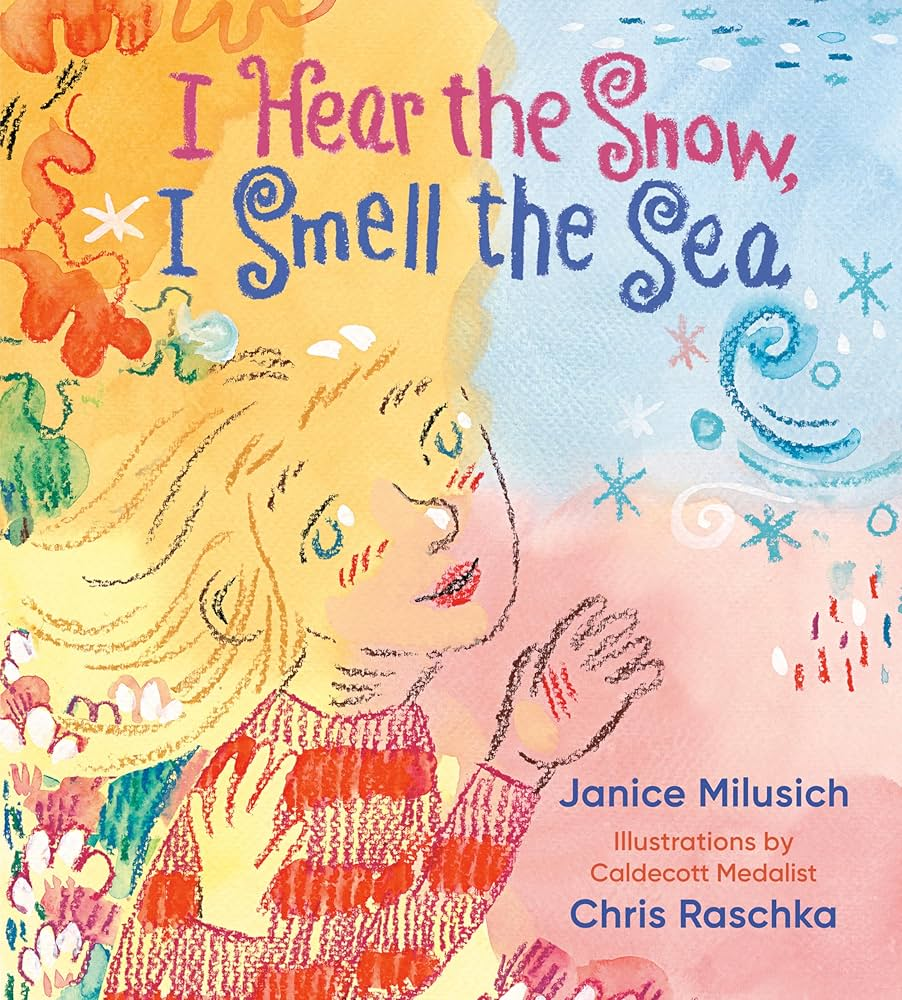
I Hear the Snow, I Smell the Sea by Janice Milusich, illustrated by Chris Raschka (Anne Schwartz Books, 48 pages, ages 4-8). Neveah enjoys the four seasons with her mother using her senses of hearing, smell, taste, and touch to experience them. Playing in the snow, taking a spring stroll, walking on the beach, and playing in the fall leaves, she enjoys the sounds, smells, and textures all around her. While she never mentions being visually impaired, the story and illustrations imply that, but it doesn’t slow her down from experiencing each season to the fullest.

I have a blind student who started kindergarten this year, which makes me extra appreciative of this book, not only for her, but for her classmates who can learn about perceiving the world through other senses. The simple illustrations do a great job of portraying the different seasons while leaving a great deal to the imagination, which will be inspired by the descriptions in the text.
Orange you ready to celebrate art?

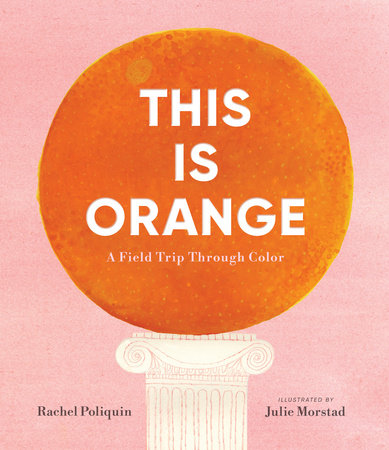
This Is Orange: A Field Trip Through Color by Rachel Poliquin, illustrated by Julie Morstad (Candlewick, 48 pages, grades K-4). Which do you think came first, the color orange or the fruit? If you guessed the color, as I did, you’re in for a surprise to kick off this book that traces the history of the color, then meanders through the worlds of art, science, nature, and history looking for examples of it. Birds’ feet are orange, and so are cantaloupe and mimolette cheese. A color called International Orange that shows up in murky skies or seas is used for astronauts’ suits and the Golden Gate Bridge. You’ll find orange in Halloween jack-o-lanterns, Buddhist monks’ robes (from orange turmeric), and a number of countries’ flags. “Now it is time for you to find orange in your world,” the book concludes. “If you look carefully, you will see orange almost everywhere.”

Although the tone is lighter, this book reminded me of Blue: A History of the Color as Deep as the Sky by Nana Ekua Brew-Hammond, in that both books wake readers up to colors so common that we take them for granted. This would be a great book for an art class, or just to sharpen observational skills. I was disappointed there was no back matter, but the last page does a great job of sending readers off into the world with a new appreciation for the color orange.

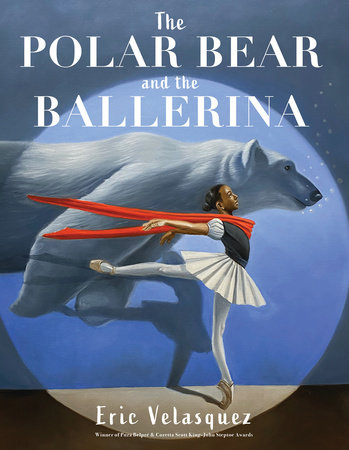
The Polar Bear and the Ballerina by Eric Velasquez (Holiday House, 48 pages, ages 4-8). A young ballerina and a polar bear bond at an aquarium in this wordless book. After the girl leaves with her mom, the bear notices that she’s left her long red scarf behind. Hoisting himself out of his tank, he walks across Manhattan to Lincoln Center, where he’s met with a “No polar bears allowed!” sign at the ticket window. His growl alerts the girl, who leaves the practice room to escort him inside to a seat. Despite disgruntled looks from his neighbors, the bear is enraptured by the show. Afterwards, he returns the scarf, then dances home, where he dreams about performing on stage with the girl. Endpapers give profiles of both the bear and the girl, a soloist at Harlem Children’s Ballet.

Kids will love the adorable polar bear and spunky ballerina in the gorgeous illustrations, and adults can use their story to facilitate conversations about making the arts accessible to everyone. For a moment, I thought ballerina Chloe Maldonado was a real girl, but then I realized the ballets listed on her resume are both books by Eric Velazquez! Those endpapers add some fun and depth to the story, though.

Three feel-good picture books

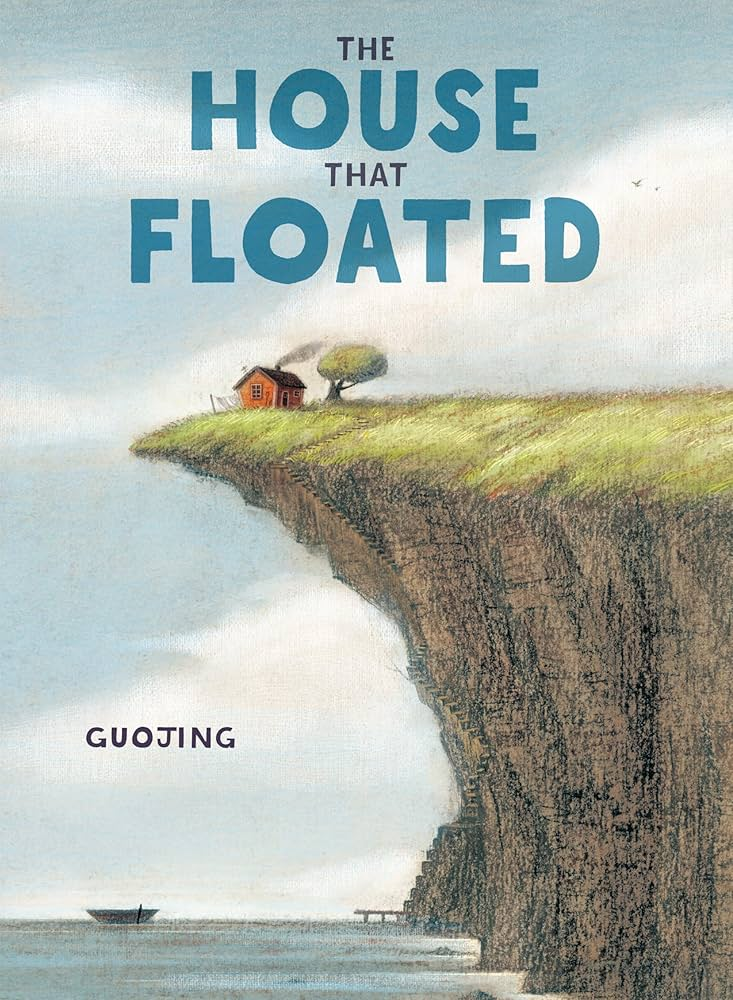
The House That Floated by Guojing (Random House Studio, 40 pages, ages 4-8). A couple lives in a small house perched on the edge of a cliff. Wordless pages show them enjoying their home and the sea below, rescuing a dolphin from a net, then commemorating the moment with a wood carving of the dolphin. They welcome a new baby into their loving home, and the child grows up to love the ocean and dolphins as well. When a storm threatens their home, the resourceful family builds a raft, takes the house off its foundation, and carries it to another cliff across the water. Others in the community help them reassemble it next to a lighthouse, and the final pages show them running toward their new home.

Kids generally love wordless books, and they tend to find a lot of details my old eyes miss, so I look forward to sharing this beautiful and heartwarming story. I liked the message about resilience in the face of change, particularly climate change. I was hoping this would be a Caldecott contender, but it looks as though Guojing lives in Canada.

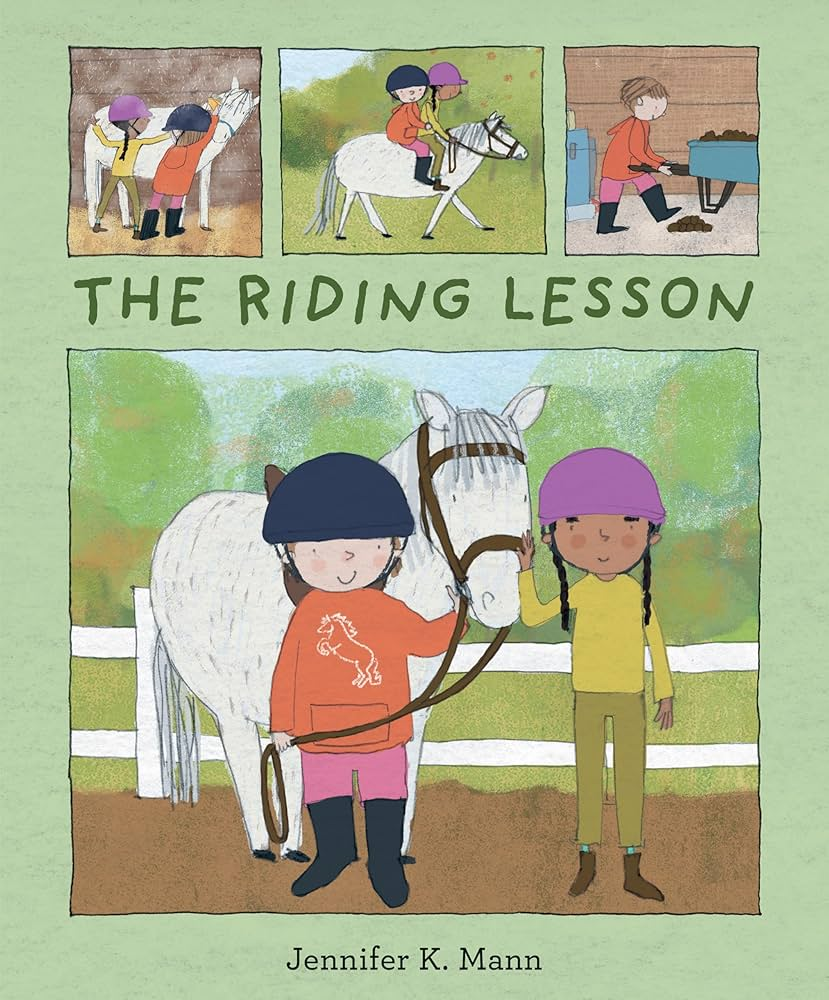
The Riding Lesson by Jennifer K. Mann (Candlewick, 56 pages, ages 4-8). Frances is excited to be going over to her friend Mae’s house for her first riding lesson. Although she’s sure she’s going to love riding–after all, she plays with toy horses all the time–that confidence vanishes when she’s confronted with a real horse named Snowball. Mae takes her through the steps of grooming and tacking up, but when it comes time to ride, Frances loses her nerve. Fortunately, Mae is a patient teacher, and after letting Frances ride double with her, Frances is ready to go it alone. Success! When they get back to the barn, the girls untack Snowball and give her a bath, then Frances gets a lesson in mucking out the horse stalls. All too soon, her mom is there to pick her up, and Frances can hardly wait until her next lesson.

I was delighted to see this book by the creator of The Camping Trip, one of my favorite end-of-the-year read-alouds. Like that book, this one captures both the excitement and fears that come with trying something new. Both narrators have an experienced peer to guide them through and to discover the joys of camping and horseback riding. The story and illustrations serve as a good introduction that will help any budding equestrian before a first lesson.

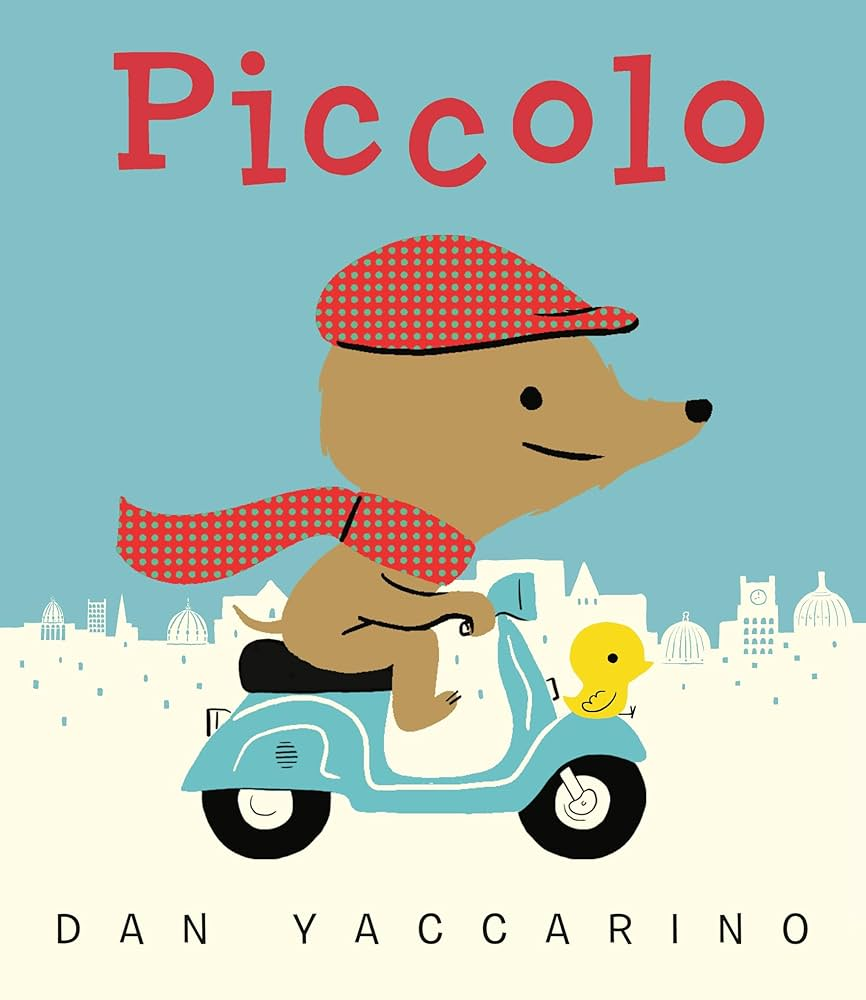
Piccolo by Dan Yaccarino (Christy Ottaviano Books, 40 pages, ages 4-8). Piccolo the shrew gives readers a taste of Italian culture while offering a few lessons in being a good friend. After making a list of where he wants to go in the cità bella (beautiful city), he sets out for the gelateria for some hazelnut gelato. Before he can take a first bite, he hears a cry for help, and dashes off to find his friend Mr. Rosso struggling to carry a painting into the museum. Fortunately, the museum is also on Piccolo’s list of destinations. The rest of the day goes that way, with Piccolo’s helpfulness leading him to enjoy the various places on the list. Alas, his day is so busy that by the time he’s ready to finish his hazelnut gelato, the gelateria has closed. Fortunately, his friend Miss Dolce needs some “help” finishing off her extra, and Piccolo’s day is complete. The end papers show the Italian phrases used in the story with English translations.

Aww, Piccolo and his friends are super cute and teach us all a good lesson about kindness and friendship! The Italian culture and language lessons are an added bonus. This would make a good introduction to young kids going to Italy for the first time.

Surviving tough times

The Library in the Woods by Calvin Alexander Ramsey, illustrated by R. Gregory Christie (Carolrhoda Books, 32 pages, grades 1-5). When a hailstorm destroys their crops, Junior and his family are forced to leave their farm and move to the city. City living feels strange, with indoor plumbing, cars driving up and down the roads, and the need for shoes all the time. But Junior is thrilled when some new friends introduce him to a public library just for Black people. He borrows three books for himself and his parents and excitedly gives his mom a book of poetry by Phillis Wheatley and his dad a book about George Washington Carver. Every night for two weeks, Dad sits out on the porch with his book, until Junior finally learns from his mother that his father can’t read. When Junior gently takes the book and starts to read it out loud, he sees tears of joy in his dad’s eyes. Includes an author’s note about his childhood, the library on which this book is based, and the ways his community and family supported education for themselves and their children.

Junior tells his story with hope and determination, showing a family doing their best to make better lives despite hard times and racism, and emphasizes the importance of books and education. The illustrations place the story in the mid-twentieth century (the author’s note reveals he first visited the library in 1959) and do an excellent job portraying the family and their North Carolina surroundings.

A Place for Us: A Story in Pictures by James E. Ransome (Nancy Paulsen Books, 32 pages, grades 1-5). The author’s note at the beginning challenges readers to think about this question: In a country of vast resources, what is our responsibility to those without access to the basic necessities? The story begins with a woman walking across a city street. Soon we see that she’s picking up her son from school. They go to a fast food restaurant where, after saying grace, they eat their dinner. From there, they head to the library, where she reads a book (Finding Langston by the author’s wife Lesa Cline-Ransome, if I’m not mistaken). When the library closes, they head for a park bench where the boy sleeps with his head in his mother’s lap, covered by her jacket, while she sits up all night. After changing his shirt and washing up at a park fountain, the boy and his mom walk back to school.

This is a powerful story, all the more so for being wordless, leading to greater reflection as you study the pictures. The falling brown leaves made me think winter is coming and wonder what these two will do. Watching them get ready in the morning raised the question of where they do their laundry and how they can live out of two backpacks. The author’s note at the front sets the tone for the story, which will undoubtedly fuel many thoughtful conversations.

Three wordless picture books

The Last Zookeeper by Aaron Becker (Candlewick,, 40 pages, grades K-5). As he did in The Tree and the River, Aaron Becker uses a wordless story to deliver a subtle message about environmental degradation with a dollop of hope woven in. The zookeeper of the title is a large robot who looks after animals at a zoo that is spread out over several small islands. In its spare time, the robot enjoys building toy sailboats and floating them in the zoo’s waters. When drenching rains flood the area, the robot figures out a way to build an ark-like sailboat to rescue the animals. They sail through stormy seas until, exhausted, they collapse on a new group of islands. Another robot appears in a hot air balloon, loads up the whole group, and flies them away to a new paradise.

I can’t wait to share this new wordless masterpiece with the many Aaron Becker fans at my school. I know they will spot all kinds of interesting details that I’ve missed in my initial perusing of the pages. Be sure to start with Jane Goodall’s epigraph to set the tone for the story: “Only if we understand, can we care. Only if we care, will we help. Only if we help, shall all be saved.”

First Day of May by Henrique Coser Moreira (Levine Querido, 40 pages, ages 3-8). A girl, bored inside, is excited to hear a forecast for sunny weather as the calendar turns from April 30 to May 1. She rushes outside, where she encounters all sorts of delights: soaring birds, baby animals with their parents, sweet-smelling flowers, and grassy hills to cartwheel down. Finally, adult hands serve her a cup of tea and cover her with a blanket so she can take a peaceful nap in the grass.

Look no further to find a celebration of spring that will delight and engage preschoolers. The book’s small size and multiple panels is just right for the youngest readers and will encourage them to seek out signs of the new season.

One Giant Leap by Thao Lam (Owlkids, 48 pages, ages 4-8). After donning boots and gloves, a young astronaut heads out into a lunar landscape, climbing up and down hills and encountering a variety of colorful creatures. As mysterious white flakes fall from the sky, the astronaut moves inside, revealing a snow suited child entering a classroom filled with other kids who are wearing clothes that match the colors and patterns of the creatures seen on the walk. A final page shows the route taken by the “astronaut” through a snowy urban neighborhood.

I wrote the review of The Last Zookeeper a few days before the other two and have shared that book with a few classes. I’m a little disappointed that it wasn’t quite as engaging as his previous books have been, and I’m now feeling more inclined to move onto One Giant Leap. I think the surprise ending will lead kids back to the beginning to notice how the pictures that are supposed to take place on the moon give hints as to what is really going on.

Once a Bird by Rina Singh, illustrated by Nathalie Dion

Published by Orca Book Publishers

Summary:  There’s still snow on the ground when a robin starts a journey that offers a bird’s-eye view of the landscape: water, roads, farms.  As the bird makes stops on a playground, at a church, and in a fountain, the reader can see that the world is slowly turning green again.  Finally, the robin lands in a tree outside an apartment building, many of the windows covered by blinds or curtains.  When it starts to sing, people appear in the windows, looking out and connecting with each other over this novelty outside.  Before long there’s a bird feeder hanging in the tree just above the robin’s new nest.  Eggs are laid, babies hatch, and soon people are drawn outside and to be with each other in a new community.  32 pages; ages 4-8.

Pros:  This beautiful wordless book could be interpreted in many different ways: I read three very different reviews that ranged from a bleak environmental message to a post-pandemic liberation.  Readers will enjoy the artwork and the freedom to interpret the story in their own way.

Cons:  Building a nest and reproducing seems like a two-bird job, but there was just the one robin to be seen.

Bunny and Tree by Balint Zsako

Published by Enchanted Lion Books

Summary:  The prologue of this wordless book shows a seed flying through the air, landing on the earth, and sprouting to eventually become a full-grown tree.  In Act One, the tree watches as a wolf chases a pack of rabbits.  Turning itself into a monster, the tree scares away the wolf and offers refuge to one of the rabbits.  Bunny asks Tree for help finding the rest of its pack, and the two set off on a wondrous journey.  After Bunny digs up Tree and puts it in a little red wagon, Tree is able to transform into a train, a boat, and a plane to carry them into the mountains where they at last find the rest of the rabbits.  The tree is transplanted and enjoys a symbiotic relationship with the bunnies, offering them food and shelter in exchange for fertilizer and friendship.  184 pages; ages 7 and up.

Pros:  This incredible wordless story unfolds over the course of nine acts and an epilogue, celebrating a wondrous friendship as well as the magic of the changing seasons.  

Cons:  I didn’t completely understand the beginning of the story until I read some of the book reviews.

The Tree and the River by Aaron Becker

Published by Candlewick

Summary:  The first spread of this wordless picture book shows a young tree standing by the river of the title with the skeleton of a house being built nearby.  A boy and a girl are playing near the tree.  On the next page, the boy (presumably) is grown up with his son, and the house has turned into a farm, with a few other houses near it, and several kids playing around the tree.  As time goes on the small community becomes a town, then a city.  A wall is built, and a war is fought.  The river is diverted and filled with boats; trains and then cars are also used for transportation.  As time goes on, the tree grows, then turns brown and dies as the civilization dies out and falls to ruin.  Finally, an acorn falls from the tree’s one remaining live branch, floating down the river until it takes root on a piece of land by the water.  On the last page, two children stand underneath the new young tree.  32 pages; ages 4 and up.

Pros:  This wordless masterpiece explores the rise and fall of human civilizations with an incredible amount of detail.  I can’t wait to share it with kids to see all the details I’ve missed (this has happened to me with Aaron Becker’s wordless trilogy, Journey, Quest, and Return).  Definitely a Caldecott contender.

Cons:  It’s definitely heavier and grimmer than the Journey trilogy, but there is that spark of hope at the end.

I Forgive Alex: A Simple Story About Understanding by Kerascoët

Published by Random House Studio

Summary:  Recess begins with different groups of kids doing different things: running, stomping in puddles, and hanging out with friends.  One boy pulls out his artwork and displays it for his friends. Alex is bouncing a basketball around the playground, teasing other kids who are trying to get it away from him.  When he throws it, it bounces on the bench where the art is set up, sending the papers into a nearby puddle.  The artist is sad, and his friends take his side, ostracizing Alex.  This continues until the next recess, when Alex tentatively smiles and waves at the boy, who walks over to him.  The two of them talk, then shake hands, and everyone joins in a friendly game of basketball.  The next day, Alex greets his new friend and gives him a drawing of the boy dunking the basketball while Alex cheers him on.  Includes a page with tips for handling similar misunderstandings for kids who have hurt someone, kids who have been hurt, and adults who are helping them.  40 pages; ages 4-8.

Pros:  The creators of I Walk With Vanessa (look for Vanessa and her friend in the illustrations) have produced another wordless masterpiece perfect for SEL education.  Kids will enjoy figuring out what’s going on in the story, and the backmatter makes it a useful tool for parents and educators.

Cons:  The title is kind of didactic.

The Depth of the Lake and the Height of the Sky by Kim Jihyun

Published by Floris Books

Summary:  A young boy and his parents leave their home in the city to drive to his grandparents’ more rural house.  As soon as they arrive, he and his dog head off into the woods to explore.  They’re delighted to find a lake with a dock, and the boy dives in.  Down, down he goes into the water, where he comes face to face with a fish.  The last page shows him and his dog stretched out on the dock in the sun.  48 pages; ages 4-8.

Pros:  A magical wordless picture book that emphasizes the importance of slowing down…both to enjoy nature in the story and to take in all the details in each illustration.  The pictures are mostly black and white with touches of blue and gold.  Most of the story feels realistic, but the underwater scenes have hints of fantasy to them.

Cons:  I was thinking that this book should be considered for a Caldecott until I realized that the author-illustrator lives in South Korea.