Crack the Cascarón: An Eggcellent Not-Just-for-Easter Shellebration by Sara Andrea Fajardo, illustrated by Rocío Arreola Mendoza (Knopf Books for Young Readers, 40 pages, ages 4-8). Toti has declared himself the King of Cascarones and has big plans for the upcoming weekend celebration (presumably Easter). Not content with the traditional confetti cascarones, Toti makes tiny stealth ones as well as some that are filled with slime. The night before the big day, while Toti is sleeping, the rest of his family raids some of his hiding places. When Toti wakes up the next morning, no one’s in the house, and when he goes to look for them in the yard, it’s an ambush! His parents, sister, and abuela inform him that not only is his plan not all it was cracked up to be, but the yolk’s on him as they bombard him with his own creations. He finally hands over his crown to Abuela, who declares herself the Queen of Cascarones. Just wait ’til next year.
I loved meeting Tito and his family, who clearly enjoy each other and aren’t afraid to pull some good-natured pranks. Although Easter is never mentioned, this would make a great read-aloud for the holiday or any time in the spring. Spanish words are mixed in with the English text, celebrating Tito’s family’s heritage. I wish there had been some back matter telling more about the cascarón tradition and maybe giving instructions on how to make them.
A Purr-fect Passover by Jenna Waldman, illustrated by Erica J. Chen (Apples & Honey Press, 32 pages, ages 3-7). An adorable group of kitties gets ready for Passover, preparing special foods like matzah bread, gelfite fish, and matzah balls. When the seder begins, the kittens enjoy dinner as well as traditions like the Four Questions and a retelling of the story of Moses and Pharaoh. Then there’s dancing, sweets, and the search for the afikoman. When the guests leave, it’s time for clean-up, and then bedtime with sweet dreams of the holiday. Includes instructions for making a matzah cover like the one pictured in the story.
This cute rhyming story makes a good introduction to Passover for the youngest kids, covering many aspects of the holiday with fun and engaging text and illustrations. Again, a little more back matter would have been a nice addition, especially for those who don’t celebrate Passover.
As You Wish by Nashae Jones (Aladdin, 272 pages, grades 5-8). Birdie and Deve have been best friends since the first day of kindergarten, but when Birdie tells Deve of her plans to be more “normal” in eighth grade by getting a boyfriend, Deve reacts coldly and before long they’re in a fight. A mysterious new girl named Nancy turns out to be the mythological spider Anansi, who grants Birdie three wishes. Each wish plunges Birdie into a new reality where she gets to see what life would be like as a popular girl, free of her overprotective mother, and worst of all, if she and Deve had never met. By the time she realizes her mistakes, she’s out of wishes, but Anansi has one more surprise in store for her.
This romance is perfect for those just getting into the genre, providing a fun introduction to the Ghanaian Anansi. The romance element is pretty clear from the start, with the plot twists coming from revelations about other characters as well as Birdie’s discoveries about herself as she fumbles her way through alternative realities.
To Catch a Ghost by Rachel Michelle Wilson (Orchard Books, 40 pages, ages 4-8, publication date July 1, 2025). “Bringing nothing to show-and-tell is like wearing shoes without socks. It stinks.” To avoid this situation, the narrator decides to catch a ghost to share with the class. Part one is the search, followed by part two: observe, in which he tries to determine what kind of ghost he’s found. Likes hide-and-seek? Mischievous. Enjoys gardening? An old soul. And almost any kind will appreciate pizza. The third and final part involves catching a ghost, but after building a cage, the narrator can’t stand the sad look on the ghost’s face and lets it go. The friendly ghost leaves behind a picture of the two of them eating pizza, though, and that is good enough for show-and-tell. Thanks to Orchard Books for an advanced copy of this book, which will be available July 1.
Fans of Wilson’s How to Pee Your Pants will enjoy this follow-up about finding a ghost. It would make a great mentor text for procedural writing, a good Halloween read-aloud that includes those who don’t celebrate the holiday, and a nice story for starting a conversation about friendship.
Sharks Unhooked: The Adventures of Cristina Zenato, Underwater Ranger by Patricia Newman, illustrated by Becca Hall (Millbrook Press, 40 pages, grades 1-5). Although Cristina Zenato grew up in Zaire (now the Democratic Republic of Congo), she and her family were Italian and returned to Italy every summer. There, Cristina grew to love swimming in the sea and was especially fascinated by sharks. She longed to learn how to scuba dive, and she finally got her chance after college on a trip to the Bahamas. Cristina decided to move there and spent hours in the water, getting to know the world underwater. Clad in a chain suit, with mackerel treats, she soon earned the trust of many of the sharks. She learned that sharks often get fishing hooks stuck in their bodies, and soon she was removing them from sharks’ gills, fins, tails, and even their throats. At first, she threw the hooks away, but eventually she collected them to use as an educational tool for humans to learn about their dangers to sharks. Includes additional information about sharks and Cristina Zenato, including a note from Cristina with a photo, and a list of books about sharks.
A Line Can Go Anywhere: The Brilliant, Resilient Life of Artist Ruth Asawa by Caroline McAlister, illustrated by Jamie Green (Roaring Brook Press, 40 pages, grades 2-5). Ruth Asawa first became aware of lines when she drew them in the dirt on her family’s farm in California. The middle of seven children, she had plenty of chores to do on the farm, but she still found time to create art, whether it was practicing calligraphy at Japanese school on Saturdays, making bracelets from discarded wire, or painting a prize-winning poster of the Statue of Liberty. When World War II broke out, an invisible line divided the Japanese and American parts of Ruth’s life. Her father was taken away, and the rest of the family was sent to a camp. Ruth practiced her art there, getting lessons from professional artists who had worked for Disney, and eventually was able to leave camp to go to college. Even after she got married and had six children of her own, she continued to create art, first making wire sculptures with thousands of intersecting lines and later getting commissions to sculpt fountains and a memorial for families imprisoned during World War II. Includes a lengthy author’s note with additional information, a couple of photos of Ruth with her art, and a bibliography.
Both Cristina and Ruth followed their unique dreams, despite the obstacles, and although both have had success in their chosen fields, it’s obvious that their joy in life came from following their passions rather than the external rewards. I was happy to read about a Ruth Asawa retrospective opening at the San Francisco Museum of Modern Art on the very same day that I read this book.
The Enemy’s Daughter by Anne Blankman (Viking Books for Young Readers, 288 pages, grades 4-7). Marta and her papa are traveling aboard the Lusitania, trying to get back to Germany with falsified documents. Just as her father’s true identity is discovered, the Lusitania is torpedoed, and the two must fight for their lives. Although they both survive, Papa is arrested immediately upon their arrival in England, while Marta manages to slip away. Hiding in a barn, she’s befriended by an Irish girl named Claire, whose family is poor but manages to find food and shelter for Marta. Marta’s talent for acting and imitating accents comes in handy to conceal her German identity and impersonate a Dutch girl. The two girls work together in a chocolate factory, and Marta saves her earnings for a train ticket to Amsterdam, where she hopes she can book passage back to Berlin. Despite having been taught to hate the British, Marta can’t help but respond to Claire’s friendship and the loving kindness of her family. When Marta’s true identity is discovered by a factory employee, Claire is horrified at first, but eventually she too realizes that their friendship is real and helps Marta escape. The last pages see Marta getting ready to travel to Amsterdam, worried but hopeful that her family will be reunited at last in Germany.
Readers will be drawn into this book right away with the tragic sinking of the Lusitania in the early chapters, followed by Marta’s struggle to survive and find her way home. I was hoping for a bit more resolution to her story, as well as finding out what happened to her father, but it’s a realistic ending given the time and place. The reflections on humanity and who is an enemy occasionally felt a little didactic but could definitely engender some interesting discussions.
Revolutionary Mary: The True Story of One Woman, The Declaration of Independence, and America’s Fight for Freedom by Karen Blumenthal and Jen McCartney, illustrated by Elizabeth Baddeley (Roaring Brook Press, 40 pages, grades 2-5). Mary Katharine Goddard didn’t get to go to school like her younger brother William did, but her mother taught her reading and math at home. When William decided to pursue bigger ambitions, Mary and her mother took over his print shop. After her mother died, Mary took charge, running a successful business until her brother asked her to move to Baltimore to help him with another shop. Once again, he left to pursue other interests, and Mary took over. As news of a revolution made its way through the colonies, Mary engaged in the risky business of publishing news and opinions about independence. After the Declaration of Independence was signed, the Continental Congress moved from Philadelphia to Baltimore, where they made the bold decision to send a copy of the document to each of the thirteen colonies. Mary was chosen as the printer, and she included her name on the declaration, using her full name, Mary Katharine Goddard instead of her usual M. K. Goddard signature. Includes additional information about Mary Katharine Goddard, the Declaration of Independence, and printing and publishing in colonial times; also a bibliography and an author’s note from Jen McCartney that tells how she completed this book after her mother (Karen Blumenthal) died in 2020.
This engaging story of a courageous woman deserves a place in any study of the American Revolution. The text and illustrations are lively, with action words like crank, whoosh, pound, and revolution woven into the pictures. The author’s note about completing the book after her mother passed away unexpectedly at the age of 61 adds a poignant note to the story of a woman who was inspired by her own strong mother.
Old School by Gordon Korman (HarperCollins, 288 pages, grades 3-7). Dexter is a 12-year-old who has spent the last six years living with his grandmother in a retirement community while his diplomat parents travel the world. He’s always been homeschooled, receiving an excellent education from a variety of experienced educators in the community. Unfortunately, his grandma never officially registered him as a homeschooler, and in seventh grade, truancy officers catch up with them and force Dexter off to middle school. At first, he’s a complete fish out of water who talks and dresses like an old man, not a middle schooler. But slowly his kindness and handyman skills start to win over some of the other kids. When Dexter fixes a vending machine with his Swiss army knife and gets expelled for having a weapon, the other kids rally to his defense and start visiting him at his home, where they soon befriend many of the older residents. Young and old alike show up for Dexter’s hearing before the school committee, where a few surprise twists result in an unexpected outcome for both Dexter and his school.
Although Gordon Korman is less than two weeks older than I am, he has written over 100 books more than I have. His books, while somewhat formulaic (this one is told in chapters that alternate among several narrators in classic Korman style), are always engaging and funny, perfect for reluctant readers. The homeschooled hero winning over middle school students reminded me a lot of another Korman book, Schooled (2008) I’ve read quite a few middle grade books with girl main characters this year, so I’m glad to have a couple that feature boys.
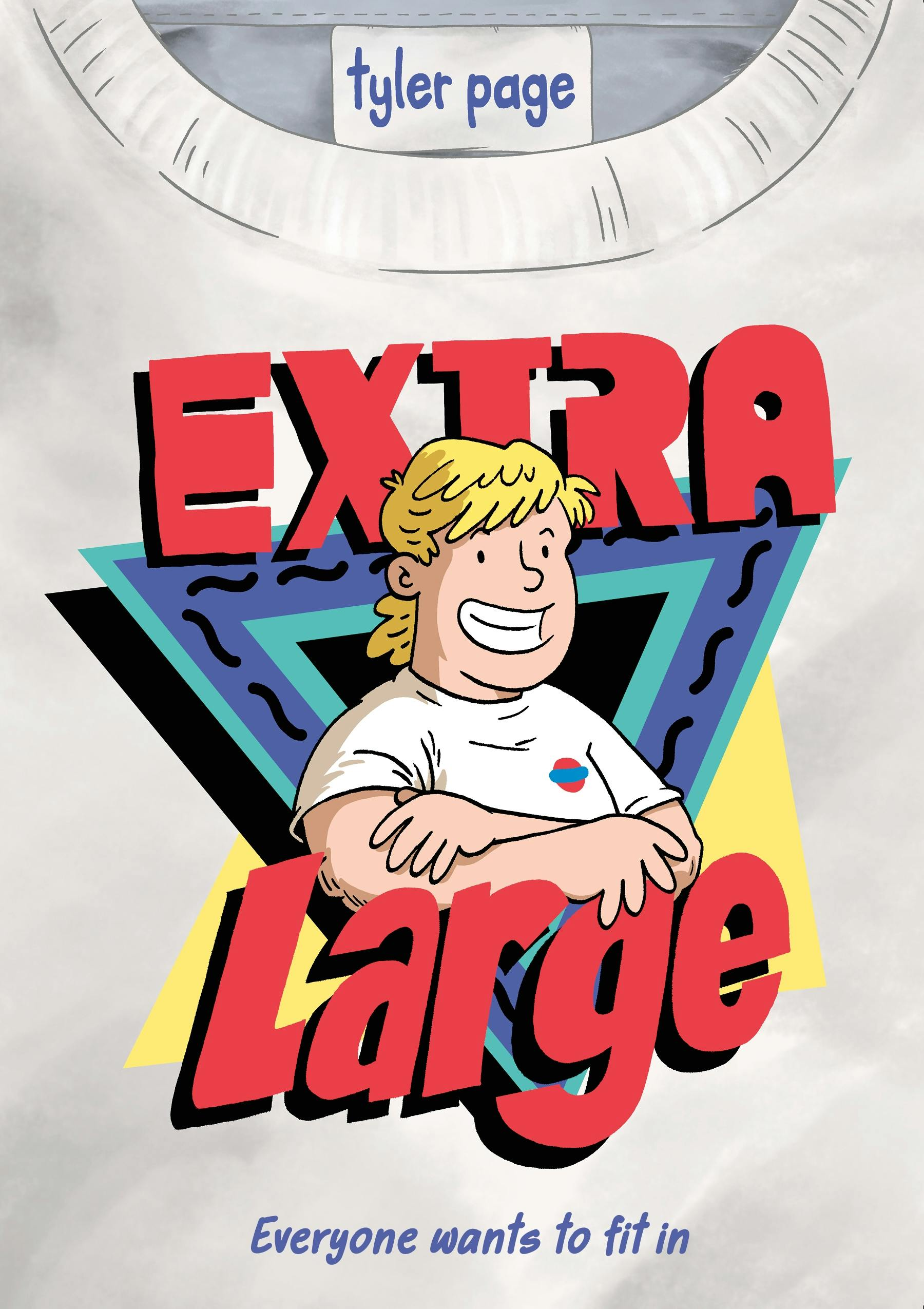
Extra Large by Tyler Page (First Second, 208 pages, grades 4-8). The summer before seventh grade, Tyler starts to be more aware of his body size. When he wins an extra-large T-shirt, he’s told he’ll grow into it. Shopping for back-to-school clothes, he has to get “husky” jeans to be able to fit into them. His dad decides to give up sugar in an attempt to get back to his high school weight and encourages the rest of the family to join him, not always in the kindest way. Tyler notices kids get bullied for their size and for other body issues, and he’s always relieved when it’s not him, taking pains to be the last to change for gym with the hope that no one will see him with his shirt off. When a new girl gets teased about her ears, Tyler joins in, even though he doesn’t see what the big deal is. As the year goes on, Tyler notices more and more that some of his closest friends can be bullies, and he starts to hang out with other kids who are kinder and make him feel good about himself. He saves money for a new bike, enjoying the way he feels when he’s active, and even gets to enjoy some of his family’s menu changes. By the end of the story, Tyler has learned a lot about accepting himself as he is.
Tyler Page’s memoir is funny and realistic, and plenty of upper elementary and middle school readers will see themselves in the pages. It’s nice to see a graphic novel addressing bullying and body image issues with a boy main character.
Zero! The Number That Almost Wasn’t by Sarah Albee, illustrated by Chris Hu (Charlesbridge, 40 pages, grades 3 and up). It’s hard to imagine a world without zero, but for much of human history, calculations were made without it. This book begins with a look at some of the earliest people to use the concept that came to be zero: Babylonians, Mayans, and Indians. Zero came to be accepted in the Arabic world, and European traders to that area brought the idea back to Europe, where it was met with…derision and scorn. While some mathematicians enthusiastically embraced zero, other Europeans mistrusted something that came from a different part of the world and continued to use Roman numerals. The invention of the printing press helped spread the word about zero, and when it was finally universally accepted, it opened the door up up to the complex ideas of modern calculus and physics. Includes additional information about zero and some of the other words we use for the concept, a map of places mentioned in the book, a bibliography, a list of math books for younger readers, a “blurry” timeline of zero, and some notes about the art.
This is a fascinating story of something most of us don’t think about, but which has been a key to scientific and technological advancement. The history of its evolution shows the dangers of not being open to the contributions of other cultures. There’s a lot of information and a huge span of history covered, making me wonder exactly what ages to recommend it for. I can see some older elementary students finding it interesting, but I think it could also be used in middle school or high school STEM classes.
The Five Sides of Marjorie Rice: How to Discover a Shape by Amy Alznauer, illustrated by Anna Bron (Candlewick, 40 pages, grades 2-5). As a child, Marjorie Rice was fascinated by shapes and arts. She learned to read at an early age, starting second grade at the age of five. Despite her interests and intelligence, her parents encouraged her to pursue a career as a secretary, and she didn’t go to college. Marjorie married and had five children. As they grew up, she started reading her son’s Scientific American and particularly enjoyed Martin Gardner’s “Mathematical Games” column. She was intrigued by one column about the problem of finding pentagons that could be tessellated infinitely without gaps. Gardner stated that all such pentagons had been discovered, but a month later, a reader discovered a new one. This inspired Marjorie to look for new ones on her own, and she eventually found four more. In 1995, she was recognized at a Mathematical Association of America meeting with a standing ovation, a true amateur who was motivated solely by her own interests and passion for shapes and art. Includes an author’s note about her personal connections to Marjorie Rice; additional information about the problem Marjorie worked on; information on how to discover a shape; a bibliography; and a couple of photos.
This engaging biography is an inspiration to follow your passions, no matter where you are in life. The storytelling is lively, and I particularly enjoyed the illustrations that do a great job of bringing Marjorie’s work to life. I struggled a little to understand exactly what she was working on, and like the previous book, this is one that may be enjoyed more by older readers with more of a mathematical background.
Eliza and the Flower Fairies (Fairy Door Diaries book 1) by Megan McDonald, illustrated by Lenny Wen (Candlewick, 96 pages, grades 1-3). At the end of the school day, Eliza hurries home and retreats to the space behind her bedroom that she’s set up with as a magical retreat where she can read about fairies. The magic turns out to be real, and she’s transported to a fairy kingdom where she befriends the flower fairies. But when Eliza accidentally enters the realm of two evil witches, she has to call on her own courage and wits to save herself and one of her new fairy friends. Back home again, she discovers that her story has magically appeared in her diary, which she enjoys sharing with her little sister Bee.
New chapter book readers will love this magical tale from the Judy Moody creator, full of enchanting colored illustrations that will spark their imaginations. The story was a little too precious for me (I prefer more of a Princess in Black vibe in my enchanted heroines), but I’m sure it will find a big audience with those who love imagining themselves into fairy tales. I can’t find any evidence of a book 2, but I can’t imagine that this won’t be a series.
Search for the Silver Shell (Coral Keepers book 1) by Robin Yardi, illustrated by Paul Kellam (Scholastic, 96 pages, grades 1-4). Princess Finn is the daughter of Queen Ula, ruler of the queendom of Anjeea. Although Finn is a shark magician with magical power over sharks, she has failed her test to become a Coral Keeper four times. When the evil magician Rozaro (who has allegedly stolen Finn’s father’s magical powers and kept him prisoner) comes to the queendom, Finn has a vision of a silver shell she must find, with the help of her friends, siblings Moon and Light. When Rozaro steals the powers of the Coral Keepers, it’s up to the three kids to go on a quest to save their people. A cliffhanger ending will leave readers eagerly awaiting book 2, due out in June.
Like many of the Scholastic Branches fantasy series, this one is surprisingly complex for an illustrated chapter book under 100 pages and does an excellent job of world building that will draw readers into this new series. I fear the cover will keep some boy readers from going any further, but I hope they will be open-minded it enough to give it a try.
Sea Legs by Jules Bakes, illustrated by Niki Smith (Graphix, 256 pages, grades 3-7). Janey’s lived on board her parents’ sailboat before, but it’s harder going back to that life this time, after going to public school for third grade and making a good friend named Rae. But she doesn’t have much say in the matter, as her family sets sail for the Caribbean. Life onboard is much different, with unique adventures and natural wonders every day, but also sometimes with boredom and loneliness. When they anchor at one of the islands so her parents can make some money, Janey’s excited to see another girl who looks just a little older than she is. Soon, she’s hanging out with Astrid, who seems cool and courageous, but who is sometimes mean to Janey and takes her on adventures that occasionally turn dangerous. Janey slowly realizes that Astrid is living with an abusive father, forced to take care of her younger half siblings and not allowed to go to school, and that the older girl envies Janey’s secure family and opportunity to get an education. When hurricane season hits hard, Janey is sent to live with her grandmother for several months. On her return, the ship is damaged, Astrid is gone without a trace, and Janey has to learn from her parents how to be resilient and get back out to sea once again. Includes notes from the author and illustrator, friends since the age of 12, about how Jules’s childhood at sea and their friendship inspired this book.
Who can resist the lure of a life at sea? I was curious to read this fictionalized graphic memoir about Jules Bakes’s unique childhood. It ended up surprising me, showing both the good and more difficult sides of this life, with Astrid’s story offering a particularly dark version of it. I was hoping for a little more resolution of Astrid’s story and her friendship with Janey, but the ambiguity felt very realistic.
Home by Matt de la Peña, illustrated by Loren Long (G. P. Putnam’s Sons Books for Young Readers, 48 pages, ages 4+). As they did with their picture book Love, Matt de la Peña and Loren Long offer meditations about home. Whether it’s an apartment next to the highway, a house near the airport, Grandpa’s houseboat, or the back of Dad’s big rig, home has a feeling of familiarity, comfort, and security. But what if you lose your home? “Hurricane rains flood your streets. Or a thick black smoke blankets the sky. Or Papa’s garment factory closes down.” You may have to leave the only home you’ve ever known, but slowly you will find your way back with the help of a father or a grandma or a teacher, because it’s those people who really are your home. And when you look up into the sky at a hawk or a mountain or the stars, you’ll remember the home we all share, “promising that all life is one life and when the winds do come they will carry you home.”
I was blown away by how much is contained in this seemingly simple picture book that could be enjoyed by a preschooler or used in a college class to reflect on all the meanings of the word “home.” The text is lyrical and thought-provoking, and as for the illustrations…well, let’s get on with it already and finally give Loren Long the Caldecott recognition he deserves.
Neecy and Nay Nay and the Tangled, Hairy Mess (Neecy and Nay Nay, book 1) by Simone Dankenbring and Syrone Harvey, illustrated by Maya Henderson (little bee books, 112 pages, grades 2-4). When Nay Nay wakes up with a big wad of gum in her hair, Big Mama takes her and her twin sister Neecy to Ms. Yvonne’s hair salon, where a spoonful of peanut butter takes care of the problem. The girls are inspired to open their own salon, which fits in nicely with the entrepreneurship project that they’re working on at school. After a successful style with one of their friends, they expand to facials and manicures, using a creative assortment of household items and producing some disastrous results. Instead of giving up, the girls learn from their mistakes and put together an A+ report on the do’s and don’ts of starting a small business. Includes Big Mama’s snickerdoodle recipe, a glossary of the big words Neecy likes to use, and a preview of book 2, which was released at the same time as this book.
Early chapter book readers will enjoy this new series. Each twin has her own distinctive personality and style, and there’s an interesting cast of supportive characters, including a close friend who lives in a foster family. The girls aren’t afraid to try new endeavors and are resilient when things don’t go as planned. Books 3 and 4 are due out by the end of the year.
Jojo vs. Middle School (Team Awkward, book 1) by Joy McCullough and Veeda Bybee (Aladdin, 192 pages, grades 3-7). Jojo’s first day of sixth grade gets off to a rough start: her mom’s embarrassing new boyfriend, online cat influencer Mr. Meow, has given Jojo a new kitten, who (unbeknownst to her) has chewed a hole in her new leggings. After she realizes that her cat-patterned underwear has been visible to the whole school all morning, Jojo retreats to an abandoned part of the school where she meets three other girls hiding from their catastrophic first mornings. A tentative friendship is born, and when they meet on the second day, they wind up sheltering in place after a bobcat sighting at the school. This results in not only a two-hour conversation that deepens their friendship, but a series of hilarious mishaps that cements it into Team Awkward. They wind up back at Mr. Meow’s with the “bobcat,” having inadvertently saved the day, and Jojo begins to see that Mr. Meow, whom she now calls Paul, may not be so bad. Book 2, featuring Team Awkward member Leah, will be out in June.
This book feels like a bit of a throwback, in a good way, since so many stories like this are being written as graphic novels these days. The chapter book format allows the introduction of many interesting characters, both at school and in each girl’s family, whom I hope we will get to see more of in upcoming books. Try it out on fans of Dork Diaries.
I regret to inform you that I’m ending this women’s history series on a bit of a downer with my trip to Salem to investigate the witch trials there. Salem has taken a horrific event from its early history and turned it into a thriving tourist industry which peaks every October. The Salem I encountered on an early spring Saturday morning was quieter, but there were still people walking around with pointy witch’s hats and plenty of witch- and wizard-themed gift shops and restaurants.
Peabody Essex Museum
The obvious place to start would have been the Salem Witch Museum. I visited years ago, and, while there was a certain educational aspect, it’s also pretty cheesy, with outdated dioramas and narration. I decided watching a life-sized replica of Giles Corey gasping “More weight!” while being pressed to death with stones was an experience I only needed once in a lifetime, so I headed to the Salem Witch Trials exhibit at the Peabody Essex Museum instead.
This is predominantly an art museum, and I wouldn’t recommend paying the $25 admission just for the one exhibit, although that is exactly what I planned to do until I found out that Massachusetts teachers get free admission. The exhibit, although small, was an excellent introduction to the trials, with panels about many of the accusers and the accused and a mural showing a chaotic scene from the trials. It helped me get a sense of the timeline and some of the people involved.
Salem Witch Memorial
From there, I walked over to the Salem Witch Trials Memorial, which is a simple outdoor memorial with a bench for the victims of the trials, each one engraved with a name, how the person died, and the date of execution. The benches are arranged in a semicircle, and people have left flowers on the benches (or, in the case of Giles Corey, stones, which struck me as true gallows humor). It’s right next to the Old Burying Point Cemetery, Salem’s oldest burial ground, and is surprisingly peaceful.
My final stop was The Witch House, which is not really a witch house, just the former residence of Jonathan Corwin, one of the judges who presided at the trials. It’s not too different from many other historical house tours except for a gruesome exhibit exploring cannibalism and how consuming parts of humans, particularly executed criminals, was considered medicinally beneficial for centuries. Corwin struck me as a powerful, wealthy member of the community who made some really bad choices, but to be fair, a lot of other people made those same choices. Sound familiar?
I chose a visit to Salem this month because of its connection with women’s history–18 of the 25 people who were executed or died in prison were women–but I came away with a sense that witch hunts are an unfortunate part of human history that can include people for any race, gender, age, or other classification. The idea of those in power targeting a more marginalized or disenfranchised group didn’t end in 1693, as a glance through any recent news headlines will reveal.
Last year’s picture book It Happened in Salem by Jonah Winter does an excellent job of asking the big questions around the Salem witch trials: Who started the hysteria? Who kept it going? What were their motivations? And perhaps most important, what would you have done? Maybe speaking up for what’s right won’t cost you your life like it could in 1692 Salem, but it can cost you friends, family, your reputation, your money. Once again, it’s all being played out in our time.
If you know of an example, you can add it to the Salem Witch Museum’s Witch Hunt Wall Project, which invites you to think of a situation that fits the formula “Fear + A Trigger = A Scapegoat.” People have been adding entries since 2017, and it’s a fascinating list. I discovered a good example of this in a new book, Dreams to Ashes: The 1871 Los Angeles Chinatown Massacre by Livia Blackburne, illustrated by Nicole Xu (Carolrhoda Books, 40 pages, grades 3-6). Fear of Chinese immigrants living in Los Angeles was triggered one night in 1871 by a gunfight that left a police officer and another man dead. The scapegoats? The entire Chinese population, who became the targets of a massacre that killed eighteen Chinese men, only one of whom was involved in the gunfight, and destroyed homes and businesses throughout Chinatown.
I’ll end by quoting the last page of this book which again makes a horrific incident relevant to today: “How does a country learn from the past? By remembering. By writing the dark stories back into history books. By shining a light on the consequences of hate and working to keep those fires from sparking again. By embracing change. By loving those who dream of a better life and affirming the humanity of all. By stepping forward. Into hope.”




 A Kids Book A Day