Three books about immigration

Finding Home: Words from Kids Seeking Sanctuary by Gwen Agna and Shelley Rotner, photographed by Shelley Rotner (Clarion Books, 32 pages, ages 4-8). Children and their families from around the world come to the United States seeking sanctuary from war, famine, natural disasters, and other dangers. Many of the photos have cartoon bubbles with kids describing in their own words how they felt when they had to leave their countries, what they miss, and the difficulties and joys in their new homes. There’s additional narrative at the end about how some of the families got to the United States, as well as resources for kids, adults, and parents, caregivers, and educators about how to make families feel welcome.

This book has some personal connections to me, because: 1. the author and photographer live near me, and I have met Shelley Rotner, 2. my Quaker meeting is part of a Circle of Care for one of the families in this book, and 3. my school in Springfield has three classes of refugee kids who have missed at least two years of school due to their circumstances. This book is at just the right level for helping kids (and adults) understand what these families have gone through and to help make them welcome in the U.S.

The Circuit: Graphic Novel by Francisco Jiménez, illustrated by Celia Jacobs (Clarion Books, 240 pages, grades 4-8). Francisco Jiménez’s memoir has been adapted as a graphic novel, telling the story of Francisco as a child, moving with his family from Mexico to California, where they became migrant workers, traveling from one farm to the next to pick cotton, strawberries, grapes, and other crops. Francisco loves to learn, but school is sandwiched between jobs, and his story is a series of losses, as he befriends kids he’ll never see again and loses his precious journal in a fire. There’s enough humor and joy to prevent the story from getting too bleak, and the story feels somewhat timeless, although I think it takes place in the 1940’s. The heart stopping cliffhanger on the last few pages will leave readers like me fervently hoping that more of Jiménez’s books will be published in graphic format.
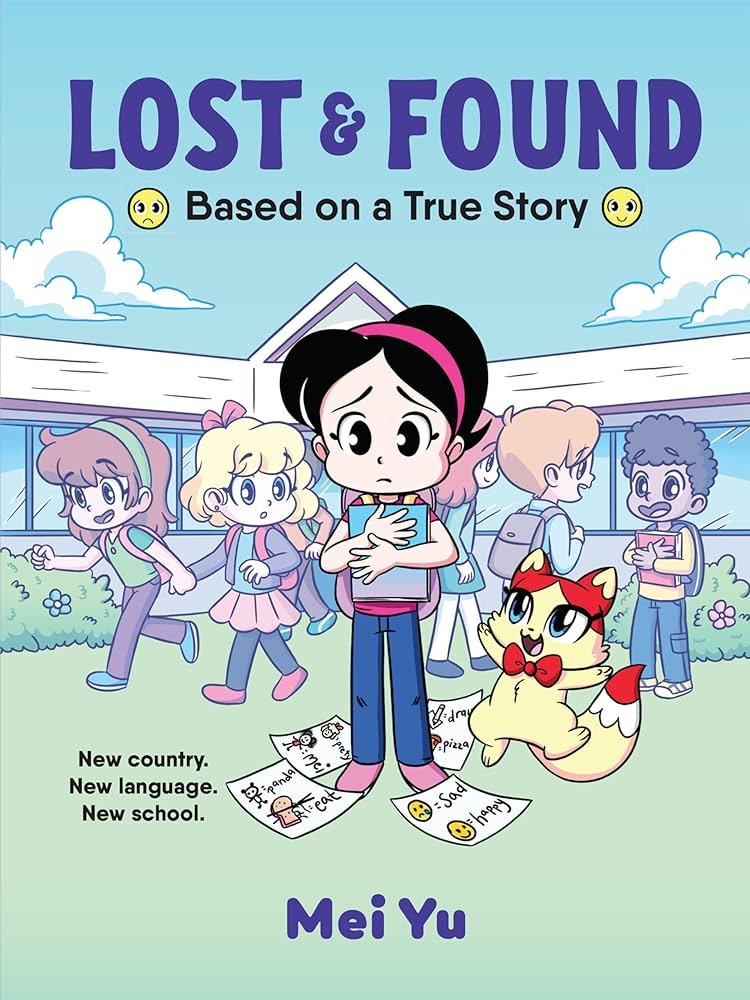
Lost & Found: Based on a True Story by Mei Yu (Union Square Kids, 128 pages, grades 2-5). Mei Yu recounts her memories of moving from China to Canada at a young age (probably six or seven). With English words in a green font, readers can see how few words she understands at school and the scary situations that ensue: using the wrong bathroom, thinking kids are laughing at her, losing her beloved sketchbook. Mei eventually uses the sketchbook to create a collection of English words, and before long, she is able to communicate and begin to make friends. An author’s note gives more information about her experience, as well as a simple glossary of Chinese words. There’s a funny bonus story about how Mei got her beloved toy cat, who appears real to her, a la Calvin and Hobbes.

It’s a pretty simple story, but the difficulties of immigration are presented in a way that beginning readers will be able to understand, and everyone is sure to love the manga-style artwork.
Science Friday

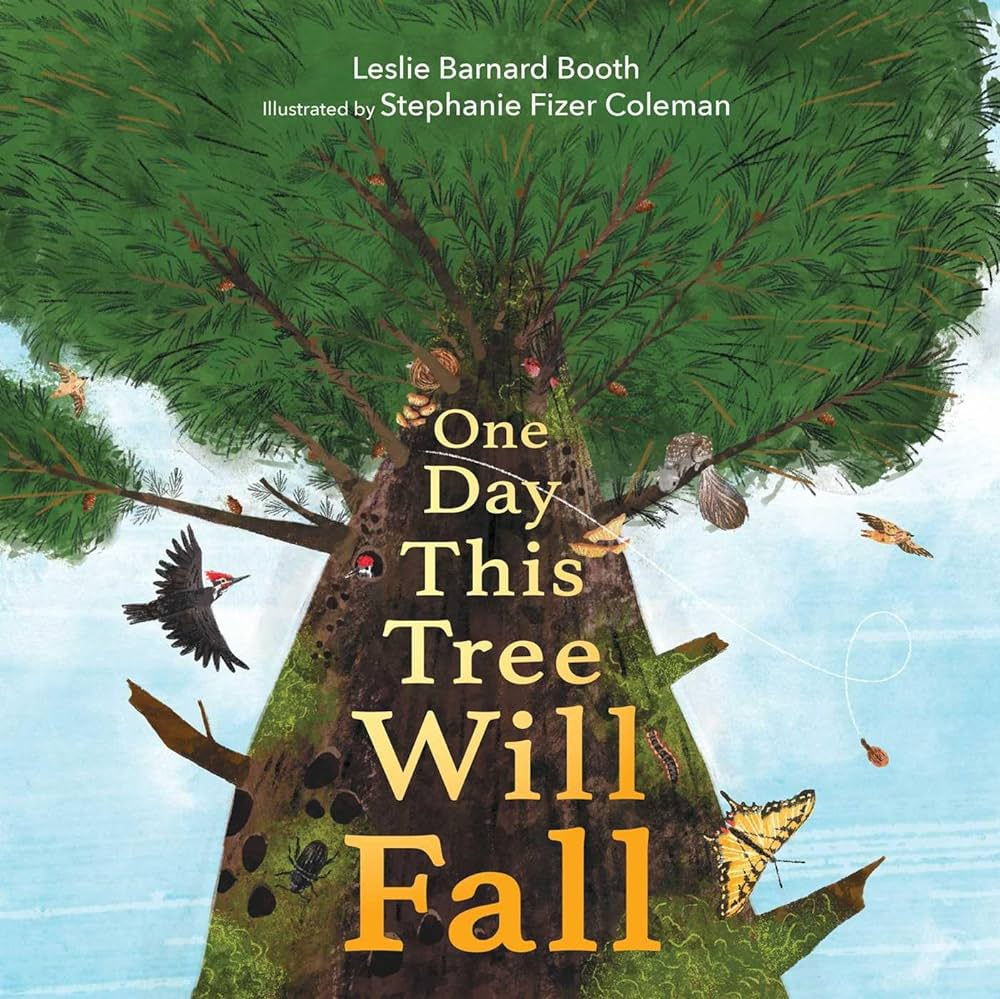
One Day This Tree Will Fall by Leslie Bernard Booth, illustrated by Stephanie Fizer Coleman (Margaret K. McElderry Books, 40 pages, grades K-4). “Wounded, worn, twisted, torn. One day this tree will fall and this story will end. Won’t it?” To learn the answer to this question posed on page 1, the narrative goes back to the beginning when a seed survives its journey to become a seedling. Its story could have ended before it began, and it could have also been ended by wind, ice, drought, and fire. But the tree survives, becoming a home to many creatures. Eventually, the tree does fall, but even when it’s lying on the forest floor, it provides food and homes to animals. Finally, it becomes part of the soil that supports a new tree seed. Includes additional information about trees and the interactions between trees and people, as well as a glossary and selected sources.

This Book Is Full of Holes: From Underground to Outer Space and Everywhere In Between by Nora Nickum, illustrated by Robert Meganck (Peachtree, 40 pages, grades 1-4). Maybe you haven’t thought a lot about holes, but you’ll start to notice them after reading this book. Whether tiny (a bleed hole in an airplane window) or enormous (the Bingham Canyon Mine in Utah), forming slowly (potholes) or quickly (sinkholes), mysterious (a wormhole) or annoyingly familiar (a hole in your sock), holes generally have interesting stories, many of which are told here. The last few pages cover English idioms that use the word hole (loophole, pigeonhole, a square peg in a round hole) and describe one last hole that’s not really a hole–a black hole. Includes a list for further reading.

Here are two STEM related titles for elementary readers to enjoy. This Book Is Full of Holes has a more unique premise, but I think I’d be less likely to use it as a read-aloud than the beautifully illustrated One Day This Tree Will Fall, which tells a fascinating story in a way that’s simple enough for kindergarteners and first graders to understand. This Book Is Full of Holes is a bit text-heavier and may lend itself better to reading on one’s own.

Three wordless picture books

The Last Zookeeper by Aaron Becker (Candlewick,, 40 pages, grades K-5). As he did in The Tree and the River, Aaron Becker uses a wordless story to deliver a subtle message about environmental degradation with a dollop of hope woven in. The zookeeper of the title is a large robot who looks after animals at a zoo that is spread out over several small islands. In its spare time, the robot enjoys building toy sailboats and floating them in the zoo’s waters. When drenching rains flood the area, the robot figures out a way to build an ark-like sailboat to rescue the animals. They sail through stormy seas until, exhausted, they collapse on a new group of islands. Another robot appears in a hot air balloon, loads up the whole group, and flies them away to a new paradise.

I can’t wait to share this new wordless masterpiece with the many Aaron Becker fans at my school. I know they will spot all kinds of interesting details that I’ve missed in my initial perusing of the pages. Be sure to start with Jane Goodall’s epigraph to set the tone for the story: “Only if we understand, can we care. Only if we care, will we help. Only if we help, shall all be saved.”

First Day of May by Henrique Coser Moreira (Levine Querido, 40 pages, ages 3-8). A girl, bored inside, is excited to hear a forecast for sunny weather as the calendar turns from April 30 to May 1. She rushes outside, where she encounters all sorts of delights: soaring birds, baby animals with their parents, sweet-smelling flowers, and grassy hills to cartwheel down. Finally, adult hands serve her a cup of tea and cover her with a blanket so she can take a peaceful nap in the grass.

Look no further to find a celebration of spring that will delight and engage preschoolers. The book’s small size and multiple panels is just right for the youngest readers and will encourage them to seek out signs of the new season.

One Giant Leap by Thao Lam (Owlkids, 48 pages, ages 4-8). After donning boots and gloves, a young astronaut heads out into a lunar landscape, climbing up and down hills and encountering a variety of colorful creatures. As mysterious white flakes fall from the sky, the astronaut moves inside, revealing a snow suited child entering a classroom filled with other kids who are wearing clothes that match the colors and patterns of the creatures seen on the walk. A final page shows the route taken by the “astronaut” through a snowy urban neighborhood.

I wrote the review of The Last Zookeeper a few days before the other two and have shared that book with a few classes. I’m a little disappointed that it wasn’t quite as engaging as his previous books have been, and I’m now feeling more inclined to move onto One Giant Leap. I think the surprise ending will lead kids back to the beginning to notice how the pictures that are supposed to take place on the moon give hints as to what is really going on.

One of these things is not like the other, take 2

Warrior on the Mound by Sandra W. Headen (Holiday House, 272 pages, grades 4-7). Cato loves baseball more than just about anything and aspires to join the Negro Leagues like his father, Daddy Mo, and his older brother Isaac. Daddy Mo died suddenly four years ago, and Cato is being raised by his grandparents, who have never told him the circumstances around his dad’s death. When white store owner Luke Blackburn builds a new baseball field for his son’s team, Cato and his friends sneak over to try it out themselves. When they’re caught, it’s the beginning of a chain of events that results in not only a baseball game between Cato’s team and the white team, but the revelation of Daddy Mo’s death, his friendship with Luke, and the guilt Luke carries about his role in the murder.

In the middle of all this, Isaac is brought home bloodied and unconscious, having been beaten as he tried to travel home during a break in the baseball season. As Isaac slowly recovers, he coaches Cato, not only in the finer points of baseball, but in surviving as a young Black man in the Jim Crow south of the 1930’s. There’s plenty of back matter to add historical context to this story, and readers will enjoy both the sports action and the history lessons. I did question if a friendship like Daddy Mo’s and Luke’s would have really survived to adulthood in that environment, but I’d like to think that it was possible.

One Big Open Sky by Lesa Cline-Ransome (Holiday House, 304 pages, grades 4-7). Just as I was finishing reading Warrior on the Mound, this book arrived for me at the library. It’s a novel in verse told by three female narrators: 11-year-old Lettie; her mother, Sylvia; and 18-year-old Philomena, an orphan with plans to be a teacher. They’re all traveling west, along with Lettie’s dad, who hopes to find a better life in Nebraska than the one they have in Mississippi. I know I would enjoy this book, but the font was tiny, and then I got distracted by another action-packed book.

And what was that book? I was looking through the most recent Scholastic flyer, and this book caught my eye: The Liars Society by Alyson Gerber (Scholastic, 304 pages, grades 4-7). Much of what is in Scholastic these days is pretty much trash, even in my low brow opinion, but this looked good, and I’ve enjoyed other books by Alyson Gerber. This one is a series opener featuring Weatherby and Jack, who take turns narrating the story. They meet at a sailing regatta, which Weatherby wins, gaining her a surprise scholarship to the prestigious Boston School, a private academy where her dad went and was part of the sailing team.

Weatherby has never met her dad, and as she gets involved with Boston and starts to learn more about her classmates, she begins to suspect that her mom has not been completely honest with her about her father. There’s a web of deception surrounding the school, and Weatherby is no exception. When she and her friends get recruited to join a powerful secret society, some of the lies begin to come to light. The twist at the end reveals an unexpected connection between Jack and Weatherby and leaves plenty of loose ends to investigate in book 2.

This book is a lot less likely to receive starred reviews or awards than One Big Open Sky, but it was a lot of fun! I did think Weatherby’s guilty secret was pretty lame, but she seemed tortured enough about it, and it got her admission into the Liars Society. It’s a promising opening for a series, with plenty of kid appeal for upper elementary and middle school readers.

You might not know it, but these two are poets

Amazing Animals from A to Z by Cece Bell (Walker Books, 64 pages, grades K-4). In her introduction, Cece Bell writes of her love of animal albums, a collection she’s acquired through the years by scouring thrift shops and antique malls. The heyday of these albums was the 1940’s through the 1980’s, when artistic differences (and toileting issues) between the animals and their human producers led to the industry’s demise. Cece has compiled an A-Z collection of her albums, with the lyrics to a song from each, from “My Aromatic Armpit Is Astonishing to All” by armadillo accordion player Arnie Dillow to “You Snooze, You Ooze” by the Zydeco Zebras. Amazingly, a QR code allows readers to listen to a recording of every song in the book. An “About the Artists” section rounds out the collection, with a paragraph about each musician or band.

This incredibly original, creative, and funny book will have kids laughing and rocking out as they enjoy the animal musicians both on the page and on their phones. I confess that the introduction was so convincing that for a second there I thought such albums actually existed. At the other end of the book, I had a brief moment of concern when I noticed that Tom Angleberger isn’t included in the “About the Author” information, but a quick trip to Wikipedia assured me that children’s literature’s favorite wacky couple is still together.

Poetry Comics by Grant Snider (Chronicle Books, 96 pages, grades 2-5). And speaking of favorites, everyone’s favorite orthodontist-by-day-illustrator (and now poet)-by-night has produced a fun and appealing collection of poems, illustrated comic-style. Divided by season, both the poems and the illustrations are brief meditations on nature, school, and life, both funny and profound. The poems are one to two pages, divided into comic book squares, with a line or two in each box, and illustrated with simple figures and backgrounds.

These would make an excellent introduction to poetry for the primary grades. Older students, even middle schoolers, might enjoy trying their hands at poetry comics of their own. All in all, this is a fun and accessible introduction to poetry.

Birds and dinosaurs

Brave Baby Hummingbird by Sy Montgomery, illustrated by Tiffany Bozic (Simon and Schuster, 48 pages, ages 4-8). A hummingbird tells his story, beginning with his birth when he and his sister hatch from eggs the size of navy beans. They’re fed every twenty minutes until the day their mother doesn’t return to the nest. Fortunately, they’re rescued and taken to a place where a human, known only as the Voice, takes care of them until they are old enough to survive on their own. Woven into the story are facts about hummingbirds’ food, flight, bodies, and migrations, and more information is given at the end, including the author’s experience with a hummingbird rescue and ways that readers can help these birds. This lovely book provides plenty of information about hummingbirds, illuminated with beautiful illustrations of the birds at every stage of their lives and the colorful landscapes they inhabit.

The Iguanadon’s Horn: How Artists and Scientists Put a Dinosaur Back Together Again and Again…and Again! by Sean Rubin (Clarion Books, 48 pages, grades K-4). Ever since humans first realized that dinosaurs once existed, they’ve been trying to imagine what these creatures looked like. Using the dinosaurs’ fossilized remains, artists have painted and sculpted prehistoric depictions…and generally gotten things completely wrong. A case in point is the iguanodon’s horn, which turned out to be (we think) a thumb spike. Sean Rubin goes through the evolution of ideas about the iguanodon, showing how increased scientific knowledge changed perceptions about what the animal looks like. He speculates on what the next ideas may be, emphasizing the fact that, barring time travel, we will never know for sure. The endnotes give additional information about each two-page spread.

Dinosaur fanatics will love this book, both the fascinating story of how science works and the illustrations, which are at once informative and funny (I liked the cartoon bubbles showing the comments of the various wrong iguanodon models: “I DO look pretty terrible here,” “Seriously. This is embarrassing.” I felt a little bogged down reading the repeated wrong guesses, but I suspect a true paleo fan will find them captivating.

Celebrating spring holidays

For those who celebrate Easter (March 31 in 2024): Elijah’s Easter Suit by Brentom Jackson, illustrated by Emmanuel Boateng (Doubleday Books for Young Readers, 32 pages, ages 4-8). Every Easter, Reverend White gives a special “Hallelujah” to the congregant who’s got the most spectacular Easter outfit. Elijah’s determined to win, but the stores around town don’t have anything that looks just right. Feeling defeated, Elijah asks previous winners Mother Green and Deacon Brown for advice. They tell him that Easter’s not about winning a competition, but about new beginnings and remembering their culture. They share how when they were kids, they often wore homemade Easter outfits, not being allowed to shop in local stores. Inspired, Elijah makes an outfit from fabrics that have happy memories for him and wows the crowd on Easter morning with his colorful patchwork suit. Hallelujah!

Verdict: A definite winner with funny illustrations depicting Elijah in a variety of interesting outfits on his shopping spree, but also offering a heartwarming message about community and being true to yourself.

For those who celebrate Eid (on or around April 9 in 2024): The Most Exciting Eid by Zeba Talkhani, illustrated by Abeeha Tariq (Scholastic, 24 pages, ages 4-8). When they spot the new moon, Safa and her family start to get ready for Eid al-Fitr. Safa is excited to wear new clothes, get gifts, and get together with family. In the morning, all her wishes start to come true, and she enjoys her presents, especially a new bike. Her cousin Alissa wants a turn, but Safa doesn’t feel like sharing. Later, Safa’s mother takes her through the neighborhood to distribute gifts, and Safa realizes that sharing is one of the best parts of Eid. After a big dinner at the grandparents’, Safa is ready to go home and ride bikes with Alissa.

Verdict: A cute story that introduces several aspects of Eid, in what appears to be a Pakistani family. It definitely has a Scholastic book club vibe to it, and unfortunately, only seems to be available in paperback.

For those who celebrate Passover (April 22-April 30 in 2024): Afikoman, Where’d You Go? A Passover Hide-and-Seek Adventure by Rebecca Gardyn Levington, illustrated by Noa Kelner (Rocky Pond Books, 40 pages, ages 4-8). Kids at a seder dinner search for the elusive afikoman through every room of the house and yard. Sharp-eyed readers will see the afikoman character hiding on every busy page. He’s finally caught, everyone gets a prize, and dinner continues, but the sneaky afikoman is seen riding away in one of the cars on the last page, wishing everyone, “Happy Pesach!”

Verdict: The bouncy rhyming text and Where’s Waldo style illustrations provide a lot of holiday fun, with details about Passover included in the glossary at the beginning, as well as being woven into the story and pictures. Spell check is telling me that the correct spelling is afikomen, but both the title and the glossary of this book use afikoman.

More graphic novels that made me eat my words

Blue Stars: The Vice Principal Problem by Kekla Magoon and Cynthia Leitich Smith, illustrated by Molly Murakami (Candlewick, 176 pages, grades 3-7). Cousins Maya and Riley are almost polar opposites, but they’re forced to share a room at their grandmother’s house when Maya’s military parents are stationed in Japan and Maya’s family moves away from the Muscogee reservations for opportunities in Urbanopolis.

At the start of sixth grade, outgoing Riley gravitates towards gymnastics and a big group of friends, while Maya prefers her own company and working on robotics. They unite against the villainous vice principal, though, when they learn of his plan to cut all after-school clubs to fund the expansion of his detention space. Working together, they discover each one has talents that lend themselves to the defeat of this plot. They begin to see themselves as superheroes, befriending two boys who become their sidekicks and assistants. The kids manage to save their school activities, but the vice principal is still at the school plotting his evil deeds, making a sequel seem inevitable.

Next Stop by Debbie Fong (Random House Graphic, 272 pages, grades 4-7). Pia’s family has endured an almost unimaginable loss, and they are dealing with it in different ways. Her mother has become withdrawn and depressed, while her dad insists that they move to have a “fresh start.” Pia is caught in the middle, blaming herself and trying to navigate her parents’ emotions. When she’s offered a bus trip to a lake rumored to have magical powers, she jumps at the chance.

The journey proves memorable, with a quirky cast of characters that slowly starts to feel like family as they travel to such sites as the world’s smallest corn maze, the Prickly Park cactus cruise, and a motel shaped like a chicken. The tour guide, a friend of Pia’s father, looks after Pia, who develops a memorable friendship with the guide’s daughter. There’s an older couple desperately seeking a cure for the wife’s illness, and a family with a young daughter with whom Pia bonds. The story of the trip is interspersed with flashback scenes in a more muted palette, slowly showing the reader what has happened to Pia’s family. When the tour finally reaches the lake, a dramatic scene unfolds in which Pia begins to get closure and to forgive herself for what happened. It may not be exactly what she was hoping for, but it helps her family move toward healing when she returns home.

Having just disparaged graphic novels for not being more creative, I am now forced to eat my words after reading these two. They both offer something new, and I found the format and story of Next Stop particularly compelling. The family tragedy and the sadness that pervades the story may make it a bit more appropriate for the older end of the recommended age range. As for Blue Stars, I loved the premise and the contributions to the story by both of the award-winning authors. I wished the book had been a bit longer to develop the plot more fully (the girls went from being enemies to close friends in the space of about a page and a half), but I think kids will love this series opener and will look forward to more to come.

Graphic novels with a touch of deja vu

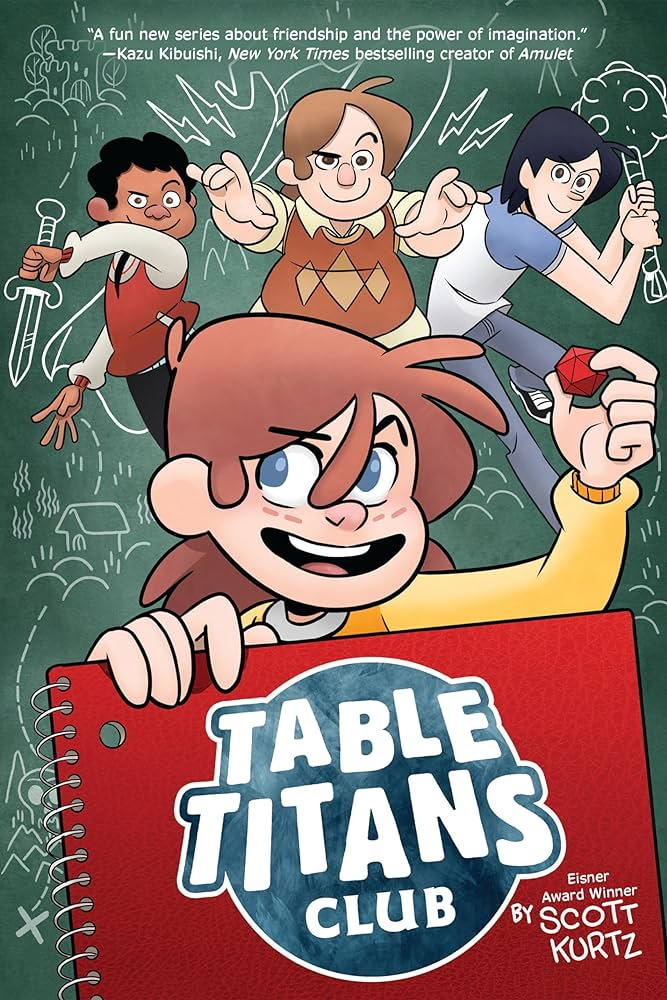
Table Titans Club by Scott Kurtz (Holiday House, 224 pages, grades 3-7). Valeria “Val” Winters is new at school, and her mom’s reminder of a fresh start tips readers off that she may have struggled before. Val’s first day is rough, but she catches the attention of the Table Titans Club, a group of Dungeons and Dragons players. After much debate among the members, one of them invites Val to join their school club. Val’s thrilled, although she’s never played D&D.

Turns out she’s a natural, and all seems to be going well until their teacher sponsor announces that his wife is having a baby, and he has to cut back on his hours. When he tells them that Coach Bitner will be replacing him, the Titans are sure their club is doomed. But Val manages to win Coach Bitner over and secure a spot on the wrestling team. After a number of bumps in the road, Val and the Titans (including another new girl Titan) manage to save the club and secure a wrestling team victory. Val’s announcement about a role-playing fantasy summer camp she’s discovered just about assures a sequel.

Duck and Moose: Duck Moves In! by Kirk Reedstrom (Disney Hyperion, 64 pages, grades 1-3). Moose loves peace and quiet, so when Duck settles in on his antlers, Moose is furious. He tries to convince/trick Duck to find a home in a pond, on a mountaintop, and inside a cave, but Duck is convinced they should be neighbors. Finally, Moose gives up. When Duck realizes how upset Moose is, he sets up a home a short distance away, then invites Moose over for a movie night. They unexpectedly bond over a favorite movie and snacks, and a surprising friendship is born.

These two graphic novels are sure to be big hits, with some funny characters, situations, and artwork as well as heartwarming conclusions. However, I couldn’t help but feel a sense of deja vu: a loveable troublemaker starting middle school is a familiar graphic novel theme and we’ve seen the introvert/extrovert friendship in other early reader series like Narwhal and Jelly, Beak and Ally, and Frank and Bean. Guess I can’t blame publishers for wanting to go with a sure thing, but a few creative risks would be nice to see as well.

Parks for everyone

Cactus Queen: Minerva Hoy Establishes Joshua Tree National Park by Lori Alexander, illustrated by Jenn Ely (Calkins Creek, 40 pages, grades 1-4). Minerva Hoyt grew up in Mississippi, where she loved to play outside and was not afraid to speak her mind. She grew up, got married, and moved to Pasadena, California with her husband. When Minerva needed a break from the city, her favorite place to visit was the Mojave Desert.

Over the years, Minerva watched as people from Los Angeles slowly stripped the Mojave of its cacti, yucca, and Joshua trees to transplant (usually unsuccessfully) to their gardens. To try to preserve this ecosystem, Minerva did something similar, but for a different purpose–she gathered plants from the desert and created an exhibit at the 1928 International Flower Show to raise awareness. Later, she worked to turn some of the Mojave into a national park. There was quite a bit of resistance to this idea from those who thought the desert was a barren wasteland, but Minerva never gave up. In 1936, President Franklin D. Roosevelt signed the law that created Joshua Tree National Monument. Almost 50 years after Minerva’s death in 1945, President Bill Clinton established Joshua Tree National Park. There’s more information about Minerva, Joshua Tree, and national parks, as well as environmental tips and a bibliography in the back.

Tasha’s Voice by Carmen Bogan, illustrated by Floyd Cooper and Daria Peoples (Yosemite Conservancy, 38 pages, grades K-3). In this companion to Carmen Bogan’s Where’s Rodney? a young girl has a transformative experience in nature, just as Rodney does in his story. Tasha is a new girl in Rodney’s class, so shy that she can’t speak when the teacher calls on her or talk to the other kids in the class. When the class takes a field trip to the park, a ranger shows them around, then lets them explore on their own. An encounter with a small turtle helps Tasha to make two new friends and to finally find her own voice.

Be sure to read the last two pages, which include an interview with Daria Peoples who completed the artwork after Floyd Cooper passed away in 2021. There’s also a brief note about parks that includes websites for Outdoor-Afro and Latino Outdoors.

Enjoy these two books for the last part of Women’s History Month! (Although Tasha’s Voice won’t be out until April). They are a celebration of national parks, the healing power of nature, and making outdoor experiences available to groups, like women and people of color, who may not have always felt welcome there.