Life lessons from this year’s Newbery Medal team

I haven’t had the chance to express how thrilled I was that the 2024 Newbery Medal went to The Eyes and the Impossible, which was written by Dave Eggers and illustrated by Shawn Harris. Apparently, these two are not ones to rest on their laurels, as each of them has a new picture book this month.

Soren’s Seventh Song by Dave Eggers, illustrated by Mark Hoffmann (Harry N. Abrams, 56 pages, grades 2-5). Soren is a humpback whale teenager (or the equivalent of that in whale years) who hates the long, droning songs the adult whales sing. After much trial and error, he comes up with his own song, but when he performs it for his peers, they’re not impressed. One even vomits into his underarm (underfin, actually). Does Soren give up? No. He takes the feedback, particularly from his very blunt friend Hans, and makes revisions. Seven revisions, to be exact. And as he travels through the sea singing his seventh song, he notices that the lobsters are grooving, seaweeds are swaying, and barracudas are boogeying. Soren’s hard work finally pays off, and his seventh song becomes the hit whale song of the year.

Although the narration is third person, it reminded me of Johannes’s voice in The Eyes and the Impossible: funny and wise at the same time, with enough confidence to keep going despite multiple setbacks. It’s kind of a long tale, what with the seven songs and all, but I’m still considering reading it to the tough audience of fifth grade. If they don’t vomit into their underarms, I’ll consider it a win.

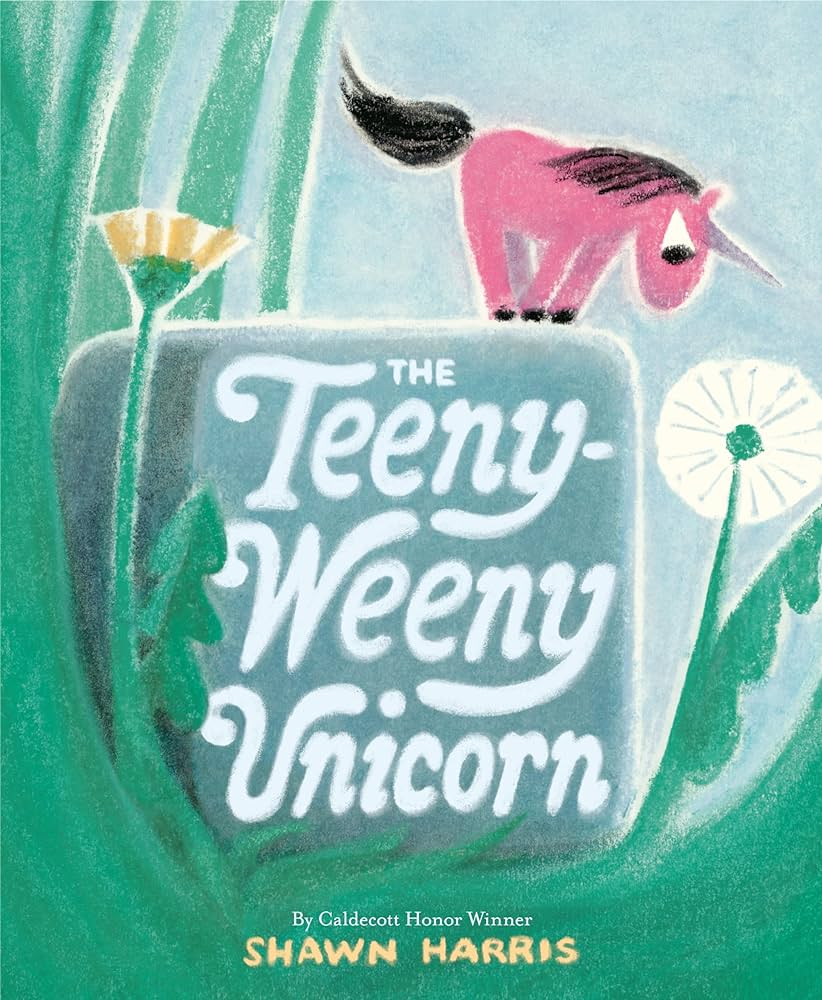
The Teeny-Weeny Unicorn by Shawn Harris (Knopf Books for Young Readers, 48 pages, ages 4-8). The titular unicorn is sort of the Stuart Little of the unicorn world, significantly smaller than the rest of his family. His much larger siblings use him as a piece in their chess games and make fun of his attempts to cannonball into the moat. Tired of their mocking, he runs off into the lawn, where he eventually comes face to face with an angry gnome. It turns out the teeny-weeny unicorn is much bigger than the gnome, and accidentally put his hoof through the gnome’s expensive sports car. Fortunately, the unicorn family is able to make things right, and readers learn an important lesson: We are all teeny-weeny. We are all giant. And we are all just the right size.

Who can resist a unicorn? Kids will love this story for sure, and Shawn Harris’s illustrations add to the fun. Dave Eggers and Soren teach us to be persistent, and Shawn and the teeny-weeny unicorn offer a lesson in self-acceptance.

Some brave girls

Small Shoes, Great Strides: How Three Brave Girls Opened Doors to School Equality by Vaunda Micheaux Nelson, illustrated by Alex Bostic (Carolrhoda, 40 pages, grades 2-5). Ten minutes before Ruby Bridges entered William Frantz Elementary School on November 14, 1960, three other six-year-old girls, Leona Tate, Tessie Provost, and Gail Etienne, started school across town at McDonogh 19 Public School. Escorted by U. S. Marshals, the girls were in a first-grade class taught by Miss Florence Meyers. Although there were other white students at school that day, they quickly left, leaving the girls as the only three students in the building for the rest of the year.

The girls were heroic, as were their parents, Miss Meyers, and the marshals, who helped them find the courage to keep going and made their first-grade year as normal as possible. Second grade proved a bit easier; after Christmas, about twenty-five new students arrived, and the kids were allowed to go outside for recess. Unfortunately, the girls were sent to a different school the following year, where they experienced bullying, racism, and occasional physical violence from students and even some of the teachers. In the end, the girls “survived and helped change our nation.”

This fascinating book will appeal to kids who are familiar with Ruby Bridges’s story. Leona, Tessie, and Gail were all interviewed for the book, as was one of the surviving U.S. Marshals. The text is quite long, and there’s a ton of back matter: more about school desegregation in New Orleans and Norman Rockwell’s painting based on it, what happened to the three girls when they grew up (two opted for all-Black schools in sixth grade, but all graduated high school, and two finished college.) There are also photos, a glossary, a bibliography, and websites with additional information.

Do You Know Them? Families Lost and Found After the Civil War by Shana Keller, illustrated by Laura Freeman (Atheneum Books for Young Readers, 40 pages, grades 1-4). After the Civil War, Lettie and her Uncle Charlie are searching for lost family members. The newspapers are filled with ads, mostly people seeking information about their families, but occasionally someone reporting that a loved one has been found. Lettie holds on to this hope as she saves her pennies and reads the ads aloud to the congregation at church. Finally, she and Uncle Charlie have saved the fifty cents needed for an ad. Weeks go by, until one Sunday, Lettie is able to share the ad from a woman saying she knows their family. “Hallelujah!” rings out through the church, celebrating with Lettie.

This moving historical fiction story of the post-Civil War years weaves some of the real ads into the narrative (the author’s note at the end tells more about them) and doesn’t shy away from stories that don’t end as happily as Lettie’s. The illustrations are beautiful, incorporating the ads and the pennies Lettie saves into the main pictures.

Two artists from Harlem

Jimmy’s Rhythm and Blues: The Extraordinary Life of James Baldwin by Michelle Meadows, illustrated by Jamiel Law (HarperCollins, 48 pages, grades 2-5). Growing up in Depression-era Harlem, the oldest of nine children, James “Jimmy” Baldwin had plenty to do to help support the family. But he always loved words and found time to read everything he could get his hands on. His love of writing and art eventually led him to Paris, where he published his first novel, Go Tell It on the Mountain. Jimmy divided his time between France and the U.S., working for civil rights and interviewing Southerners for his essay collection The Fire Next Time. In 1971, devastated by the assassinations of Malcolm X, Medgar Evers, and Dr. Martin Luther King, Jr., he moved to an idyllic village in the south of France, creating a home that became a gathering place for friends and family from around the world. Includes an author’s note, James Baldwin’s oeuvre, a timeline, and photos on the endpapers.

This is a captivating biography of James Baldwin, with striking art by debut illustrator Jamiel Law. I’m ashamed to admit that I’ve never read anything by James Baldwin, but this book piqued my curiosity about his novels and essays. I do find it difficult to figure out the niche for picture books like this. Many reviewers recommend it for ages 4-8, but in my opinion, there’s not much here that would hold the interest of that age group. I would almost save it for middle school or high school, where it could serve as an introduction to Baldwin’s writing.

Everywhere Beauty Is Harlem: The Vision of Photographer Roy DeCarava by Gary Golio, illustrated by E. B. Lewis (Calkins Creek, 48 pages, grades 2-5). The narrative follows photographer Roy DeCarava as he wanders through Harlem after work on a summer evening, taking pictures as he goes. Most of his subjects are people, although one is a close-up of a crumpled soda can. The narrative, interspersed with quotes from Roy, is like a snapshot from his life. Readers will learn more about him through the additional information, photos, and timeline at the end, with resources provided to do more research.

The text and illustrations feel impressionistic, with just enough of a story to whet readers’ appetites. It would make a great introduction to photography, encouraging kids to look around their own neighborhoods for interesting subjects. Although there’s a list of museums featuring Roy’s photographs, it would have been nice to include a few in the book.

Two picture books that may inspire a family camping trip

Eclipse by Andy Rash (Scholastic Press, 40 pages, ages 4-8). ”Two months ago, I learned there would be a total solar eclipse,” the narrator begins. ”A month ago, I picked out the perfect place and time to watch the eclipse.” The countdown is on as he orders official eclipse glasses a week before the eclipse, travels with his dad a day before to a campsite near the big event, packs up to go to the perfect viewing site an hour before, and arrives a minute before. ”Now, Dad and I are in the dark.” Following this climactic moment, he and his dad will sit in traffic, finally get home, and savor their memories. 

I learned from reading this book that there’s a total solar eclipse in the United States on April 8! It looks like my school will be at about 90-95% totality, occurring right at dismissal, which could very well spell the end of the world. To prepare, I plan to read this fun and informative book to as many classes as I can. I liked the format of story, placing the eclipse as the central event, with the past and future referenced from the moment of totality. There’s additional information about different types of eclipses at the end, and the endpapers have a map showing annular and total eclipses in the US from now until 2048. I couldn’t see the path the April 8 one will take over Massachusetts, because it was hidden by the taped-down dust jacket.

Climbing the Volcano: A Journey in Haiku by Curtis Manley, illustrated by Jennifer K. Mann (Neal Porter Books, 48 pages, ages 4-8). A boy narrates his family’s adventure to climb South Sister, a dormant volcano in the Cascade Mountains of Oregon, using haiku poetry to tell the story. It’s an all-day hike, up past the tree line, into the snow, and finally to the summit! The descent is easier, and they finish the day back at their campsite for dinner and a well-earned rest. There’s additional information at the end about South Sister, the Cascades, what to bring on a hike, the flora and fauna encountered in the book, and haiku.

I love Jennifer Mann’s illustrations; just like in The Camping Trip, she makes you want to get out in nature. And of course, haiku is all about nature, making it an excellent format for describing the journey. This haiku doesn’t follow the 5-7-5 rule that’s often taught in schools, so read the end material to prepare if you’re reading with kids who know that format. 

Three Black history nonfiction books

More Than a Dream: The Radical March on Washington for Jobs and Freedom by Yohuru Williams and Michael G. Long (Farrar, Straus, and Giroux, 272 pages, grades 6 and up). What many Americans know about the 1963 March on Washington begins and ends with Martin Luther King, Jr.’s “I Have a Dream” speech. But the march, the full name of which was the March on Washington for Jobs and Freedom, was much more radical than that one speech might suggest. Impatient with the slow pace of the Kennedy administration to pass even a watered-down civil rights bill, organizers A. Philip Randolph and Bayard Rustin wanted to advocate for more sweeping changes such as school integration, an end to police brutality, and economic justice for all races, including the possibility of replacing capitalism with socialism.

I was fascinated by this story, and there may be extra interest generated from last year’s movie Rustin, about Bayard Rustin, a queer Black Quaker who was an outsider in every way possible, but who never gave up on his vision of justice. Filled with photos, sidebars, and stories of ordinary people who went to incredible lengths to organize and/or attend the march, this is an engaging read, and the 15 pages of notes at the end are a testament to how well-researched it is. If you’re a Kennedy fan, prepare for some disillusionment, such as when Robert Kennedy casually refers to the march as “that old black fairy’s anti-Kennedy demonstration.”

We Are Your Children Too: Black Students, White Supremacists, and the Battle for America’s Schools in Prince Edward County, Virginia by P. O’Connell Pearson (Simon and Schuster Books for Young Readers, 288 pages, grades 5-8). As promised in an earlier post, here’s a more in-depth look at what happened when the Prince Edward County, Virginia public schools closed down for four years to prevent integration. The book starts with a 1951 walkout organized by high school student Barbara Johns to bring attention to the deplorable conditions of her all-Black high school. Her case eventually became part of Brown vs. Board of Education, the Supreme Court ruling that ultimately led to the shutdown of the schools. 

While a segregated private academy solved the problem of education for the county’s white residents, Black families scrambled to find a way to send their children to school. Quakers and other activists around the country offered to host kids, while other students lived with relatives or traveled long distances each day. Some tried to get an education through hastily organized schools in homes or churches. But all suffered in some way; even those who graduated from high school usually had to leave their families and go live in unfamiliar communities, often the only Black students in their new schools. And many simply missed the four years of school, leading to poor economic outcomes for them as adults.

Sadly, this felt like reading a blueprint of efforts today to use vouchers and “school choice” to keep schools segregated and to diminish or even eliminate public education. The story is infuriating, and so is the fact that it’s not more widely known about. There’s a lengthy timeline at the end that puts the events of the book into context with what else was happening in the civil rights movement at the time, as well as a bibliography, index, and notes.

Unequal: A Story of America by Michael Eric Dyson and Marc Favreau (Little, Brown Books for Young Readers, 368 pages, grades 7-12). ”This is a book of truth. So we’ll start by telling you the stone-cold fact that there are many people who do not want you to read it.” American history has been whitewashed time and again, the authors state in their prologue, by people who don’t want to “feel victimized or collapse in a puddle of guilt.” True history is important, though, and they relate it in twenty chapters, each opening with a contemporary scene demonstrating that the injustices of the past often continue into the present. 

Topics range from school segregation to Jim Crow and lynching to voting rights to police brutality. Each chapter could easily stand on its own to teach a particular topic and tie it to current events. The writers tell their stories compellingly in a way that would undoubtedly engage both middle school and high school students. The final chapter, about Nikole Hannah-Jones and her struggles to teach Black history, would make an excellent introduction to a wide range of history classes. Almost 30 pages of notes and a comprehensive index round out this well-researched book.

I can’t remember how I heard about this book, but somehow I had it in my mind that it was from 2024. After reading it, I discovered it was actually published in 2022, but it’s certainly still timely and having put in the effort to read it, I’m including it with the 2024 books.

Happy Valentine’s Day! Happy Lunar New Year! I read a YA romance!

Lunar New Year Love Story by Gene Luen Yang, illustrated by LeUyen Pham (First Second, 352 pages, grades 6 and up). In my quest to mix things up a bit more this year, I’m hoping to expand my horizons, occasionally anyway, to young adult literature.  When I saw the three starred reviews for this graphic novel by an award-winning team, I decided it was a good place to start. I was right. 

Valentina used to love Valentine’s Day until her freshman year in high school, when she learned that her mother, gone her whole live and presumed (by Valentina) to be dead, is still alive and estranged from her and her dad. The ghostly Cupid who has long been her friend turns into a more menacing spirit of St. Valentine and tells Valentina that her family is doomed never to find true love.

Her crush on Les leads her to try lion dancing, and her passion for the dance becomes intertwined with her new romance with Les. But Les is a player, and before long, Valentina begins to wonder about his quieter, more serious cousin Jae. A series of misunderstandings keeps them apart, almost forever, but as Valentina grows and learns more about herself and her family, she finally finds the courage to set things right.

Wow, YA romance is a more serious business than the innocent middle school crushes of middle grade literature! There is true love to be found here, but I can’t think of anything that would raise red flags for middle school librarians. Most of the reviews I saw recommend it for grades 8 and up, but I think some sixth and seventh graders would enjoy it, too. Even if they’re not into romance, there are plenty of interesting family and cultural issues to keep many readers satisfied. And the art is truly spectacular, particularly the renditions of the lion dancing. Although it’s only February, I’m sure this will be an awards contender next January!


New Black history picture books

With Martin Luther King, Jr. Day in January and Black History Month in February there are always new books about Black history to start the year off. Today, I bring you three nonfiction picture books, but there’s more to come! Stay tuned for some historical fiction and longer nonfiction–even a YA book, as I expand my horizons in the new year.

Fighting With Love: The Legacy of John Lewis by Lesa Cline-Ransome, illustrated by James Ransome (Simon and Schuster/Paula Wiseman Books). This comprehensive look at Lewis’s life begins with John’s Alabama childhood, surrounded by the love of family and church, and continues through his early years of activism, particularly with the Freedom Riders, ending with him about to lead the march across the Edmund Pettus bridge. 

The back matter gives some additional information about Lewis’s life, including a timeline, sources, a bibliography, and photos of the author and illustrator with John Lewis. At 48 pages, each with a pretty good chunk of text, it’s a great and thorough biography, although perhaps a tad long for younger listeners. (48 pages, grades 2-5)

When the Schools Shut Down by Yolanda Gladden, as told to Dr. Tamara Pizzoli, illustrated by Keisha Morris (HarperCollins). When Yolanda Gladden was ready to start school, the public schools in her town of Farmville, Virginia were closed. From 1959-1963, Prince Edward County closed its schools to avoid integration, opening a private academy for white children. Black parents scrambled to find ways to educate their children, and Yolanda went to school at First Baptist Church until she was 10 years old, when the public schools finally re-opened. She was at the top of her class and kept the lessons she had learned in resiliency and pride in her heritage. Includes authors’ notes, photos, a timeline, and sources for further reading.

This is an inspiring story about an important–and shocking–chapter of U.S. history that has often been neglected. However, having just finished a longer book on this topic (coming soon in another blog post), I found Yolanda’s story a bit too rosy. The real story is more complicated and didn’t have this happy of an ending for many kids. (40 pages; grades 1-4)

We Dream a World by Yolanda Renee King, illustrated by Nicole Tadgell (Orchard Books). Yolanda Renee King, the only grandchild of Dr. Martin Luther King, Jr. and Coretta Scott King, expresses gratitude to her grandparents for their vision and hard work. She then shares her own dreams for the future, inviting others of her generation to create a better world. Yolanda has been an activist from a young age, as her parents explain in the back matter, describing the 2018 March for Our Lives where she was asked to address the crowd and made an excellent impromptu speech (watch it here). There are plenty of photos in the back matter, too, as well as some information about Martin Luther King, Jr.

It’s an inspiring read that encourages kids to dream and to speak up for what they think is right, all beautifully illustrated with soft watercolors. It would be easy to get some writing prompts from the text, and I can imagine kids being extremely interested in the backmatter with the photos and description of Yolanda’s activism. A little more editing would have served the book well, giving it a sharper focus. (40 pages; grades K-5)

Please note, I’ve updated my Black History book list, adding books from last year. 

Hiatus

Happy new year!

I usually start posting books for the new year around this time, but I’ve decided to extend my hiatus this year. In December I found myself feeling burned out by this blog as I have never felt before, and it took some serious will power to get through the end of the year. 

After nine years and over 3,000 posts, I’m feeling like it’s time for a change. A couple of weeks ago, I was ready to shut the whole operation down, but as I’ve started to see new books being released in 2024, I’m experiencing some new energy.

I have a few ideas about what I think will come next, and right now I’m guessing that it won’t be a daily review with a summary, pros, and cons. But I want to take a little more time for consideration, so I hope you will bear with me and watch this space for further developments.

I’d love to hear your thoughts! Feel free to leave a comment or email me at jkdawson115@gmail.com.

Five favorite graphic novels

Wildfire by Breena Bard

Published by Little, Brown Ink

A nuanced and timely story about a family’s losses during a wildfire and the emotions that go with that experience, as well as feelings of powerlessness in the face of climate change.

Slime Shop created by Karina Garcia with text by Kevin Panetta, illustrated by Niki Smith

Published by Versify

I didn’t expect to get so emotionally invested in a bunch of slime characters in this cute and charming graphic novel.

Mexikid: A Graphic Memoir by Pedro Martin

Published by Dial Books

This 1970’s road trip memoir strikes the perfect balance between funny and poignant, featuring a memorable immigrant family with ties to both Mexico and the United States. I’d love to see this win some awards next month.

Parachute Kids by Betty C. Tang

Published by Graphix

Betty Tang drew on her own experiences and those of other immigrant families to create this rich and engaging story about three siblings trying to make it in the United States while their parents stay in Taiwan to financially support them.

Hoops by Matt Tavares

Published by Candlewick

Based on a true story about one of the first girls’ high school basketball teams, this graphic novel is fun and fast-paced, showing the uphill battle female athletes faced in the early days of Title IX.

5 favorite nonfiction books

What a Map Can Do by Gabrielle Balkan, illustrated by Alberto Lot

Published by Rise x Penguin Workshop

My wish for a really good map book for young kids finally came true this year. This one covers all the basics and is super interactive in a way that will greatly appeal to early elementary students.

Glitter Everywhere! Where It Came From, Where It’s Found & Where It’s Going by Chris Barton, illustrated by Chaaya Prabhat

Published by Charlesbridge

All the fun (and science, history, and art) of glitter with none of the mess.

Stranded! A Mostly True Story from Iceland by Ævar Þór Benediktsson, illustrated by Anne Wilson

Published by Barefoot Books

Truly one of the quirkiest nonfiction books I’ve ever read, this would make a fun read-aloud for older elementary kids. I enjoyed the running gag that there was one untrue thing in the story, demonstrating that truth really is stranger than fiction.

The Indestructible Tom Crean: Heroic Explorer of the Antarctic by Jennifer Thermes

Published by Viking Books for Young Readers

I’m a huge fan of Jennifer Thermes’s art, and she successfully combines it here with the riveting story of Irish explorer Tom Crean. This book inspired me to see a one-man show about Crean when I was in Dublin this summer, which I also highly recommend.

Cut! How Lotte Reiniger and a Pair of Scissors Revolutionized Animation by C. E. Winters, illustrated by Matt Schu

Published by Greenwillow Books

I’m always up for a biography of an interesting woman, and I enjoyed learning about Lotte Reininger, whose extreme perseverance and dedication to her art revolutionized the world of animation.