Remember Us by Jacqueline Woodson

Published by Nancy Paulsen Books

Summary:  Jacqueline Woodson drew on her childhood experiences growing up in the 1970’s Bushwick neighborhood of the Bronx to create the characters of 12-year-old Sage and her friends.  Sage is the best basketball player in the neighborhood, a talent she inherited from her late father, a firefighter who died on the job.  Fire is on the minds of everyone in the community that summer, as buildings are burning down with increasing frequency.  Sage’s mother is working hard to move out of Bushwick and into a safer brick house.  As the summer moves on, Sage has a frightening incident that leaves her questioning herself and temporarily giving up basketball.  Her good friend Freddy helps her get back, making it even harder when she learns that she’s moving at the end of the summer.  The last few pages move forward in time, showing how Sage makes a new life for herself in Queens and how her friendship with Freddy survives into adulthood.  Includes an author’s note about Jacqueline Woodson’s childhood experiences that inspired the book.  192 pages; grades 4-7.

Pros:  A poetic memoir that introduces readers to a close-knit community that’s being ravaged by circumstances beyond their control.  Sage deals with some tough emotional issues but is sustained by the love of family and friends, all of which is subtly expressed through Woodson’s beautiful writing.

Cons:  There was a brief mention near the end that landlords were responsible for the fires.  I was curious to learn more, but there was no mention of that in the author’s note.

Animals in Pants by Suzy Levinson, illustrated by Kristenand Kevin Howdeshell

Published by Harry N. Abrams

Summary:  “Don’t put a goat in overalls. Really. I mean it. They tend to eat their overalls. Trust me. I’ve seen it.”  Yet the goat and a couple dozen of her friends are rocking their pants, from jeans to lederhosen to slacks (for yaks).  Each poem is just a few lines long, accompanied by humorous illustrations, making this short enough to easily read in a single sitting.  Prepare yourself for the end: “The bad news? The tailor’s incredibly slow. It takes him forever to stitch and to sew. To let out a pant seam, it could be a year. To add a new zipper, the timeline’s unclear. He fusses and frets over each inch of cloth…The good news? He’s fast for a sloth.” 32 pages; ages 4-8.

Pros:  Kids will get a kick out of these animals in their pants with impeccably rhymed poems and fun illustrations.  These took me back to A. A. Milne poems of my early childhood.  A perfect introduction to poetry, and for what it’s worth, this is currently #15 on the Goodreads list of Newbery predictions.

Cons:  I almost missed the child saying, “What? You’ve never seen animals in pants?” on the front endpapers, due to the jacket flap covering up most of her.  The good news is, she’s on the back asking the same question about animals in hats, which bodes well for a sequel.

When Moon Became the Moon by Rob Hodgson

Published by Rise x Penguin Workshop

Summary:  In 11 very short chapters, readers learn about the moon–how it was created, its orbit, craters, phases of the moon, and its relationship to Earth.  Most chapters are just a few sentences, illustrated with colorful anthropomorphized celestial bodies that talk with cartoon bubbles.  Kids will gain a greater appreciation for the moon and its effects on Earth and may be inspired to dream of traveling there some day after reading the final chapter on space exploration.  64 pages; ages 4-8.

Pros:  Fans of Stacy McAnulty’s Our Universe series will enjoy this book with its colorful illustrations and humorous, easy-to-understand information.  

Cons:  No back matter? Lunacy.

Curlfriends: New In Town by Sharee Miller

Published by Little, Brown Ink

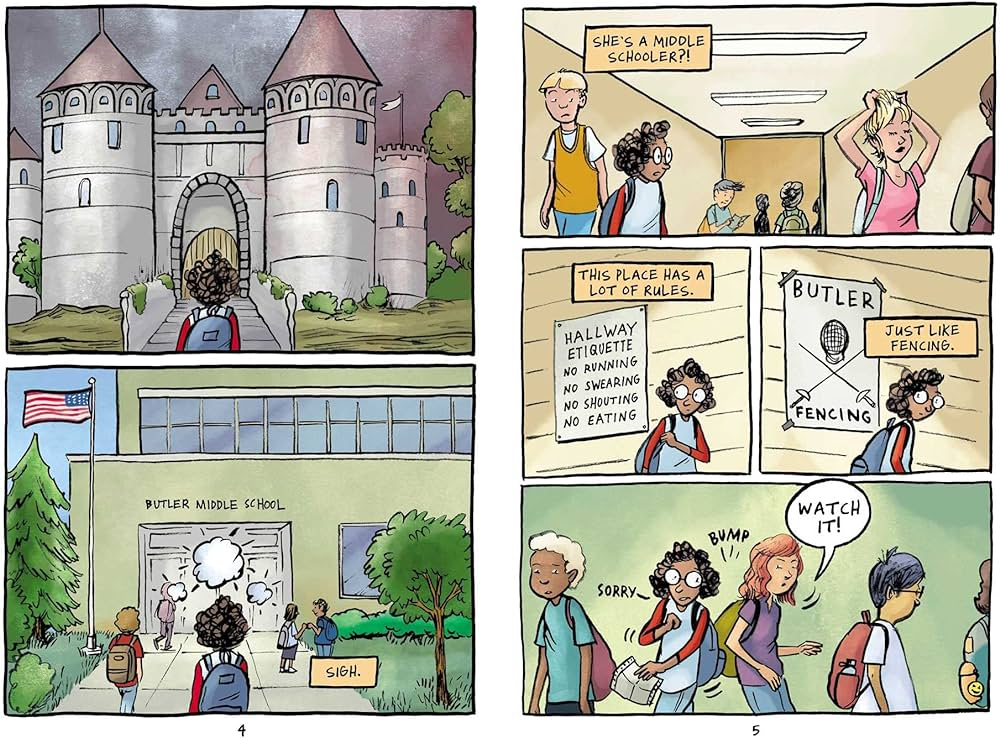
Summary:  Charlie’s lived all over the world as a military kid, but now that her dad’s retired, the family’s settled down in her parents’ old hometown.  It’s tough starting middle school three weeks late, but Charlie’s determined to fit in by studying fashion websites and magazines to perfect her clothes and hair.  A catastrophe the first day of school ruins her hairdo but gets her a new group of friends who call themselves Curlfriends after the curly hair they all have.  Although she likes the girls, Charlie’s afraid that they won’t like her if she shows them her real personality.  A series of mishaps finally shows her that being herself is best, and after letting down her guard, the Curlfriends are closer than ever.  288 pages; grades 3-7.

Pros:  Fans of middle school graphic novels will love this family and friendship story that gracefully delivers a be yourself message and shows readers that you can start over any time.  I’m happy to see this billed as book 1 on Amazon, as it has the feeling of a successful series starter.

Cons:  I was starting to lose patience with Charlie.  She’s lucky she has such understanding parents and friends.

Fungi Grow by Maria Gianferrari, illustrated by Diana Sudyka

Published by Beach Lane Books

Summary:  There are lots of books about plants’ life cycles, but this one focuses on fungi, which grow from spores, not seeds.  The text begins with how the spores travel and reproduce, then describes all kinds of fungi, showing readers a colorful array that they can see, as well as cutaways that show the underground fungal world.  Specific species are described in greater detail with a smaller font.  Fungi can be poisonous, but they can also help humans in a variety of ways.  Includes additional information and a glossary, list of sources, and additional resources.  48 pages; grades K-4.

Pros:  A fascinating and beautiful look at a wide range of species that many readers may have noticed in passing but will now have reason to examine more closely.  Diana Sudyka is one of my new favorite illustrators this year, illuminating the text with bursts of colorful mushrooms and other fungi.  

Cons:  The zombie ant fungus may give you nightmares.

Mabuhay! by Zachary Sterling

Published by Graphix

Summary:  JJ and Althea are both trying to navigate middle school, JJ by trying to fit in even if it means hiding who he really is, and Althea by pretending not to care that she’s lost her closest friends.  To make matters worse, the kids are expected to help out with the family food truck on weekends and school vacations.  Their mother uses Filipino folklore to teach them lessons about hard work and discipline.  But when strange things start happening to both kids, they realize that their family has magical powers and that the folktales are based on truth.  When a monster from the stories threatens the world, it’s up to their family to summon their powers and save the universe.  Along the way, JJ discovers his own worth, Althea learns to value her true friendships, and they both come to appreciate their quirky family and their heritage. Includes an author’s note, a recipe for adobo chicken, and a glossary.  240 pages; grades 4-7. 

Pros:  An excellent blend of middle school angst, Filipino culture, and magical battles against evil forces, with outstanding artwork and a memorable family.

Cons:  While I appreciated the pronunciation guides and definitions footnoted at the bottom of many pages, the font was so tiny that I finally gave up on them.

The Puppets of Spelhorst by Kate DiCamillo, illustrated by Julie Morstad

Published by Candlewick

Summary:  The old sea captain Spelhorst just wanted to buy the girl puppet, who reminded him of a lost love, but the five puppets were a set, so he ended up with the king, the wolf, the boy, and the owl as well.  After his death, they’re sold and wind up in a home with two little girls and their maid.  While the oldest girl is writing a puppet show, the puppets somewhat inadvertently have some amazing adventures.  Finally, it’s time for the show, and they are gathered together again.  They perform a magical story that has repercussions beyond the show, with an unexpected twist at the end paves the way for a sequel.  160 pages; grades 2-5.

Pros:  Kate DiCamillo uses her gifts of storytelling to create fascinating and distinctive human and puppet characters that convey messages that readers will take long after they finish reading the story. Julie Morstad’s illustrations help bring the characters to life.

Cons:  I know I’m in a tiny minority, but I’m not a big Kate DiCamillo fan.  Her language never feels very kid friendly to me.  I would hands-down choose Dogtown as a book recommendation for this age group over this book.

Boyogi: How a Wounded Family Learned to Heal by David Barclay Moore, illustrated by Noa Denmon

Published by Candlewick

Summary:  A family is struggling after the father comes home from a stint in the military.  Dad is silent, prone to nightmares, and easily angered.  Mom explains PTSD to their young son (the narrator): “When Daddy was away, some bad things happened…Those bad things harmed his mind.”  One day, the family goes to the YMCA, where Mom and Dad take a yoga class while the boy watches.  Before long, father and son are going every week, gradually getting better at the poses in the class, and Dad makes up the name boyogi for his son.  He tells his son that between yoga and therapy, he’s doing a lot better, making the boy feel happier as well.  32 pages; ages 4-8.

Pros:  An excellent kid-friendly introduction to both yoga and PTSD, with great digital illustrations of lots of yoga poses that kids will want to try.  

Cons:  Some additional information on PTSD and the benefits of yoga would have been a good supplement.

On the Tip of a Wave: How Ai Weiwei’s Art Is Changing the Tide by Joanna Ho, illustrated by Catia Chien

Published by Orchard Books

Summary:  Chinese artist Ai Weiwei spent his childhood in a labor camp after his father, a renowned poet, was targeted by the government.  They lived in an underground hole, where Ai would create sculptures from the dirt.  He grew up to be an artist, studying in the US before returning to China where he was imprisoned for criticizing the government.  After his release, he moved to Germany where he uses his art to bring attention to the plight of refugees, people displaced from their homes the same way he was.  One of his most famous works was created from lifejackets left behind by refugees landing in Greece.  Ai’s art “challenged the world to see differently…[and] invited the world to take action.”  Includes four pages of additional information and photos.  48 pages; grades 3-8.

Pros:  A beautiful and moving tribute to Ai Weiwei’s work with illustrations in shades of blue and orange that incorporate photos of refugees and his art into the pictures.

Cons:  I think this would be a very difficult book for kids to understand without having a considerable amount of background knowledge.  I was pretty confused by the story until I read the information at the end. 

Come and Join Us! 18 Holidays Celebrated All Year Long by Liz Kleinrock, illustrated by Chaaya Prabhat

Published by HarperCollins

Summary:  Throughout the year, a class learns about the holidays different kids celebrate as part of their cultures.  Each child describes the holiday in a paragraph, with colorful illustrations showing a family celebration.  There are sure to be some new ones to many readers, including Obon, Makahiki, and Vesak, as well as some that may be familiar like the Jewish High Holidays, Kwanzaa, and Día de Los Muertos.  At the end of each holiday description is a question for discussion, like “What kinds of stories do you tell on your holiday?” and “Do you gather with family to celebrate your holidays?”  Includes an author’s note about her own childhood experience celebrating Jewish holidays and not observing Christmas, as well as a glossary.  40 pages; grades K-5

Pros:  A fascinating look at other cultures and the special days they observe with appealing illustrations and interesting questions that will help make connections with readers’ own experiences.

Cons:  This felt like kind of a lot to read all at once; it might be better to do a little at a time, or to use it as a resource for learning about specific holidays.