Alabama

This summer I decided to travel to the Deep South. I flew to Nashville, rented a car, and drove to Alabama, Mississippi, and back to Tennessee, where I visited Memphis before returning to Nashville. Aside from a marching band trip to the Mardi Gras when I was 15, I’ve never traveled in this part of the country, and I was curious to experience it for many reasons.

Thanks in large part to books that I’ve read and reviewed here over the years, I have learned far more about Black history than I ever did in school, and I wanted to see some of the places that I’ve learned about. The history of the South continues to have an enormous impact on the United States today, and I wanted to experience for myself what this part of the country is like and to witness the ways that its history is told. I’ll be writing three posts to cover the eight days I spent on this trip.

I arrived in Nashville on July 3, with a plan to start in Birmingham on July 4. Yes, July 4. Not the best planning on my part, as both the 16th Street Baptist Church and the Birmingham Civil Rights Institute were closed for the holiday. I made a quick stop so that I could at least see the outside of the church, then drove on to Montgomery.

I started my tour of Montgomery the next day with a trip to the Rosa Parks Museum and Library. The museum does a great job of bringing Rosa Parks’s contributions to life with a re-enactment of her bus ride and arrest, and plenty of artifacts and information about the Montgomery Bus Boycott.

One recurring theme for me on this trip was the marginalization of women in the civil rights movement, and it started at this museum. I learned that Rosa Parks and her husband lost their jobs and received death threats due to her activism, leading them to move to Detroit. There, Parks continued to work for civil rights, often embracing a more militant philosophy than Martin Luther King, Jr. She was included to the 1963 March on Washington, but only introduced and recognized, not invited to speak.

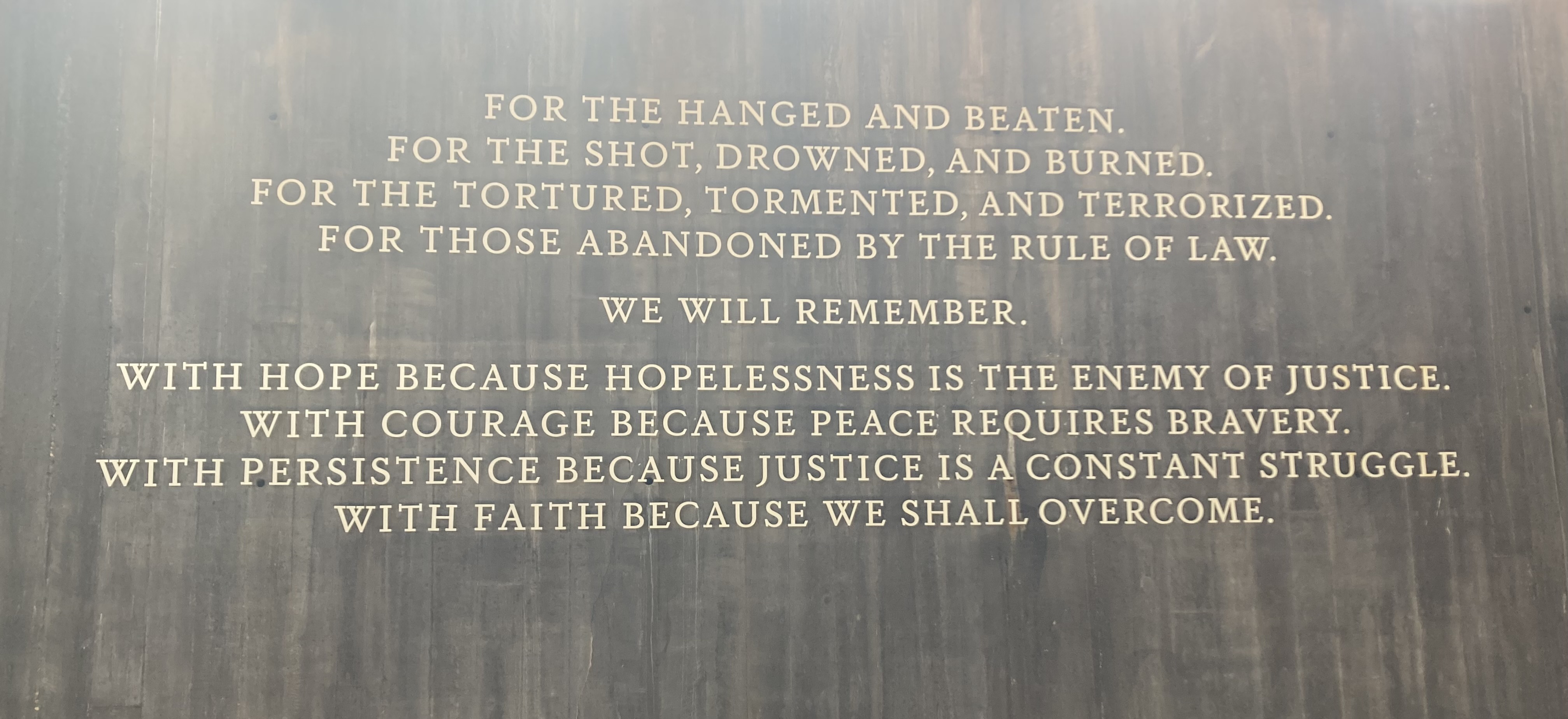
From there, I headed for the National Memorial for Peace and Justice and the Legacy Museum. These are both part of the Equal Justice Initiative, have a total admission fee of $5.00, and are about a five-minute drive from each other. I started at the National Memorial for Peace and Justice, a memorial for the victims of lynching. It’s a 600-acre open-air space on top of a hill: a roof with slab after slab suspended from it, arranged by state and county, each one listing the victims of lynching in that county with each person’s name if its known, race, gender, and reason for and date of their murder.

The Legacy Museum’s full name is The Legacy Museum: From Enslavement to Mass Incarceration, and it explores the legacy of racism in America, beginning with the African slave trade and continuing through slavery, Jim Crow, chain gangs, and the mass incarceration of the Black population that continues today. There are lots of interactive exhibits, and it would be easy to spend most of the day at these two institutions.

They are hard places to visit, and probably best for middle school kids and older, but I wish every American could see them. I would suggest starting with the Legacy Museum. The National Memorial for Peace and Justice is described as a “sacred space for truth-telling and reflection about racial terrorism and its legacy,” and serves as a place to reflect on what is shown in the museum. I saw a man weeping in the middle of the Legacy Museum; you may want to plan on some breaks along the way.

I finished up in Montgomery at the Freedom Rides Museum, which provides an engaging history of the 1961 Freedom Rides, but after my other museum visits, I couldn’t help feeling discouraged by what I learned there. The Supreme Court ruled in 1946 that segregation on interstate buses was unconstitutional, but southern states ignored the ruling. The Freedom Riders endured a bus fire, arrests, and lengthy imprisonments in inhumane conditions just to finally get this 15-year-old ruling enforced.

I asked the tour guide about Diane Nash, whom I recently learned about from the book Love Is Loud by Sandra Neil Wallace.  A leader in desegregating Nashville’s lunch counters and organizing the Freedom Rides, Diane is another woman who was key to the success of the civil rights movement, but whose name is not as well-known as many of the men.  She continues her activism to this day, and I learned that, while Representative John Lewis agreed to record some of the narration heard in the museum, Diane Nash refused. The museum is run by the state of Alabama, and she didn’t want to support the state government in any way.

I had an AirBnB reserved in Newbern, Alabama, and drove through Selma on my way there. I saw a bridge ahead and realized it was the Edmund Pettus Bridge made famous by the brutal beatings of demonstrators on Bloody Sunday, March 7, 1965, and by the Selma-to-Montgomery march. I stopped for a photo and walked around the interpretive center there. I had plans to visit the National Voting Rights Museum and Institute but felt too fried by my day to do much more.

A Black man approached me as I was heading for my car and told me that he had two uncles who were in the 1965 march. They were never bitter, he said, and believed that we are all “99.5% the same.” He and his wife are teachers, and he was selling a newspaper about their work mentoring local kids. He shook his head at the amount of gun violence in his community and the lack of political will to do anything to stop it. I found myself tearing up from all that I had seen that day, and after I bought a paper from him, we hugged at the foot of the Edmund Pettus Bridge.

Books about Alabama

Birmingham

Let the Children March by Monica Clark-Robinson (Houghton Mifflin Harcourt, 2018)

The Watsons Go to Birmingham–1963 by Christopher Paul Curtis (Delacorte Press, 1995)

The Youngest Marcher: The Story of Audrey Faye Hendricks, A Young Civil Rights Activist by Cynthia Levinson (Atheneum Books for Young Readers, 2017)

We’ve Got a Job: The 1963 Birmingham Children’s March by Cynthia Levinson (Peachtree, 2012)

Montgomery

Because Claudette by Tracey Baptiste (Dial Books, 2022)

Twelve Days in May: Freedom Ride 1961 by Larry Dane Brimner (Calkins Creek, 2017)

Rosa by Nikki Giovanni (Henry Holt and Co., 2005)

Claudette Colvin: Twice Toward Justice by Phillip Hoose (Square Fish, 2009)

Rosa’s Bus by Jo S. Kittinger (Calkins Creek, 2017)

Rosa Parks: My Story by Rosa Parks (Puffin, 1999)

Sweet Justice: Georgia Gilmore and the Montgomery Bus Boycott by Mara Rockliff (Random House Studio, 2022)

Love Is Loud: How Diane Nash Led the Civil Rights Movement by Sandra Neil Wallace (Paula Wiseman Books, 2023)

Selma

Turning 15 on the Road to Freedom: My Story of the 1965 Selma Voting Rights March by Lynda Blackmon Lowery (Dial Books, 2015)

Because of You, John Lewis: The True Story of a Remarkable Friendship by Andrea Davis Pinkney (Scholastic, 2022)

The Teachers March! How Selma’s Teachers Changed History by Sandra Neil Wallace (Calkins Creek, 2020)

Child of the Civil Rights Movement by Paula Young Shelton (Schwartz and Wade, 2009)

Like Lava in My Veins by Derrick Barnes, illustrated by Shawn Martinbrough

Published by Nancy Paulsen Books

Summary:  Bobby Beacon has a superhero’s name (“beacons lead people and show them the way”), and now he’s off to a superhero’s school, Academy of Kids With Awesome Abilities, or AKWAA.  His superpower is light and fire, but sometimes if he gets angry, his powers overwhelm him, and he ends up destroying things.  His first teacher, Ms. Flores, doesn’t always treat him respectfully, and Bobby ends up melting his chair.  Having witnessed another student, Pause, get expelled and sent to the Institute of Superpowers for misusing her superpowers, Bobby is afraid he’s headed in that direction.  But a smaller class and a more understanding teacher, Miss Brooklyn, make him feel welcome at school and give him strategies for channeling his powers.  He needs those strategies when the head of the Institute and Pause come looking for him.  He manages to defeat the head and puts in a good word for Pause to get her readmitted to AKWAA.  It’s a happy ending, and the final page hints that a sequel may be in store.  40 pages; grades 1-4.

Pros:  Fun comic book meets Black empowerment in this story of superhero kids learning to channel their powers for goods.  Miss Brooklyn provides a great model for a compassionate teacher, showing the importance of listening and using empathy to reach kids.  The cover and illustrations make this a book that will fly off the library shelves.

Cons:  This felt like it would have worked better as a longer graphic novel with more character and plot development.

Will on the Inside by Andrew Eliopulos

Published by Quill Tree Books

Summary:  Will is passionate about his soccer team and enjoys an easy camaraderie with his teammates, despite his somewhat introverted nature.  Stomach issues and fatigue lead to a diagnosis of Crohn’s disease and being sidelined from soccer.  With more free time, Will starts hanging out with Griffin, a boy who’s been picked on by Will’s other friends for asking one of the boys, Will’s best friend Henry, to the school dance.  As he comes to terms with his chronic disease, the ways it impacts his life, and questions about his own sexuality, Will learns to ask for help when he needs it and to speak up when he sees injustice or bullying.  304 pages; grades 4-7.

Pros:  This is one of the best middle grade books I’ve read this year.  It’s based on the author’s own experiences with Crohn’s and questioning his sexuality, and Will’s voice is pitch perfect.  I’m happy to see so many boy protagonists in the middle-grade world this year.

Cons:  Getting Crohn’s disease in middle school seems like the worst.

Whale Fall: Exploring an Ocean-Floor Ecosystem by Melissa Stewart, illustrated by Rob Dunlavey

Published by Random House Studio

Summary:  When a whale dies, its massive body sinks to the bottom of the deep sea, beginning a 50-year process that supports all kinds of ocean life.  Hagfish, sleeper sharks, and other scavengers are the first to arrive, eventually picking the bones of the whale clean.  Zombie worms feed on the bones, and squat lobsters eat the zombie worms.  The process continues for decades, supporting millions of animals in the deep sea, until every trace of the whale has disappeared.  Includes additional information on the 22 animals included in the main text, a list of selected sources, and resources offering additional information.  40 pages; grades K-4.

Pros:  A fascinating look at a process scientists didn’t know occurred until 1987.  The illustrations perfectly capture the deep sea, with close-ups of some of the creatures featured in insets.  A unique topic that is sure to capture the interest of budding marine biologists.

Cons:  The picture of hungry hagfish descending on the whale carcass may be a bit disturbing to whale lovers. Circle of life, man.

Cake vs. Pie by Sudipta Bardhan-Quallen, illustrated by Stephani Stilwell

Published by Clarion Books

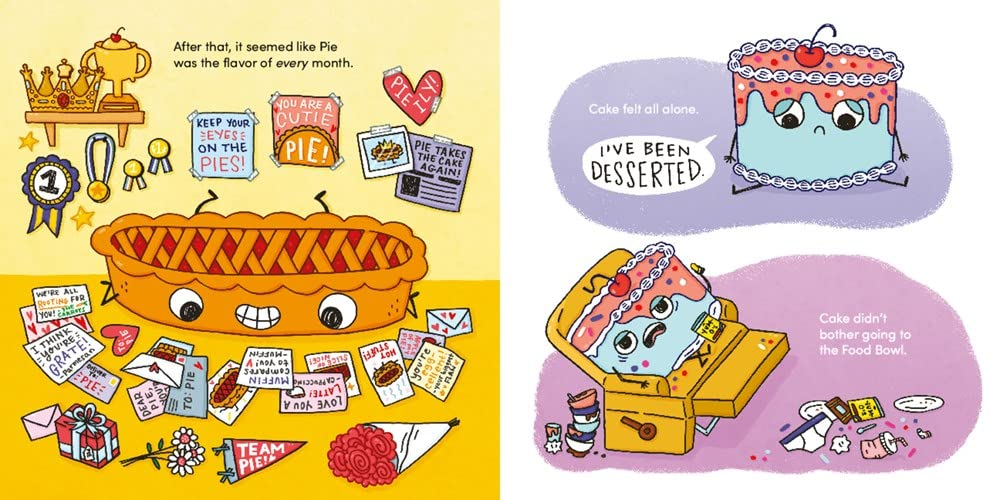
Summary:  Cake is the best kind of friend and rules the bakery until Pie comes along.  “Pie was warm and open.  Charming to the core, Pie was always surprising.”  Cake and Pie become friends, until Cake starts to feel jealous of the attention Pie is getting.  Cake challenges Pie to a food fight, then gets all decked out for the occasion with extra frosting and candles.  It turns into a disaster, prompting Cake and Pie to talk and resolve their differences.  All is well until the last page, which shows Hot Dog and Hamburger going at it in the ring.  32 pages; ages 4-8.

Pros:  A fun and funny celebration of friendship with illustrations that are positively yummy.

Cons:  If you carrot stand food puns, donut pick up this book.

Spanish Is the Language of My Family/El español es la lengua de mi familia by Michael Genhart, illustrated by John Parra

Published by Neal Porter Books

Summary:  Manolo is excited to sign up for his school’s Spanish spelling bee, because “Spanish is the language of my family,” or “es la lengua de mi familia.”  He already knows how to spell a lot of Spanish words, but some are unfamiliar to him, and his abuela helps him prepare.  While they study, she tells him how she and her classmates were punished for speaking Spanish in school.  On the big day, there’s stiff competition, but Manolo wins the bee by correctly spelling “respeto,” the Spanish word for respect, which he has for his abuela, his family, and his Spanish language.  Includes an author’s note with additional information about the history of the Spanish language in the United States and the National Spanish Spelling Bee.  40 pages; ages 4-8.

Pros:  Manolo’s pride in his bilingualism is evident, with Spanish words easily woven into the text, and a contrast to abuela’s shameful experiences with the language when she was growing up.  John Parra’s illustrations are always a treat. I hope this story will inspire educators to check out the Spanish spelling bee.

Cons:  The disgraceful history of the Spanish language in the U.S.

A Human for Kingsley by Gabriel Evans

Published by Little Hare Books

Summary:  Kingsley’s a bit of a free spirit, but he’s decided to own a human.  It’s a big responsibility, so he takes his time choosing.  One woman is too fast, another (hairdresser) doesn’t appreciate the hair Kingsley adds to her collection, and a third has too many “small human subordinates” (kids).  Then he meets a girl whom he finds intriguing.  She’s loud and a bit bossy, but Kingsley hangs around, observing some of her odd hobbies like reading and taking a bath on purpose.  Unsure, Kingsley takes a walk to consider his options.  The girl goes out looking for him, and when she finds him, tells him that she missed him and leads him back to her house.  Kingsley realizes he’s found a human who needs him…and that means he’s also found a home.  32 pages; ages 4-8.

Pros:  Kids will fall in love with the adorable and somewhat droll Kingsley, whose quest for a home reminded me of a Gen-Z’er’s search for the perfect job.  

Cons:  Despite the picture of a dog in a bun on his food truck, I thought Kingsley should have at least considered the hot dog man.

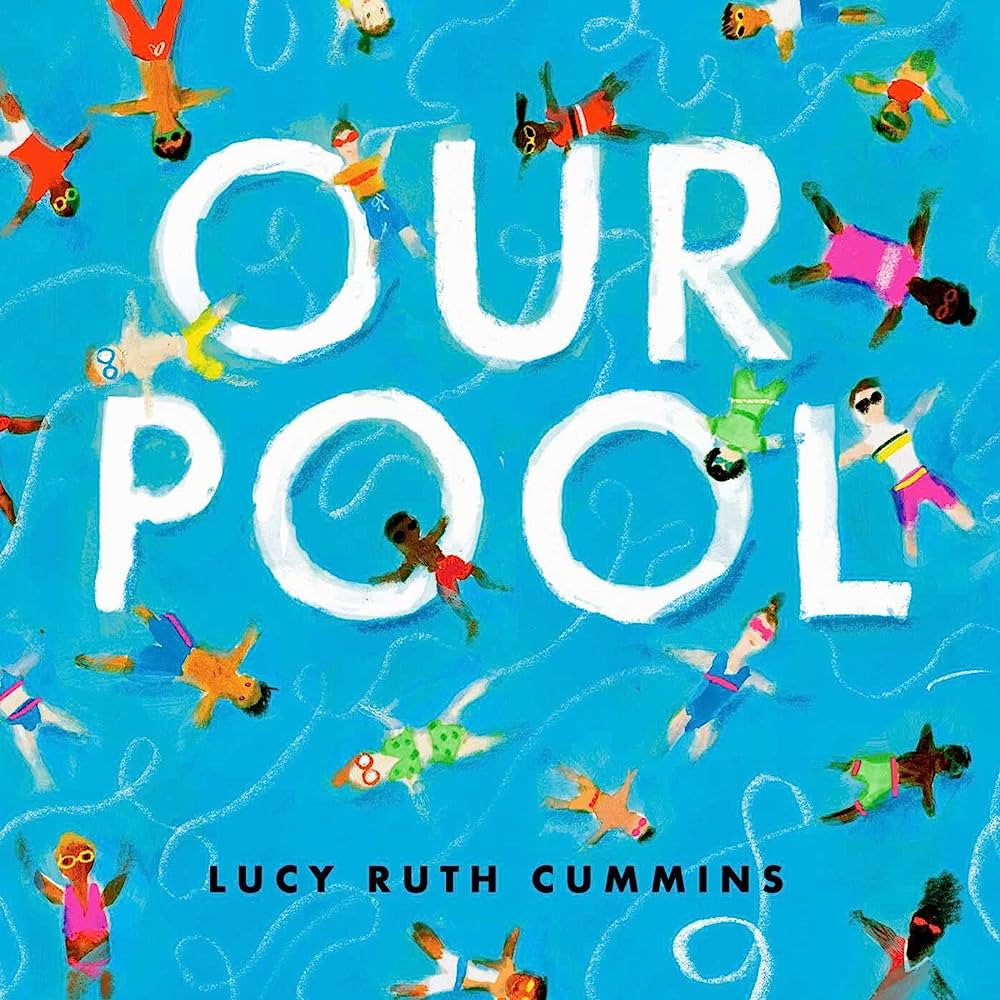
Our Pool by Lucy Ruth Cummins

Published by Atheneum Books for Young Readers

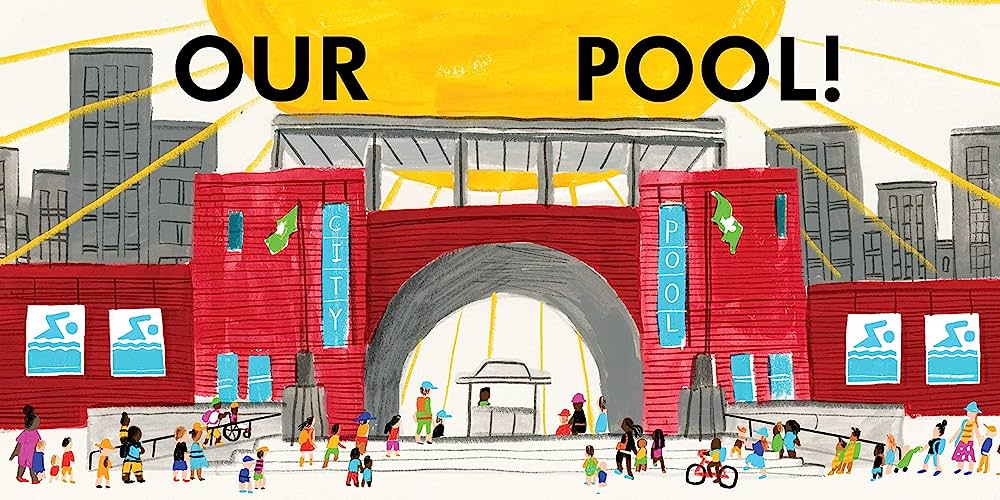
Summary:  It’s Pool Day!  A child and mother join the parade of families heading to the city pool.  After a quick stop in the locker room and a sunscreen rubdown, it’s time to head for the water, joining all kinds of other people who swim, float, or sit on the sides and chat.  There’s Marco Polo, racing, and swimming between friends’ legs, where kids feel like dolphins.  After one last cannonball, the family heads for home, happily making one more stop at the ice cream truck.  48 pages; ages 4-8.

Pros:  A fun slice of summer that perfectly captures the joy of swimming in a crowded city pool on a hot day.  Although the story is narrated in first person, it’s impossible to tell who the narrator is from the busy illustrations, and the diverse cast of characters will mean that many kids will see themselves in the story.

Cons:  I prefer my swimming a bit less crowded.

Ready for Kindergarten by Bethany V. Freitas, illustrated by Maja Anderson

Published by Clarion Books

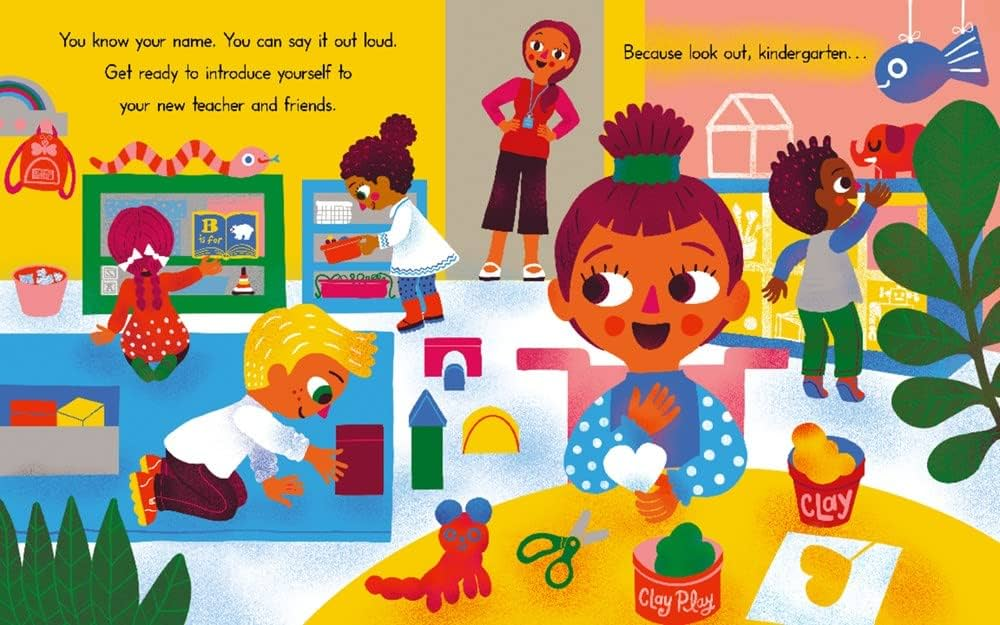
Summary:  Are you ready for kindergarten?  You’ll be practicing skills and learning new ones, like singing the alphabet, counting, creating art, and identifying shapes and colors.  If you like to play with friends and be on the go, you’re ready.  Practice saying your name so you can introduce yourself to your new teacher and classmates.  Get ready for a fun year of kindergarten!  Includes tips for caregivers about preparing kids for kindergarten.  32 pages; ages 4-6.

Pros:  This cheerful and encouraging book with its bright, busy illustrations will have kids excited for the first day of kindergarten.  The tips at the end make it a great resource for parents and other caregivers.

Cons:  Feels like preschool kids are doing a lot of what’s portrayed here as being done in kindergarten. 

Half Moon Summer by Elaine Vickers

Published by Peachtree

Summary:  Drew and Mia were born on the same day at the same hospital in Half Moon Bay, California.  When Drew wouldn’t stop crying, the two babies were put in the same bassinet, which calmed Drew down.  Mia and her family moved to Sacramento, but the summer after sixth grade, her family is back for a few months, and she and Drew, initially not knowing their history, become friends.  Their story is told in chapters that alternate between Drew’s prose journal entries and Mia’s verse ones as each one faces family difficulties: Drew’s father’s mysterious illness seems to be worsening, while Mia is dealing with the heartbreaking loss of a home that the family has dreamed of for years.  When they decide to train together for a half marathon, each one has individual reasons for running, but they support each other to keep going, both during their early morning runs and on the day of the race itself.  The end of the summer means Mia is moving back home, but the friendship promises to keep going through potentially difficult days ahead.  288 pages; grades 4-7.

Pros:  A compelling story of two kids dealing with some pretty serious family difficulties who show readers how to cope with courage and grace.  Their two distinctive voices, with the alternating prose and poetry narratives, keep the story moving along at a good pace.

Cons:  The story about the two kids meeting as babies was cute but felt like a bit of an unlikely coincidence.