As usual, I will be posting my end-of-the-year favorites lists between Christmas and New Year’s!
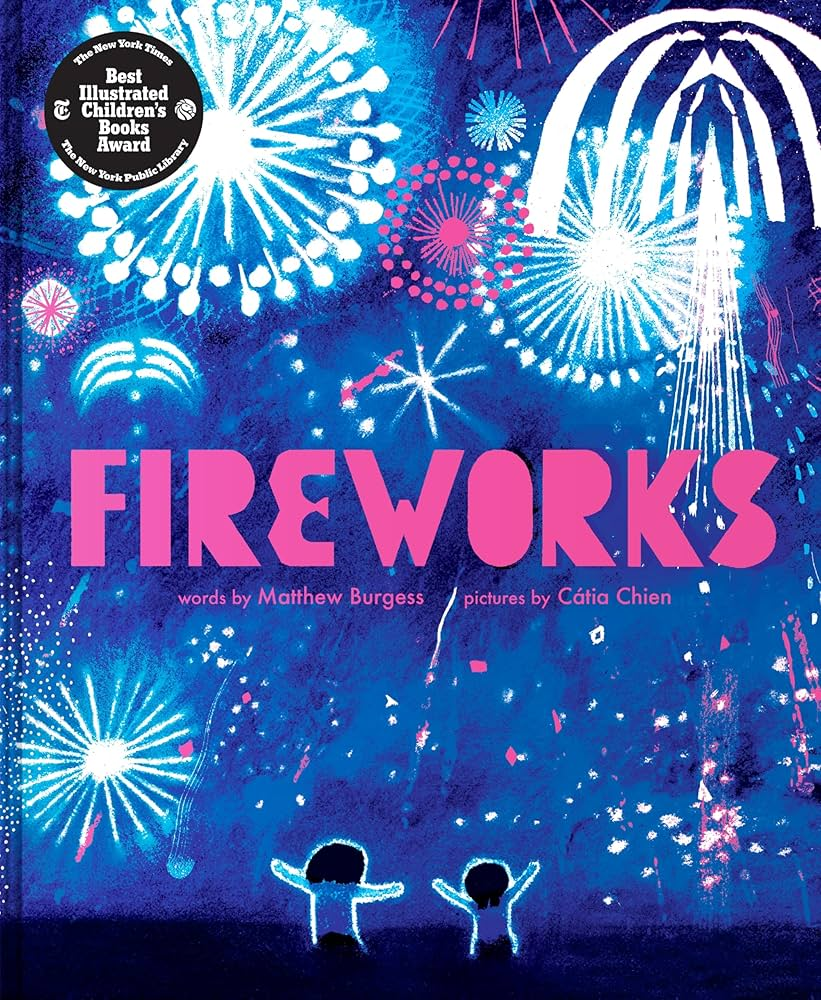
Fireworks by Matthew Burgess, illustrated by Cátia Chien (Clarion Books, 44 pages, ages 4-8). The text of this story engages all the senses in describing a summer day, and the explosion of fireworks at the end–including a foldout page with the grand finale–is truly spectacular.
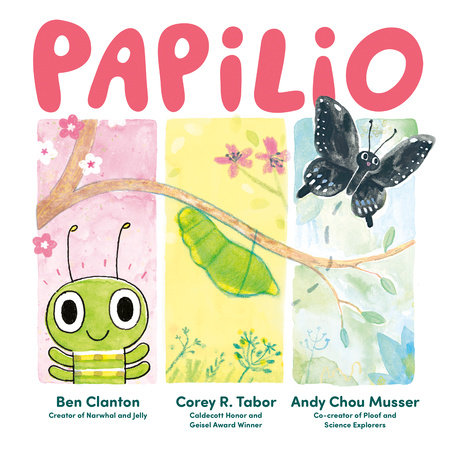
Papilio by Ben Clanton, Corey R. Tabor, and Andy Chou Musser (Viking Books for Young Readers, 48 pages, ages 3-7). I read this book to many groups of kids last spring, and it never got old: a classic tale of butterfly metamorphosis told in three chapters, each distinctively illustrated by a different artist, yet all seamlessly tied together.
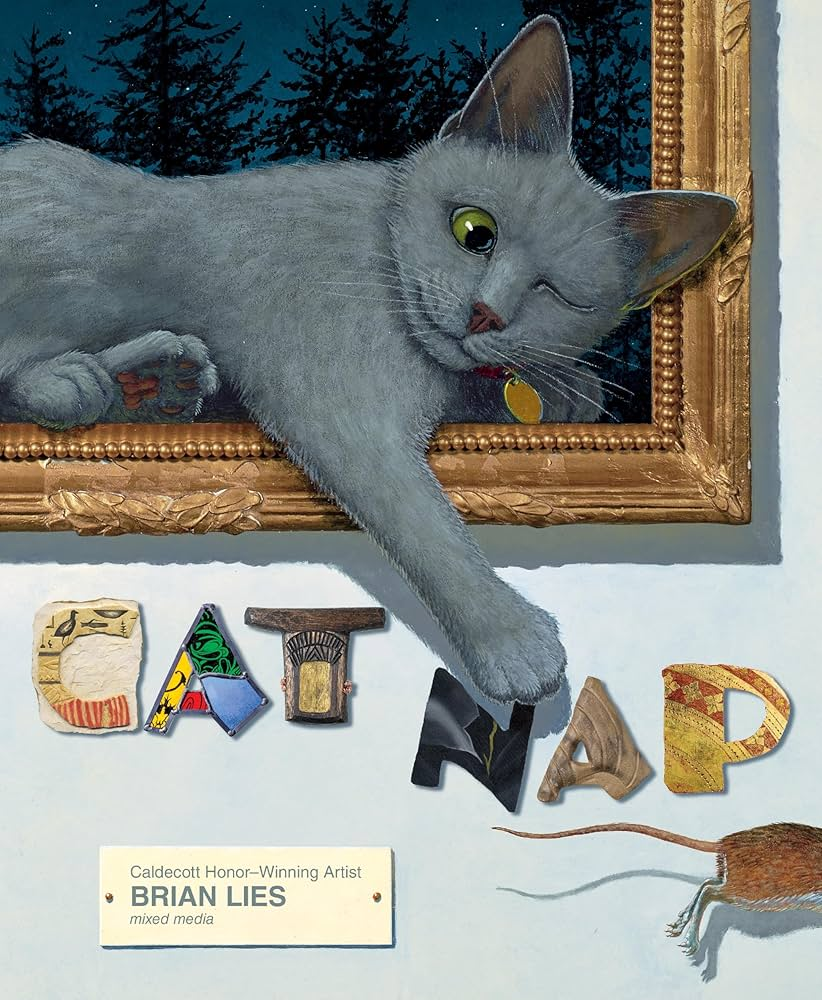
Cat Nap by Brian Lies (Greenwillow Books, 48 pages, ages 4-8). This is an amazing book to me, with Brian Lies’ stunning reproductions of a wide range of artworks, complete with the main character cat inserted into each one. I particularly appreciated his artist’s note at the end which celebrates the joy of creating with your own hands, something we all could use a reminder about in this age of AI.
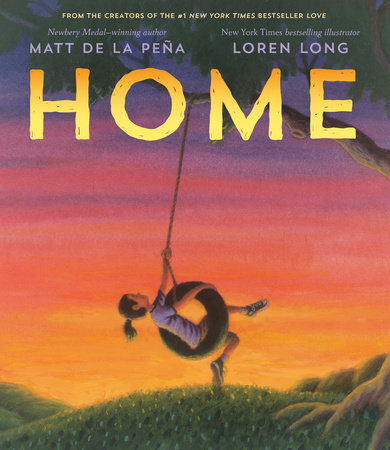
Home by Matt de la Peña, illustrated by Loren Long (G. P. Putnam’s Sons Books for Young Readers, 48 pages, ages 4+). The meditations on home in this book can be read on many different levels by all ages of readers. I’d love to see Loren Long finally get some Caldecott recognition, especially after last year’s The Yellow Bus was passed by.
Don’t Trust Fish by Neil Sharpson, illustrated by Dan Santat (Dial Books, 40 pages, ages 4-8). Try to figure out who the narrator of this book is as he explains the different types of animals with a big detour to disparage all sorts of fish. Personally this was not a favorite–although I’ll always route for Dan Santat–but the kids I read it to loved it, and it would make a good springboard to discussing bias in the media.
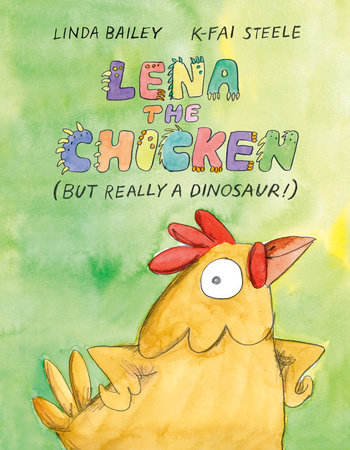
Lena the Chicken (But Really a Dinosaur) by Linda Bailey, illustrated by K-Fai Steele (Tundra Books, 56 pages, ages 4-8). Lena may look like a chicken, but deep down she knows she’s a dinosaur. She doesn’t understand why her family and friends are scared of everything and never stand up for themselves. Lena believes in guarding the coop, which frustrates the humans–all except for Madeline, the youngest human who likes Lena’s personality. That dinosaur personality finally pays off when a weasel attacks the coop, and Lena’s dinosaur roar causes enough damage to the weasel’s nose to keep him away forever. Madeline’s science fair research reveals that Lena and the rest of her family ARE related to dinosaurs, giving the chickens a big boost of confidence in themselves. Include additional information about the dinosaur-chicken connection.
I loved this book on a number of levels: the funny story and illustrations, the lesson about boldly being yourself, and the science information about dinosaurs and chickens. It’s going on the top of my read-aloud list for 2026.
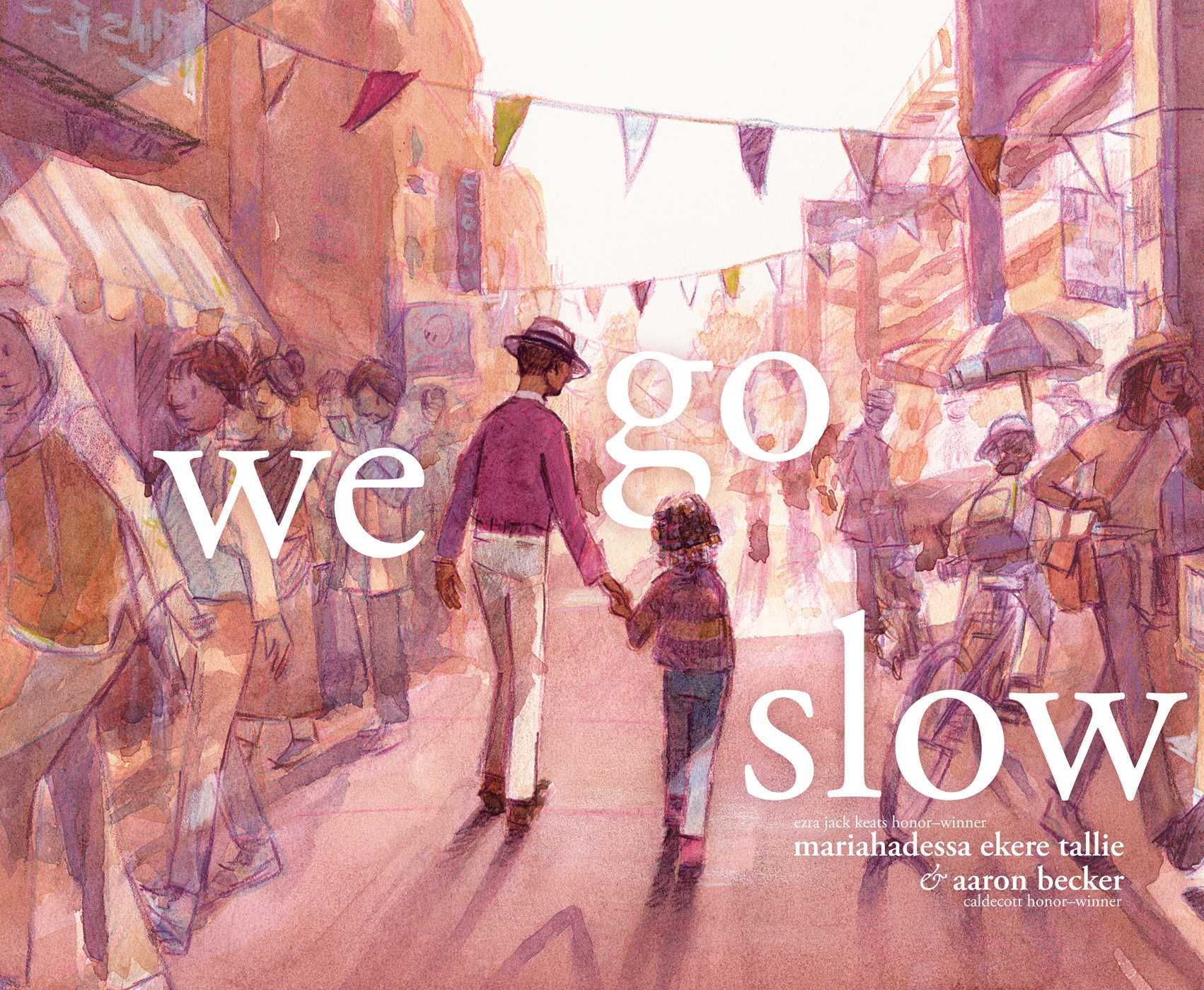
We Go Slow by Mariahadessa Ekere Tallie, illustrated by Aaron Becker (Atheneum Books for Young Readers, 32 pages, ages 4-8). A wordless opening spread shows family members rushing out the door, their scrubs and soccer uniform giving hints about their activities for the day. Meanwhile, the youngest in the family eats breakfast with her grandfather, savoring the food and sharing stories of last night’s dreams. Then they head outside where they spend the day enjoying the sights, sounds, and tastes of all that the city has to offer. “We go slow” is the repeated refrain as they relish each experience. The illustrations depict the changing light as the day moves toward evening, and the two take the bus back to their own front door.
You should definitely go slow to enjoy Mariahadessa Ekere Tallie’s poetic text, complemented by Aaron Becker’s gorgeous illustrations. This would be a great mentor text to teach about using sensory details in writing, and a way for younger kids to learn about their senses, as well as encouraging all readers to slow down and enjoy each moment.
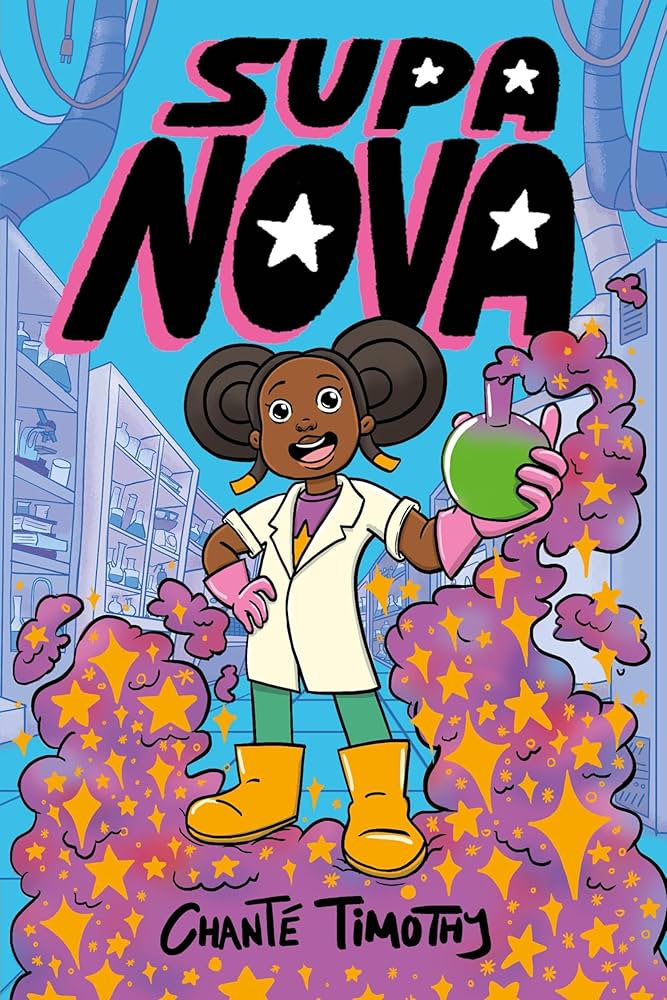
Supa Nova by Chanté Timothy (Nosy Crow, 160 pages, grades 2-5). Inspired by her scientist parents, Nova has created a secret lab that she accesses through her bedroom. After learning about islands of plastic trash floating in the ocean, Nova sets out to create a plastic-eating creature. The key to success turns out to be her teenage sister’s discarded wad of gum, and before long Nova has made an adorable pink monster named Chomp. Unfortunately, Chomp has a voracious appetite for plastic and an unfortunate propensity to grow quickly when he eats. Soon he’s threatening to consume the entire town, and Nova has to act quickly–and to reluctantly call on her sister for help. The two of them find an ingenious solution, shrinking Chomp to a more manageable size and convincing the adults to find a home for him on one of those plastic islands. Includes an author’s note on the science behind the story, some drawing tips, and a preview of the next Nova book.
This cute story is a quick read and would be a good point of entry for beginning readers to try out a full-length graphic novel. Nova’s larger-than-life adventures bring to mind TV cartoons, with the science occasionally feeling a bit like a magic trick, but she’s a spunky and resourceful protagonist who serves as a good role model for girls (and boys) who are interested in science.
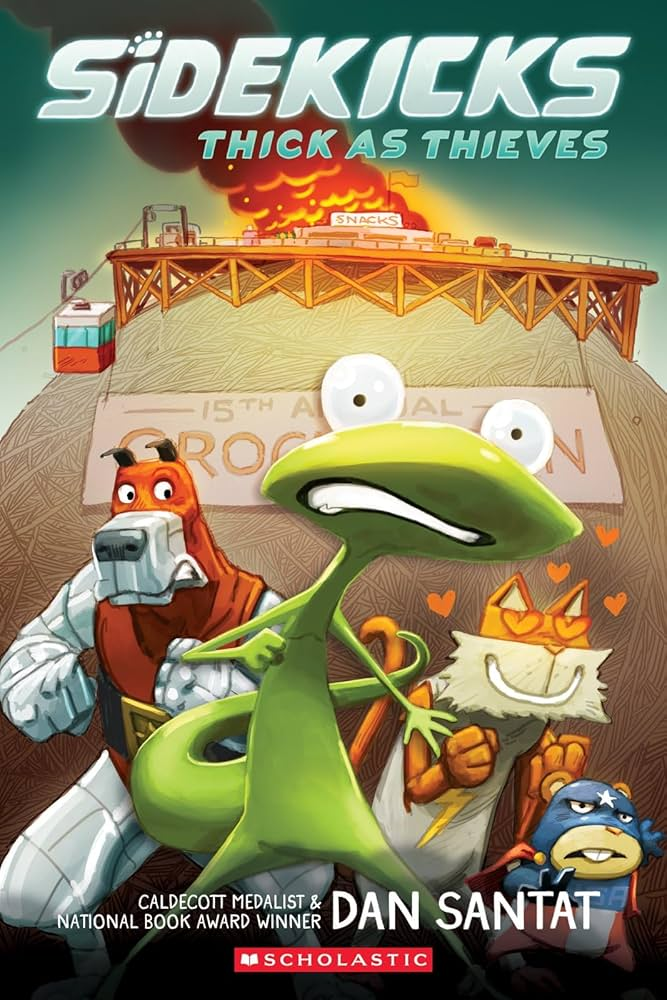
Sidekicks: Thick as Thieves by Dan Santat (Graphix, 208 pages, grades 3-7). I’m a little confused about this series: a book called Sidekicks by Dan Santat was published in 2011, but it looks like it was reissued as book 1 in a series last year. Book 2 is due to be released in the first week of 2026. When Scholastic offered to send me both books, I readily agreed, read both of them, and feel pretty sure this will be a hit series. The sidekicks are the pets of aging superhero Harry Blake, aka Captain Amazing. Each one has a superpower, but also a flaw or two, and part of the fun is watching both the people and the animals mess up.
In book 2, Harry and his older sister head off for a crochet convention as part of Harry’s attempt at retirement. While they’re away, chameleon Shifty’s older brother Whipley shows up. The two brothers were close at one point, but now the other pets–Manny the cat, Roscoe the dog, and Fluffy the hamster–are suspicious of Whipley’s intentions. Is he really there to reconnect with Shifty, or is he a spy working to bring down Captain Amazing? When Shifty leaves with Whipley, the other sidekicks go after him, and they wind up in an epic showdown right in the middle of the crochet convention. The good guys win for now, but readers are encouraged to stay tuned for two more upcoming installments. The fast-paced plot, constant humor, and Dan Santat’s incredible artwork will definitely appeal to fans of Dog Man and Bad Guys.
How to Save an Otter (Wildlife Rescue book 1) by Kate Messner (Bloomsbury Children’s Books, 118 pages, grades 1-4). Ivy and her mother and brother are trained Critter Courier volunteers, so when they find an injured baby otter, they know just how to get her to the animal hospital. Over the next several days, Ivy’s time is taken up with working on an Earth Day project and keeping tabs on the young otter’s recovery. She’s been going through a tough time since her cousins, who were also her best friends, moved away, but as she shares her animal rescue experiences with the girls on the group project, she realizes she may be able to make new friends. By the end of the story, Ivy’s feeling a lot better about school, and she and her family are able to help out with reintroducing the otter to her natural habitat. Includes an author’s note about her own experiences volunteering and a wildlife hospital, tips for kids to help out with wildlife rescue, and a preview of the next book in the series, which was published at the same time.
Kate Messner can generally be counted on for enjoyable early chapter books that will engage newly independent readers. This one fits the bill: a series starters about relatable school problems and an adorable baby animal, with plenty of illustrations and a page count just under 100 (the rest is back matter and a preview of book 2). The main story starts and ends with chapters told from the otter’s perspective, giving kids hints as to the nature of her injury and what may have happened to her family, although it’s never definitively revealed.
Bad Cheerleader by Alex Thayer (Aladdin, 288 pages, grades 5-8). Margaret, or Bag for short, is dealing with a lot at home and at school: her parents are separated, her dad is struggling with addiction, and her older sister Miranda not only acts like she hates Bag, but seems to be hiding a secret or two as well. Bag has recently been diagnosed with dyslexia, and although she loves books, she’s a slow reader and struggles with her other school work. When her mom has to work late, Bag reluctantly agrees to join Miranda at cheerleading practice, hoping to find out more about what is going on with her sister. She immediately gets recruited as the squad’s equipment manager, and in a hilarious sequence of events, winds up leading cheers at a big basketball game. She eventually finds out what Miranda has been doing and why, which ultimately brings the two sisters closer as they realize they need each other’s support to get through their family’s tough times.
This book dealt with heavier issues than I was expecting from the title and cover, but it did so with a light touch and plenty of humor. Middle school readers will definitely relate to Bag’s struggles, and root for her as they get to know her quirky personality and determination.
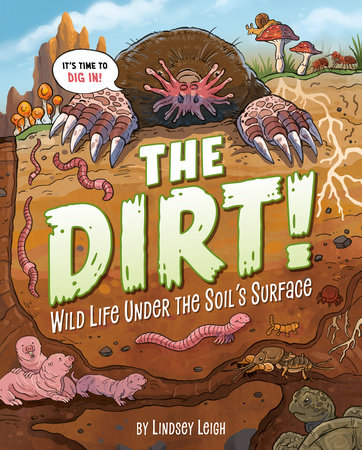
The Dirt!: Wild Life Under the Soil’s Surface by Lindsey Leigh (Penguin Workshop, 96 pages, grades 3-8). In this companion to The Dark! (caves) and The Deep! (oceans), readers get to explore the layer of soil that covers much of the surface of the planet. They’ll learn about the life forms that keep that soil healthy and fertile, from tiny bacteria to larger animals like meerkats and armadillos whose burrows help to aerate the soil. The final two pages offer tips for helping to protect soil from erosion, acid rain, and chemical fertilizers. Includes an index.
The graphic format and humorous tone in the writing and illustrations will draw in readers, but don’t be fooled by the light touch–there is plenty of fascinating information here about soil and the importance of the many, many life forms that support it. Readers will come away with a greater appreciation of the delicate balance necessary to keep soil healthy, and the final pages offers them ways to do their share to protect it.
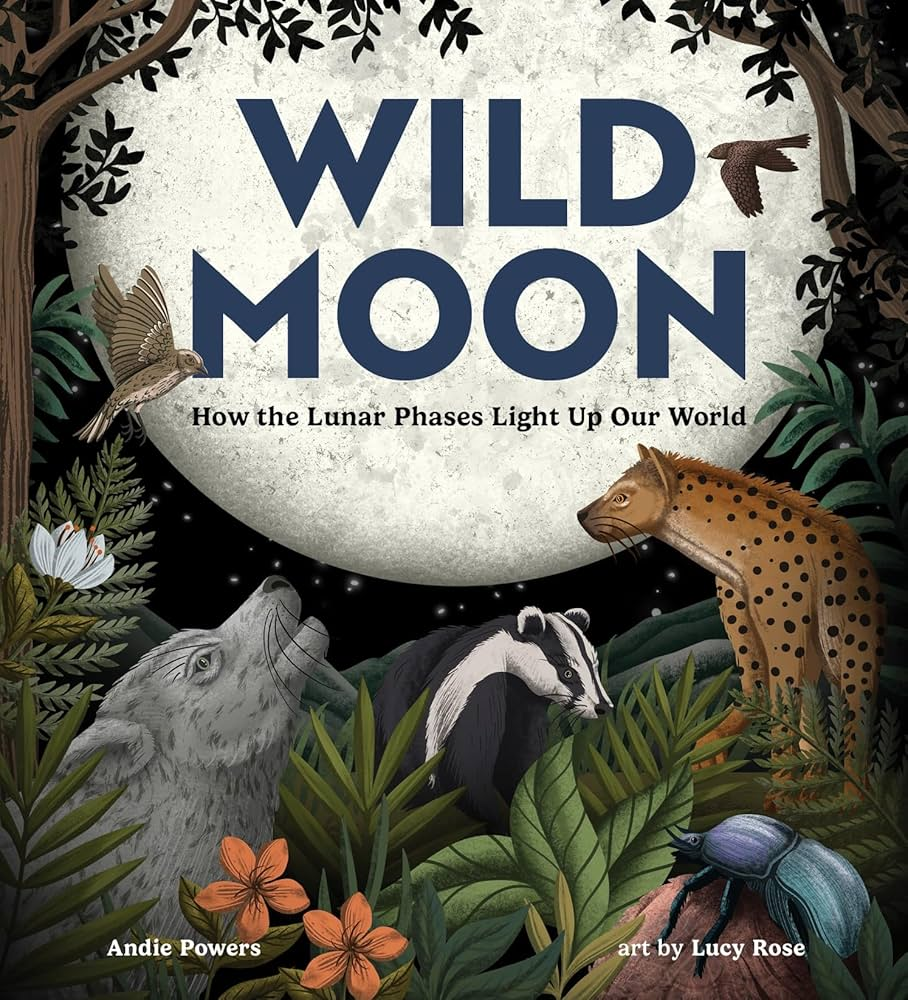
Wild Moon: How the Lunar Phases Light Up our World by Andie Powers, illustrated by Lucy Rose (Published by Gibbs Smith, 32 pages, grades K-4). The moon narrates this story of how its phases change, shifting the amount of light to reach the Earth, which affects animal behavior around the globe. The darker nights of the moon are better for animals such as lions who have good night vision, but more dangerous for prey animals with poorer eyesight, like zebras. The bright light of the full moon is a signal to some animals, such as coral in the Great Barrier Reef, to mate and breed. The super moon, micromoon, blood moon, and lunar eclipse are all briefly defined, and the end matter summarizes the moon phases, gives traditional full moon names for each month, and explains what a blue moon is.
The main text of this beautiful book is written as a poem, while facts about the different animals are presented in a smaller font around each page. The nighttime illustrations are gorgeous, with all kinds of animals shown in their habitats. Although the text is pretty short, there’s a lot of information packed into it, although I wish the explanation of the moon on the tides had been expanded on a bit, as that is a concept I struggle with.
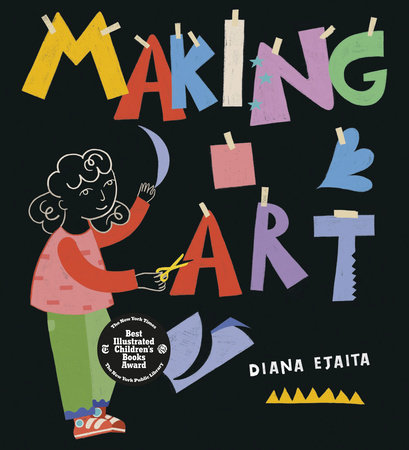
Making Art by Diana Ejaita (Rise x Penguin Workshop, 32 pages, ages 4-8). “Let’s look around and make some art,” begins this introduction to all different aspects of art. You can make new things or create from old things. It’s important to listen to your feelings, and those feelings can be communicated through your art. It can be difficult (and frustrating) to come up with ideas for your art, but then sometimes inspiration will strike like magic! Works of art can be given away or kept as a gift to yourself. No matter what, art adds beauty to the world, so thank you for your art!
This introduction to art could be used for anyone from a preschool class exploring art for the first time to a group of retirees rediscovering their creativity. The message is simple, yet wise and universal, and invites anyone to use art to express themselves. The illustrations portray a wide range of visual arts, as well as music, dance, and writing.
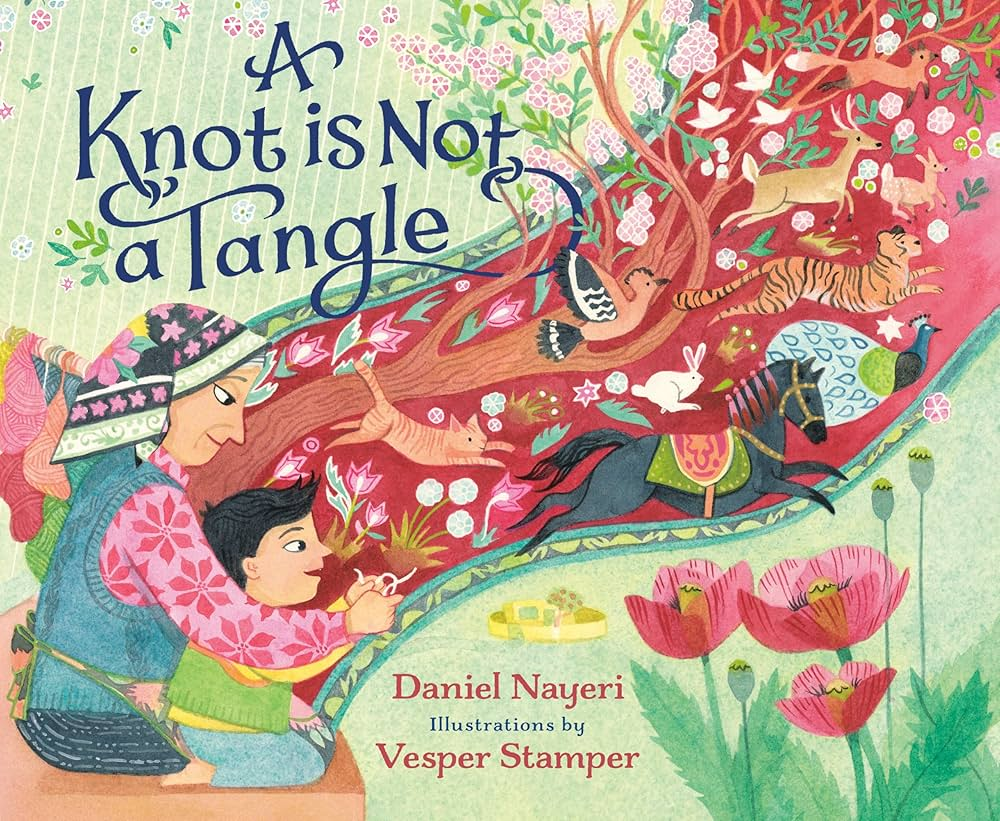
A Knot Is Not a Tangle by Daniel Nayeri, illustrated by Vesper Stamper (Knopf Books for Young Readers, 48 pages, grades 1 and up). A boy narrates the process of creating a Persian rug with his grandmother in Iran. “All of this takes weeks, but in my memory, it’s one long wonderful day.” In that day from his memory, he and his grandmother wash, card, and spin wool that his grandfather has sheared from their sheep. They dye it and plan the pattern and colors for the new rug on graph paper, then finally start knotting on the loom. The boy keeps wanting perfection, but his grandmother reminds him that the most important part of their rug is that it will become a place for the family to gather, just like the old one that they’re replacing has been. She even pulls one knot out, the “Persian flaw,” symbolizing that that there is no such thing as perfection. Finally, the new rug is done, and the old one gets moved underneath the loom, and “It feels just right to have it there.” Includes an author’s note with additional information on Persian rugs.
Award-winning author Daniel Nayeri has crafted a beautiful picture book celebrating an art form that will be new to many readers. The illustrations do a great job of showing the process of knotting–although, I’ll be honest, I still don’t really get it, but this may whet readers’ appetites to dig deeper. The message about tempering perfectionist tendencies is delivered gently by a wise grandmother who clearly values her heritage and enjoys passing it on to her grandson.
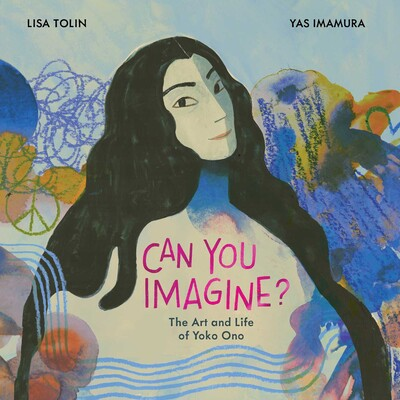
Can You Imagine? The Art and Life of Yoko Ono by Lisa Tolin, illustrated by Yas Imamura (Atheneum Books for Young Readers, 48 pages, grades 2-5). Yoko Ono spent her childhood moving between Japan and the U.S. during a time when she felt unwelcome in both places. After enduring wartime hardships in Japan, she moved permanently to the United States, where she studied art and music. Refusing to embrace norms in either field, she explored her own ways of creating art, which often involved audience participation designed to provoke thoughts and ideas. Her greatest fame came after she met and married John Lennon, when racism, misogyny, and the idea that she broke up the Beatles unleashed waves of public hatred toward her. After Lennon’s murder, Ono has continued to create art while working to preserve her husband’s legacy. Includes quite a bit of additional information about Yoko Ono and her art, as well as a bibliography.
I confess I grew up with a pretty negative impression of Yoko Ono, having absorbed the “she broke up the Beatles” message, but my daughter, an episode of the You’re Wrong About podcast, and now this beautiful book have helped me to see her in a completely different light. She had a pretty horrific childhood but instead of being broken by it, she emerged resilient and with a desire to work for peace through her art. It’s pretty clear that the Beatles broke themselves up, and this book focuses on the positive aspects of the Lennon-Oko collaboration. I’m grateful that this talented author-illustrator team continues the revisionist history, although it may be more appreciated by adults than children.
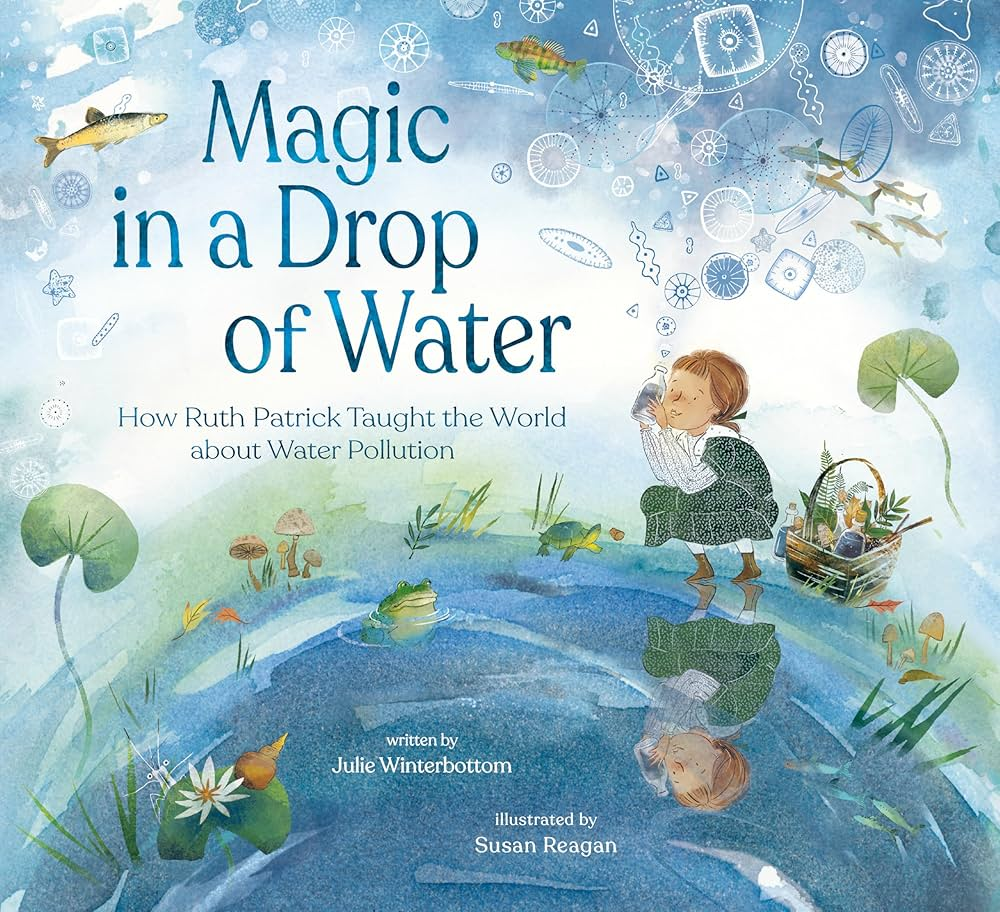
Magic in a Drop of Water: How Ruth Patrick Taught the World about Water Pollution by Julie Winterbottom, illustrated by Susan Reagan (Rocky Pond Books, 48 pages, grades 1-5). Encouraged by her father, Ruth Patrick grew up exploring woods and streams, fascinated by what she saw when she looked at her collections under a microscope. She went on to study biology, specializing in diatoms, the microscopic algae found in all bodies of water. Her questions about the effects of pollution on water led her to study both healthy and polluted streams, documenting all the life forms found in each, and discovering that pollution destroyed the balance of life that healthy water had. She became a lifelong advocate for clean water, including helping to write the Clean Water Act of 1972, and continuing to wade into streams and rivers just a few years before her death at age 105. Includes additional information, a timeline, and a bibliography.
Ruth Patrick lived up to her father’s advice to leave the world a better place than she found it, following her passion at a time when women weren’t particularly welcome in the scientific world and making many contributions to our understanding of water pollution and biodiversity. Her story is told in an engaging fashion, and the illustrations do a magnificent job of capturing Ruth’s work and her underwater observations, although I wouldn’t have said no to a slightly larger font for the text.
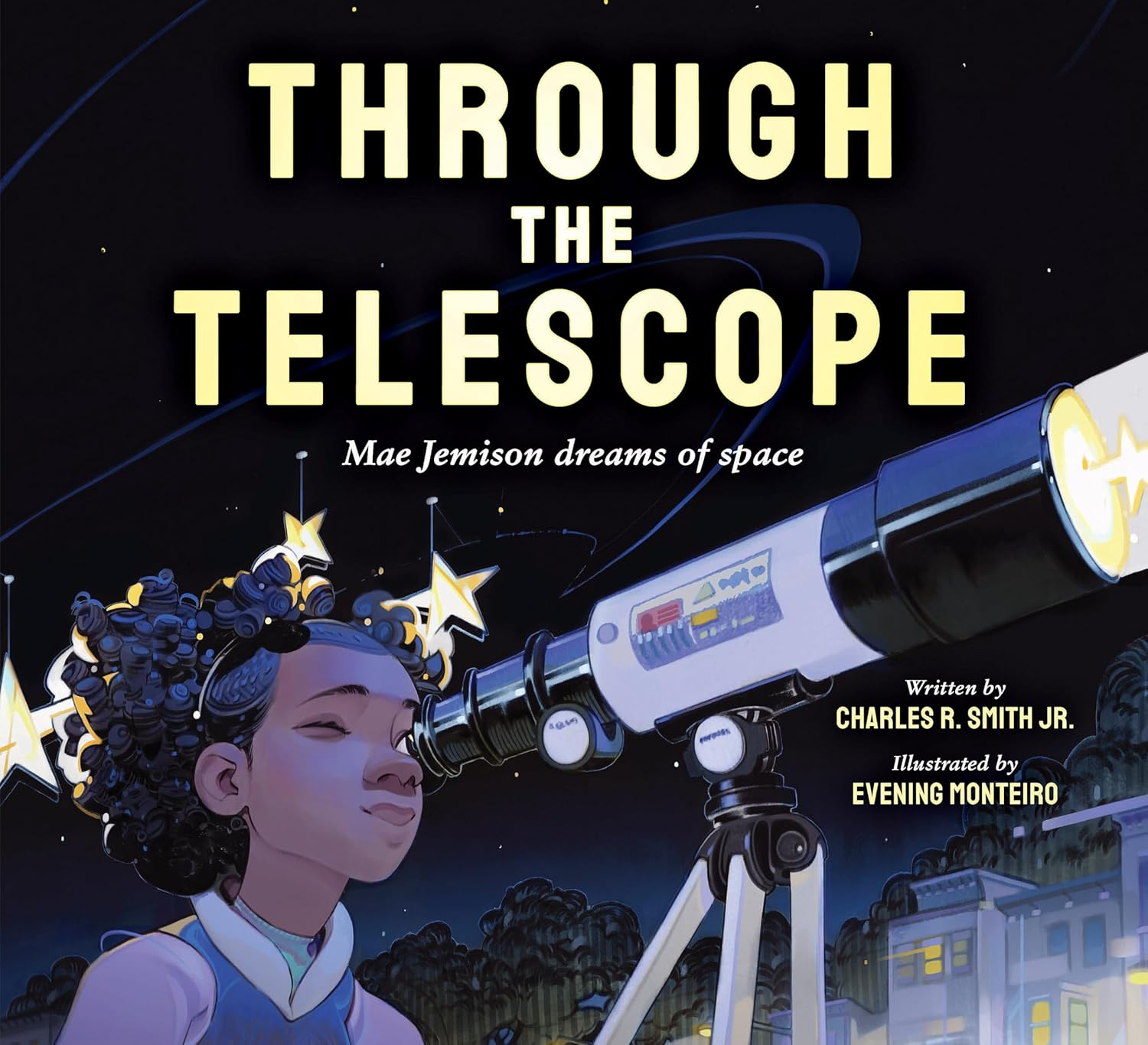
Through the Telescope: Mae Jemison Dreams of Space by Charles R. Smith, Jr., illustrated by Evening Monteiro (Orchard Books, 40 pages, ages 4-8). A young Mae Jemison peers through the telescope, dreaming of traveling into space. Rhyming text and illustrations explain what she sees: the moon, planets, constellations, and galaxies. As she looks, she imagines floating through space, and the final illustration shows an adult Mae in her astronaut suit standing behind the child. Includes ten facts about Mae Jemison.
This would make a good introduction to Mae Jemison for younger readers, and it includes quite a few astronomy terms and facts which they will find interesting as well. Like Mae Among the Stars, there’s very little biographical information. It would be great to get a longer picture book biography that gives a fuller picture of Jemison’s life.
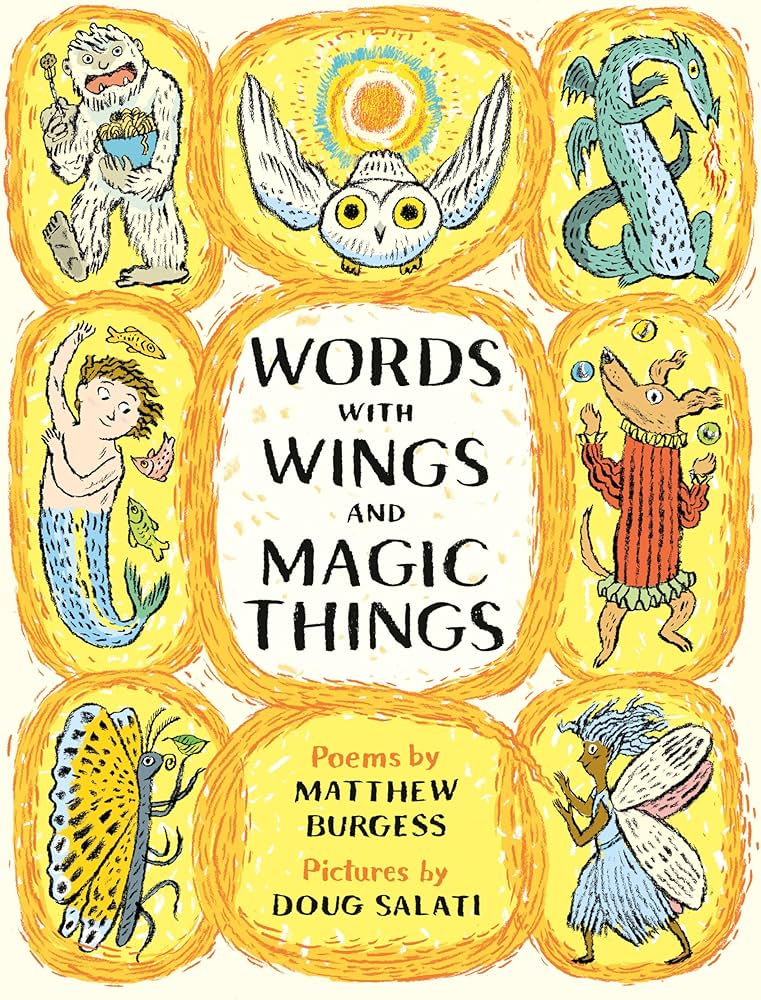
Words with Wings and Magic Things by Matthew Burgess, illustrated by Doug Salati (Tundra Books, 128 pages, grades 1-5). This poetry collection is divided into seven sections: Welcome, Wonders, Wild, Wheee!, Whoops and Whallops, Windows, and Whispers & Well Wishes. The poems range from Jack Prelutsky-laugh-out-loud funny to thought provoking meditations. All are illustrated by Caldecott Medalist Doug Salati with a colorful collection of animals and humans, mostly younger ones, with some fun cut-outs on the pages that start each new section. Includes an index.
This feels like a happy throwback to the days when Prelutsky and Shel Silverstein published lengthy collections of poems, with a nice mix that includes multi-stanza stories mixed in with meditative poems just several lines long. The illustrations add a lot to the fun.
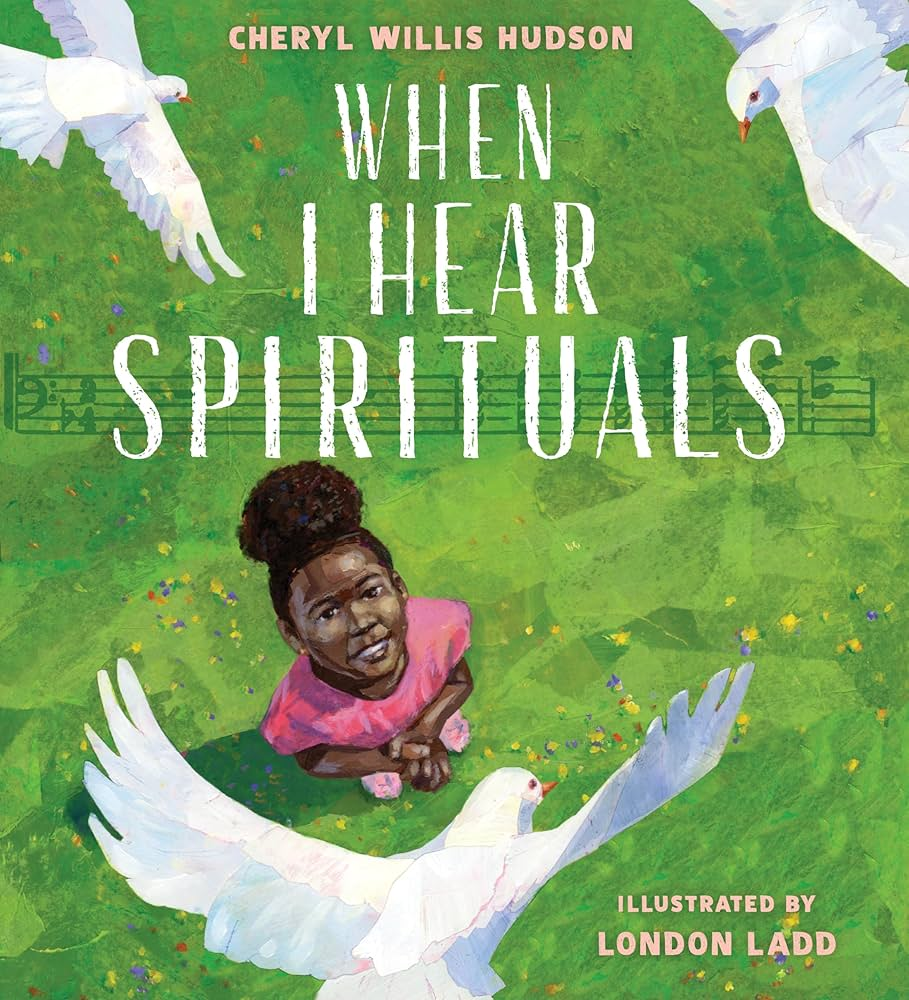
When I Hear Spirituals by Cheryl Willis Hudson, illustrated by London Ladd (Holiday House, 40 pages, grades 1-4). Each two page spread features a young girl describing how spirituals make her feel, with the words to different spirituals written on the facing page. The brilliant illustrations portray her singing, dancing, and praying, as well as showing scenes from Black history, when spirituals gave people courage and hope. A long author’s note describes the history of spirituals and her personal connection to them. There’s also a glossary, a list of the historical figures and events shown in the book, and a long lists of resources for listening to spirituals and learning more about them.
This beautiful book should definitely be considered for a Coretta Scott King award, both for the writing and the illustrations. The text reads like poetry and focuses on emotions evoked by spirituals, but there’s also plenty of information and resources for more research and listening.
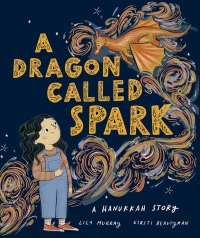
A Dragon Called Spark: A Hanukkah Story by Lily Murray, illustrated by Kirsti Beautyman (Kalaniot Books, 32 pages, ages 4-8). Eva’s adjusting to a new home as Hanukkah is approaching. She sees children playing outside her window and feels lonely, comforting herself that she still has her little dragon named Spark. The first Hanukkah candle is lit and placed in the window, and the next day a neighbor named Charlie comments on it, promising to look for more. The next night, the family takes some latkes and jelly donuts to Charlie’s house, and the kids get to know each other better. Eva tells Charlie about Spark, and Charlie finds that he can see Spark, too! At the park the next day, Eva overhears Charlie telling other kids about Spark and worries they are laughing at her, but Charlie assures her they all want to see the dragon. Eva uses her storytelling talents to help them all find their own dragons, and much to her surprise, by the final night of Hanukkah, she and Spark are surrounded by a new group of friends–both human and dragon. Includes additional information about Hanukkah.
Hanukkah traditions are skillfully woven into this story about making friends in a new place and the power of imagination, play, and stories. Kids can decide if they think the dragons are real or imaginary and look for evidence for either argument in the text and the illustrations. This would make a great companion to A Dragon for Hanukkah by Sarah Mlynowski.
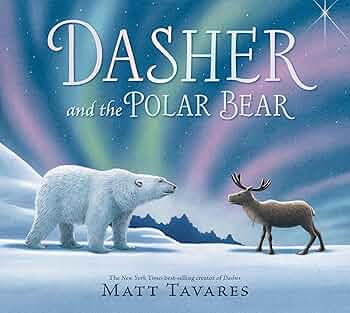
Dasher and the Polar Bear by Matt Tavares (Candlewick, 40 pages, ages 4-8). In her spare time before Christmas Eve, Dasher loves going on adventures. One night she sees the Northern Lights and flies toward them for a better view. When she lands, she encounters a large polar bear named George who scares her at first, but who turns out to be a kind friend who’s intrigued by her flying. When he tries it out, though, he lands with a huge splash in the icy sea. When Dasher gets home, she tells her mother about George, wondering why Christmas magic doesn’t work for everyone. Her mother assures her that it does, just in different ways, and Dasher gets to see what she means on Christmas Eve. After emptying his bag, Santa heads for George’s home, where he offers the polar bear a ride in the sleigh, which George describes as “exhilarating!” and “positively unforgettable!” Back home, Dasher tells her mother that seeing George so happy was her favorite part of Christmas Eve.
This sequel to Dasher and Dasher Can’t Wait for Christmas provides another satisfying holiday tale with amazing illustrations of reindeer, Santa, the Northern Lights, and George, a new character with a hilariously rich vocabulary. Fans of the other Dasher books will not be disappointed.
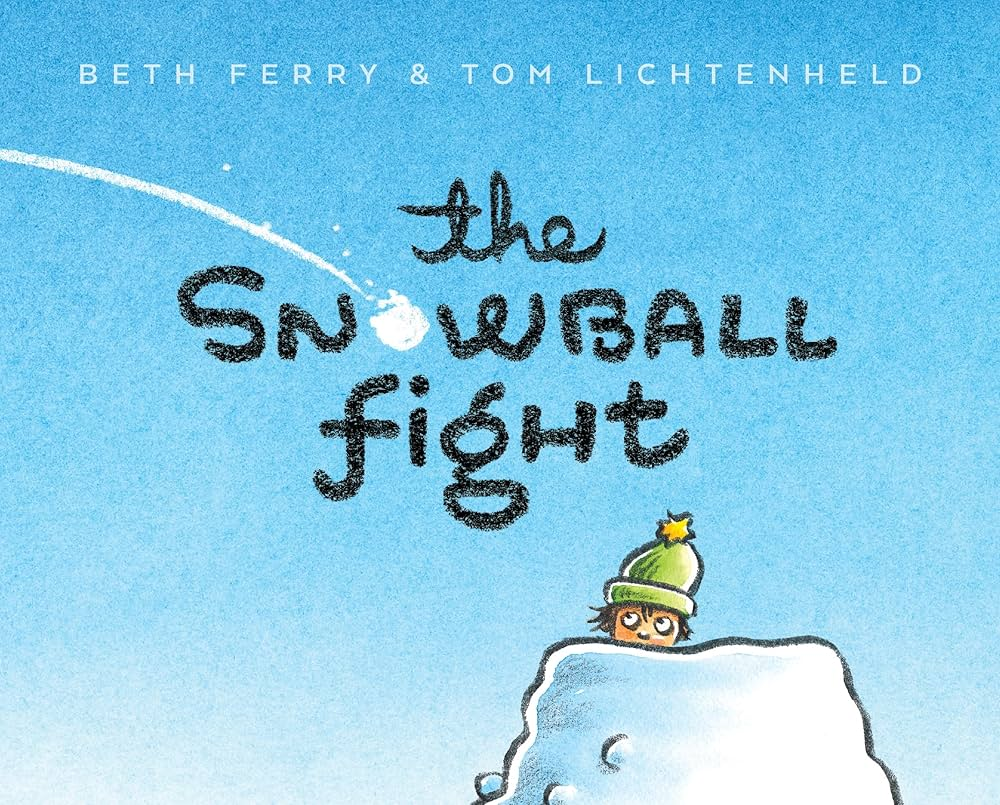
The Snowball Fight by Beth Ferry, illustrated by Tom Lichtenheld (Clarion Books, 48 pages, ages 3-8). Neighborhood friends enjoy a snow day that starts with the creation of two forts armed with plenty of snowballs. After lobbing these at each other for a while, one of the forts gets buried in snow that falls off a nearby roof, creating the perfect conditions for sledding. From there, it’s time to go inside for a cookie and hot chocolate break, but three marshmallows floating side by side in the cocoa remind the friends that they never built a snowman. Back outside they go to enjoy the final hours of their snow day.
This author-illustrator team never disappoints, and their latest creation comes at a perfect time, with 3-6 inches in the forecast here for tomorrow. The rhyming text is simple but catchy, and would be equally fun to listen to or to use for some reading practice, while the simple illustrations perfectly captures the chilly fun of playing in the snow, and the cozy warmth of heading inside.
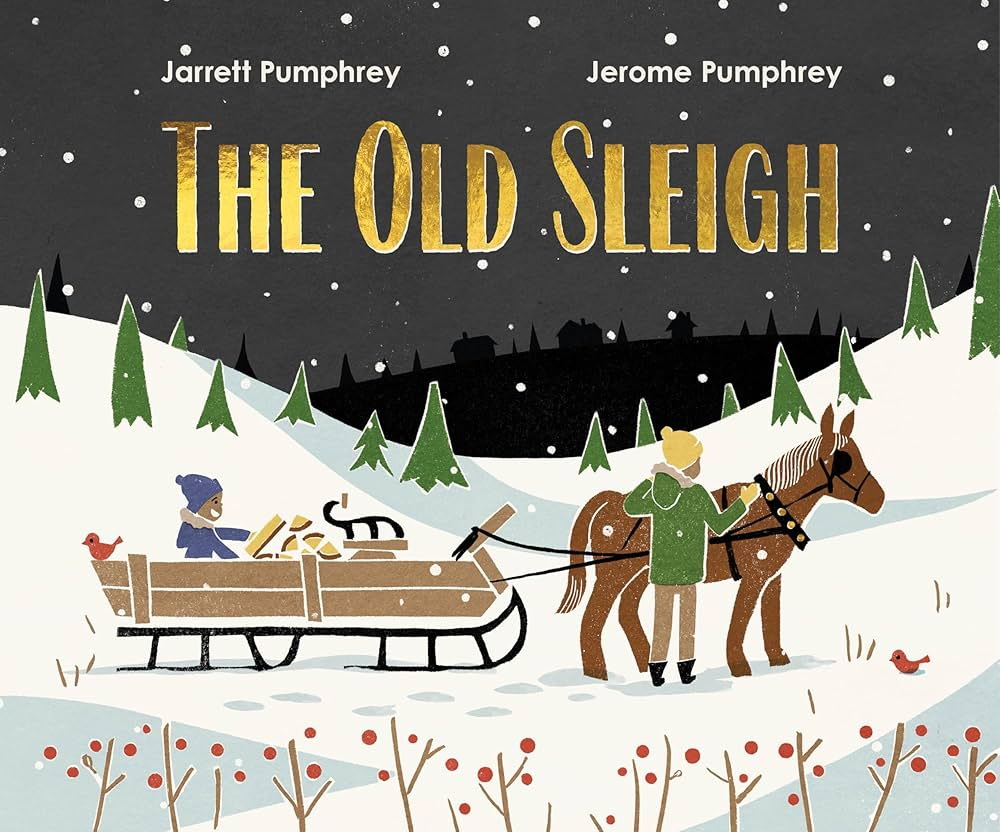
The Old Sleigh by Jarrett Pumphrey and Jerome Pumphrey (Norton Young Readers, 48 pages, ages 4-8). The Pumphrey brothers are back again with a holiday follow-up to The Old Truck and The Old Boat. The sleigh in this story is used to transport firewood in a small town, a boy and his dad working together to chop it, load the sleigh, and deliver it to the delighted townspeople who use it for warmth and light. But when the town grows, so do the loads of wood until one day, the old sleigh breaks in half. While Dad repairs it, the boy makes his own small sled so that he can continue to bring wood to his favorite customers. Finally, the old sleigh is repaired, and the work continues. The last page shows the old sleigh, now painted the same red as the boy’s sled, with a driver who looks like a grown-up version of the boy, delivering wood in the “small city.”
This deceptively simple story celebrates community, winter, and the circle of life as the town grows, but the boy and his father continue to serve their community, bringing both actual and metaphorical warmth and light with their firewood deliveries. While not specifically a holiday book, this has a definite December vibe, and would make a great gift or read-aloud in the last few weeks of school before vacation.



 A Kids Book A Day