Building by Henry Cole

Published by Katherine Tegen Books

Summary:  “Building, building.  That is what beavers do best.”  This is the repeated refrain in a story that follows a pair of beavers through a year beginning in late winter.  They pick a spot to live by a stream and build a dam and a lodge.  The dam creates a pond, and the lodge provides a safe place for babies.  As the seasons progress, the beavers face a coyote and a heavy rainstorm, but their defenses protect them from these dangers.  They gather enough twigs and branches to survive the winter, then settle down in the lodge as the snow begins to fall.  Includes an author’s note with additional information about beavers.  40 pages; ages 4-8.

Pros:  As he did with robins in Nesting, Henry Cole tells a gentle story about beavers as they journey through the seasons.  The detailed illustrations are mostly in black and white with highlights of seasonal colors (green grass, red leaves).  The author’s note invites wonder by contemplating the beavers’ amazing engineering feats.

Cons:  The interaction with the coyote wasn’t quite as dramatic and exciting as the snake attack in Nesting.

Crab & Snail: The Invisible Whale (Crab & Snail book 1) by Beth Ferry, illustrated by Jared Chapman

Published by HarperAlley

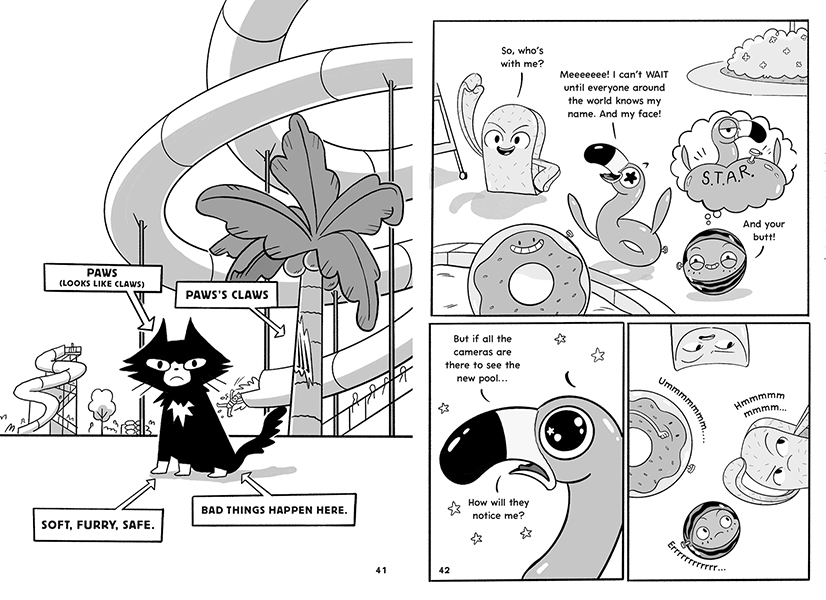
Summary:  Crab and Snail are BBF’s (best beach friends), who hang out with a couple of barnacle sidekicks named Drip and Grip.  When a mysterious rain shower starts following Crab and Snail around, they can’t figure out what’s happening until a know-it-all gull tells them an invisible whale is following them around.  They send their friendliest smiles out to the ocean and are rewarded with a new friendship with Isabel who is, in fact, an invisible whale.  She ends the book by serenading them with a lullaby as the sun goes down.  Look for book 2 in November.  64 pages; grades 1-3.

Pros:  There are plenty of laughs and celebrations of friendships in this graphic series starter that will definitely be a hit with Narwhal and Jelly fans and other beginning readers. 

Cons:  I would have preferred the structure of a chapter book.

My Hands Tell a Story by Kelly Starling Lyons, illustrated by Tonya Engel

Published by Reycraft

Summary:  As Zoe and her grandmother make bread together, the girl marvels at her grandmother’s hands and thinks of the stories they tell.  Grandma tells of her young adulthood working in an office and dancing on stage, later on getting married and creating a home and garden.  When Zoe looks at Grandma’s hands, she sees words on them like “mother”, “planter”, and “nurturer.”  She wonders what stories her own hands will tell someday, then realizes that she can already see some there: building, baking, playing clapping games with friends.  Back home, she uses her hands to tap out some of her stories on her computer.  Includes a recipe for Zoe and Grandma’s Cinnamon Bread.  32 pages; ages 4-8.

Pros:  This quiet intergenerational story invites contemplation and could lead to discussions or writings about the stories told by a child’s or an adult’s hands.  The vibrant illustrations perfectly capture the characters, their hands, and their stories.

Cons:  Be careful not to drool on the recipe page.

Caprice by Coe Booth

Published by Scholastic

Summary:  Caprice has just finished a summer program at the prestigious Ainsley International School and has done well enough there to be offered a full scholarship for eighth grade through high school.  Returning home to her friends and family in Newark for the last few days of summer, she’s torn between taking this amazing opportunity or finishing middle school with the people she loves.  Complicating her decision are flashbacks of memories from when she was four years old that are increasingly difficult to ignore.  When Caprice’s grandmother in Baltimore gets sick, her family returns to the house where she spent her first few years, and she is forced to confront the trauma that happened there.  As the week draws to a close, Caprice is finally able to admit to her parents that she was molested by her uncle and can begin the healing process that will allow her to make the right decisions about her future.  Includes a note about resources for survivors of abuse.  256 pages; grades 5-8.

Pros:  This compelling story drew me in right from the beginning.  The main narrative takes place over the course of a week, with the author skillfully weaving in Caprice’s poetry and flashbacks of memory to lead to a satisfying ending.  The topic of sexual abuse is handled in a way that’s appropriate for middle grade readers.

Cons:  The end note about resources was pretty short.

Out of this World: Star-Studded Haiku by Sally M. Walker, illustrated by Matthew Trueman

Published by Candlewick

Summary:  This collection of haiku looks at different aspects of the universe including constellations, astronomers, stars, the sun, all the planets (even Pluto!), moons, comets, and asteroids.  Each poem is supported with mixed media art to show various spacescapes.  Includes additional information for each section, a glossary, a reading list, and a list of online resources.  48 pages; grades 2-6.  

Pros:  This book will appeal to many different types of readers: poets (a great intro to haiku), scientists, and artists.  The illustrations are awe-inspiring and will fire up kids’ imaginations about the wonders of space.

Cons:  I wish someone had come up with a slightly more imaginative title than the hackneyed “Out of This World”.

The Little House of Hope by Terry Catasús Jennings, illustrated by Raúl Colón

Published by Neal Porter Books

Summary:  Esperanza, Manolo, Mami, and Papi look hard to find a new home when they arrive in the U.S. from Cuba.  The house they find is small and needs some work, but everyone pitches in to fix it up.  It’s not easy to find the time because all four members of the family are working hard to earn money and learn English.  Eventually things get easier, and they’re able to share their home with two other families who have recently immigrated from Cuba and Mexico.  Over the years, more families come and go, and Esperanza always creates special artwork for them to take for their new homes.  48 pages; ages 4-8.

Pros:  A positive look at the experience of immigrating to the United States, showing families who are able to get ahead through hard work and sharing.  Raúl Colón’s beautifully colored illustrations add just the right touch.  Thanks to Terry Catasús Jennings, who sent me a signed copy of this book (which unfortunately got a bit mangled by the U.S. postal service).

Cons:  Immigrant kids today may find their experiences are not as rosy as the ones pictured here. The back flap mentions that this story is based on the author’s experiences moving to the U.S. in 1961.  I wish she had included a note with more information about that and how times have changed since then.

Star Child: A Biographical Constellation of Octavia Estelle Butler by Ibi Zoboi

Published by Dutton Books for Young Readers

Summary:  This biography of science fiction writer Octavia Butler is told through a collection of poetry, photographs, and quotations from Butler.  Starting with her early life as a solitary child growing up in 1950’s Pasadena, readers get to see how Octavia’s struggles in school, her introverted nature, and her love of books combined to lead to her a life as a writer.  She was fascinated by science fiction, although almost all of the writers and heroes of the stories were white men.  After years of rejection, she finally began selling her stories and eventually wrote books that earned her Nebula and Hugo awards as well as a MacArthur fellowship.  Includes a final chapter on Ibi Zoboi’s connection to Octavia Butler (they shared a birthday and met in person several times, including a science fiction writing workshop) and a list of Butler’s books.  128 pages; grades 7-12.

Pros:  This unique biography is a pretty quick read but gives an intimate look at Octavia Butler’s life and writing.  Readers who are not familiar with Butler’s work (like me) may be motivated to seek it out after getting this introduction.

Cons:  I saw some recommendations for this book starting in fifth grade, but I think it would be better appreciated by middle school and high school students, since Butler’s books are for young adults and adults.

Different Kinds of Fruit by Kyle Lukoff

Published by Dial Books

Summary:  Annabelle’s not super excited about starting sixth grade.  It’s her last year at the Lab School, where she knows her other classmates a little too well after six years in school together.  But this year begins to look different when a new student named Bailey walks into the classroom.  Bailey is nonbinary, and Annabelle is fascinated by them.  The two become friends, and Annabelle finds herself hoping it will turn into something more.  When Annabelle brings Bailey home, she’s dismayed by her parents’ cool reaction to them.  Later, her parents reveal that her dad is a trans man, and Annabelle’s world turns upside down.  With the help of Bailey and their parents, Annabelle and her family start to become part of the LGBTQ+ community, allowing them to learn more about themselves and to live more genuine lives.  320 pages; grades 4-7.

Pros:  Newbery honoree Kyle Lukoff has created another heartwarming story that explores the lives of LGBTQ+ kids and their families and friends.  Bailey and Annabelle have to deal with a classmate (aptly named Dixon), his mother, and a wishy-washy principal who work to keep any LGBTQ+ discussion out of the classroom, and readers will get some insights on how to deal with that issue.

Cons:  Bailey and their parents seemed a little too good to be true, and sometimes seemed to exist just to educate Annabelle and her family.

Apple Crush by Lucy Knisley (Peapod Farm, book 2)

Published by Random House Graphic

Summary:  Jen and her family continue the story started in Stepping Stones.  She and her mom have settled into the routine of life on Peapod Farm with her mother’s boyfriend Walter.  Walter’s daughters Andy and Reese visit on the weekends.  Fall brings the beginning of middle school and a job for Andy and Jen helping to set up a haunted hayride at a neighboring farm.  The owner’s nephew Eddie is also working there, and even though he and Jen have a lot of common interests, Andy has a crush on him.  Jen doesn’t understand all the fuss made about romance and runs into even more issues with this when she becomes friends at school with a boy named Ollie.  Like it or not, romance is part of middle school life, and Jen has to learn to both deal with it and to speak up for herself and what she wants in her own life.  Includes several pages at the end in which Lucy shares incidents from her childhood that influenced this book.  208 pages; grades 3-7.

Pros:  Another fun graphic novel about a middle school girl that does a great job capturing family and friendship dynamics.  The fall setting makes this a perfect back-to-school book.

Cons:  While I would no longer describe Walter as verbally abusive (as I did in my review of book 1), he still presents as an insensitive dunderhead.  

You Ruined It by Anastasia Higginbotham

Published by Dottir Press

Summary:  11-year-old Dawn has recently been sexually assaulted by her 22-year-old cousin.  When the story opens, she has just told her mother and sibling Billie.  Everyone has different reactions.  Dawn sometimes feels like she has left her body and is looking down on herself; she also misses the close relationship she had with her cousin and is struggling to come to terms with what he has done to her.  Billie is angry and says they want to kill their cousin.  Dawn’s mother is sad, angry, and glad that Dawn has told her what happened; she also signs herself up for a self-defense class.  When Mom tells her mother and the cousin’s parents what has happened, they don’t believe her and say that Dawn is just trying to get attention.  Dawn is fortunate to have caring and understanding people in her life who are determined to end the legacy of abuse that has also affected them.  By the end of the story, Dawn has started to find people and resources to help her heal.  Includes several pages of resources and discussion questions at the beginning and end for kids who have experienced sexual abuse or know someone who has.  96 pages; grades 3-8.

Pros and cons:  Although this was a difficult book to read and review, I recognize it is an important resource for kids who have experienced sexual abuse and the family members, counselors, and others who are trying to help them.  The story is told in a format similar to a journal, with a font that looks like handwriting and art created from collage and Spirograph drawings (more on those in the back matter).  The story itself shows a wide range of emotions and reactions to the abuse, and the resources and discussion questions add another empathetic layer.