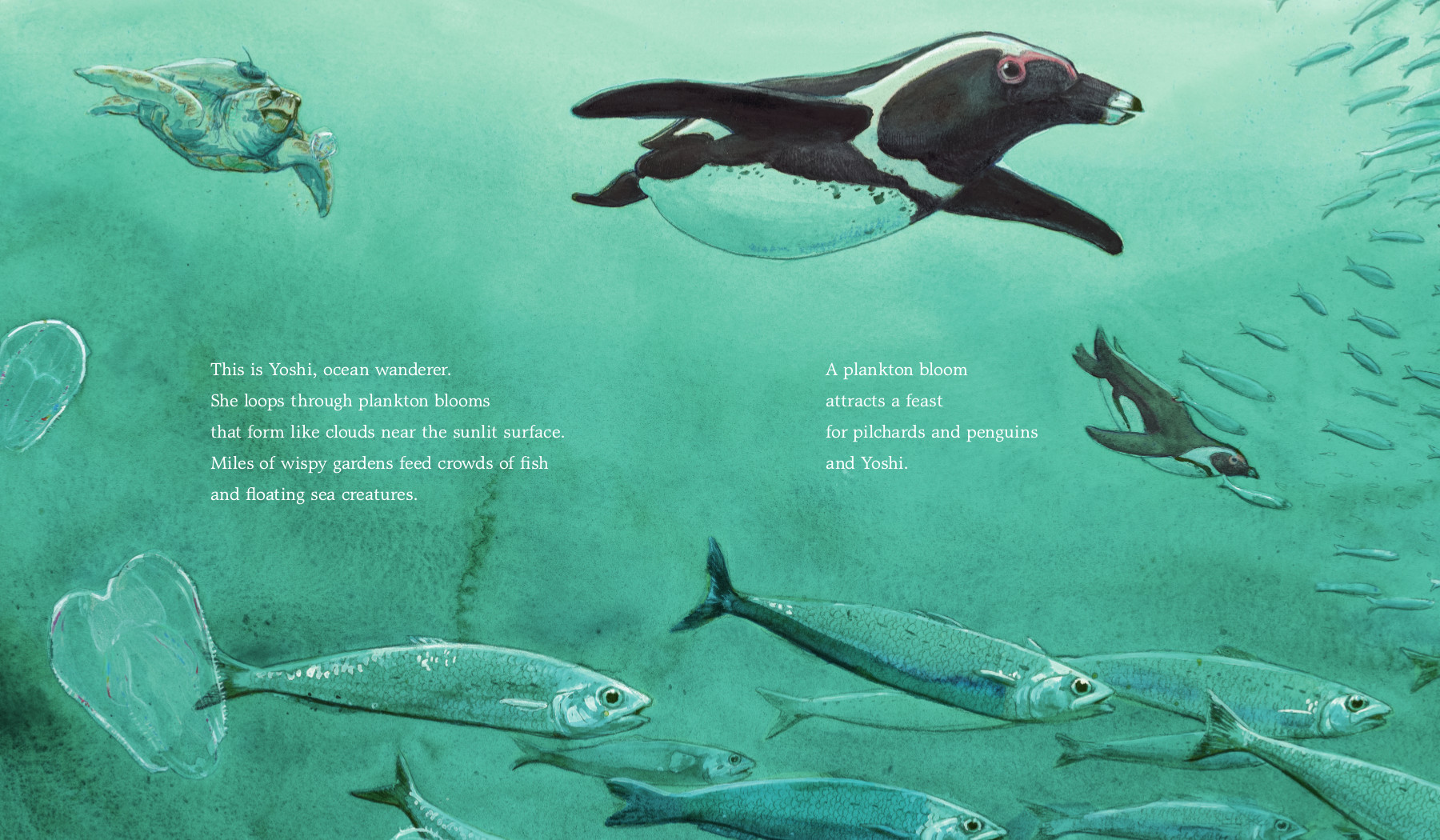
Waiting for Mama by Gianna Marino

Published by Viking Books for Young Readers

Summary:  A penguin egg narrates what it hears as its mother goes for food and its father keeps it warm and safe, tucked between his feet.  Finally, the egg hatches, and the baby is able to see its dad.  When the mother penguins all return, the baby listens for its mother’s distinctive sounds.  Finally, it recognizes her, and the family is reunited.  Includes additional information about emperor penguins.  40 pages; ages 2-6.

Pros:  Beautiful illustrations depict penguin scenes both close-up and zoomed out, backed by gorgeous Antarctic sky.  Does double duty as a perfect read for Mother’s Day or Father’s Day.

Cons:  Cons for a book about animal parents on Mother’s Day? Not on my watch.  

Dress-Up Day by Blanca Gómez

Published by Harry N. Abrams

Summary:  The narrator is excited to wear her homemade rabbit costume for dress-up day at school.  But when the big day arrives, she’s home sick in bed.  She’s feeling better the next day, so her mom suggests she wear her costume.  She’s excited to get to school but feels self-conscious when she sees the other kids in their regular clothes.  Turns out that Hugo was out sick the day before, too, and a few minutes later, he shows up at school in his costume…a carrot!  “Be sad no more, little rabbit–your carrot is here!”  Before long, everyone is hopping around the playground, and Hugo is her new best friend.  The next day, the other kids come to school in costume, ready to play more imaginary games.  40 pages; ages 3-6

Pros:  Well, right off the bat, I love Hugo.  Any kid who dresses up like a carrot, then says the line above is someone I’d like to hang out with.  Overall, this is a cute story that will resonate with preschoolers and show them that it’s okay to do their own thing.

Cons:  Getting sick on dress-up day.

Surviving the Wild (series) by Remy Lai

Published by Henry Holt and Company

Summary:  Each book in this new graphic novel series tells a true story of survival from an animal’s perspective.  Star and her mother and aunt seek a new home due to deforestation.  They swim to an island where they’re captured by humans and sent to an elephant sanctuary.  Rainbow survives a wildfire in the Australian bush country and is taken to a koala hospital before being released back into the wild.  Both books include several pages at the end that tell more about the animals, their story, and what kids can do to help the environment.  108 pages; grades 1-4.

Pros:  A perfect trifecta of cute and funny animals, graphic novel format, and important environmental information.  Book 3, Sunny the Shark, will be available in August.

Cons:  The ways to take action feel like such tiny drops in the whole climate change bucket.

Emily’s Big Discovery (The World of Emily Windsnap) by Liz Kessler, illustrated by Joanie Stone

Published by Candlewick

Summary:  Even though Emily and her mother live on a houseboat, young Emily isn’t allowed to go into the ocean.  Her mother warns her that the water is dangerous.  When Emily gets a chance to try swimming lessons at school, she’s excited and dives right into the pool.  She feels right at home until she gets a strange sensation in her legs, like they’re sticking together.  Her instructor tells her she got a cramp and has her rest by the side of the pool, but Emily can’t stop thinking about what it was like being in the water.  That night, she sneaks off the boat and goes into the ocean.  When she has the same sensation in her legs, she realizes they’ve turned into a tail, and she’s a mermaid!  She meets another mermaid, Shona, and the two become friends and explore the ocean.  Emily returns home in the morning with the feeling that her mermaid adventures have just begun.  56 pages; grades 1-3.

Pros:  Based on the middle grade books about Emily Windsnap, this early chapter book series starter is a real charmer, especially the illustrations. Demand for mermaid books always outpaces supply, so I look forward to adding this series to my library.  Book 2 will be out in September.

Cons: The story has plot holes big enough to sail a ship through. Has Emily never taken a bath?  How could she take swimming lessons at school without her mother’s permission?  Didn’t anyone notice that she became a mermaid in the pool? How does she look so chipper going off to school at the end after being up all night? 

Kick Push by Frank Morrison

Published by Bloomsbury Children’s Books

Summary:  Ivan is a skateboard champ whose moves have earned him the nickname Epic from his friends.  When his family moves to a new neighborhood, he hits the streets with his skateboard, but he misses having friends around to cheer him on.  He tries to connect with kids through football, soccer, and basketball, but those sports prove not to be his thing.  To cheer him up, his mom gives him money to buy a treat at the bodega.  He travels there by skateboard, practicing his tricks as he zooms past groups of kids.  They’re impressed, and Epic discovers that being true to his skateboarding self has gotten him a new group of friends.  Includes an author’s note (at the beginning of the book) about his own less-than-stellar skateboarding attempts.  40 pages; ages 4-8.

Pros:  The be-yourself message combines lots of skateboarding language and some pretty epic illustrations.  Frank Morrison is overdue for a Caldecott, and hopefully that committee and/or Coretta Scott King will consider this book.

Cons:  Despite Epic’s expertise, I thought a helmet and some other protective gear would have been a nice addition to the illustrations.

Let’s Go to Taekwondo! A Story About Persistence, Bravery, and Breaking Boards by Aram Kim

Published by Holiday House

Summary:  Yoomi is a dedicated taekwondo student looking forward to earning her yellow belt.  On the day of the test, she and the other white belt kids kick and punch with no problem.  When it comes to breaking a board, though, Yoomi is afraid of getting hurt and stops just short of the board.  Her teacher assures her she can try again, but Yoomi becomes so anxious about not being able to break the board that she stops going to class.  Her grandmother doesn’t try to force her to go but tells Yoomi that she is going to stop trying to learn how to use the computer to call her sister in Korea.  Yoomi encourages her to keep trying, and eventually Grandma succeeds.  Yoomi gets the point and returns to class the next day, where she finally breaks the board and gets her yellow belt.  Includes additional information about taekwondo.  40 pages; ages 4-8.

Pros:  This story of persistence is populated with adorable animals.  Grandma wisely shows rather than tells, and Yoomi shows courage in continuing to try something that is difficult for her.

Cons:  Master Cho is a scarily large rabbit…approximately the same size as one of the adult judges, a tiger, yet the mouse adult judge fits into the palm of the tiger’s hand (paw). 

Louisa June and the Nazis in the Waves by L. M. Elliott

Published by Katherine Tegen Books

Summary:  Louisa June is the youngest of five children who live with their tugboat captain father and a mother who often suffers from “melancholy”.  World War II has begun, and there are rumors of German submarines attacking ships in the waters off of their Tidewater Virginia community.  One day Louisa’s brother Butler, a gifted writer who’s gotten a full scholarship to William and Mary, goes on a job with his father.  On the way home, their tugboat is torpedoed.  Their father survives, but Butler does not.  Mama goes into a deep depression, unable to get out of bed and blaming her husband for Butler’s death.  Louisa June increasingly leans on Cousin Belle, an elderly woman with an adventurous past, and a force of nature who can take charge when the situation demands.  As Louisa looks for ways to help defeat the Germans, she finds herself in dangerous situations and has to learn to lean on those around her, including her mother, who turns out to be stronger than any of them realize.  Includes a 17-page author’s note with additional historical information that includes facts about Mama’s depression and anxiety.  320 pages; grades 4-7.

Pros:  With many starred reviews, this excellent historical fiction novel is likely to be on some Newbery lists this year.  The memorable characters and well-researched history make it a great choice for fans of The War That Saved My Life and A Place to Hang the Moon.

Cons:  I had high hopes for this book, but it never really grabbed me the way the aforementioned two WWII novels did.  It sometimes felt like the author was trying a little too hard to tell the history at the expense of the story, particularly with Cousin Belle who seemed to have met an unlikely number of famous people during her WWI adventures. It’s gotten five starred reviews, though, so definitely check it out for yourself.

Sun in My Tummy by Laura Alary, illustrated by Andrea Blinick

Published by Pajama Press

Summary:  Oatmeal, blueberries, and milk may seem like a ho-hum breakfast, but there is magic in the foods we eat.  The oats and the blueberries grew out of the soil, warmed by the sun, and watered by the rain.  They make food from sunlight, creating seeds which can be used to grow new plants.  The cow was able to make milk because she ate grass that grew with the help of sun and rain as well.  “Inside everything, if you look deep enough, you will find the sun. Warm-hearted. Generous. Giving.”  Includes additional information about photosynthesis.  32 pages; grades K-3.

Pros:  This is an excellent science book for primary grades, starting with a concept everyone will recognize and using free verse and whimsical illustrations to foster a sense of wonder about the natural world.

Cons:  I felt like this book could use a subtitle, since “Sun in My Tummy” may not immediately call to mind photosynthesis.

Endlessly Ever After: Pick Your Path to Countless Fairy Tale Endings by Laurel Snyder, illustrated by Dan Santat

Published by Chronicle Books

Summary:  Your mama wakes you up with the news that your granny is ill and you need to take her a basket of food.  Do you put on your faux fur cape (turn to page 20) or your favorite red cape (page 6)?  Each choice leads to a new twist in the story, some intersecting with other fairy tales like Snow White and Jack and the Beanstalk, until an end is reached, either happy or tragic.  One path leads to the last few pages, where Red (a.k.a. you) decides to go on more adventures and is told “But whether you adventure far or sit alone or snooze, the thing you must remember is that every day…you choose.”  92 pages; grades K-3.  

Pros:  I was excited about this book when I read reviews, and it did not disappoint.  I’m looking forward to sharing it with some classes, where I’ll have the kids vote on which path to take.  The rhyming text is fun to read, and Dan Santat’s illustrations add delightful touches to all the stories.

Cons:  I got eaten by the wolf pretty early on.

Sir Ladybug by Corey Tabor

Published by Balzer + Bray

Summary:  Sir Ladybug is a modest knight who likes to hang out with his friends, Pell, a roly poly bug who serves as his herald, and Sterling, his trusty squire, who’s a snail with a shell that’s bigger on the inside than the outside.  Sir Ladybug claims that he will go on a quest when one presents itself, and soon enough his path crosses with a panicky caterpillar being chased by a “monster” (actually a chickadee).  The insects head inside Sterling’s shell to strategize and come up with a perfect solution: Sir Ladybug will bake his famous lemon cake which will take care of the chickadee’s hunger and save the caterpillar.  Surprisingly, this plan works, and the satiated chickadee declares them all friends.  68 pages; grades 1-3.

Pros:  Caldecott honoree Corey Tabor has created this fun new early graphic novel starring creatures who resemble some of the characters in Mel Fell.  The bugs are pretty cute, the story is pretty funny, and this is sure to appeal to graphic novel fans who enjoy books like Narwhal and Jelly.  Look for books 2 and 3 coming later this year.

Cons:  No lemon cake recipe.