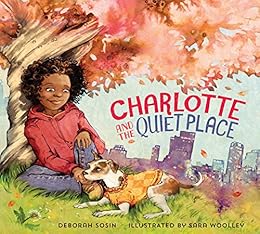
Charlotte and the Quiet Place by Deborah Sosin, illustrated by Sara Woolley

Published by Plum Blossom Books
Charlotte and the Quiet Place - Kindle edition by Sosin, Deborah, Woolley,  Sara. Children Kindle eBooks @ Amazon.com.

Summary: Charlotte lives in a noisy world. Her house is noisy, her street is noisy, even the library is noisy. Charlotte wishes she could find a quiet place. One day, she takes her dog for a walk in the park. He sees a squirrel and breaks free to chase it. Charlotte runs after him, and they end up in a quiet grove. When Charlotte sits down to catch her breath, she notices her breathing going in and out. Her thoughts slow down, and she finds herself, finally, in a quiet place. After that, whenever the world around her starts getting too noisy, Charlotte knows how to breathe deeply, slow her thoughts, and get back to the quiet place she found in the grove. Ages 3-8.

Pros: An excellent introduction to mindfulness and meditation for young kids.

Cons: An author’s note about the importance of mindfulness for children and some helpful tips for achieving it would have been useful.

.

Out of the Woods: a true story of an unforgettable event by Rebecca Bond

Published by Farrar Straus Giroux Books for Young Readers 

Summary: Antonio lives in the hotel his mother runs in 1914 Canada. He loves helping the different workers there and exploring the rooms on the second and third floors. One day, when Antonio is almost five, a man on the third floor spots smoke in the woods. Before long, the hotel is surrounded by fire, and all the inhabitants have to wade into the lake. As the fire closes in, wolves, moose, porcupine, bears, and other forest inhabitants join the humans in the lake. People and animals stand together until the fire passes by. The animals return to the forest, and the people go back to the hotel, which miraculously survived the blaze. An author’s note shows a picture of the real Antonio, the author’s grandfather, and tells how the story of the forest fire was passed down in her family. Grades 1-4.

Pros: A good mentor text for memoir writing. Kids will be fascinated by the forest fire and the gathering of all the animals. The beautiful illustrations look like old-time photographs.

Cons: The old-fashioned cover is not particularly eye-catching. Kids might have to be led to this book.

Fur, Fins, and Feathers: Abraham Dee Bartlett and the Invention of the Modern Zoo by Cassandre Maxwell

Published by Eerdmans Books for Young Readers 

Summary: When Abraham Dee Bartlett was growing up in the early 1800’s, there were no zoos. The closest thing was menageries where animals were kept in small cages for people to come and see. Abraham loved animals and read all that he could about them as a boy and a young man. His vast knowledge of wild animals eventually caught the attention of the London Zoological Society, and he was appointed superintendent of the new London Zoo. During his 38-year tenure there, he revolutionized the care of wild animals. He built larger enclosures for animals, learned how to feed them a healthy diet, and made labels so visitors could learn more about what they were seeing. By empathizing with the wild animals in his charge, he learned to keep them healthy and happy, and developed animal care methods that are used by zoos and veterinarians today. A timeline, author’s note, and brief bibliography are included. Grades 1-4.

Pros: Not only is this an interesting and inspiring story of a little-known man, but the cut paper collage illustrations are gorgeous. Readers will want to take their time with this book, enjoying both the text and the richly detailed pictures.

Cons: The final Doctor Dolittle-like illustration of Abraham surrounded by smiling animals is probably not entirely realistic.

The House That Jane Built: A Story about Jane Addams by Tanya Lee Stone, illustrated by Kathryn Brown

Published by Henry Holt and Company 

Summary: Growing up in a wealthy Illinois family, Jane Addams felt strongly that she wanted to help poor people. As a young woman, she visited Toynbee Hall in London. It was called a settlement house because wealthy people “settled” or lived among the poor. Upon returning home, Jane decided to start a settlement house in Chicago, Hull House. She devoted the rest of her life to Hull House, providing services and teaching skills to help people have better lives. Her model helped shape modern community centers. An author’s note tells more about Addams’ work for peace that included membership on the boards of the NAACP and the ACLU, and which was recognized with a Nobel Peace Prize in 1931. Grades 1-5.

Pros: An inspiring story of a woman who was one of the most famous American women of her time, but who is little known today.

Cons: Reading about Jane Addams on Wikipedia, I realized how much this brief picture book had to cut out of her rich and interesting life story.

I See A Pattern Here by Bruce Goldstone

Published by Henry Holt and Co. 

Summary: Patterns can be made in many different ways. This book looks at some of them, such as sliding, rotating, flipping, squishing, and stretching. Photos show examples of different types of patterns occurring both in nature and works of art from around the world. “MathSpeak” boxes give mathematical terms for the different ways patterns are created. The last two pages show ways to create patterns of your own. Grades K-3.

Pros: An excellent introduction to patterns that could be used for both math and art. The pages are appealing with plenty of white space and colorful photos.

Cons: Although patterns seem cool and fun, I never really understood why they were emphasized quite so much in the elementary math curriculum.

Wrap-Up Wednesday: Fifth Grade Favorites

During these first few weeks of school, I’ve tried some “book tastings” with fifth graders.  I put out a lot of the new books and have them sample three different books for a couple minutes each.  I’ve supplemented this with some book talks.  After doing this in seven fifth grades, I’ve gotten a sense of what are some favorites this year:

The Terrible Two by Mac Barnett and Jory John, illustrated by Kevin Cornell, published by Harry N. Abrams.

Wimpy kid fans have been checking out this book about two battling pranksters who unite to create the ultimate prank against their principal.

Fish in a Tree by Lynda Mullaly Hunt.  Published by Nancy Paulsen Books.

Sixth-grader Ally has moved so frequently that her dyslexia has gone undiagnosed.  She feels like an outsider at school until substitute extraordinaire Mr. Daniels gets her some help.  Definitely the sleeper of the new school year, with quite a few fifth-grade girls clamoring for this title.

Roller Girl by Victoria Jamieson.  Published by Dial Books.

No surprise here.  Astrid’s story about joining the roller derby has been popular with my Raina Telgemeier fans, and I expect word-of-mouth to play a large role as the school year progresses.

How to Speak Dolphin by Ginny Rorby.  Published by Scholastic.

Any book with a dolphin on the cover is sure to generate some interest.  The story is compelling, too, with Lily forced to make a difficult choice when she suspects the dolphin who is helping her autistic brother is being mistreated.

Ava and Taco Cat by Carol Weston.  Published by Sourcebook Jabberwocky.

I’ve been surprised at the interest in this book.  One reader has already finished it and asked me for the sequel, Ava and Pip (fortunately, I had it).  Ava’s story about her new cat is told in diary format, with some of the wordplay her entire family enjoys.

HiLo: The Boy Who Crashed to Earth by Judd Winick

Published by Random House

Summary: At the beginning of this graphic novel, D.J. hears a loud boom and sees a huge flash of light. Rushing to investigate, he discovers a boy wearing silver underpants who remembers nothing about himself.  He’s pretty cheerful about his situation, though, and quickly acclimates by absorbing all of D.J.’s vocabulary when they touch hands. As the story unfolds, the boy, who eventually remembers his name is HiLo, turns out to have fallen to earth from another planet and has a powerful enemy chasing him. Subplots involve D.J. feeling like an underachiever in a family of superstars and his reunion with his old friend Gina who has moved back to town after a three-year absence. D.J., HiLo, and Gina manage to save the planet…for now. Grades 3-6.

Pros: A funny, action-packed first entry in a new series. The cliffhanger ending promises more installments to come. A good choice for reluctant readers.

Cons: A few too many suspenseful situations were resolved with the appearance of a new superpower HiLo didn’t know he had.

Nerdy Birdy by Aaron Reynolds, pictures by Matt Davies

Published by Roaring Brook Press

Summary: Nerdy Birdy has big glasses, small wings, and is allergic to birdseed. He’s good at reading, playing video games, and reading about video games. He really wants to hang out with the cool birds, Eagle, Cardinal, and Robin. One day, he happens upon a bunch of other nerdy birds on a wire who convince him to join them. They point out there are more of them than the cool birds, and that the cool birds are actually so busy being cool that they don’t have any friends. Pretty soon, Nerdy Birdy has a whole gang of friends. Then along comes Vulture, who’s sort of, well, goth. The rest of the gang doesn’t like him, but Nerdy Birdy’s motto is, “There’s always room for another.” So he goes against the group, and before long, he’s made yet another friend. Ages 4-8.

Pros: A very funny look at kids’ friendships with a positive message for those who might not feel “cool”. The illustrations add a great deal to the humor.

Cons: The nerdy birds were just a tad stereotypical.

Funny Bones: Posada and his Day of the Dead Calaveras by Duncan Tonatiuh

Published by Abrams Books for Young Readers 

Summary: In late nineteenth century Mexico, Jose Guadalupe Posada (Lupe) was a prolific artist who owned his own print shop. He became well-known, first for his satirical political illustrations, and later for his prints of Calaveras, or skeletons, that were extremely popular around Dia de los Muertos (Day of the Dead) celebrations. This book tells the story of Posada’s life, and also details the steps of his various printmaking techniques and looks at possible meanings behind some of his more enigmatic works. Back matter includes a lengthy author’s note about Posada and the history of Dia de los Muertos celebrations; a glossary and bibliography; and a list of U.S. locations where Posada’s works can be viewed. Grades 1-5.

Pros: This book could be used for many subjects: history, art, and Mexican culture. The illustrations are done in a Mexican folk art style and include several of Posada’s works.

Cons: Some may find the Calaveras a bit creepy.

How to Swallow a Pig: Step-by-Step Advice from the Animal Kingdom by Steve Jenkins and Robin Page

Published by HMH Books for Young Readers

Summary: Each page gives an illustrated how-to guide for different animals and the unusual things they do: how to trap fish like a humpback whale, how to crack a nut like a crow, how to woo a ewe like a mountain sheep. There are 4-6 steps for each process, all featuring lots of interesting animal information with a touch of humor. The last three pages include thumbnail pictures and further information on each animal, plus a bibliography. Grades 1-4.

Pros: Steve Jenkins and Robin Page team up yet again for another fascinating look at the animal kingdom. Lots of gross, funny, and interesting facts are illustrated with the usual detailed cut paper illustrations. This would make a good mentor text for teaching procedural writing.

Cons: The format of this book makes it a bit difficult to read cover to cover. Unlike the pig of the title, it is probably best digested in small chunks.