We Rock! (Music Lab): A Fun Family Guide for Exploring Rock Music History by Jason Hanley

Published by Quarry Books

Summary:  Billed as a book to help families enjoy rock and roll music together, each two-page spread of this book features a single hit by a famous artist.  There’s a “Historical Fact/Social Connections” paragraph, “Song Facts”, “Try This at Home”, and a sidebar that tells what to listen to in each verse of the song, broken down by time.  Chapters include Rock and Roll Basics, Rocking Out, Deep Soul, Punk Rock, Dance Music, New Rock Sounds, and New Wave.  An appendix includes additional singers and bands related to each of the 52 artists profiled.  Ages 10-110.

Pros:  Written by the director of education at the Rock and Roll Hall of Fame, this is a pretty definitive guide to rock music.  Any fan will find it a difficult book to put down, and it would make sharing your favorite oldies with the kids a great deal of fun.

Cons:  No Grateful Dead?

The Doldrums by Nicholas Gannon

Published by Greenwillow Books 

Summary:  Archer B. Helmsley has spent his whole life in Helmsley House, surrounded by stuffed animals and other artifacts collected by his grandparents, the famous explorers Ralph and Rachel Helmsley.  Ever since Ralph and Rachel went missing on an iceberg in Antarctica, Archer’s mother has kept him at home in an attempt to keep him safe from any exploring instincts he may have inherited.  But as Archer gets older, he becomes restless, and eventually decides it’s up to him to head for the South Pole and rescue his grandparents.  He enlists the help of two neighbors, the cautious Oliver Glub, who is good at worrying over details, and the mysterious Parisian, Adelaide L. Belmont, whose wooden leg is a testimony to an adventurous past.  The whole rescue plan comes to an uproarious climax on a museum field trip complete with an evil teacher, a gazelle mask, a glass eye, and a pack of hungry tigers.  Grades 3-7.

Pros:  Fans of Roald Dahl and Lemony Snicket will appreciate the quirky characters and settings of this debut novel.  The author is also an artist who created over 20 gorgeous color illustrations, as well as many smaller black-and-white ones throughout the book.

Cons:  The whole story seemed to build toward a grand final adventure that never actually happens.

The Whisper written and illustrated by Pamela Zagarenski

Published by Houghton Mifflin Harcourt Publishing 

Summary:  A little girl in a red hood gets to borrow a book her teacher promises is full of wonderful stories.  As she races home with the book, the words leak out the bottom and drift away, until a clever fox catches them in his net.  Arriving at home, the girl is disappointed that the book has only pictures, no stories.  She’s about to abandon it when she hears a whispered voice telling her to use her imagination.  Back she goes to the first illustration, trying to imagine what the story would be.  Her stories grow more creative and complex with each page, until she falls asleep.  In the morning, she rushes back to tell her teacher how much she loved the book, helping the clever fox reach some grapes along the way.  Grades K-3.

Pros:  This book reminded me of one of my favorite elementary school creative writing exercises, where the teacher would post a picture and we’d have to write a story about it.  The sumptuous illustrations could inspire endless stories.  This would also make a great introduction to wordless picture books and how to make up your own stories.  Look for the fox’s appearance on every page.

Cons:  Kids may need some help appreciating this book, which doesn’t have the conventional story arc.

We Forgot Brock! By Carter Goodrich

Published by Simon and Schuster Books for Young Readers 

Summary:  Phillip and Brock are best friends.  It’s a little annoying that Mom and Dad can’t see Brock and don’t believe that he exists, but they generally don’t let this bother them.  One night, the whole family goes to the Big Fair, where they ride on the merry-go-round, the bumper cars, and the tilt-a-whirl.  Phillip falls asleep after the Ferris wheel ride, and the family heads for home, unaware that Brock is still riding the Brain Shaker.  When Phillip wakes up at home, he realizes that Brock is still at the fair.  Meanwhile, Brock is on the Ferris wheel, trying to find Phillip and his family.  A little girl named Anne and her friend Princess Sparkle Dust see him and bring him home with them.  The next day, Phillip rides his bike around, looking for Brock, and eventually finds him with Anne.  All four become fast friends, which works out great, because at least Mom and Dad can see Anne.  Ages 3-8.

Pros:  A fun take on the imaginary friend story, told with great respect for the imaginary friends.  I love the drawings of Brock and Princess Sparkle Dust.  Look for Brock’s blushing cheeks when he rides home in the back seat with the princess.

Cons:  With two swords, Brock seems to be a bit heavily armed to be going to the fair.

Aaron and Alexander: The Most Famous Duel in American History by Don Brown

Published by Roaring Brook Press 

Summary: Aaron Burr and Alexander Hamilton were almost the same age.  Both grew up as orphans, fought in the American Revolution, and were key figures in early American government and politics.  Moving in the same social and professional circles, they were friends early in their careers, but later became bitter political enemies.  Hamilton helped defeat Burr in his presidential campaign against Thomas Jefferson, and again in his bid for governor of New York.  Finally, Burr challenged Hamilton to a duel.  It was an illegal but not uncommon practice at the time; Hamilton had been challenged eleven times before, and Burr had had had a hole shot through his coat in a previous encounter.  On the morning of July 11, 1804, they met in Weehawken, New Jersey, stood thirty feet apart, and shot at each other.  Hamilton was hit and died the next day.  Burr survived, but was forever after despised by much of America.  Includes an author’s note and bibliography.  Grades 2-5.

Pros:  The names Aaron Burr and Alexander Hamilton may be familiar to kids, but they are unlikely to know much about them aside from their famous duel.  This picture book introduces both men sympathetically and gives a good overview of their lives.

Cons: The details of their political differences are a bit skimpy.

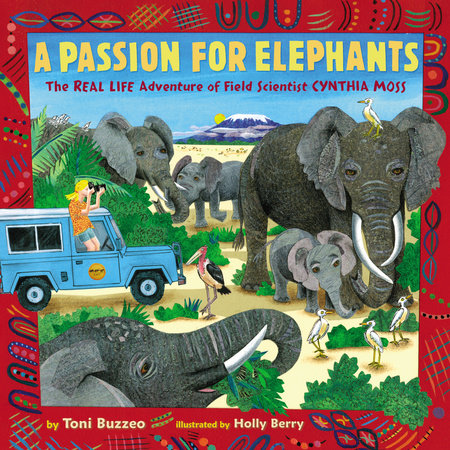
A Passion for Elephants: the real life adventure of field scientist Cynthia Moss by Toni Buzzeo, illustrated by Holly Berry

Published by Dial Books for Young Readers 

Summary:  Cynthia Moss was never afraid of BIG things.  That’s the recurring refrain in this story of scientist Cynthia Moss, who grew up riding horses in Virginia and went on to become a journalist.  An invitation from a college friend sent her to Africa, where she got a job photographing elephants for a zoologist.  This ignited a passion, and she began to recognize individual elephants and their families.  She went on to found the Amboseli Elephant Research Project and made many new discoveries about elephant behavior.  Eventually, concerned about the decline of elephant populations caused by poaching, Cynthia became an activist, working to get a global ban on the sale of ivory in 1990.  Her work continues today, both researching and protecting the elephants she loves.  Back matter includes further information about Moss, further reading, and additional sources.  Grades K-3.

Pros:  An inspiring biography of a scientist who has made a difference.  Less well-known the Jane Goodall, Cynthia Moss’s career parallels hers, in her long years studying animals in Africa and her work around the world to protect them.  The colorful illustrations would make this a great read-aloud to share with kids.

Cons:  The most recent source listed in the additional resources is from 2010.

The Copper Gauntlet by Holly Black and Cassandra Clare

Published by Scholastic Press 

Summary: Callum Hunt is getting ready to go back to school for his second year at the Magesterium, when he makes a disturbing discovery: his father, Alistair, has a secret basement room where it looks like he’s getting ready to perform potentially fatal experiments on both Call and his wolf, Havoc. Call escapes to his friend Tamara’s mansion, where he meets up with other magicians and learns about a powerful copper gauntlet that has been stolen from the Magesterium.  When the kids return to school, Call learns that Alistair is a leading suspect in the theft and, against his better judgement, decides that he must try to find his father and warn him about the accusations made against him.  Tamara, Aaron, and Jasper join Call on his quest, which ends, as these quests so often do, in a huge showdown between the forces of good and evil.  The Enemy of Death seems to have been defeated, but there is just enough doubt around that issue to pave the way for book three of the Magisterium series.  Grades 4-7.

Pros:  Fans of Harry Potter and Rick Riordan will be delighted with this series about a boy discovering his magical powers at a school for magicians.  The magical world is well-crafted and the action is non-stop.

Cons:  The great majority of the story took place outside the Magisterium, taking away the fun element of a magic school.

Orpheus in the Underworld by Yvan Pommaux

Published by Toon Books

Summary: Orpheus was the son of the king of Thrace and Calliope, muse of epic poetry. With that gene pool, it came as no surprise that he turned out to be not only musically gifted but pretty good looking as well.  Before long, he fell in love with Eurydice, and the two of them got married.  On their wedding day, Eurydice was bitten by a snake and died.  Overcome with grief, Orpheus tried to rescue her from the underworld.  He was allowed to take her, under the condition that he couldn’t look back.  Of course, right at the last possible moment, he couldn’t help himself, and checked to make sure she was behind him.  She vanished forever, and Orpheus went around singing songs about Eurydice until he was torn apart by jealous women.  (I’m not making this up).  Grades 4-8.

Pros:  The story is compellingly told, particularly the trip to the underworld.  The text is part regular book and part comic; the accompanying illustrations are beautiful.

Cons:  Mythology and comic art is a tricky combination, and some of the comic dialogue seems a bit forced (Orpheus: I couldn’t help myself, I needed to see you again.  Eurydice: I’m glad you left your lyre this time.  Your voice is music enough to my ears.).  Ick.

The Seventh Most Important Thing by Shelley Pearsall

Published by Alfred A. Knopf

Summary: When Arthur Owens throws a brick at the Junk Man who roams his neighborhood picking through trash, the old man’s arm is broken and Arthur is sent to juvie. At his probation hearing, the Junk Man, a.k.a. James Hampton, requests that Arthur be sentenced to community service helping him. On his first day of the job, Arthur goes to the address he’s been given and finds a locked garage with a rusty shopping cart outside containing a list of the seven most important things he’s to find in the trash: cardboard, foil, light bulbs, mirrors, pieces of wood, glass bottles, and coffee cans. As the months wear on, Arthur gets to know Mr. Hampton and helps him create his work of art, The Throne of the Third Heaven. He begins to see that the seven most important things on Mr. Hampton’s list parallel the seven most important things in his own life. Through their work, he is able to grieve for his recently deceased father and let go of his guilt about his brick-throwing. By the end of their time together, everything has changed, and Arthur finds himself responsible for sharing Mr. Hampton’s masterpiece with the world. Grades 5-8.

Pros: A powerful story of redemption based on the real-life James Hampton and his eccentric and visionary work of art. The characters are perfectly rendered, from a Holden Caulfield-like Arthur to his gruff but caring probation officer, Officer Billie, to his struggling mother, and of course, the eccentric Mr. Hampton himself.

Cons: The two photographs of James Hampton and his work of art are too small to satisfy my curiosity about what he and the amazing Throne of the Third Heaven looked like.

Two White Rabbits by Jairo Buitrago, illustrated by Rafael Yockteng

Published by Groundwood Books 

Summary: A little girl and her father are making the difficult journey from Central America or Mexico to the United States. They travel first by small boat, then on the top of a freight train.  They’re delayed by soldiers, and have to run away.  Sometimes the father has to stop and work to earn more money.  The story is told by the girl, who doesn’t know where they’re going.  She passes the time counting birds, clouds, and soldiers.  She plays with a boy when her father has to work.  She wonders where they are going and how long it will take to get there.  Grades K-3.

Pros:  A fascinating and eye-opening story for children living north of the border.  The text, in the little girl’s voice, doesn’t explain many of the things going on in the illustrations, like the father grabbing his daughter and fleeing from soldiers.  There are few details given about their homeland, making the story more universal.

Cons:  It’s hard to understand what’s going on just from reading the text.  Young readers will need an adult to give the story some context.