The Last Fifth Grade of Emerson Elementary by Laura Shodd

Published by Wendy Lamb Books 

Summary:  Emerson Elementary School will be razed and replaced by a supermarket at the end of the year.  The eighteen fifth graders in Ms. Hill’s class have a range of emotions about this.  To express them, their teacher has them write poems which will be placed in a time capsule inside the wall of the new store.  The class is diverse in ethnic and family backgrounds, and their individual struggles at school and at home show up in their poetry.  Each one grows through the year, making and losing friends, accepting changing family situations, and learning about themselves.  By the end of the year, they are ready to accept the inevitable, and find their own ways into middle school.  End matter includes several pages about the different forms of poetry and the prompts the students had to work from, as well as a glossary.  256 pages; grades 3-7.

Pros:  This first-time author does an amazing job of creating 18 distinct, likeable characters.  Although this could be a quick read, it pays to take it slowly, going back to see other poems written by each student to really get to know them.  The extra information on different poetic forms would make this an excellent and accessible introduction to poetry.

Cons:  It’s pretty difficult at the beginning to keep track of who’s who in the class.

Raymie Nightingale by Kate DiCamillo

Published by Candlewick 

Summary:  Raymie Clarke has a plan to win the 1975 Miss Central Florida Tire contest.  In addition to the $1,975 prize money, she wants her father to see her picture in the paper.  Then maybe he will change his mind about running away with a dental hygienist and come back to his family.  Part of Raymie’s plan is to take baton lessons, and it’s here she meets Louisiana and Beverly.  Louisiana is an orphan living with her impoverished grandmother, looking for Archie, her cat that she was forced to give to a shelter.  Beverly, whose father has moved to New York and whose mother is responsible for the bruise on Beverly’s face, is already an expert twirler.  Her motivation for entering the pageant is to sabotage it.  Slowly, unpredictably, these three girls form a bond that results in a wild night together, culminating in Raymie Clarke, renamed Raymie Nightingale by Louisiana, saving her friend’s life.  272 pages; grades 4-7.

Pros:  A bittersweet story about three girls trying to find their way in a world of sad, lonely, and angry adults.  By the end of the book, a friendship has been formed, and each girl has grown up a little in her own unique way.

Cons:  Clearly I’m in the minority, but I just don’t get the appeal of Kate DiCamillo.  Her characters are so quirky they don’t even seem real to me.  The first half of this book seemed like a random string of bizarre occurrences; there is a “look-at-how-clever-I-am” quality to her writing..  However, my opinion notwithstanding, I’m sure by this time next year, the cover of Raymie Nightingale will be sporting a shiny silver or gold Newbery sticker.

Olinguito, de la A a la Z! by Lulu Delacre

Published by Lee and Low Books 

Summary: Never heard of the olinguito? Don’t worry, scientists have only known about it since 2006. Lulu Delacre has created an alphabet book with text in both Spanish and English that follows zoologist Dr. Kristofer Helgen through the cloud forest of Ecuador as he looks for and finally finds this little animal. The olinguito doesn’t make an appearance until “W”, though, so the reader gets introduced to many other flora and fauna of the rainforest. Extensive back matter includes information about the discovery of the olinguito, the cloud forest, the illustrations, plus a lengthy glossary…all in both English and Spanish. 40 pages; grades K-4.

Pros: The illustrations are as lush and colorful as the cloud forest. The text could be used as a simple alphabet book or as a resource for research, depending on which parts are used.

Cons: The English is sometimes not as alliterative as the Spanish in the alphabet portion of the book.

You’re Doing THAT in the Talent Show?! By Lynn Plourde, illustrated by Sue Cornelison.

Published by Disney Hyperion 

Summary:  Penelope and Tiny are best friends, but when it comes to the talent show, they can’t agree.  Penelope wants to be front and center, whether it’s dancing, acting, singing, or a combination of all three.  Tiny can’t imagine being in the spotlight, and advocates for a performance with the chorus.  Finally, they come up with the perfect solution: to perform separately, but cheer each other on enthusiastically.  The plan goes off without a hitch, and Tiny even gets a chance to save Penelope’s act from a potential disaster.  The last page lists tips for a spectacular performance.  32 pages; ages 4-8.

Pros:  The classic story of an introvert and extrovert trying to work together.  Bright, cheerful illustrations and a friendship with a perfect ending will keep readers happy.

Cons:  The text got a little repetitious.

Cloth Lullaby: The Woven Life of Louise Bourgeois by Amy Novesky, pictures by Isabelle Aresenault

Published by Abrams Books for Young Readers 

Summary:  Louise Bourgeois (1911-2010) spent her childhood along the banks of a river in France.  Her mother repaired tapestries, and Louise learned the art of weaving from her.  Although she studied math at the Sorbonne, Louise ultimately became an artist.  After her mother died, she made a giant sculpture of a spider, famous for its weaving, and spiders appeared in a lot of her other works.  Later in life, she gathered fabric from many different people and places in her past and created works of art with the different textiles.  She continued to create art right up until the time of her death at age 98.  End matter includes additional biographical information.  40 pages; grades 2-6.

Pros:  The illustrations are exquisite and really capture Louise’s life and art.  The text is almost poetic.

Cons:  This is not a straightforward biography, and kids may find some of the text difficult to understand.  The biographical information at the end is helpful; it may be useful to present it before reading the story.

When Green Becomes Tomatoes: Poems for All Seasons by Julie Fogliano, illustrated by Julie Morstad

Published by Roaring Brook Press 

Summary:

march 22

just like a tiny, blue hello

a crocus blooming

in the snow

Starting with the spring solstice (March 20), these poems wind their way through the seasons, finishing up on March 20 of the following year.  In between are poems about flowers and strawberries, the beach, pumpkins, and frost and snow.  The title of each poem is a date, and all are illustrated with simple but evocative pictures.

Pros:  This year of poems would make an excellent introduction to poetry and may inspire young writers to try to capture the various seasons through their own words.

Cons:  There was no poem for my birthday.  Or for my half-birthday, for that matter, which happens to be today.


Summerlost by Ally Condie

Published by Dutton Books for Young Readers 

Summary:  Cedar, her mother, and younger brother are spending the summer in a newly purchased vacation home following the death of her father and middle brother in a car accident.  Their new house is in the town her mother grew up in, which is also home to the Summerlost Shakespeare Festival.  One day, Cedar sees a boy riding his bike in a costume.  Leo is a neighbor who works selling concessions at the festival, and he recruits Cedar to join him.  They quickly become friends, and Leo confides that he is starting a secret tour about the life of Lisette Chamberlain, the most famous actress ever to come out of the festival, who died mysteriously 20 years ago.  Soon Leo and Cedar are both giving the tours, and slowly learning to trust each other with their hopes, dreams, and fears.  As the summer progresses, Cedar gradually begins to come to terms with her grief and to start thinking about healing and moving on with her life.  272 pages; grades 4-7.

Pros:  A beautiful tale of friendship and healing, with a little bit of a mystery thrown in.  Despite the subject matter, the story was surprisingly upbeat.

Cons:  I almost decided against reading yet another story of a kid dealing with a tragedy; however, I was glad I persevered.

Ideas Are All Around by Philip C. Stead

Published by Roaring Brook Press 

Summary:  The narrator has to write a story, but he has no ideas.  So he decides to take his dog, Wednesday, for a walk.  Along the way, they see flowers, a turtle, people, trains, and clouds.  The narrator thinks about where the people on the trains might be going and how it might be to write his story on his old typewriter back at home.  He talks to a woman who used to rent a room to him, and remembers when he spilled blue paint on her sidewalk.  He stops to have coffee with her, and when he tells her his problem, she replies that ideas are all around.  Finally, he goes home and starts typing on the old typewriter.  48 pages; grades K-5.

Pros:  Read this to get creative juices flowing.  The stream of consciousness writing and somewhat abstract prints, interspersed with photos, will inspire readers to look around them for ideas.  It would be an excellent springboard to taking a walk and focusing on observation skills.

Cons:  Kids might find this a little dull as a story; it really is more of a tool for creativity.

The Wild Robot words and pictures by Peter Brown

Published by Little, Brown 

Summary: When a ship carrying 500 robots sinks in a hurricane, only one of the robots survives. She is ROZZUM Unit 7134, better known as Roz, and she washes up on an island inhabited only by animals. As she explores the island to learn more about her new home, the animals fear they are being invaded by a monster. Gradually, they learn that she likes to help them, and they, in turn, help her. When she adopts an orphaned gosling and builds a nest for herself and her new son, she becomes a full-fledged member of the community. Her building and fire-making abilities save the animals during an unusually frigid winter. Roz’s happy world is shattered, though, when her robot past catches up with her. War comes to the island as the animals seek to protect her. Can this robot really be “wild”, or must she be true to her automaton nature? 288 pages; grades 3-7.

Pros: Charlotte’s Web meets The Iron Giant in this debut novel from illustrator Peter Brown. The story is touching without being sappy or emotional, and thought-provoking without being preachy. If I were on the Newbery committee, this would be going to the top of my list.

Cons: The ending is a little dark. Until the last few chapters, I thought this would be a perfect read-aloud for grades 2 and up. After finishing it, I would say grade 3 or even 4 would be the youngest. Read it first if you’re not sure.

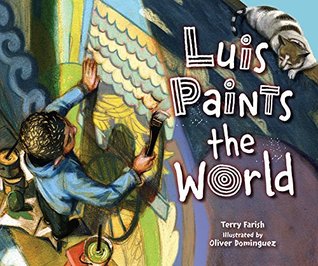
Luis Paints the World by Terry Farish, illustrated by Oliver Dominguez

Published by Carolrhoda 

Summary:  Luis is sad because his brother Nico is leaving to join the army and go overseas.  When Nico tells Luis he is going to see the world, Luis begins painting a mural trying to capture the world so Nico will want to come home again.  After Nico leaves, Luis incorporates photos that Nico texts him into his mural.  Gradually, their mother and others from the neighborhood join in to make the mural a community effort.  The seasons pass, and finally, one warm summer day, Nico comes home again.  A note from the author explains that Luis, Nico, and the mural are based on her experiences working in Lawrence, Massachusetts.  32 pages; ages 4-9.

Pros:  The rich, colorful illustrations capture Luis’s mural beautifully, and the story is real and heartfelt.

Cons:  A few of the Spanish words and phrases aren’t translated.