How This Book Was Made by Mac Barnett, pictures by Adam Rex

Published by Disney-Hyperion 

Summary:  Reading other reviews for this book, I learned a new word—metafiction, which Merriam-Webster tells us is “fiction which refers to or takes as its subject fictional writing and its conventions.”  Fiction and nonfiction are blurred here as Barnett and Rex show how their book was made, with a few questionable additions like an arm-wrestling tiger, marauding pirates, and a pile of books visible from outer space.  The concepts of author, illustrator, editor, and publisher are all introduced in the context of producing a book from start to finish.  The final page reminds kids that a book really isn’t a book until it is read, so that you, the reader, have been an integral part in the making of this book.  48 pages; ages 4-8.

Pros:  If you’re looking for a straightforward account of how books are made, this may not be the best choice, but if you’re looking for an exercise in hilarious craziness, this will fit the bill.

Cons:  For the illustrator biography on the back flap, Adam Rex takes the phrase “How this illustrator was made” literally, resulting in a slightly PG-rated couple of sentences.

Ugly: a memoir by Robert Hoge

Published by Viking


Summary:  When Robert Hoge was born in 1972, he was missing most of his left leg, his right leg was deformed, and he had severe facial abnormalities.  At first, his mother couldn’t bear the thought of bringing him home to join his four older siblings, but eventually she came around and became his staunchest defender.  Despite many surgeries to rebuild his nose, move his eyes closer together, and amputate part of his right leg, Robert strove—and for the most part succeeded—to have a happy childhood.  His memoir tells of universal kid experiences making friends, trying different sports, and getting in trouble.  It also relates the teasing he got from other kids, including his top ten list of nicknames with ratings for originality and power to hurt.  When Robert was 14, his parents told him doctors were ready to perform a big operation on him to improve his appearance.  After weighing the risks and potential rewards, Robert decided he had come as far as had with his face the way it was, and would forego the operation to move forward being himself.  200 pages; grades 4-8.

Pros:  Called by some a real-life Wonder, this book has a more matter-of-fact tone, but is inspiring nonetheless. There’s plenty of dry British humor (the Hoge family is Australian), and Robert is a quick study figuring out how to fit in with his peers without compromising his own sense of self.

Cons:  Robert’s decision not to have the final operation seemed somewhat abrupt, and left me hoping for a sequel to find out how he made it through the rest of his teen years.

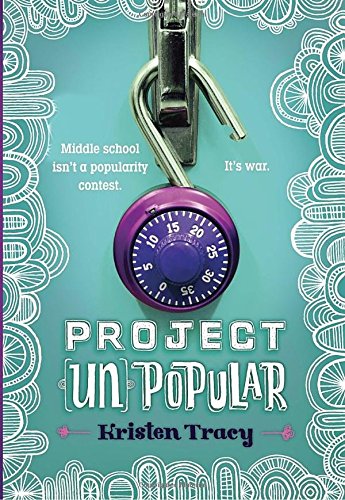
Project [Un]Popular by Kristen Tracy

Published by Delacorte Press 

Summary:  Perry’s excited to be starting middle school, especially when she joins the yearbook staff as a photographer.  When eighth grade editor Anya takes Perry and her best friend Venice aside to give them “feedback” on their photos, Perry is thrilled, but Venice is suspicious.  Seventh grader Leo tells them that Anya isn’t to be trusted, and before long he and Venice are plotting against her.  Perry, feeling left out, allies herself with Anya, but becomes disillusioned when she realizes Anya is creating a yearbook that will showcase her and her popular friends.  Perry tries to take control, but ends up making things far worse, ultimately causing a suspension for Leo and detention for both her and Venice.  It looks like Perry and Venice’s friendship may be over, but things are smoothed over by the end, and they’re ready to face the future in book 2 of this series.  336 pages; grades 4-7.

Pros:  Readers will laugh out loud at Perry’s missteps and constant misreadings of various situations.  A series that’s sure to be as popular as Anya purports to be.

Cons:  I occasionally found Perry’s level of naiveté unbelievable.

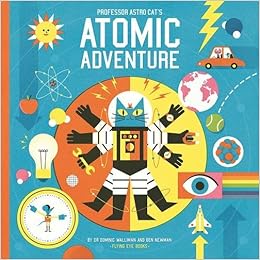
Professor Astro Cat’s Atomic Adventure by Dr. Dominic Walliman and Ben Newman

Published by Flying Eye

Summary:  Professor Astro Cat takes readers on a tour through the world of physics.  After announcing that physics holds the answers to many questions (“Why is the sky blue?” “How does a boat float?”), he covers many of the basics of physics, including gravity, sound, light, atoms, matter, energy, and more.  Each two-page spread of this oversize book has a dizzying array of graphics giving facts, answers to questions, and real-life examples.  This is a British import, so there are some British spellings and measurements.   A glossary-index is included at the end.  56 pages; grades 2-6.

Pros:  A very complete introduction to physics, explained in a kid-friendly but not condescending way, with eye-catching illustrations throughout.

Cons:  It will take a dedicated science fan or some adult support to get through all the content here.

Snow White: A Graphic Novel by Matt Phelan

Publisher:  Candlewick Press 

Summary:  The story of Snow White is retold in a Depression-era New York City setting.  Samantha White’s mother often calls her Snow, but sadly she dies of what appears to be tuberculosis when Samantha is still quite young.  Enter the evil stepmother, queen of the Ziegfeld Follies, who dazzles Snow’s father into marriage, then sends her stepdaughter away to school.  Before long, the father is dead, and the stepmother sets her sights on Snow.  Running away, Snow meets up with seven young street urchins who hide her and protect her as best they can.  They’re no match for Snow’s evil foe, though, and before long, Snow has fallen into a deep sleep.  A handsome New York City detective holds the key to her awakening, the evil stepmother is disposed of in a fitting ending, and Snow, the detective, and their seven boys live happily ever after.  216 pages; grades 5-8.

Pros:  An amazingly well-done retelling of the classic tale in an unexpected setting.  It’s a story of few words, with much of it being told through the artwork, which perfectly captures the era.

Cons:  This evil stepmother goes beyond Disney…she’s a cold-blooded killer with at least two murders under her belt before she goes after Snow.

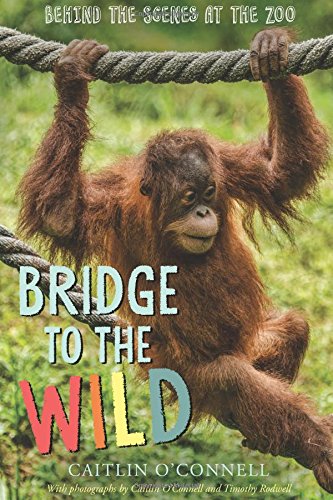
Bridge to the Wild: Behind the Scenes at the Zoo by Caitlin O’Connell, with photographs by Caitlin O’Connell and Timothy Rodwell

Published by HMH Books for Young Readers


Summary:  Caitlin O’Connell, elephant scientist and science writer, expands her horizons here to many other zoo animals.  Touring Zoo Atlanta in Atlanta, Georgia, she gives readers a behind-the-scenes look at how zoo staff study animal behavior.  Readers will learn how panda mothers interact with their babies, how hierarchies work with various social animals like elephants and gorillas, and how zoo staff handle deadly poisonous snakes.  Much of what is learned about animals in captivity can be applied to helping species survive in the wild.  The last chapter describes ways humans have been able to help endangered animals such as Brazil’s lion tamarin.  Includes extensive bibliography, source notes, and index.  208 pages, grades 5-7.

Pros:  Animal lovers will learn a lot from this book, and come away with a new appreciation for zoos and the people who work there.  Excellent photographs illustrate almost every page.  Chapters could be read in isolation by those interested in a specific animal.

Cons:  At 208 pages, it will take a pretty dedicated young zoologist to get through the whole book.

Lucy & Andy Neanderthal by Jeffrey Brown

Published by Crown Books 

Summary:  Siblings Lucy and Andy, as well as their friends and family, are Neanderthals, which means…what?  Two modern scientists appear at the end of each chapter to fill the reader in on how Neanderthals hunted, created tools, communicated, made clothes, and more.  There are pertinent comments throughout the story which is a humorous slice-of-life look at several days with the Neanderthals.  The family prepares  for a big mammoth hunt, goes on the hunt, then turns the dead mammoth into meat and clothes.  At the end, the Neanderthals meet up with some humans, who seem to be fabulous new neighbors until Andy overhears them plotting to take over the Neanderthals’ cave.  This sets up for book 2 which is previewed on the final few pages.  There’s a section at the end with still more Neanderthal information, and a note from the author in which he claims to have read almost 100 books to prepare for the creation of this graphic novel.  224 pages; grades 2-6.

Pros:  Far more educational than what I was expecting from the author of Jedi Academy, but don’t worry, there is plenty of fun mixed in as well.  This one is guaranteed to fly off the library shelves, and readers will be laughing too much to realize they’re learning, too.

Cons:  I prefer some color in my graphic novels.

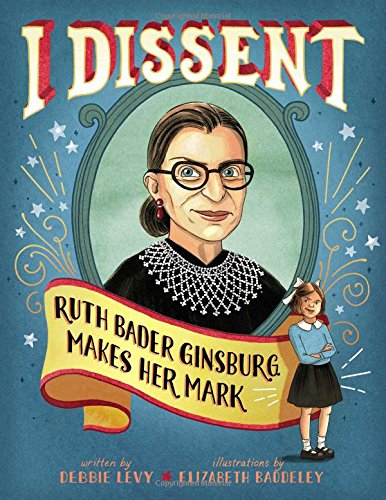
I Dissent: Ruth Bader Ginsburg Makes Her Mark by Debbie Levy, illustrated by Elizabeth Baddeley

Published by Simon and Schuster 

Summary:  Growing up in the 1940’s, Ruth Bader noticed many prejudices and injustices.  There were hotels and restaurants that banned her family because they were Jewish.  Girls weren’t expected or encouraged to do many of the things boys could do.  Even as a left-handed person, Ruth faced discrimination, getting a “D” in penmanship when she was forced to write with her right hand.  Ruth’s mother took her to the library and encouraged her to get an education; although she died the day before Ruth’s high school graduation, Ruth persisted and went to college and law school.  Overcoming the difficulties of being hired as a female lawyer, she eventually became a law professor, then a judge.  In 1993, Ruth Bader Ginsburg was appointed to the Supreme Court.  Throughout her career, up to the present day, she has fought for the rights of those who experience discrimination.  Now the oldest member of the Supreme Court, there are those who think it’s time for her to retire.  Ruth Bader Ginsburg dissents.  Includes an extensive author’s note with additional biographical information, notes on the Supreme Court cases mentioned in the text, and a bibliography.  40 pages; grades 1-4.

Pros:  The first picture book about this woman who continues to inspire.  Building Ruth’s story around her experiences with discrimination and passion for justice gives the story a good focus.  The illustrations add a bit of humor and incorporate some of the text into the pictures.

Cons;  Those whose politics don’t match Ginsburg’s may disagree with the way some of the Court cases are described.

I

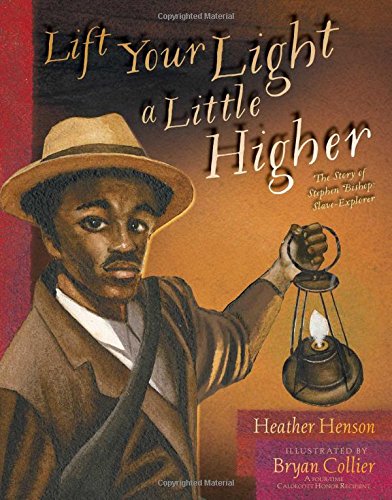
Lift Your Light a Little Higher by Heather Henson, illustrated by Bryan Collier

Published by Atheneum


Summary:  Stephen Bishop invites you to join him on a tour of Kentucky’s Mammoth Cave.  Born a slave, Bishop was trained as a tour guide for this huge cave system (the longest in the world) that was on his master’s plantation.  Although other slaves also guided visitors, Stephen became the most famous.  He discovered new animals and forged new paths through the caves.  He shows visitors his name on the cave wall, written along with his wife’s and many other visitors’, with the smoke from a candle tied to a long stick.  Little is known of Stephen Bishop’s life, which ended at the age of 37.  He is buried not far from the entrance to Mammoth Cave.  Author’s and illustrator’s notes at the end give more information about Bishop and how this book was created.  32 pages; grades 1-4.

Pros:  The lyrical text and beautiful illustrations by Bryan Collier bring this little-known man to life, along with the caves he loved and studied for many years.  Since so little is known about him, this isn’t really a biography, but more an imagined meditation on slavery, race, and life.

Cons:  Read the author’s note first, or the story will be hard to understand.

Click Here to Start by Denis Markell

Published by Delacorte Press 

Summary:  During 12-year-old Ted’s final visit with his somewhat mysterious great uncle, Uncle Ted extracts a promise from young Ted to not give up and keep looking for answers.  Shortly afterward, his great uncle dies, and Ted inherits his apartment and all its contents.  He and his friend Caleb are psyched to dig into the mess, but disappointed when Ted’s father invites his boss’s daughter, Isabel, to join them.  Isabel turns out to be a brain, which is helpful as the three are drawn deeper and deeper into a search for lost treasure.  Ted is an expert an online escape-the-room games, and it turns out his great uncle created a hunt perfectly honed to his skills.  The only problem is there’s at least one bad guy racing to find the same treasure, and it’s hard to tell who he is.  With plot twists on practically every page, the three kids finally end up victorious, with a few ends left loose to pave the way for a sequel.  320 pages; grades 5-8.

Pros: Fast-paced and funny, this is sure to engage reluctant readers with its non-stop action and humorous dialogue.

Cons:  Plan on suspending your disbelief by chapter two and keeping it suspended up until the last page.  The solution to this puzzle is way beyond the capabilities of any mortal mind, and there are a few too many coincidences to be believable.  Don’t think too much…just enjoy the ride.