Secret Engineer: How Emily Roebling Built the Brooklyn Bridge by Rachel Dougherty

Published by Roaring Brook Press
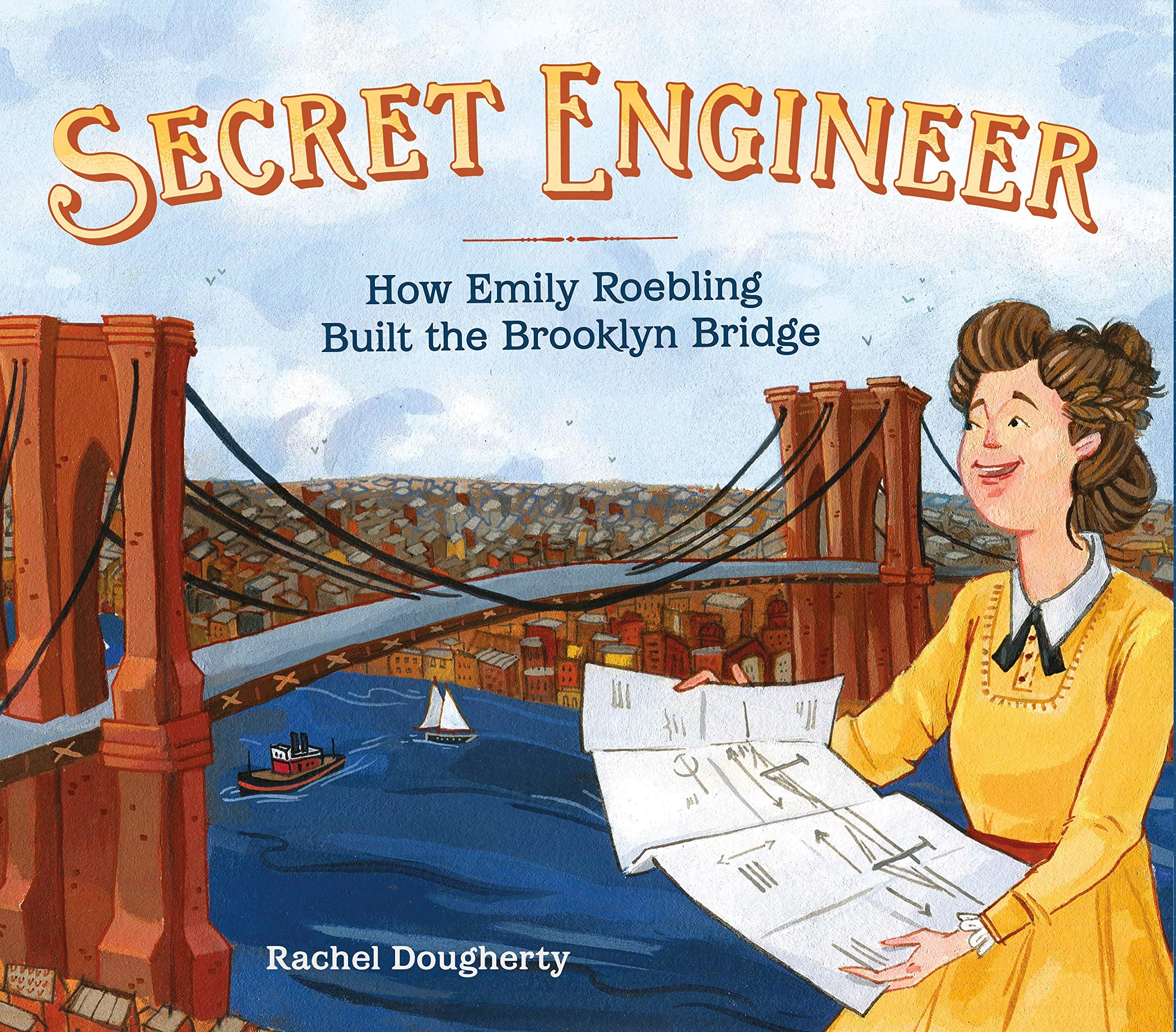
Image result for secret engineer amazon

Image result for secret engineer emily roebling

Summary:  Unlike many girls of her time, Emily Warren enjoyed studying math and science.  When she married Washington Roebling, she insisted on joining him on his travels through Europe as he sought ideas to build a bridge from Brooklyn to Manhattan.  Construction began in 1870, with caissons being sunk into the river bottom. Many workers got sick with “caisson fever” from working inside the hot, damp structure, and Washington was afflicted in 1872.  Unable to return to work, he began to rely on Emily to communicate his ideas to the construction workers at the bridge. Eventually, Emily taught herself bridge engineering and began to feel confident enough to add her own ideas.  A week before the opening of the Brooklyn Bridge in 1883, Emily assuaged people’s concerns about its stability by taking the first trip across in an open carriage. Crowds on both sides of the river celebrated the opening on May 24, “never even knowing about the contributions of an insistent woman named Emily Roebling.”  Includes additional information about Emily, a glossary, and a list of additional resources. Photos of the Brooklyn Bridge appear on the endpapers. 40 pages; grades 2-5.

Pros: An inspiring story of a little-known woman who educated herself to be able to play a key role in one of the great engineering feats of her day.

Cons:  I was curious about caisson fever and Washington’s fate, but there was no information about that.
If you would like to buy this book on Amazon, click here.

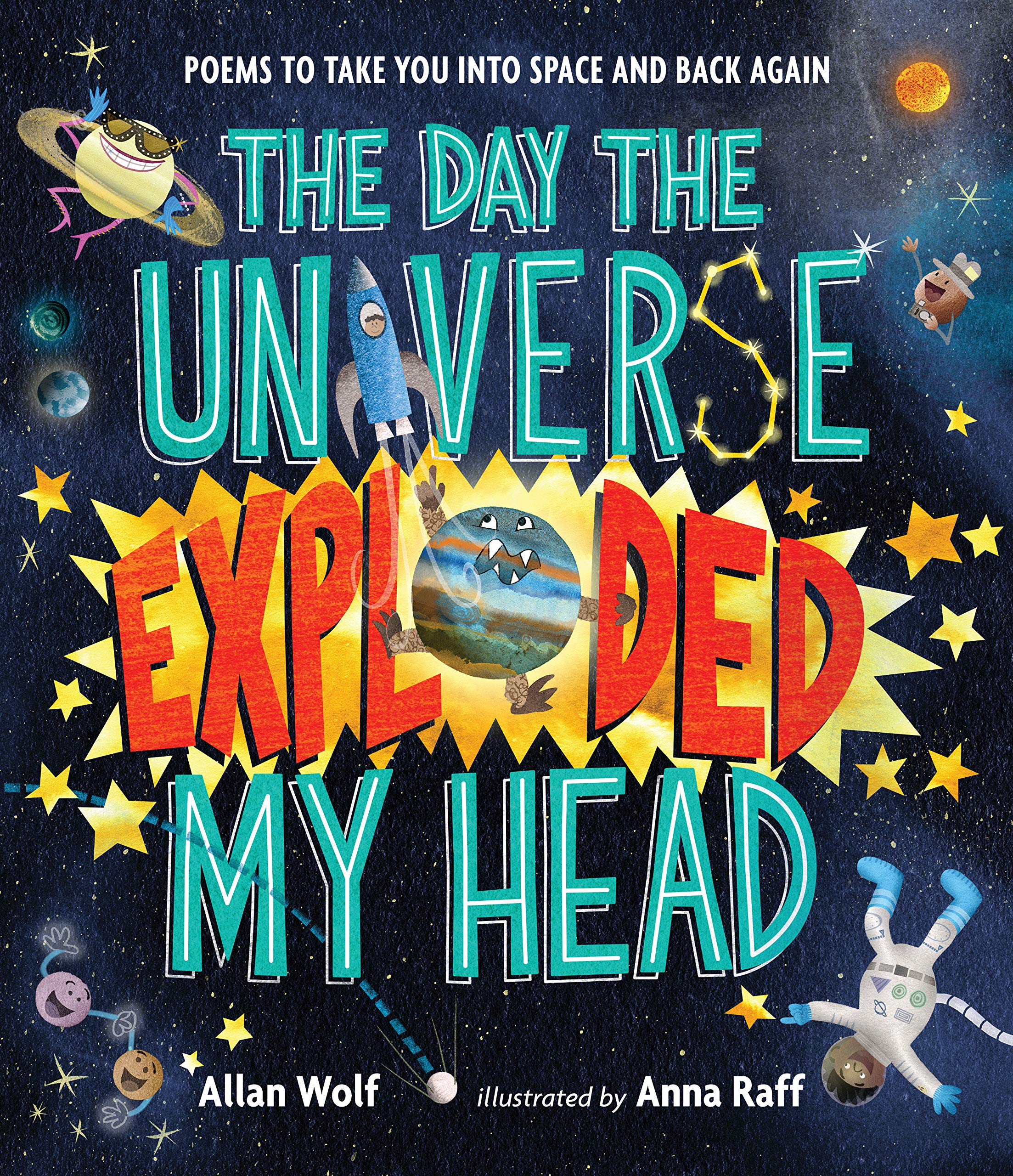
The Day the Universe Exploded My Head by Allan Wolf, illustrated by Anna Raff

Published by Candlewick

Image result for day the universe exploded my head

Image result for day the universe exploded my head

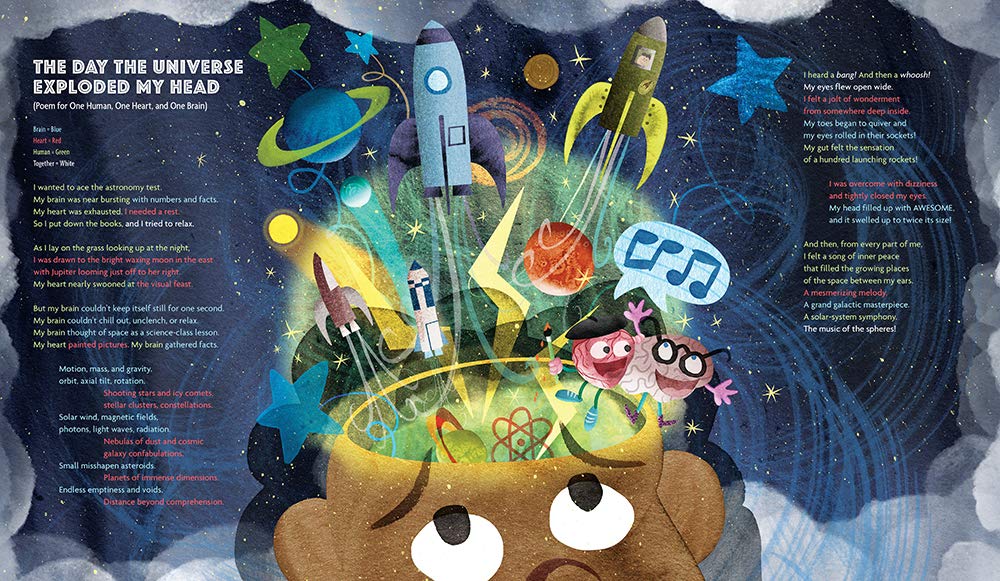
Summary:  These poems cover many aspects of astronomy and space travel, including the sun, moon, planets, meteors, black holes, eclipses, stars, rockets, astronauts, and Sputnik. The final piece, “The Day the Universe Exploded My Head” tells readers, “You can learn many facts about space from a book/But nothing’s as real as a firsthand look.”  This poem, like several of the others, is written for multiple voices, with different parts shown in different colors. Includes notes on the poems that give more information about each topic; a glossary of selected space terms; and internet resources.  56 pages; grades 2-6.

Pros:  It’s a fabulous collection of funny and informative poems that will teach kids a lot about space and astronomy.  I particularly liked the poems for multiple verses; they would be fun to do as a classroom performance.

Cons:  It would have been nice to see more information about the different forms of poetry, like the sonnet (or sunnet) that appears on page 1.

If you would like to buy this book on Amazon, click here.

Operation Frog Effect by Sarah Scheerger

Published by Random House Books for Young Readers

Image result for operation frog effect amazon

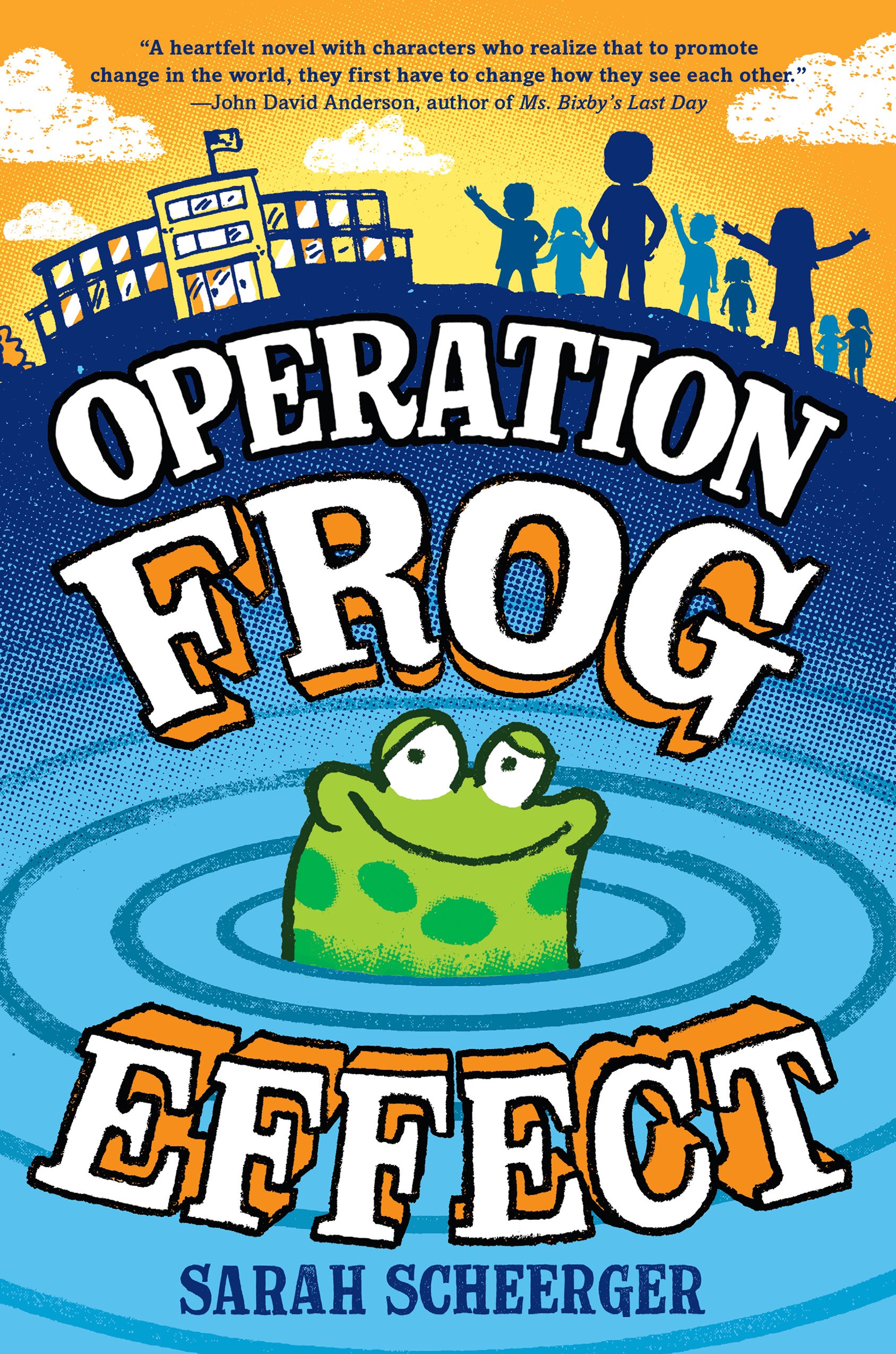
Summary:  Eight fifth graders tell about the first half of the year through journal entries to their teacher, Ms Graham.  There is friendship drama, a budding romance, a boy who is threatened with homelessness, and a girl from Mexico who worries about being deported. Some of the kids write letters for their journal entries, while one writes all his in the form of a screenplay, and another draws his as wordless comics.  Their initial connection is through the class pet, Kermit the frog, but soon they are bonding through the social action projects their teacher initiates. When one of those projects leads four of the kids to do something dangerous, Ms. Graham is the one who gets in trouble and is threatened with losing her job.  The kids put their social action lessons to work to find a way to help their teacher and make a difference in their community, resulting in a deepening of friendships and a happy ending for all. 320 pages; grades 3-7.

Pros:  Fans of the Mr. Terupt books or Fish In a Tree will enjoy this uplifting school story with multiple perspectives and writing types.  Inspired readers can find resources at the end to help them learn more about how they can make a difference.

Cons:  Sadly, there doesn’t seem to be time in real life to do all the cool community-building activities and service projects that Ms. Graham’s class gets to do.  After the kids’ victory, a school board member comments, “I hope you all stay engaged for our next topic, which has to do with standardized testing.” Now, that’s realistic.

If you would like to buy this book on Amazon, click here.

Puddle by Richard Jackson, illustrated by Chris Raschka

Published by Greenwillow Books

Image result for puddle raschka amazon

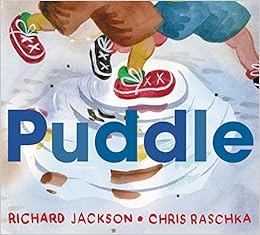
Summary:  An unhappy puddle feels like it’s too big compared to the smaller puddles surrounding it.  “If this rain keeps on, I’ll soon be a POND.” And things happen that aren’t always pleasant.  A fishy-smelling seagull swoops in. Kids run through, bouncing a basketball. Worst of all, a poodle stops by.  “‘No piddle,’ Puddle cries. ‘No, NO!’” But it’s too late, and the puddle gets a splash of yellow. The sun comes out, the other puddles dry up, and the puddle is alone.  As the kids run in from recess, they notice a rainbow reflected in the puddle, and one girl stays behind to reach out (hopefully not where the poodle peed) and watch the colors shimmer.  All of puddle’s troubles are forgotten as it makes a connection with the girl. 40 pages; ages 4-8.

Pros:  Is this the first book ever to be narrated by a puddle?  The brief rhyming text and illustrations that show a puddle’s perspective share a sweet message about love and friendship.  The inside flap summarizes with an acrostic poem: Puddle Understands Despite Deluge Love Everything.

Cons:  With that sun shining, puddle’s days seem numbered.

If you would like to buy this book from Amazon, click here.

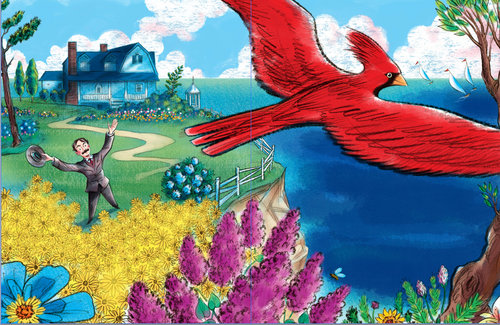
The Crayon Man: The True Story of the Invention of Crayola Crayons by Natascha Biebow, illustrated by Steven Salerno

Published by HMH Books for Young Readers

Image result for crayon man amazon

Image result for crayon man salerno

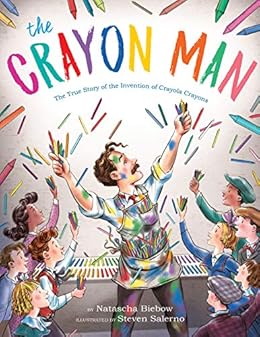
Summary:  Consider the humble crayon.  Seems like it has always been with us, but prior to the 20th century, kids were limited to dull slate pencils.  Along came Edwin Binney, an inventor who loved color. Working with his cousin, C. Harold Smith, he created gray slate pencils, white chalk, and black crayons.  But colored crayons eluded him.  At his secret lab in Pennsylvania, he melted paraffin wax, ground rocks and minerals into powders, and mixed in clay to thicken the substance.  One evening in 1903, Edwin announced that he had successfully made colored crayons. His wife Alice combined the French words craie (stick of chalk) and ola (oily…an oily stick of chalk?  hmmm) to come up with the now ubiquitous Crayola brand.  Fortuitously, crayons were created around the same time that cheap paper became available, and the rest is colorful history.  Includes two pages of photos showing how Crayola crayons are made today (at the Binney-Smith factory in Easton, PA, where I did an internship while attending Lafayette College many moons ago); more information on Edwin Binney; and a bibliography of primary and secondary sources.  48 pages; grades 1-4.

Pros:  Kids will be fascinated to learn how their crayons were invented.  The illustrations of workers covered in color after laboring over pigments all day are fun, and Edwin Binney’s perseverance is a good lesson in not giving up.

Cons:  The origin of the “Burnt Sienna” color name is not revealed.

If you would like to buy this book on Amazon, click here.

Image result for crayon man This also appears if you do a Google Images search for “Crayon Man”
Hey, Water! by Antoinette Portis

Published by Neal Porter Books

Image result for hey water portis

Summary:  A little girl addresses water as she experiences it in many different forms: “Hey, water, I know you!  You’re all around. You spray up. And down,” she says, as the illustrations show a faucet, sprinkler, and shower.  Each page has a single word on it, as well as the picture and line(s) of text. Although the text is spare, the book explores different states of matter, bodies of water like lakes and rivers, properties of water, and its importance in our everyday lives.  “Hey, water, thank you!” the narrator concludes; the pages following that have information on water forms, the water cycle, and conserving water, as well as additional resources. 48 pages; ages 4-8.

Pros:  For such a short and entertaining read, this book packs a pretty good educational punch, providing an excellent and engaging introduction to many aspects of water.

Cons:  While the section on conserving water emphasizes the importance of doing so, it doesn’t give any practical tips.

If you would like to buy this book on Amazon, click here.

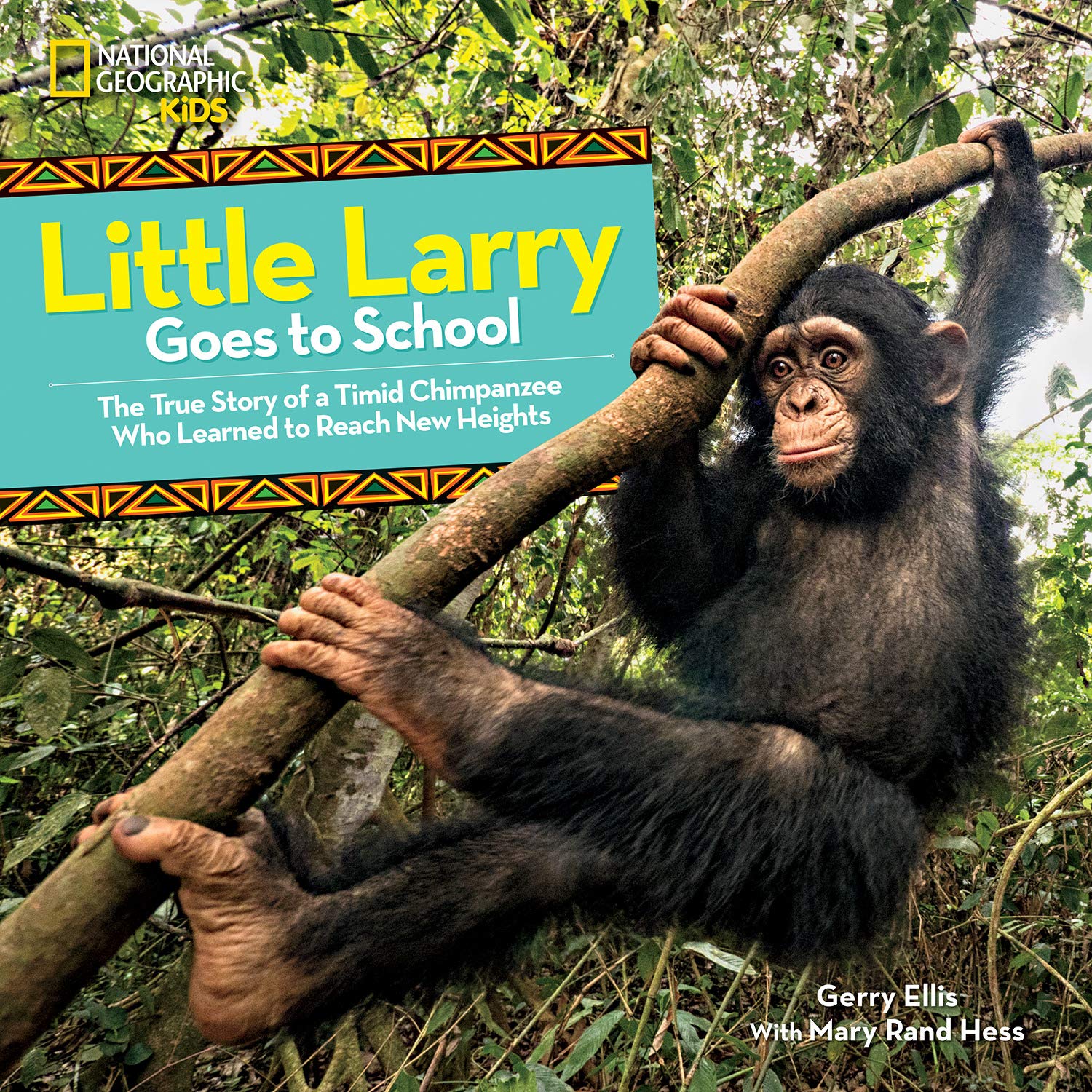
Little Larry Goes to School: The True Story of a Timid Chimpanzee Who Learned to Reach New Heights by Gerry Ellis with Mary Rand Hess

Published by National Geographic Children’s Books

Image result for little larry goes to school amazon

Image result for little larry goes to school mary rand hess

Summary:  Shortly after his birth, Little Larry was injured in an accident and rescued by humans.  His caregivers taught him some rudimentary chimpanzee skills, but he didn’t hang out with other chimps until he was eight months old.  He got along well with his playmates, but seemed to be afraid to climb trees. After months of watching the others climb, Larry slowly started to explore, first on vines close to the ground, then eventually high into the trees.  After graduating from his forest school, Larry was released into a chimpanzee sanctuary in Cameroon where he still lives today. Includes tips on speaking chimpanzee, sources of more information, additional facts; and an author’s note about the endangered status of chimpanzees.  32 pages; ages 4-8.

Pros:  Larry’s story is short and simple, but the photographs of him and his playmates are irresistible.  Facts about chimps’ diet, behavior, and communication are woven into the narrative, and the information at the end provides lots of other places to go for more research.

Cons:  There was very little information on Larry’s caregivers or the sanctuary where he lived.

If you would like to buy this book on Amazon, click here.

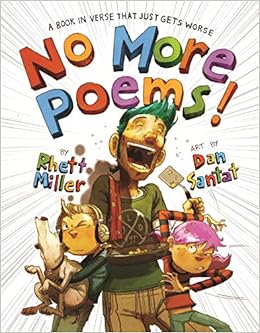
No More Poems! A Book In Verse That Just Gets Worse by Rhett Miller, illustrated by Dan Santat

Published by Little, Brown Books for Young Readers

Image result for no more poems amazon

Image result for no more poems dan santat

Summary:  Rhett Miller, who apparently is a famous enough singer and songwriter to be in Wikipedia, has created a collection of 23 poems on such kid-friendly topics as dogs, homework, baseball, and how to use karate to flush a toilet in a public restroom.  Each poem is accompanied by a Dan Santat illustration; some include the poem as part of the picture, such as “My Device” which is written like a series of texts. Includes an author’s note at the beginning explaining his use of punctuation (or lack of).  48 pages; grades 2-5.

Pros:  Fans of Jack Prelutsky and Shel Silverstein will love this colorful collection that includes just enough bathroom humor (“3:00 AM Pee”) and gross themes (“Hairs”, “Stinky-Mouth You”) to keep any elementary kid happy.  The poetry perfectly captures kids’ voices (“My dad is a rock star/And I’m just like whatever” begins the jaded kid narrator of “Rock Star Dad”), and the illustrations provide the perfect complementary comic touches.

Cons:  “Brotherly Love” gets a little dark for the younger elementary crowd.

If you would like to buy this book on Amazon, click here.


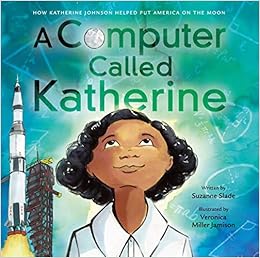
A Computer Called Katherine: How Katherine Johnson Helped Put America On the Moon by Suzanne Slade, illustrated by Veronica Miller Jamison

Published by Little, Brown Books for Young Readers

Image result for computer called katherine amazon

Image result for computer called suzanne slade

Summary:  Similar to last year’s Counting on Katherine, this picture book biography tells the story of Katherine Johnson’s life, beginning with her early fascination with math that eventually led her to a career at NASA.  Her brilliance was finally recognized there as she broke down the barriers that had kept women and blacks from the higher-level positions. This story focuses on her contributions to Apollo 11, the mission that included the first walk on the moon.  Katherine was instrumental in helping to calculate the flight plan that took the three astronauts to the moon and brought them safely back home again. Includes photos of Katherine and some of the documents she worked on at NASA, a time line, and author’s and illustrator’s notes.  40 pages; ages 4-8.

Pros:  Katherine Johnson’s story is brought to life in a way that is accessible for younger readers.  There’s an emphasis on her love of counting from an early age, and a fun incorporation of incorrect math facts (segregated schools seemed as wrong as 5+5=12; Katherine being excluded from NASA meetings was as wrong as 5×5=20).

Cons:  The story is light on dates and places, and there’s no list of further resources, so this wouldn’t be the best book for research or reports.

If you would like to buy this book on Amazon, click here.

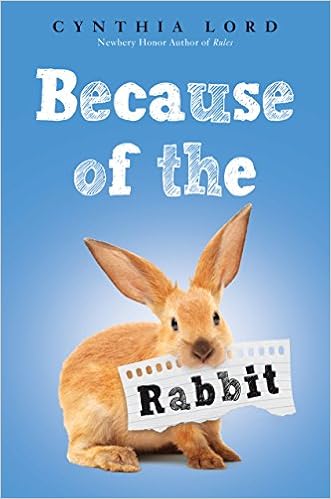
Because of the Rabbit by Cynthia Lord

Published by Scholastic Press

Image result for because of the rabbit cynthia lord amazon

Summary:  Emma’s been homeschooled all her life, but when her brother starts high school, she starts feeling left behind, and decides to go to public school for fifth grade.  The night before she’s starting school, her game warden father gets a call about a rabbit that’s stuck in a fence. Emma goes along for the rescue, and ends up falling in love with the rabbit, a tame former pet, whom she names Lapin.  School gets off to a rough start: Emma gets paired with Jack, a boy with autism, for a class project, and starts to worry that her association with him will prevent her from making other friends.  But she has a kind heart, and with the help of her family and Lapin, she figures out a way to help Jack while navigating the uncertain waters of fifth grade friendships. Includes an author’s note explaining where her inspirations for different elements of the story came from, and encouraging readers to draw on their own life experiences for their writing.  192 pages; grades 3-5.

Pros:  Cynthia Lord has written another winning middle grade novel that would make an excellent read-aloud or book club book.  Emma is an honest and caring narrator, and readers will relate to her experiences at school. Lapin’s appearance on the cover will make this book irresistible, and kids will enjoy Lord’s nonfiction Borrowing Bunnies for more information on pet rabbits.

Cons:  The ending wrapped things up a bit too neatly.

If you would like to buy this book on Amazon, click here.