Summary: A girl enjoys solitary pleasures, like reading a book, riding a bike, and eating a cookie. The text on each page ends with “But what if a friend stops by?” Sharp-eyed observers will notice a small stuffed animal in each illustration. Turn the page and the girl is joined by a real-life version of that animal, enjoying the activity together. The last page shows the girl cozily in bed, with a stuffed penguin under her bed as she drifts off to sleep. 40 pages; ages 3-7.
Pros: This charming book shows the pleasures of spending time alone and using your imagination. It would be a fun one to share, as kids will get a kick out of finding the animal in each illustration to predict what they’ll see when you turn the page.
Cons: Doesn’t the penguin want to be cozy under the covers, too?
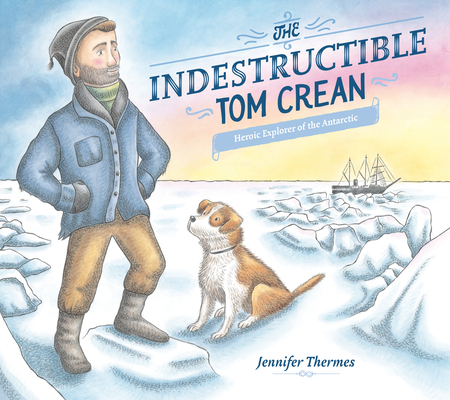
Summary: Tom Crean grew up on the coast of Ireland and went to sea like most of the other young men around him. But his fate took an unusual turn when he volunteered to be a last-minute replacement on board Robert Scott’s ship Discovery sailing for Antarctica. This was the first of three trips Tom took to Antarctica: he was also part of Captain Scott’s attempt to be the first to reach the South Pole and was on board the ill-fated Endurance with Ernest Shackleton. In fact, Tom was one of three men responsible for the rescue for the rest of the Endurance crew. Shackleton tried to convince Tom to go on one more Antarctic exploration, but by then Tom had settled down in Ireland, opening the South Pole Pub (still operating today) with his wife, and raising three children. Includes an afterword with additional information, a timeline, and a list of sources. 56 pages; grades 2-5.
Pros: I love Jennifer Thermes’ illustrations, especially her maps, and am delighted to see on Amazon that she has a book about the history of America coming out this summer. The illustrations are delightful, and the story is riveting, with plenty of back matter to make it a pretty complete biography.
Cons: Made Antarctica seem unappealing as a travel destination.
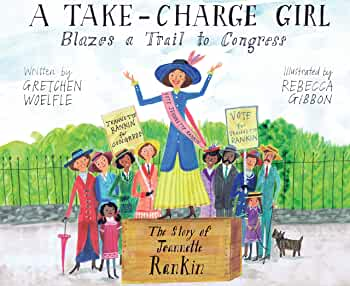
Summary: Jeannette Rankin was a take-charge girl from the start, helping out on her Montana ranch wherever she could. Traditional female roles didn’t appeal to her, but social justice did, and she moved from working at a settlement house to campaigning for women’s suffrage. After a victory for the cause in Montana, Jeannette decided to expand her influence by running for Congress. On November 7, 1916, Jeannette won the election, becoming the first U.S. Congresswoman. Five months later, she took her seat in the House of Representatives as a representative from Montana, declaring, “I may be the first woman member of Congress, but I won’t be the last.” 40 pages; grades 1-5. Includes additional information about Jeannette Rankin, a timeline of her life, and additional resources.
Pros: I’ve been working on a picture book biography of Jeannette Rankin off and on for the last few years, and this book is far better than anything I’ve been able to come up with. The writing and illustrations are lively and capture Jeannette’s can-do spirit.
Cons: To me, one of the most interesting things about Jeannette is that she voted against both World War I and World War II (the only member of Congress to do so for WWII), which was political suicide but supported her pacifist beliefs. This part of her career is relegated to the back matter.
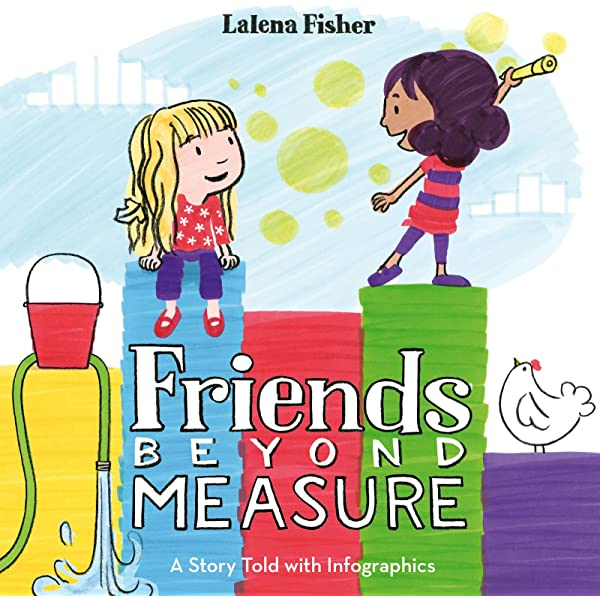
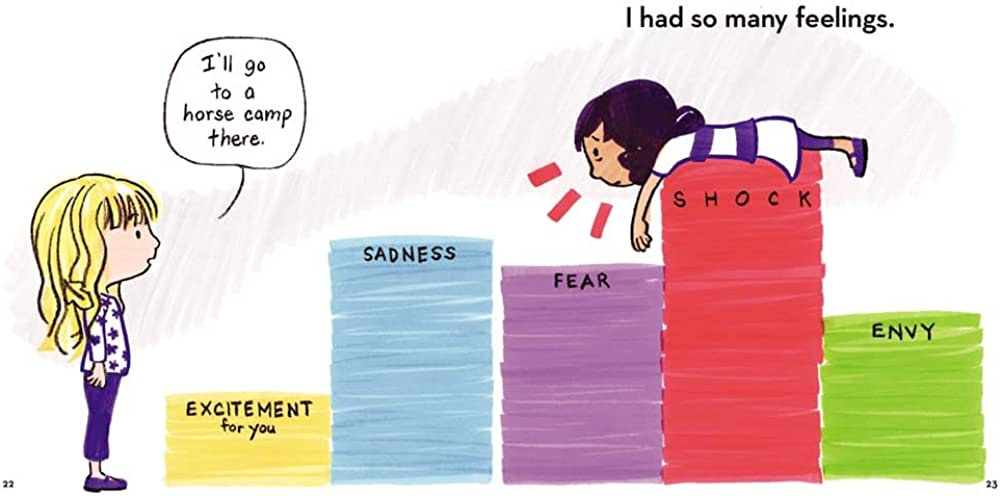
Summary: Ana and Harwin are best friends, a relationship that Ana likes to chart through infographics. She starts with a Venn diagram of the two girls, showing what is unique to them and what they have in common. Other charts and graphs show how they spend their time and how they work out disagreements. When Harwin announces she is moving far away, both girls are devastated. Ana shares her emotions through a bar graph, then makes a flowchart to weigh the consequences of packing herself in Harwin’s suitcase. The move goes ahead, but the two girls make plans (with charts) for staying in touch and for adventures they will have together when they’re older. Includes additional information on twelve different types of infographics. 40 pages; grades 1-4.
Pros: There’s a lot of mathematical information packed into this cute friendship story, providing a fun way to introduce infographics that could serve as a springboard for kids making their own.
Cons: This could be slow going as a group read-aloud since each page may require a lengthy explanation.
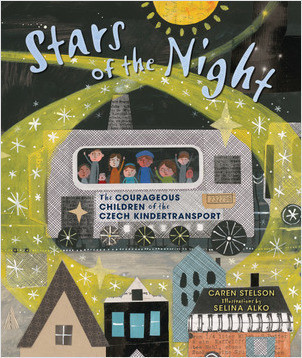
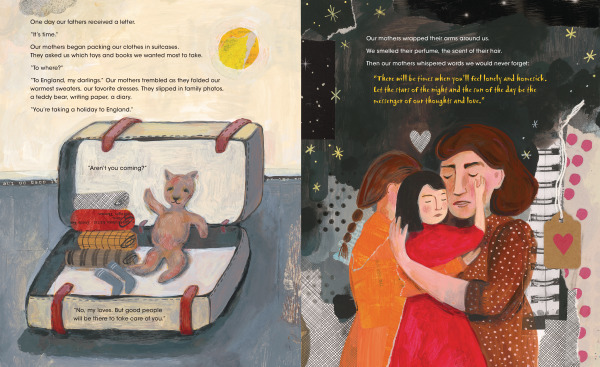
Summary: Beginning in Czechoslovakia in 1938, the story follows five children from a peaceful happy life to a period of increasing restrictions and hardships for Jews. When Germany occupies Czechoslovakia in March 1939, the children’s parents have a difficult decision to make. The kids are only vaguely aware of the man who’s offering them the chance to escape to safety. Before long, the families are at the Prague railway station, saying good-bye to their children as they board trains that will take them to England. The children soon learn that the man has made arrangements with British families to take them in. As the years pass, they grow more comfortable in their new homes, but worry as they hear news of Czechoslovakia. Their fears are confirmed at the end of the war when most learn that their parents have not survived. Fifty years later, they finally learn the identity of the man who saved them–Nicholas Winton, the British man who rescued 669 children. Includes a timeline and extensive information on the Kindertransport Movement, Nicholas Winton, the five children, and The Children’s Memorial in Jerusalem, as well as additional resources, and notes from the author and illustrator. 40 pages; grades 3-6.
Pros: The beautiful illustrations, riveting story, and extensive back matter make this a compelling nonfiction book that anyone with an interest in World War II or the Holocaust will want to get their hands on.
Cons: This story is told from the children’s perspective, so Nicholas Winton is simply a mysterious man, as he would have been to them. His story is so interesting, though, that it seems a shame to relegate him to the back matter. For a different perspective, be sure to check out Peter Sis’s Nicky and Vera.
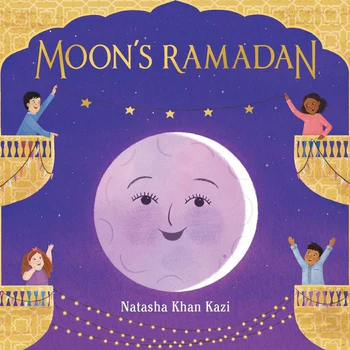
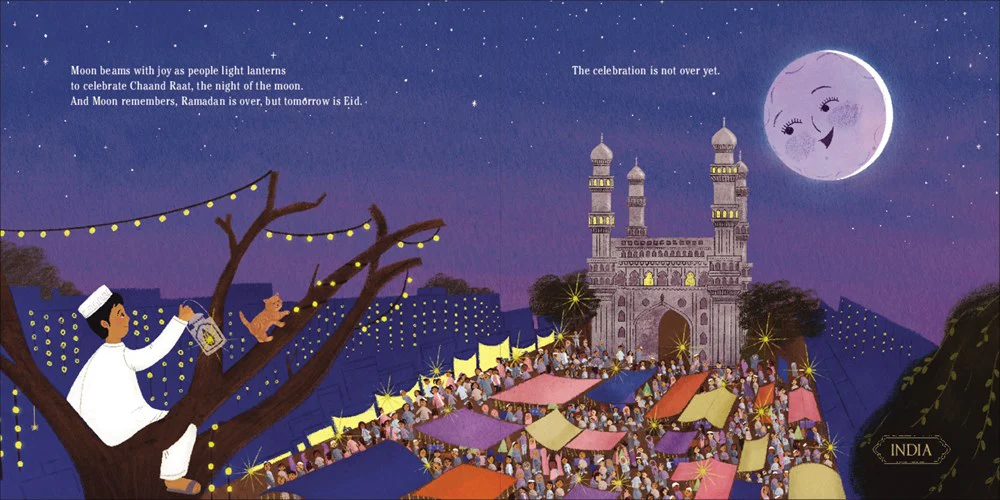
Summary: Moon travels around the world during the month of Ramadan, as the part of her visible to Earth changes from the tiny crescent that signifies the beginning of the month to a full circle, and back to the sliver that heralds the end of the month and the Eid celebration. She watches Muslims in countries around the world fasting, worshiping, and practicing kindness and charity. As night falls on the Eid celebration, “a billion faces smile up at Moon. Moon sees a world of love and kindness, and she glows with gratitude.” Includes a brief author’s note with additional information about Ramadan, information about the lunar cycle with pictures of the phases of the moon, and a Ramadan glossary. 40 pages; ages 4-8.
Pros: This is a much-needed introduction to Ramadan with beautiful illustrations that show Muslims from all around the world. I love that it’s told from the perspective of the moon and includes some scientific information…check out the phases of the moon on the endpapers.
Cons: The labels identifying the different countries were in a smallish font that didn’t show up well; it took me a few pages to notice them.
Summary: As he moves toward adulthood, Trev is faced with some difficult decisions. His stepfather is in jail for hitting his mom, and Trev wants to learn how to fight so he can protect her when his stepdad is free again. But Trev is surrounded by people who care about him: his mom, his sisters, his teacher, and various “uncles” who are connected to him by blood or friendship and who encourage him to use his hands for his artistic talents. When Trev ends up using them destructively in an attempt to protect one of his sisters, he begins to learn the downsides of violence. As he says at the end, “I don’t have it all figured out, but I feel better knowing I have help.” 144 pages; grades 5-9.
Pros: Short chapters, a distinctive voice, and universal problems make this an excellent choice for tweens and teens, especially young Black men. It’s a quick read, but it could serve as a vehicle for many different discussions and/or writing prompts.
Cons: Much of the story and conflict was internal, so there’s not a lot of action.
I’m trying a new experiment: travelogues for families with book recommendations to read in conjunction with the visits. Over my February school vacation week, I took a day trip to Concord, Massachusetts, a town I’ve been to many times, since I lived for 20 years in neighboring Stow. Despite my familiarity with Concord, I still made some new discoveries. I focused on the transcendentalists rather than the Revolutionary War aspect, partly because of my own interests and partly because I found so many books about them. Here’s my report from that visit.
I started my day with breakfast at The Club Car Cafe in West Concord (note: West Concord is officially part of Concord but has its own downtown). This is a converted railroad depot with a model train running along a track overhead, or if you have a train aficionado in the family it’s a fun place to get breakfast or lunch. The West Concord train station is nearby, so you may see the real thing as well.
The Old Manse
From there I headed to the Old Manse, a historic house owned by the Trustees of Reservations. It was built by Ralph Waldo Emerson’s great-grandfather, William, in 1769, and you can see Old North Bridge from at least one of its windows, so it’s a good way to connect the Revolutionary and transcendentalist histories of Concord. Both Ralph and Nathaniel Hawthorne lived there, and there’s a windowpane where Hawthorne’s wife carved a pretty lengthy message with her diamond ring, commemorating the beauty of an ice storm that she shared with her 10-month-old daughter.
I took the “family friendly” tour of the Old Manse, which I’m sure seemed like an odd choice since I was the only one on the tour. I explained what I was doing, and the tour guide, at my request, treated me like an 8-year-old for most of the tour to show me how she interacts with kids. She did a good job of being engaging and focusing on details that would be interesting to kids, and the tour was 30 minutes instead of the standard 50 minutes.
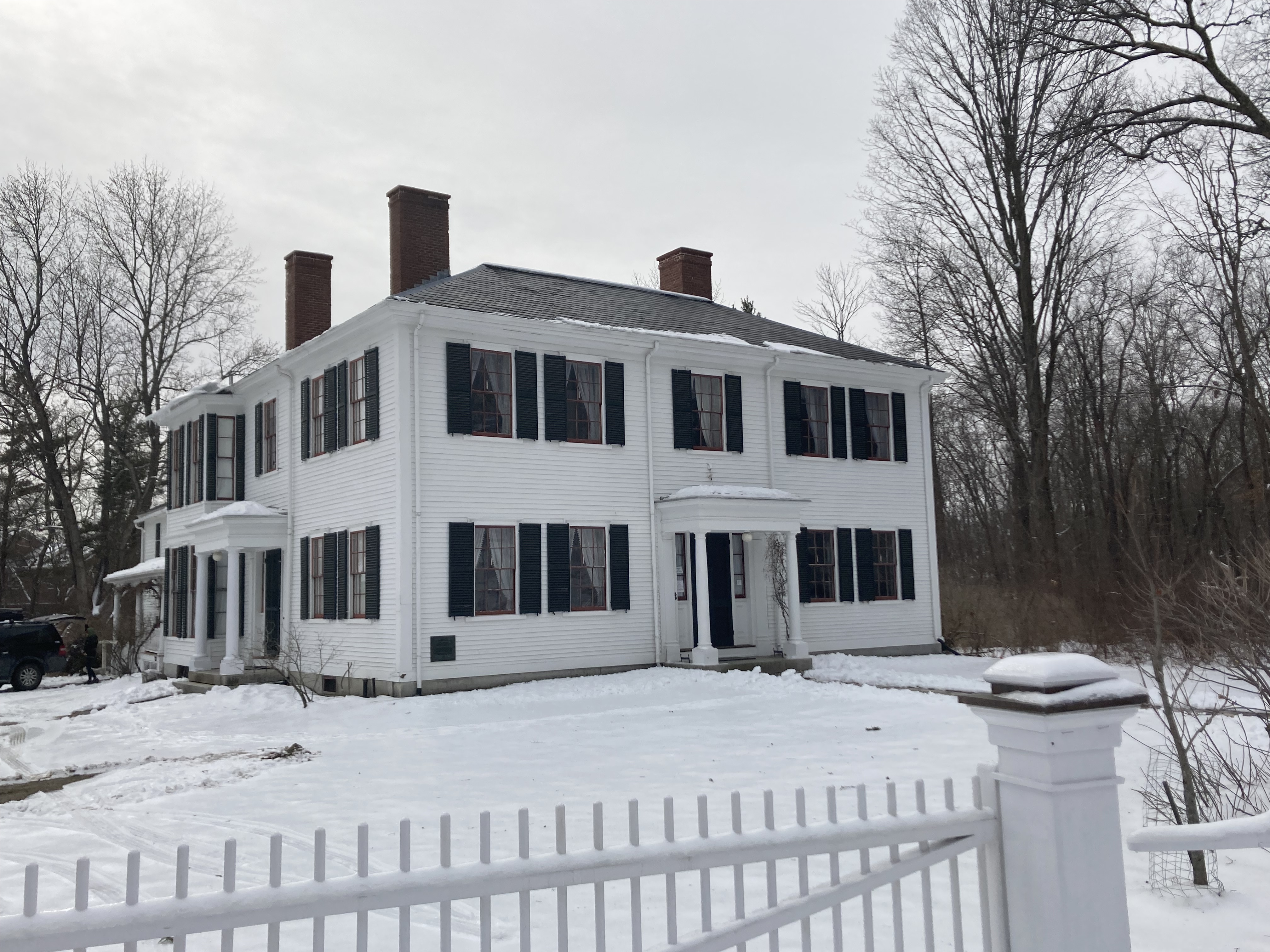
Ralph Waldo Emerson’s house
From there, the logical next step would have been Ralph Waldo Emerson’s house, but unfortunately it was closed for the winter. I’ve never given RWE much thought but reading A Home for Mr. Emerson by Barbara Kerley (Scholastic, 2014) got me interested enough in him and his house (which burned to the ground when he lived there) that I was sorry I couldn’t get a tour. The book does a good job describing Emerson’s life, house, and his importance to Concord, and it distills his philosophy into small, easily digestible chunks, which, as near as I can tell, is no easy feat.
Lunch was at Helen’s on Main Street, a family-friendly restaurant that’s been in Concord for almost 90 years and always seems to be hopping. If you’re looking for pancakes, a burger, or ice cream, this is a great choice. After lunch, I walked along Main Street, stopping in The Concord Bookshop, which is just a few years younger than Helen’s and will fill all your Concord-related reading needs. When my kids were little, we used to love visiting The Toy Shop on the corner of Main and Walden. I thought the pandemic had done them in, but it turns out they’ve moved across the street as The Concord Toy Box. It’s smaller and less prominent than the former store, but definitely worth seeking out.
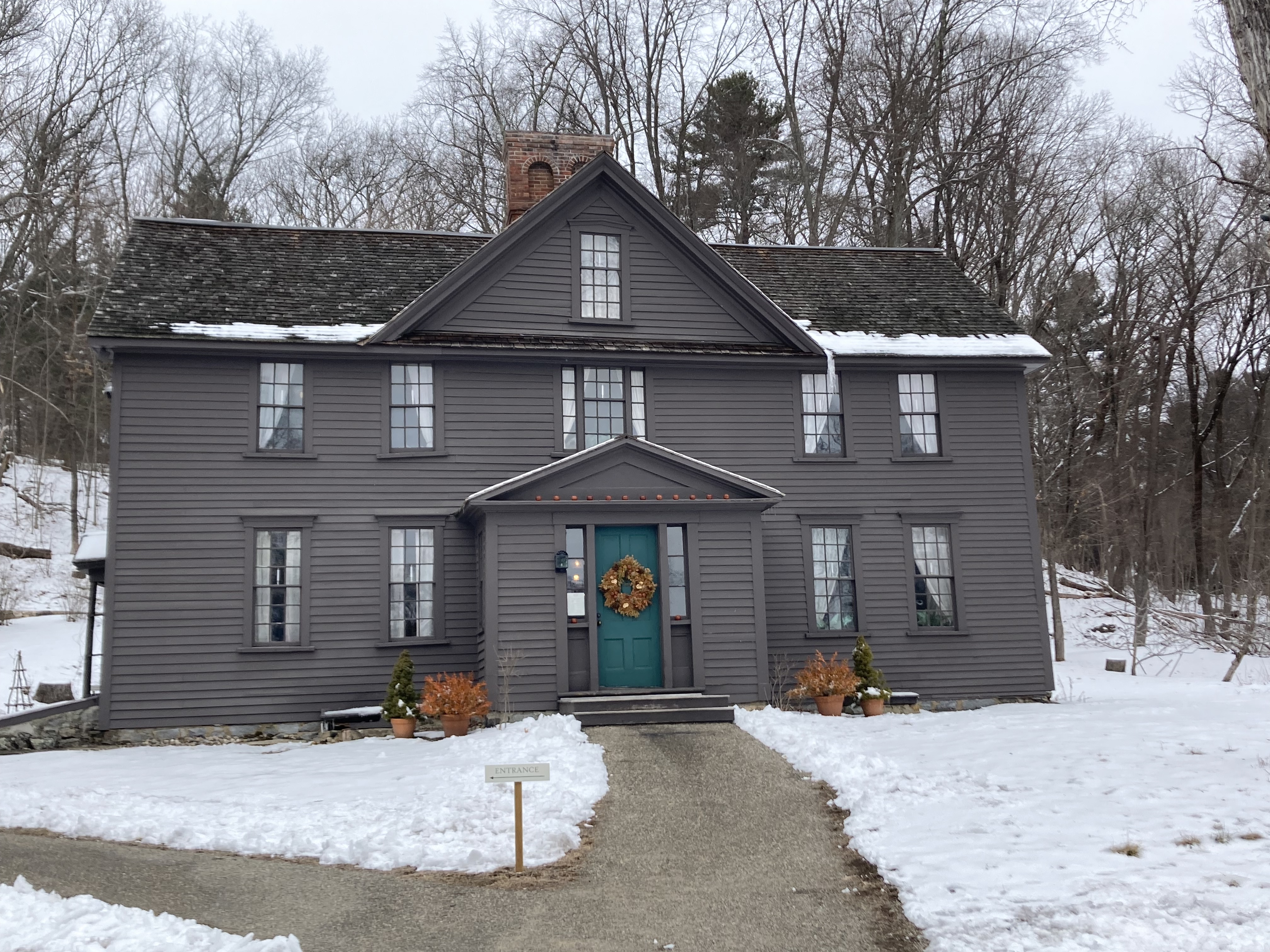
Orchard House
The School of Philosophy
Louisa May Alcott’s Orchard House is right down the street from Emerson’s, and I had signed up for a tour at 1:45. This was a tour I’d done a few times before, and I was probably a bit jaded going into it. The guide struck me as a bit fawning about the Alcott family, but the young women in my group loved it, and you probably will too. We began the tour by viewing a film in the School of Philosophy started by Louisa’s father Bronson (located behind the main house), then we were split into two groups. The other group included some pretty young kids, and they seemed to move through the house quite a bit more quickly than we did, so it appears that tours can be tailored for the age group.
If you want to learn more about Louisa May Alcott, start with Louisa: The Life of Louisa May Alcott by Yona Zeldis McDonough (Henry Holt, 2009), which is an excellent introduction to Louisa and her family. Another good choice that ties Louisa to another of Concord’s leading lights is Louisa May & Mr. Thoreau’s Flute by Julie Dunlap and Marybeth Lobiecki, illustrated with striking woodcuts by Caldecott winner Mary Azarian (Dial, 2002). If you share my suspicion that the family succeeded in spite of, not because of, Bronson Alcott, this book will really seal that deal.
For older kids, you can’t beat the original Little Women and/or one of the many film versions. Middle school readers might want to go from there to a modern graphic version of the story like Jo: An Adaptaion of Little Women (Sort of )by Kathleen Gross (Quill Tree, 2020) or Meg, Jo, Beth, and Amy by Rey Terciero (Little, Brown Books for Young Readers, 2019). It’s fun to see what’s the same and what’s different from the original, and–spoiler alert–both give Beth a happier ending.
A statue of Henry David Thoreau outside his house
The inside of Thoreau’s house
My last stop for the day was Walden Pond. I’ve been there many times, often in the summer when the parking lot gets filled by noon. But on this 20-degree day, the lot was almost completely empty. I parked by the visitor center and traipsed through icy snow to look at the replica of Thoreau’s house, which gives new meaning to “tiny house.” I didn’t venture across the street to the pond, as it was freezing outside and pretty icy under foot. Having visited in all seasons, I’d recommend spring or fall for a good hike around the pond when you won’t have to fight for a parking spot.
I love the idea of Walden (the book, that is), and I’ve attempted to read it multiple times, but there’s a lot to wade through to get to the good stuff. I discovered a graphic version called Thoreau at Walden by John Porcellino (Little, Brown Ink 2018) that distills out some of the more memorable lines from the original in an easy-to-read comic version. It’s a great introduction for older elementary school and middle school kids, and honestly could serve as a sort of Cliff’s Notes version for those assigned to read the book in high school or college.
Another title for that age group is I Begin With Spring: The Life and Seasons of Henry David Thoreau by Julie Dunlap (Tilbury House, 2022). Part nature journal, part Thoreau biography, it tells the essentials of Henry’s life in an engaging way with plenty of illustrations.
Younger kids will enjoy the Henry series by D. B. Johnson starting with Henry Climbs a Mountain (HMH Books for Young Readers, 2003). Henry is a bear, but his adventures are drawn from Thoreau’s life and include a lot of his philosophy.
If You Spent a Day with Thoreau at Walden Pondby Robert Burleigh (Christy Ottaviano, 2012) is a beautiful picture book for slightly older readers, imagining a journey through time to see how Henry would have spent the day at Walden.
Finally, I discovered a new book called Of Walden Pond: Henry David Thoreau, Frederic Tudor, and the Pond Between by Lesa Cline-Ransome (Holiday House, 2022) that takes an interesting look at the intersecting lives of Thoreau and Frederic Tudor, an entrepreneur who harvested ice from Walden Pond and figured out how to preserve it and ship it to India. This was featured as a StoryWalk on the Woods Path when I visited.
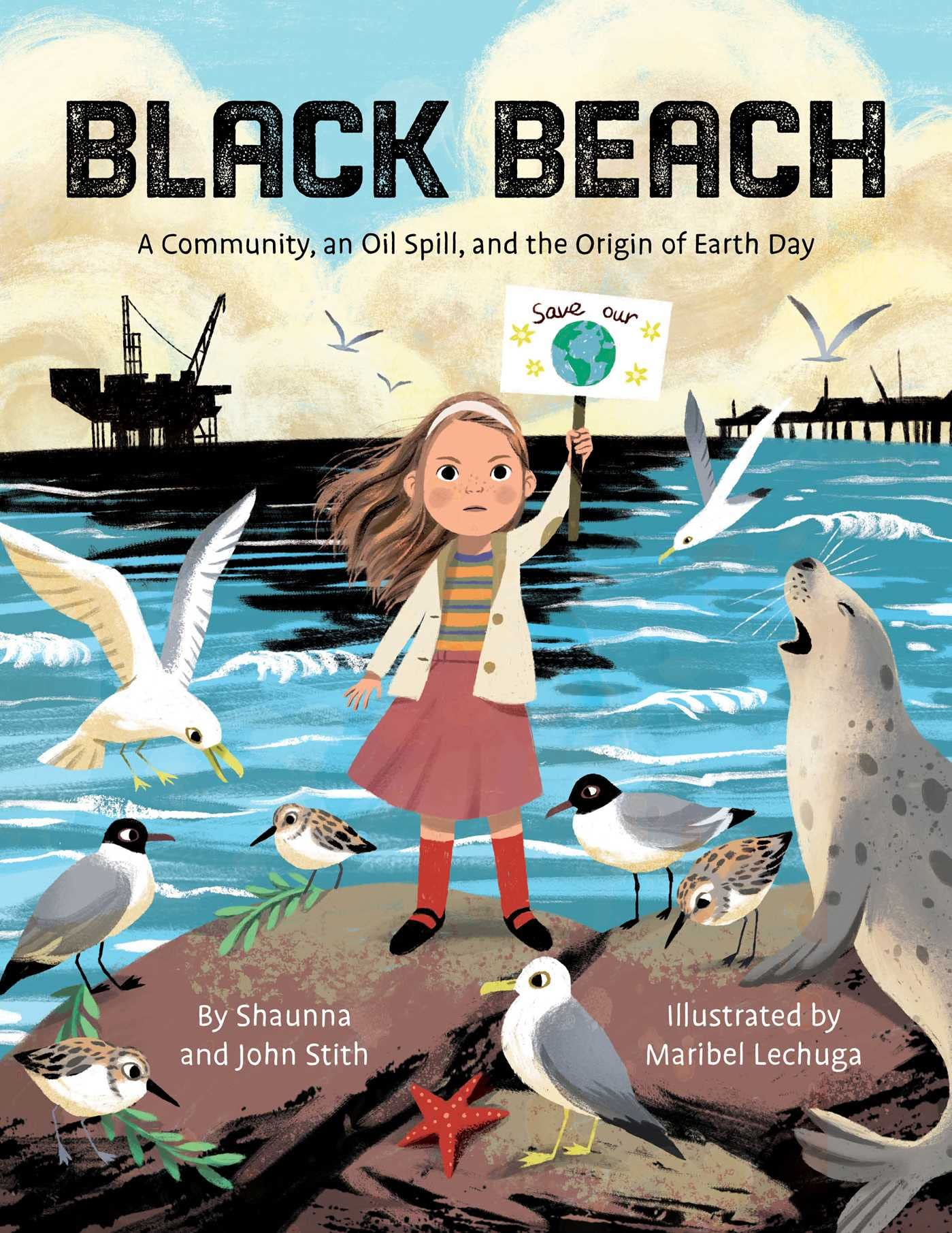
Summary: Sam is in class drawing a picture of her favorite Santa Barbara beach when the principal walks in and whispers something to her teacher. She finds out the news at home when her parents tell her about the oil spill that’s polluting her beloved beach. As the oil starts to wash ashore, Sam feels sad, then angry, as she watches her parents and other volunteers try to clean up the damage. She and her friends fill bottles with the oil and mail them to politicians. News coverage increases, and several months later, U.S Senator and environmental activist Gaylord Nelson visits the beach, inspiring him to organize the first Earth Day. On April 22, 1970, people around the world celebrated, protested, and taught about the environment, beginning a movement that continues today. Includes an authors’ note, a bibliography, a timeline, additional information about Earth Day, and a list of ten ways to become an environmental activist. 40 pages; ages 4-8.
Pros: An excellent read-aloud for Earth Day. The perspective of the fictional Sam brings this true story to life for kids, and the additional information gives them concrete actions to take for the environment.
Cons: Showing the damage wrought by the oil company, then urging kids to take shorter showers and turn off the lights feels like misplaced responsibility.
Summary: Our newest Supreme Court Justice gets her own picture book biography with the repeating refrain of “she rose.” Ketanji rose from a childhood filled with the love and support of parents and grandparents who took pride in their heritage and valued education. She rose to overcome teachers who made fun of her name and discouraged her from applying to Harvard to follow her dream of becoming a lawyer and then a judge. And ultimately, she rose to the challenge of four days of tough questions by the Senate Judiciary Committee to become the first Black woman Supreme Court justice. Includes a letter from the author to her granddaughter and “all our daughters” and a timeline of Ketanji Brown Jackson’s life. 40 pages; grades K-4.
Pros: This inspiring biography will help kids get to know Ketanji Brown Jackson. Her own quotes are sprinkled throughout the text, adding her voice to her story.








 A Kids Book A Day