Bea and the New Deal Horse by L. M. Elliott

Published by Katherine Tegen
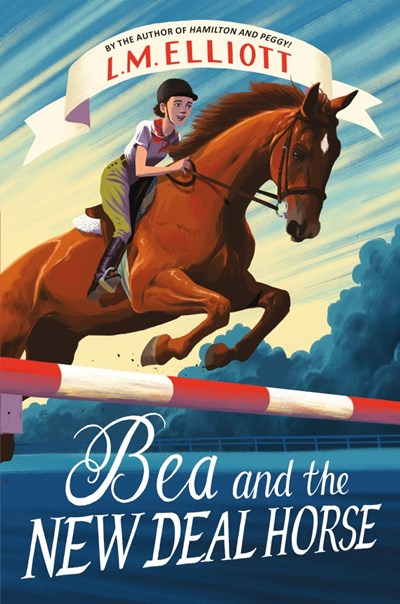
Summary:  The Great Depression has taken just about everything away from Bea: her dad’s job, her mother, and her home.  Now her father is drinking too much, trying to hold things together for Bea and her younger sister Vivian as they travel from one place to the next.  After sleeping in a barn in Virginia one night, Bea wakes up to discover her father has left a note and vanished.  The note says that Mrs. Scott, the owner of the farm, is the mother of the girls’ mother’s college roommate and will give them a place to live.  Bea is cautious about revealing their identity, but eventually Mrs. Scott discovers them and reluctantly lets them stay on her horse farm.  She is facing financial difficulties as well and has recently made things worse by buying an ornery chestnut horse to save him from an abusive owner.  Bea takes a liking to the horse, and after many ups and downs, Mrs. Scott agrees to train her to ride, with the hope of showing and selling him in a few months.  Bea, Mrs. Scott, and the horse have all been through some tough times, and it’s difficult for them to trust one another, but slowly they start to forge a bond, helped by Malichi, a blind Black WWI veteran who works in the house and Ralph, a loyal stable hand for many years.  By the time of the horse show, despite the high stakes, the somewhat patchwork group has solidified into something resembling a family.  Includes a lengthy author’s note with additional historical information and a list of sources.  384 pages; grades 4-7.

Pros:  Fans of The War That Saved My Life will want to check out this historical fiction novel with a heroine whose gritty determination has been shaped by hardship.  Anyone who loves horses will also appreciate the many scenes of riding and barn life, and I encourage you to keep a few Kleenexes handy for the final horse show.

Cons:  I was not crazy about the name they finally chose for the chestnut horse.

My Powerful Hair by Carole Lindstrom, illustrated by Steph Littlebird

Published by Harry N. Abrams

Summary:  The narrator can’t wait to grow her hair out, believing, as her ancestors did, that hair is a source of strength and memories.  Her mother has always had short hair, having been forced to have it cut at an Indian school and always being told that it was too wild to wear long.  As the girl grows up, she marks important days by how long her hair is and weaves the memory of each day into her hair.  When her grandfather dies, she cuts her hair and sends it with him into the spirit world.  Her mother decides to join her when she begins the journey of growing her hair long again.  Includes an author’s note about indigenous people’s beliefs about hair and her own family’s experience with Indian boarding schools where children were forced to have their hair cut.  48 pages; ages 4-8.

Pros:  A fascinating story that brings to light an aspect of Native American culture that may not be familiar to many readers, and also shows, yet again, the disastrous impact of boarding schools on that culture.  The narrator’s decision to undo the trauma of several generations is inspiring.  I loved the illustrations, which look like they have been painted on wood with brilliant, vibrant colors.

Cons:  I didn’t fully understand the mother’s decision to keep her hair short until I read the author’s note at the end.

How to Write a Poem by Kwame Alexander and Deanna Nikaido, illustrated by Melissa Sweet

Published by Quill Tree Books

Summary:  As they did with How to Write a Book, Melissa Sweet and Kwame Alexander (this time with Deanna Nikaido) dive into the world of poetry.  “Begin with a question/like an acorn waiting for spring,” then close your eyes, use your imagination, listen, explore what you are feeling, find a word or two.  “Now, show us what you’ve found.”  The text begins with a quote from Nikki Giovanni, “We are all either wheels or connectors.  Whichever we are, we must find truth and balance, which is a bicycle.”  The illustrations build on this, with circles, spheres, and bicycles throughout.  32 pages; grades K-5.

Pros:  A gorgeous introduction to poetry with spare but evocative language and riotously fun collage illustrations that spark the imagination.

Cons:  Like How to Write a Book, this strikes me as a book that will appeal more to adults than children.

My Baba’s Garden by Jordan Scott, illustrated by Sydney Smith

Published by Neal Porter Books

Summary:  The author’s note at the beginning tells of his Baba, a Polish survivor of World War II, who settled in a renovated chicken coop in Canada with her husband.  Jordan Scott didn’t know his grandfather, but visited his grandmother every day, forming a bond that transcended their different languages through food, gardening, and collecting worms to enrich the soil.  The story is a memoir of their times together, continuing until the chicken coop is torn down and Baba comes to live with the family.  Although she can’t get out and work in the garden anymore, the boy continues to spend time with her each morning, planting tomatoes on her windowsill, and showing her the worms he finds as she watches from her window.  32 pages; ages 4-8.

Pros:  The team that brought you I Talk Like a River has created another beautiful family story, understated in its narration, but perfectly conveying the love between a child and his grandmother.  

Cons:  My hopes for Sydney Smith to win a Caldecott were dashed when I read on the back flap of the book jacket that he lives in Canada.

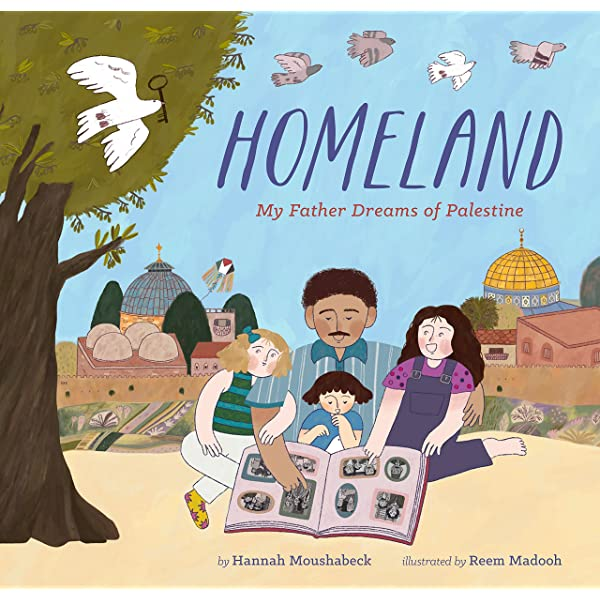
Homeland: My Father Dreams of Palestine by Hannah Moushabeck, illustrated by Reem Madooh

Published by Chronicle Books

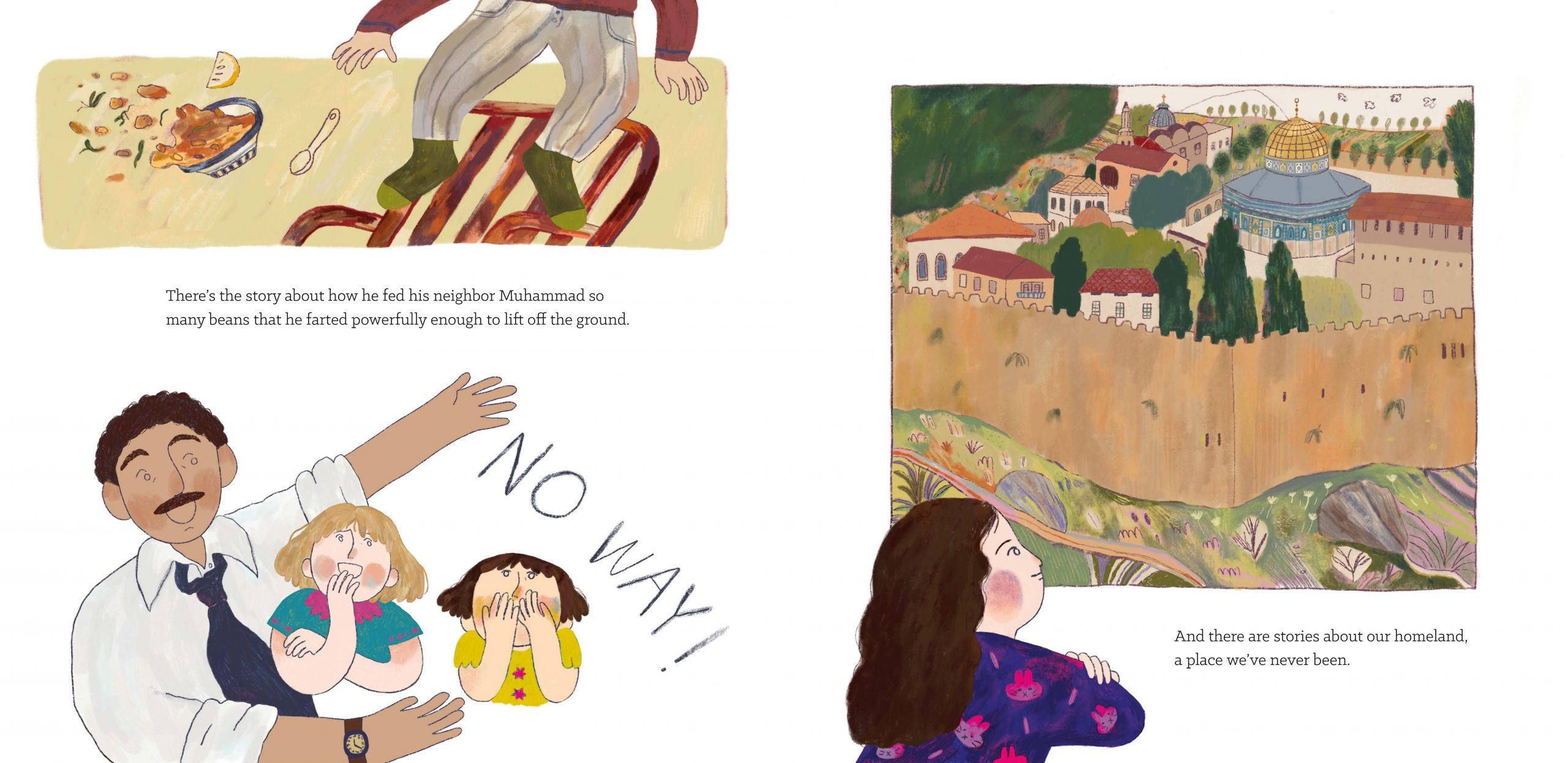
Summary:  A girl and her two siblings love their father’s bedtime stories, especially those about their homeland, a place the kids have never seen.  Their father tells about visiting his grandparents in the Old City of Jerusalem, with the sights, sounds, smells, and tastes of a bustling city with a rich history.  The story ends with his grandfather releasing hundreds of homing pigeons.  “Won’t they fly away?” asks the boy, to which the grandfather replies, “This is their home.”  It’s the last time their father sees his grandfather, and he shows his kids the rusty key to the family’s home.  The children fall asleep and dream of their homeland.  Includes a glossary of Arabic words and an author’s note (with photos) about the history of Palestine, which is her own homeland.  40 pages; grades K-3.

Pros:  The story and folk art-style illustrations bring to life the family’s homeland in Palestine and beautifully convey the sadness and longing they have to return there.

Cons:  Readers unfamiliar with the history of this region will need some additional information to understand what’s going on.

Fae and the Moon by Franco Aureliani, illustrated by Catherine Satrun and Sarah Satrun

Published by Yellow Jacket

Summary:  Fae has been alone since her mother mysteriously disappeared, supported only by a bunny friend and a couple of mice.  She dreams about her mom every night and is sure she is still alive somewhere.  Her mother had a strong connection to the moon, and one night Fae decides to remove it to the sky, hoping her mom will notice and return home.  The disappearance of the moon triggers some pretty unsavory animal behavior, and in a series of adventures, Fae learns that not only are a swarm of rats trying to steal the moon from her, but the “bunny” is really a power-hungry monster.  Fae discovers that she has powers of her own and manages to bring about a happy ending for herself and her mother.  Includes four pages showing the creation of the story and illustrations.  144 pages; grades 3-5.

Pros:  Don’t be deceived by the short length of this graphic novel; it’s a pretty elaborate fantasy story that will appeal to a wide range of elementary students.  Readers will be happy with the pretty strong hint at the end that there will be a book 2.

Cons:  No page numbers.

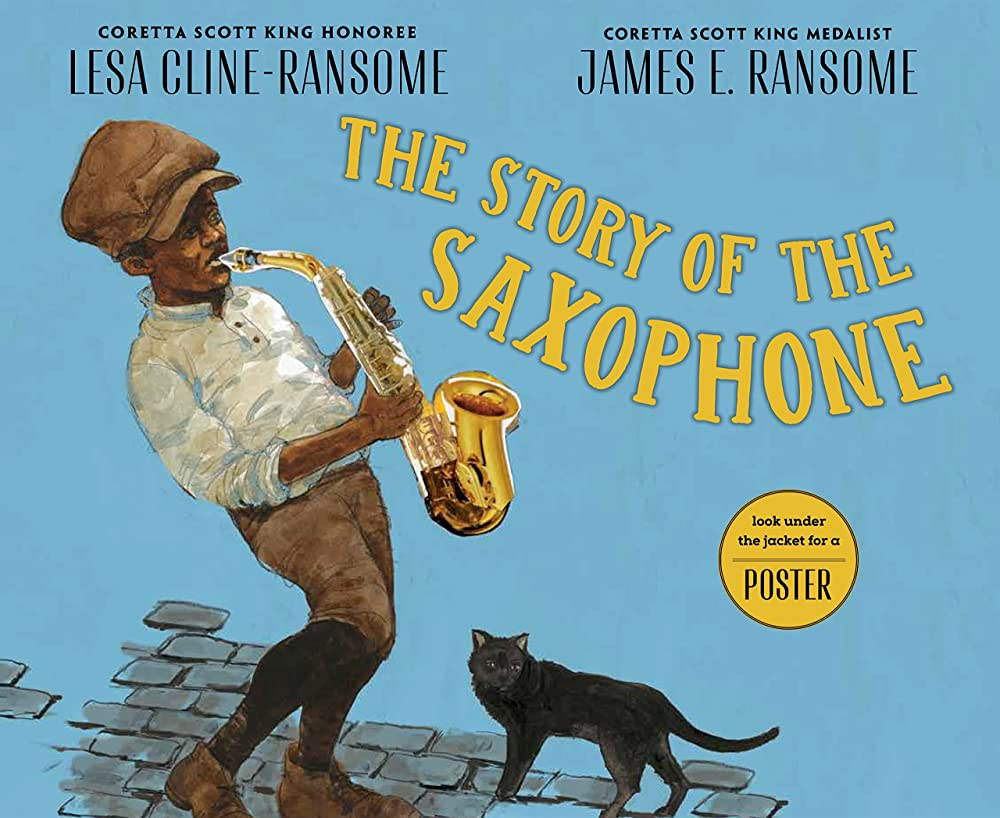
The Story of the Saxophone by Lesa Cline-Ransome, illustrated by James E. Ransome

Published by Holiday House

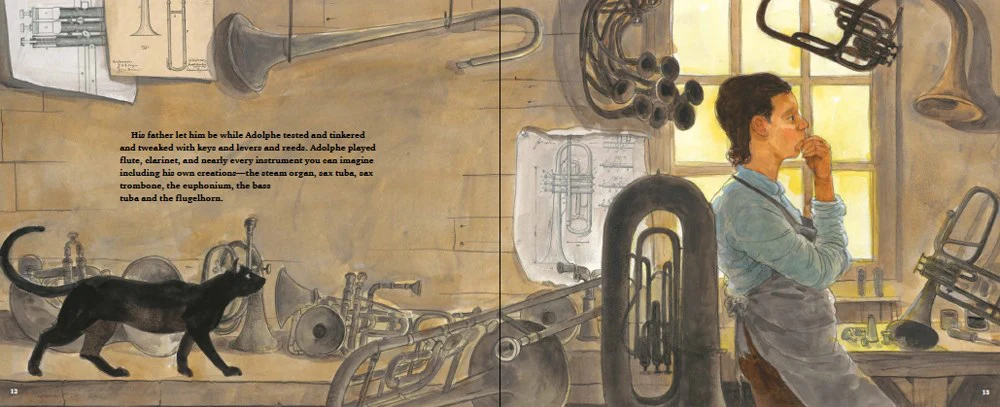
Summary:  Although the saxophone is known for its role in American jazz music, its story starts in 19th-century Belgium with a young man named Joseph-Antoine Adelphe Sax.  The son of an instrument maker, Adolphe was curious and inventive.  He loved creating new instruments and decided that symphonies and marching bands needed one whose volume was between a clarinet and a trumpet.  The result, the saxophone, was mostly met with disdain or even downright hatred until the French composer Hector Berlioz fell in love with it.  Soon, the saxophone was sweeping through regimental bands all over Europe.  When France went to war with Mexico in 1861, a member of the Mexican Cavalry Band got his hands on a saxophone and eventually brought it to New Orleans, where jazz musicians embraced it and continue to do so today.  Includes portraits of jazz saxophonists on the endpapers.  40 pages; grades 1-5.

Pros:  This would make an excellent addition to a music library, and budding saxophonists will find the history of their instrument inspiring.  James Ransome’s illustrations bring the various characters and time periods to life.

Cons:  I was looking forward to additional information about Sax and his instrument, with maybe a timeline and additional resources, but there were none of those things.

Aniana del Mar Jumps In by Jasminne Mendez

Published by Dial Books

Summary:  Aniana loves to swim, but her swim team is a secret between her and her Papi, since Mami has extreme anxiety about water, dating back to her brother’s drowning death in a hurricane during her childhood in the Dominican Republic.  When Aniana develops symptoms of what is later diagnosed as Juvenile Idiopathic Arthritis, she’s forced to tell the doctor about her swimming, and Mami is sure that God is punishing her for lying.  Slowly, Aniana comes to terms with her illness and begins to see herself as a new person–someone who has to deal with a chronic disease, but also someone who is no longer afraid to speak up for herself.  A crisis brings the need for some resolution, bringing Mami the help she needs and allowing Aniana to find her way back to swimming.  Includes an author’s note about her own life experiences, including a chronic illness, that inspired her to write this book.  384 pages; grades 4-8.

Pros:  I jumped into this beautiful novel in verse and found it hard to put down.  Aniana is an inspiring protagonist who is forced to learn to live with a pretty debilitating disease and manages to re-make herself into someone stronger.

Cons:  I got very frustrated by Mami.

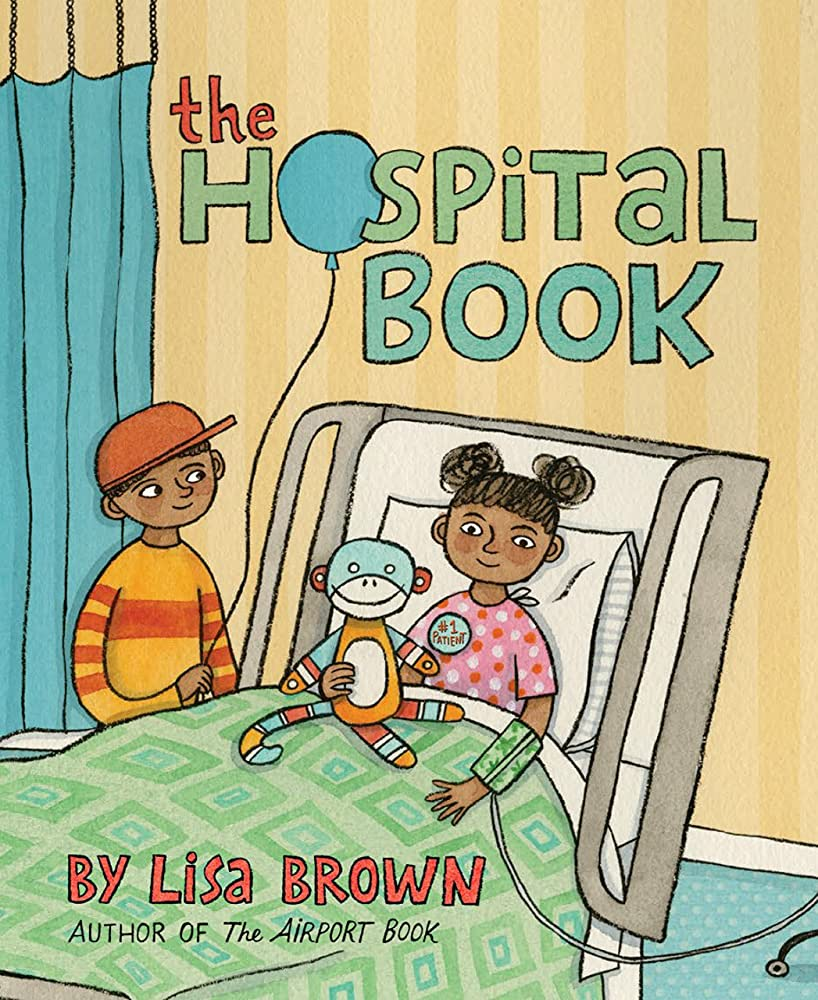
The Hospital Book by Lisa Brown

Published by Neal Porter Books

Summary:  “When I went to the hospital, I cried nine times,” begins the girl narrator, then recounts what each of those times was.  Sometimes the pain makes her cry, like when her stomach starts hurting, and when the car goes over a bump on the way to the hospital.  Other times, it’s from fear, when she finds out she has appendicitis, and she needs an operation.  And once the procedure is done, and she’s staying overnight at the hospital, she sheds a few tears of loneliness.  But in the morning, her family visits, there are pancakes for breakfast, and then she gets to go home.  There are a few tears of joy when she arrives, but those, she says, don’t count.  40 pages; ages 4-9.

Pros:  Just as she did in The Airport Book, Lisa Brown offers a comforting tour through the hospital (based on the reappearance of the sock monkey, I’m pretty sure this is the same family).  There is some sly humor, with hospital staffers Nurse Nightingale and Drs. Zhivago and Watson, but Brown doesn’t shy away from some of the less happy emotions kids may feel in the hospital and matter-of-factly explains some of the procedures they may encounter there.  

Cons:  I’ll take an airport visit over a hospital one any day.

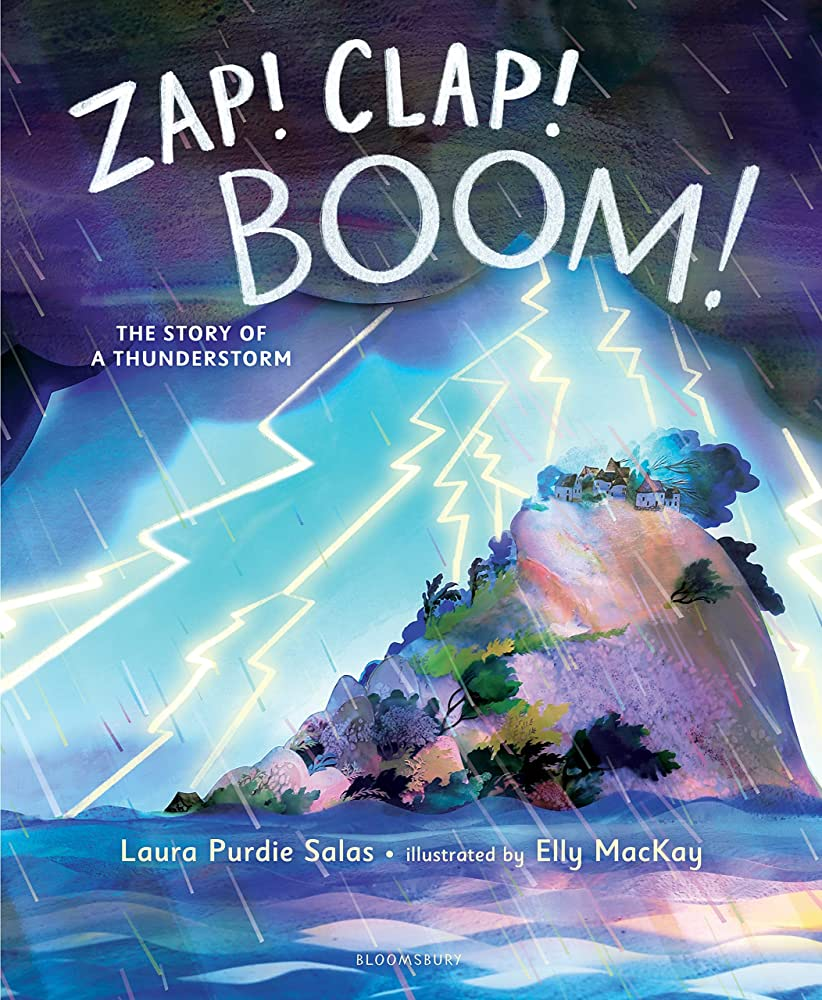
Zap! Clap! Boom! The Story of a Thunderstorm by Laura Purdie Salas, illustrated by Elly MacKay

Published by Bloomsbury Children’s Books

Summary:  Three children play on a sunny day.  Then dark clouds roll in, and suddenly, “ZAP! CLAP! BOOM!” there’s a clap of thunder and lightning is seen in the distance.  The children head for home and three goats run for shelter as the rain arrives.  Safe in their house, the kids watch the lightning and rain.  Then just as quickly, the storm moves on, and both sets of kids head outside again, as “the world now shines.”  Includes additional information on the science of thunderstorms, as well as a list of books and websites.  40 pages; ages 4-9.

Pros:  The rhyming text is very catchy, and kids will enjoy saying the repeated “Zap! Clap! Boom!” refrain.  The dramatic illustrations capture all the phases of a thunderstorm, and the back matter makes this a useful resource for older readers.

Cons:  I thought the kids could have moved toward home a little quicker when the storm arrived.