The Year My Life Went Down the Toilet by Jake Maia Arlow

Published by Dial Books
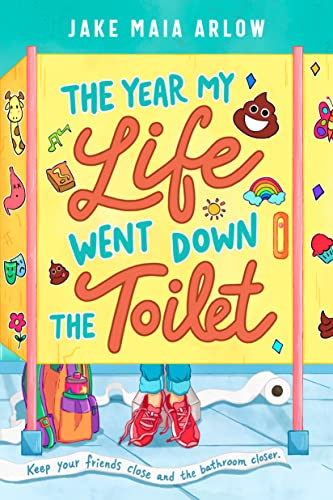
Summary:  Al is hoping her new doctor can make her stomach problems disappear, so she’s crushed to learn she has Crohn’s disease, which can be controlled but not cured.  Her flare ups seem to get worse with stress, and Al has plenty of that when her best friend Leo gets a part in the school play and has less time for her, and her mom and Leo’s mom start dating.  An IBS support group proves helpful in helping Al process some of her feelings about having a chronic disease and introducing her to some new friends who can relate to her experiences. Al develops a crush on one of the girls in the group and has to deal with the additional stress of coming out to her friends and family.  Communication proves to be the key, and after a rocky few months, Al finds her way back to those she loves the most.  288 pages; grades 4-7.

Pros:  I’ve gone my whole life without reading a book about a middle schooler with Crohn’s disease and now…two in less than a month.  Al’s story, like Will’s, conveys the difficulties of dealing with this illness and the grief of learning that it’s chronic, while at the same time containing universal and relatable middle school issues with family and friends. If you’re looking for an LGBTQ+ friendly book, every main character in this story falls into that category.

Cons:  Al spends a lot of the book being sulky and uncommunicative, behavior that is certainly understandable given her circumstances, but if I had to choose someone to hang out with from these two books, I’d have to go with Will.

Together We Swim by Valerie Bolling, illustrated by Kaylani Juanita

Published by Chronicle Books

Summary:  A family is enjoying some time at the pool.  Mom, Dad, and the sister are all accomplished swimmers, but the youngest is still learning.  Short rhymes describe the action (“Toe dip/Side grip”) as he tentatively explores the water.  The other family members are encouraging, showing him the basics and staying nearby with a kickboard and noodle to keep him safe.  By the end, he’s learned how to move his arms and legs and is thrilled to be starting to swim.  They towel off, have a family hug, and “filled with pride/off I stride.”  40 pages; ages 3-6.

Pros:  A perfect summer book and an empowering one that shows a Black family that loves swimming and is making sure their kids know how to swim too.  I missed last year’s Together We Ride, which features the same family teaching the daughter how to ride a bike.

Cons:  Seems like June 15 would have been a better release date for this book than August 15.

Night Owl Night by Susan Edwards Richmond, illustrated by Maribel Lechuga

Published by Charlesbridge

Summary:  Sova is eager to accompany her scientist mother on one of her evening owl watches, but every time she asks, Mama tells her that a scientist must learn to wait.  Finally, Sora is old enough, and the big night arrives when the two of them go off together.  Once again, there’s a lot of waiting: Mama sets a timer for thirty minutes, and the two of them play games in the wildlife sanctuary’s cabin until the timer goes off.  They go out to check the nets for owls.  The first two times, there are just leaves, but on the third trip–finally–there’s a saw-whet owl.  Back at the cabin, Mama measures and bands the owl, explaining how the bands help scientists track the owls’ migration.  Together, the two of them release the owl, and Sora feels a part of herself take wing and fly away with the owl.  Includes additional information about four types of owls; a note from the author about saw-whet owl banding (with a photo); and additional resources.  32 pages; ages 4-9.

Pros:  Fans of Jane Yolen’s Owl Moon will enjoy this story with its portrayal of a woman scientist.  It’s remarkably engaging, considering how much waiting is involved, and incorporates quite a bit of scientific information.

Cons:  I was getting a little impatient to finally see an owl.

My Head Has a Bellyache and More Nonsense for Mischievous Kids and Immature Grown-Ups by Chris Harris, illustrated by Andrea Tsurumi

Published by Little, Brown Books for Young Readers

Summary:  A companion to I’m Just No Good at Rhyming, this book of poems begins with “World, Watch Out!” where the narrator is ready to conquer the world…until he trips down the stairs after forgetting to tie his shoes.  The poems cover all kinds of topics like families (“Sometimes Dads Are No Help At All”), holidays (“Valentine Poem for Someone You Don’t Care About”), books (“Help! I’m Trapped in ‘Happily Ever After’!”), and so much more.  Many of the page numbers have fun facts next to them that also form rhymes: “78: one right through twelve added up all the way, 79: a really bad year to have been in Pompeii.”  Includes a glossary of terms (written as a 14-verse poem); somewhat unconventional indexes by title and subject; and a list of books by (and not by) the author and the illustrator.  192 pages; grades 1-5.

Pros:  The back cover cautions that, “extreme laughter while reading this book may give your belly a headache.”  It’s a fair warning, as the book is packed with funny and clever poems and illustrations.  Just the first few pages gave me ideas for sharing with various age groups.  I wouldn’t try to read the whole book at once but to savor it a few pages at a time.

Cons:  I prefer a bit more color variety in illustrations.

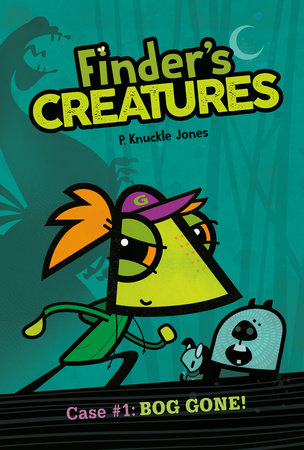
Bog Gone! (Finders Creatures, Book 1) by P. Knuckle Jones

Published by Penguin Workshop

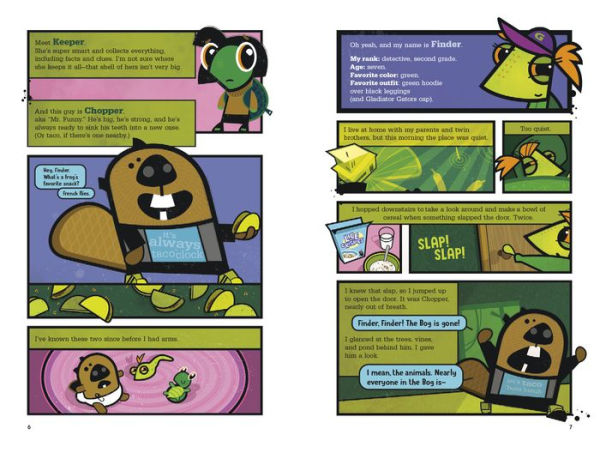
Summary:  Second grader Finder (frog) and his friends Keeper (turtle), and Chopper (Beaver) have their hands/paws full when the other animals from Belly Acre Bog disappear.  Finder’s hero is Seymour Warts, a brilliant detective based on Sherlock Holmes, who solves his own mystery during the course of the story.  A series of misadventures ensues, but both Finder and Seymour manage to crack their cases.  112 pages; grades 2-4.

Pros:  The many fans of early graphic novels like The Bad Guys, Max Meow, and The InvestiGators will enjoy this mystery, which includes plenty of madcap humor.  The word choices and color-coded speech bubbles makes this a good choice for newly independent readers.

Cons:  No sign yet of book 2.

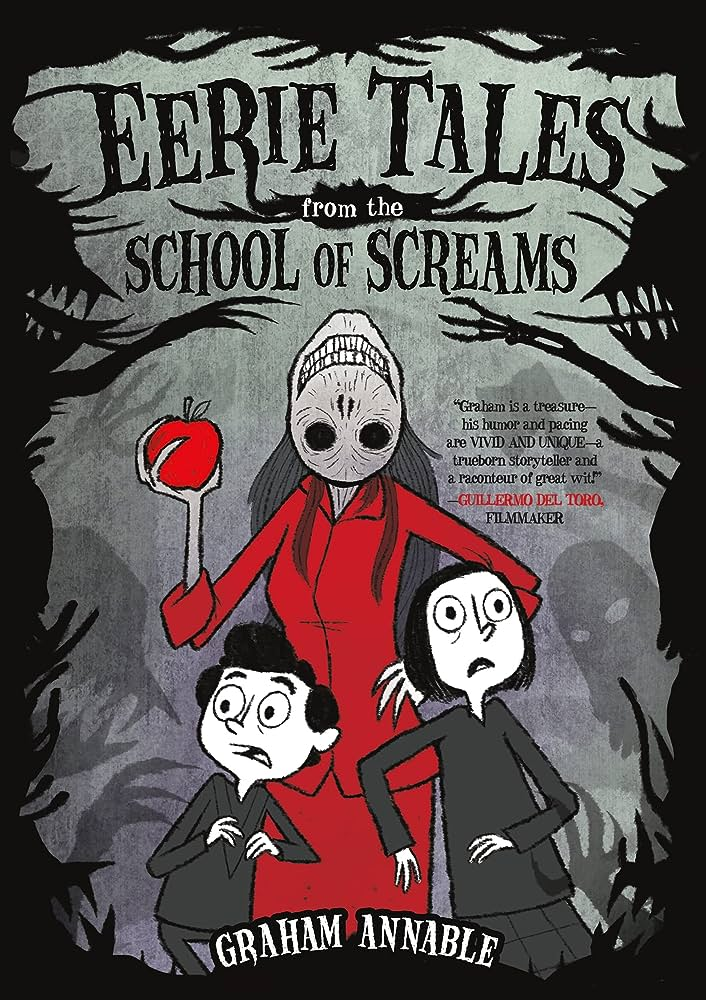
Eerie Tales from the School of Screams by Graham Annable 

Published by First Second

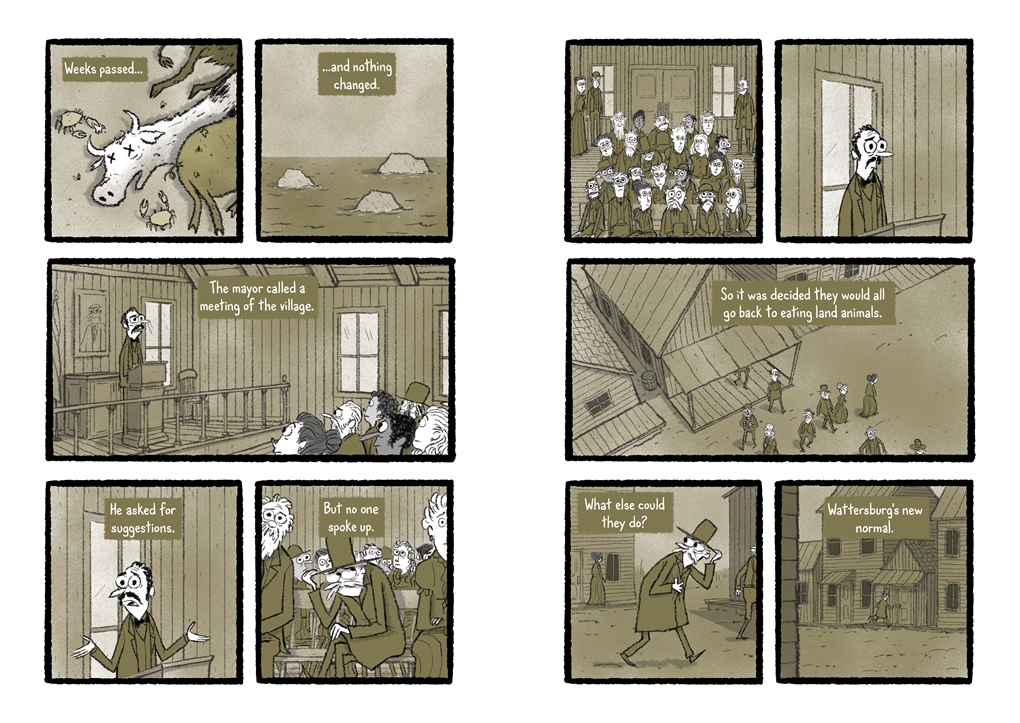
Summary:  Ms. Nomed has her students come up one by one to share a scary story with the rest of the class.  Each tale is illustrated with various shades of a single color to help differentiate one from the other.  Humorous commentary from the other kids at the end of each one lightens the mood a bit before plunging back into another creepy world where things are not always what they seem and monsters, ghosts, and zombies are real.  The final story turns out to be true, and the class has to join forces when Ms. Nomed reveals her true self.  368 pages; grades 4-7.

Pros:  A graphic novel scary story collection?  Someone has a finger on the pulse of elementary students!  Plan on buying multiple copies for the library, as this is sure to be a huge hit.  The artwork is excellent, and the stories are genuinely creepy.

Cons:  As always with scary stories for elementary kids, be aware that these may be disturbing for some readers.

Mexikid: A Graphic Memoir by Pedro Martin

Published by Dial Books

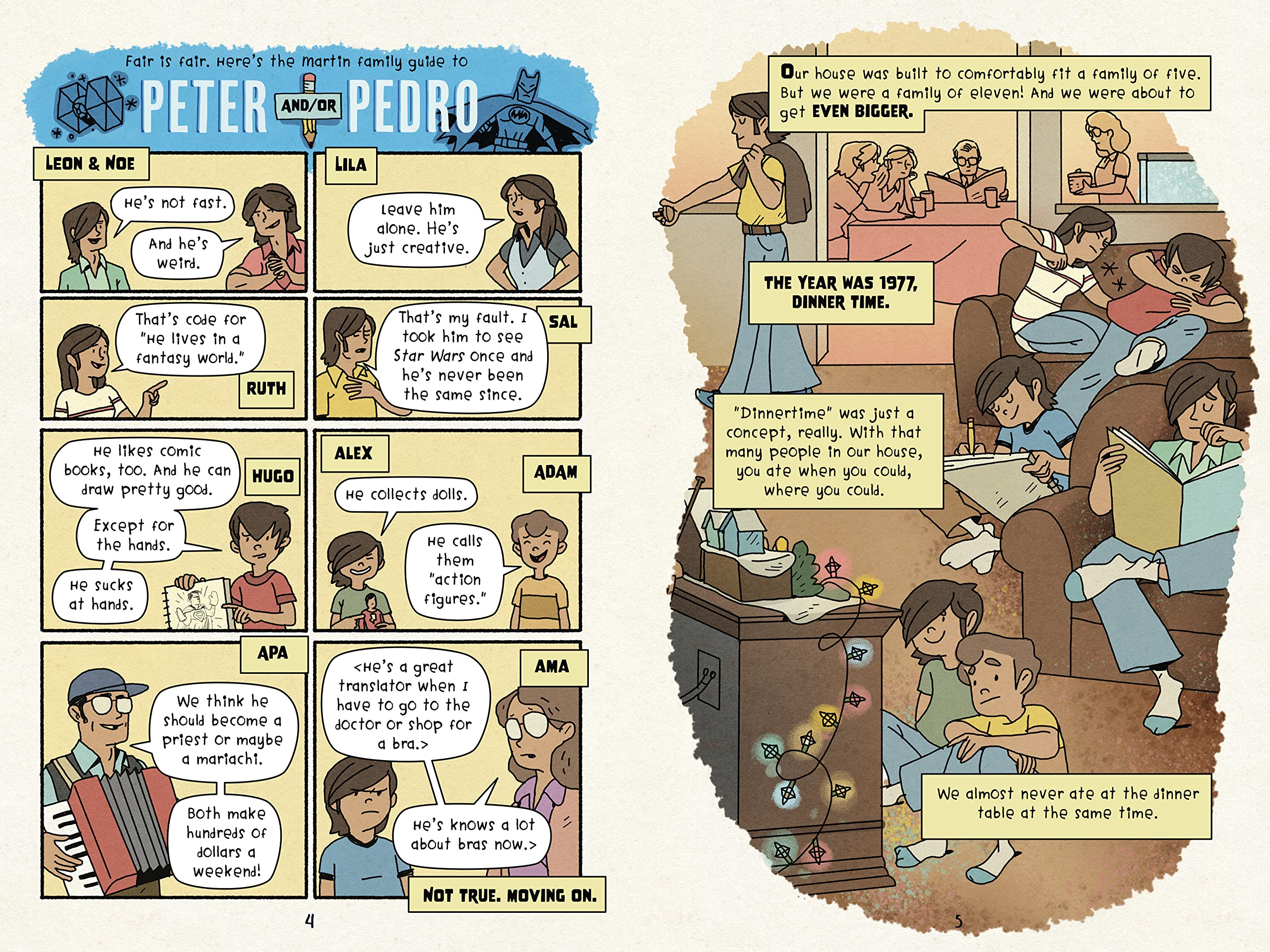
Summary:  Pedro’s house feels pretty small with his parents and eight brothers and sisters, so when he learns that his grandfather is coming to live with the family, he’s not happy.  Not only that, but the whole family has to travel to Mexico to pick up Abuelito.  The kids are divided into two groups: the five oldest were born in Mexico, and the younger four, including Pedro, arrived after the family had moved to California.  The older group takes a pick-up truck for the big road trip, and the rest of the family travels in a used RV.  There are plenty of adventures both on the trip and during the weeks they spend in Mexico with their extended family.  Pedro is in awe of his grandfather, who was part of the Mexican revolution, but by the end of the trip, he’s shown he has a few heroic qualities of his own.  Available in both English and Spanish language editions.  320 pages; grades 4-8.

Pros:  This road trip graphic novel strikes the perfect balance between funny and poignant, featuring a memorable immigrant family with ties to both Mexico and the United States.  Readers of a certain age will appreciate the loving references to Star Wars, Fleetwood Mac, Happy Days, and other 1970’s touchstones.

Cons:  I found the font a little hard to read, particularly the lowercase d’s that looked more like a’s.

Hope in the Valley by Mitali Perkins

Published by Farrar, Straus and Giroux

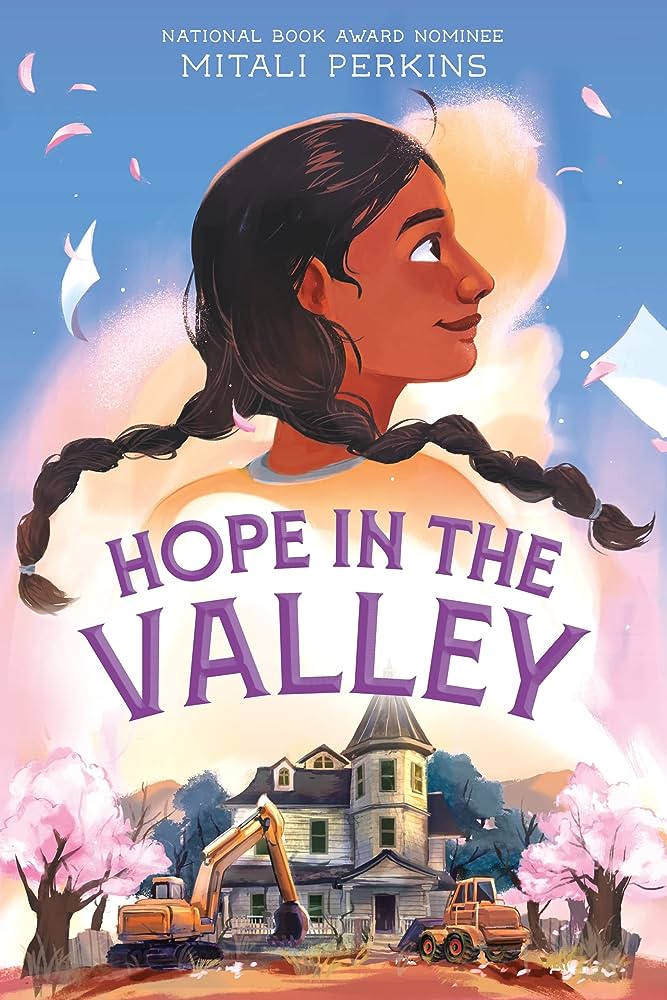
Summary:  Pandita is looking forward to a relaxing summer of reading in her favorite secret hiding place–the porch of the abandoned house next door, a place she and her late mother liked to spend time.  When she learns that the house is being torn down by developers, Pandita is horrified and becomes part of a group trying to save it for historical preservation.  Her research on the old house leads to some surprising discoveries, as well as some new friendships.  There are other changes afoot during the summer, including four weeks of drama camp and a potential new stepmother whose brash opinions cause Pandita to label her The Intruder.  At first reluctant to attend drama camp, Pandita eventually discovers a talent for singing and learns to overcome her fear of speaking in public, a lesson that serves her well in her fight for the house.  Although things don’t turn out exactly the way Pandita wants them to, she discovers that change can be a good thing sometimes, leading to new connections and experiences.  304 pages; grades 4-7.

Pros:  This engaging historical novel documents the rapid changes going on in Silicon Valley in the 1980’s.  Introverts will take Pandita’s struggles and triumphs to heart and cheer her on as she discovers new talents and makes new friends.

Cons:  Although The Intruder eventually won the family over, she seemed pretty obnoxious at times, and I foresee some rocky times ahead for her and Pandita.

Two books about self-acceptance

Greenlight by Breanna Carzoo

Published by HarperCollins

Hidden Gem by Linda Liu

Published by Henry Holt

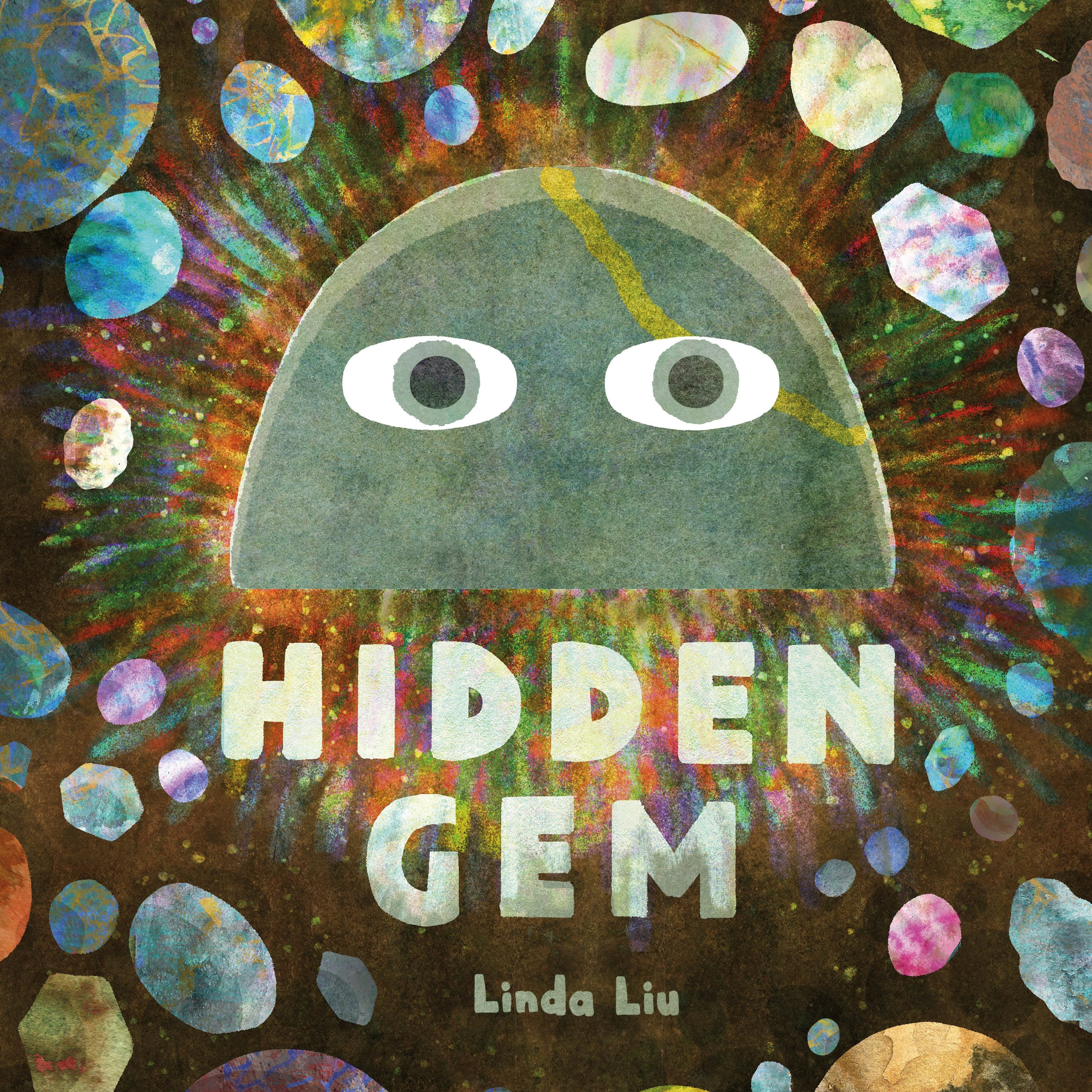
Summary: Two unconventional narrators discover their own value. Greenlight doesn’t like the fact that the cars slow down for Yellowlight, stop for Redlight, but speed through Greenlight, seeming to ignore it. Taking a break for a few minutes, with closed eyes and some affirmations repeated, Greenlight starts to see its own value and is ready to shine bright. In Hidden Gem, an ordinary rock can’t help comparing itself unfavorably when it goes to a museum exhibit of gems. But with the help of a spectacular diamond, the narrator comes to realize that every rock is special in its own way. 32 pages (Greenlight) and 40 pages (Hidden Gem); both ages 4-8.

Pros: With school starting up again, teachers and counselors will be looking for books like these that incorporate humor and striking illustrations (especially in Hidden Gem) to give kids some strategies for feeling good about themselves and accepting others for what they are.

Cons: Both books seemed to prioritize the message over the story.

The Red Jacket by Bob Holt

Published by HarperCollins

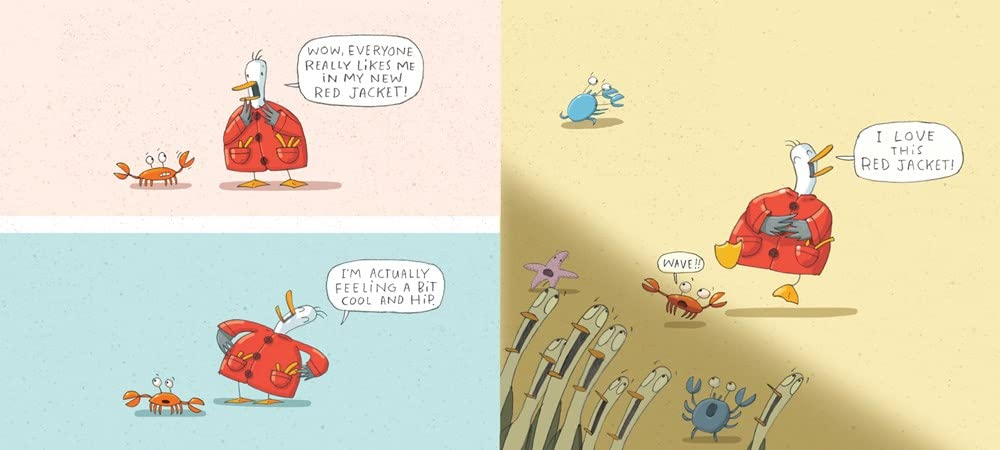
Summary:  The first few wordless pages show Bob the seagull watching other sea creatures having fun together while he feels left out and alone.  Another bird comes along and offers Bob her red jacket (with fries in the pockets!), saying that she no longer needs it.  The jacket gives Bob the confidence to talk to the other animals.  Their responses reveal that they’ve always liked Bob but never had the chance to get to know him (“I didn’t know Bob could talk”).  When a huge wave causes Bob to lose his beloved jacket, his friends pitch in and help him recover it.  Bob spots a lonely turtle and offers the jacket to her, saying that he no longer needs it.  The turtle walks away happily, fries spilling from the pockets of her new red jacket.  40 pages; ages 4-8.

Pros:  A cute story with appealing comic-style illustrations that could open up some interesting conversations about where self-confidence comes from.

Cons:  Those have to be some soggy fries.