Black History for younger kids

Greatness by Regis and Kahran Bethencourt (Little Brown Books for Young Readers, 40 pages, ages 4-8). When Nasir and Imani visit Grandma, she pulls out a special photo album handed down to her from her mother. Inside are photos of great people from Black history. The kids get out dress-up clothes and pretend to be Bessie Coleman, a Tuskegee Airmen, and business people from Black Wall Street. Then some magic happens, and they are pulled into the album, where they become the famous people in the photos, like Katherine Johnson, Barack Obama, Colin Kaepernick, and Ruby Bridges. For Grandma, though, nothing compares to the greatness she saw in the two babies pictured at the end–and after spending so much time imagining themselves among greatness, Imani and Nasir feel like nothing is impossible. Includes some photos and additional information about all the people from the photo album.

Every year, I gather books for our big Black History read-aloud, where community members come to our school and read to all the classes. It can be challenging to find books for the younger grades, and this one would make a great introduction to a wide variety of historical figures, encouraging kids to think about their own dreams. The photos of the kids dressed up are fun and inspiring, although I wish there had been photographs of all the famous people at the end.

Sharing the Dream by Shelia P. Moses, illustrated by Keith Mallett (Nancy Paulsen Books, 32 pages, ages 4-8). Agnes is excited to be on a bus with her parents, traveling from Birmingham, Alabama to Washington, D.C. in August, 1963 to attend the March on Washington. There’s a stop at Frederick Douglass’s house, where Agnes is amazed to see Black and white people drinking from the same water fountain. Then it’s on to the March, where Agnes sits on Daddy’s shoulders to hear John Lewis and Josephine Baker speak, and Mahalia Jackson sing. Finally, Dr. Martin Luther King, Jr. steps up to the podium. “Tell ’em about the dream,” Agnes hears Mahalia Jackson say, and Dr. King delivers his now-famous words about his dream. Afterwards, Agnes sees Black and white people sitting side by side, soaking their tired feet in the reflecting pool, before she and her parents get back on the bus heading home to Birmingham. Includes an author’s note and thumbnail profiles of six people at the March who are mentioned in the story.

I’m so happy to see this book describing the 1963 March on Washington from a young child’s perspective. Agnes is probably about six years old, telling about events in a way that primary students will understand. There’s plenty of information packed into her story, though, with an introduction to such celebrities of the time as Lena Horne, Sidney Poitier, and Jackie Robinson. The straightforward story and illustrations make this a perfect introduction to this important event from Black history.

O Is for Owl. And Octopus.

To See an Owl by Matthew Cordell (Random House Studio, 40 pages, ages 4-8). Janie is a birder whose ultimate quest is to see an owl. Her patient mother (“Mama doesn’t look for birds the way I do”) takes Janie on trips to meadows and forests where she can look for birds. This year, Janie has a teacher who shares her passion. Mr. Koji shows the class pictures from his birding expeditions and maps he made as a child and tells the class, “To see an owl is magic.” When Janie shares her owl drawings, journal, and maps with the class, Mr. Koji is impressed by her determination and tells her where he’s recently seen a pair of great horned owls. Back home, Janie convinces her mother to take her on one more outing, and when they get to the place Mr. Koji described…there are the owls. Magic.

Caldecott Medalist Matthew Cordell clearly shares Janie’s passion for owls (read about it on the book jacket’s back flap), and he conveys that passion, as well as the persistence needed and the amazing rewards that come from finally seeing that owl. His illustrations capture the beauty and majesty of nature, and show readers how to use art to record their outdoor adventures like Janie does. As someone who shares Mama’s indifference to birding, I admired her for being willing to keep taking her daughter out on various excursions. This book would go well with Owl Moon by Jane Yolen or Night Owl Night by Susan Edwards Richmond

Octopus Ocean: Geniuses of the Deep by Mark Leiren-Young (Orca Book Publishers, 104 pages, grades 4-7). The author introduces octopuses with the story of his first meeting with an octopus named Storm at the Salish Sea Centre in British Columbia. From there, he moves on to five chapters describing many aspects of octopuses’ lives: anatomy, reproduction, intelligence, food, defenses, and homes in the ocean. The second half of the book includes stories of amazing “octopus celebrities” who carried out elaborate escapes or predicted the outcome of soccer games with amazing accuracy. There’s a chapter about the effect of the documentary The Octopus Teacher on educating the public on this amazing animal, which has led to a decrease in human consumption of octopus meat. The final chapter gives readers suggestions for helping octopuses survive in the wild and keeping oceans cleaner and healthier. Includes a glossary, an index, and a list of resources.

I learned a ton about the octopus from reading this book, and anyone doing research will not have to go much further to get everything they need on the topic. I found the second half of the book a bit more engaging than the first half, particularly the chapter on octopus celebrities. The book is pretty text-heavy, and It would be nice to have a companion picture book, which I think would find a wider audience.

A collection of mysteries and the mystery of collections

Casey’s Cases by Kay Healy (Neal Porter Books, 160 pages, grades 2-5). Fifth grader Casey aspires to be a detective, and sees a mystery in almost every situation. Who is the new girl? Where is her missing hair band? What did her crush write in his notebook? Who is the owner of the lost cat she found? Some mysteries are solved in a few minutes (the hair band), while others take the whole book to solve (the new girl, Jan, who becomes Casey’s best friend), and some have surprise twists (the stray cat, whose growing belly turns out not to be from eating too much tuna). Here’s hoping that Casey and Jan will team up for another book of mysteries.

The humor, simple story line, and short chapters will make this an appealing choice for beginning and/or reluctant readers, who may also enjoy copying the drawings that employ basic shapes, such as the triangle-headed Casey.

Monti and Leo: A Mystery in Pocketville by Sylvie Kantorovitz (Walker Books, 80 pages, grades 1-4). Monti and Leo enjoy looking at Mrs. Sheep’s collection of small figurines on display at the local library. In fact, Monti is so enchanted with one item in the collection that he’s a prime suspect when it disappears. Leo wrestles with his feelings that Monti might have wanted it enough to take it, but ultimately he believes in his friend’s innocence and sets out to solve the mystery. When he starts hearing about other missing items around town, he discovers a bird he’s never seen before flying overhead with an item in her beak. Leo runs after the bird, climbs a huge tree, and discovers all the missing treasures–including the figurine–in the bird’s nest. In the final chapter, Monti thanks his friend and reveals his new collection: containers, each one holding a mini collection of different small items.

This is book two of a series I missed last year (thank you, Walker Books for sending me a review copy). The animal cast will appeal to fans of Mr. Wolf’s Class, and it would make a good book for those just starting with chapter books. I’m always fascinated by animal stories in which some of the animals act like humans and others are more like animals (like how Marc Brown’s Arthur has a pet dog), so I was intrigued by the fact that one crow was living in a nest acting bird-like, while another one was the local librarian.

A Pocket Full of Rocks by Kristin Mahoney, illustrated by E. B. Goodale (Knopf Books for Young Readers, 40 pages, ages 3-8). Mom may say a pocket full of rocks will make your coat dirty, Dad might ask where your other mitten will go, and your sister will dismiss them as ordinary, but you know those rocks will make excellent chairs for fairies, or let you write on the sidewalk if you don’t have chalk. There are other collections to fill your pockets as the year goes on: petals in the spring, seashells in the winter, and acorns in the fall. Each object fires up your imagination, and at the end of the year, you can use them for presents: a bowl of shells for Dad’s dresser, tiny pictures on the acorns for your sister, and a bag of petals for Mom to put in the drawer with her sweaters. And a pocket full of rocks for you to make sleds for the fairies.

Wow, this book really took me back, as my older daughter–soon to turn 30–was a collector just like the narrator. I don’t remember flower petals, but our house had plenty of rocks, shells, and acorns, with imaginative stories about each collection. This would be a lovely book to begin a conversation about collecting, seasons, or making crafts from your imagination, with illustrations that beautifully capture each season.

Graphic novels with a STEAM theme

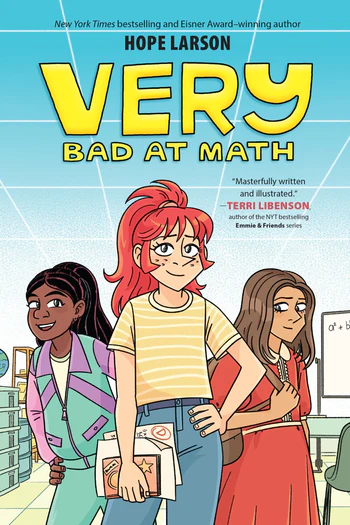
Very Bad at Math by Hope Larson (HarperAlley, 240 pages, grades 4-8). Verity “Very” Nelson is an athlete, musician, popular eighth-grade class president, and ace student…except when it comes to math, which she is failing miserably. When she’s told she has to bring up her math grade to stay on student council, Very starts working with a tutor. Despite her hard work, her progress is slow, and when Very makes a costly mistake at a class fundraiser, her tutor realizes she’s transposed two numbers and diagnoses her with dyscalculia. He starts to work with her on learning strategies to help her with this disability, and by the end of the book, Very’s back on top and on her way to being successful at math. But Very is something of an activist, and she’s determined to make school a better, more just place for students with disabilities, and the last few pages show her talking to her favorite local politician about ideas she has to do just that.

I’m always happy to see a new graphic novel by Hope Larson, especially one for elementary readers, since most of her books are for young adults. This one is sure to be popular with both elementary and middle school, particularly those who are dealing with some sort of learning issue. Very is resilient and persistent in her efforts, but she also has to learn how to deal with setbacks and not making progress even with hard work. I hope we’ll see a second book to find out how she brings her fight for justice to her school.

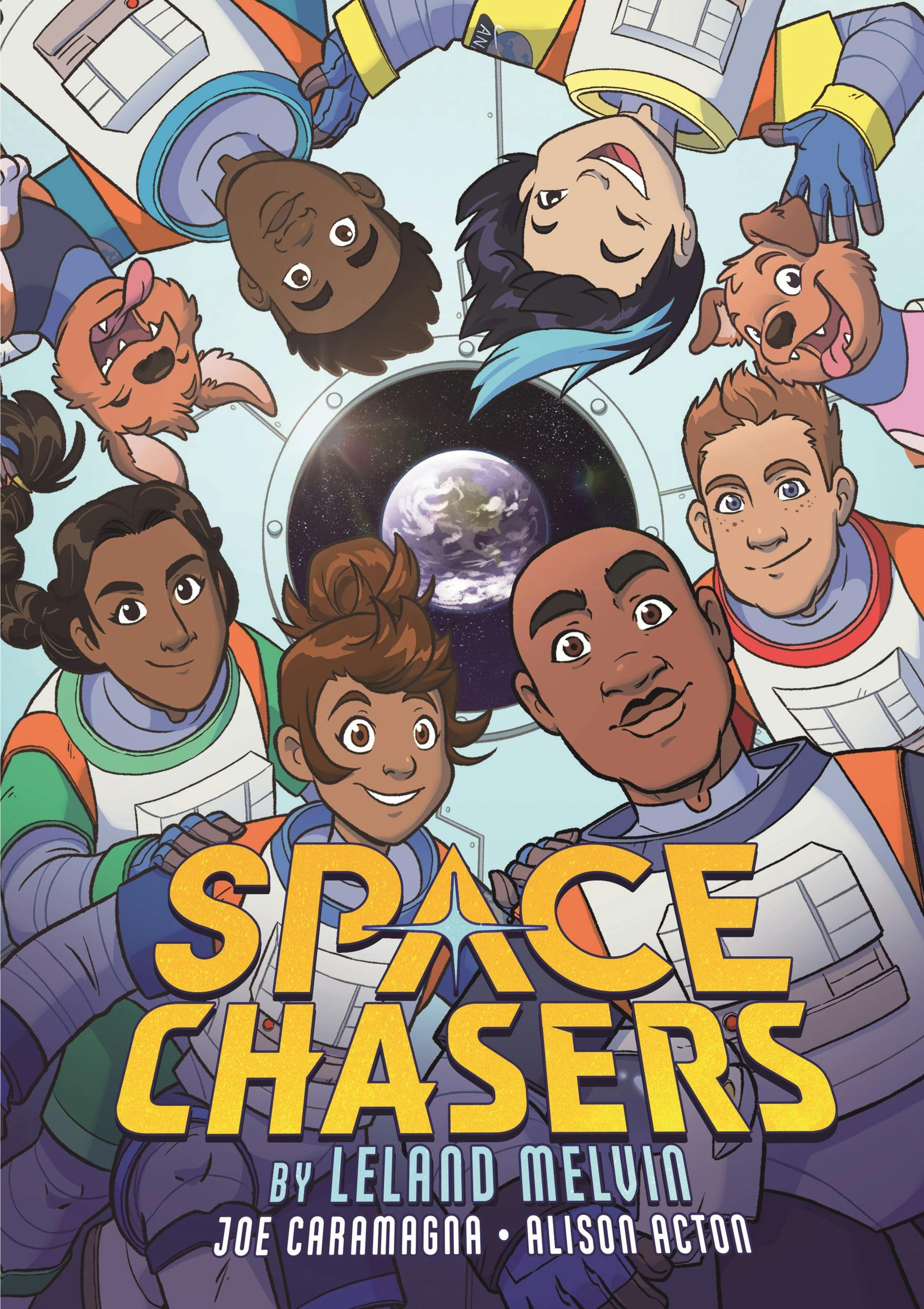
Space Chasers by Leland Melvin and Joe Caramagna, illustrated by Alison Acton (First Second, 240 pages, grades 3-7). Five middle school students are chosen to be part of NASA’s new STEAM team program, undergoing rigorous training to prepare them for a mission into space. When that mission goes awry, three of the kids wind up on a space station with no adult supervision and must figure out what to do to save the mission…and themselves. Each of the participants brings unique skills to the program but also their own insecurities that sometimes get in the way of solving problems, particularly under pressure. When everyone’s safely back on Earth, the powers-that-be deem the program too dangerous, but the kids manage to convince them otherwise, opening the door for book 2. Includes some work-in-progress art and an author’s note.

Former astronaut Leland Melvin has written a fun space adventure with five endearing kids who get the opportunity of a lifetime. I haven’t been so nervous about the outcome of a space adventure since I watched Apollo 13, which made it hard for me to put the book down. I’ll admit it took some suspension of disbelief to believe that NASA would send middle school kids into space, but heck, if you had told me a few months ago that a 19-year-old nicknamed “Big Balls” would be a senior advisor at the State Department, I would have been pretty skeptical of that as well.

Cutting hair and a mixed-up pair

The Snips: A Bad Buzz Day by Raúl the Third, inked by Elenora Bruni and Elaine Bay (Little, Brown Ink, 128 pages, grades 2-5). The Snips are a superhero quintet from Scissors City, who not only give the best haircuts, but also use their powers to create such technology as barber-pole jet packs and and drone barber bots. When the Bad Buzz Boys come to town, threatening to destroy one of the Snips’s record for most haircuts given in one day, our heroes spring into action to save the day. The Bad Buzz Boys are racing through town, randomly giving terrible haircuts, and the Snips are able to not only stop them, but to repair the damage and to remind everyone that working together and valuing community are much more important than setting records. Includes additional information about barber poles, the real-life record holder for haircuts given in a day, and directions for drawing one of the Snips.

Those familiar with Raúl the Third’s zany, high-energy comic art will be thrilled to hear that he has a new graphic novel, which appears to be a series opener. Dog Man fans will enjoy a new set of superheroes, and those that speak Spanish–or aspire to learn–will find plenty of it (with translations) interspersed throughout the text.

Operation: Cover-Up by Tate Godwin (Andrews McMeel Publishing, 192 pages, grades 3-6). New Leaf Elementary has two new kids in the fifth grade: Sy always has a joke to tell, while Nick enjoys sharing his wealth of knowledge and advanced vocabulary. A series of mishaps results in Sy being seen as the braniac and Nick getting the label of class clown. Both try to be who they think their classmates want them to be, and when they meet and realize what’s happened, they decide to help each other keep the cover-up going. A new friend named Violet, who’s a secret comic artist, helps them see the importance of being themselves, and a school talent show allows all three to share their real talents with the rest of their classmates. A sequel, Operation: Make a Splash is promised on the last page.

Share this fun and clever graphic novel with fans of Mr. Wolf’s Class. Readers are sure to get a laugh from Sy and Nick’s mishaps and subsequent bumbling efforts to cover up the truth about themselves and will learn a good lesson or two about being true to yourself.

Once upon a time

The Princess Swap: Cinderella and the Beast or Beauty and the Glass Slipper by Kim Bussing (Random House Books for Young Readers, 304 pages, grades 3-7). Ella from Cinderella and Belle from Beauty and the Beast unexpectedly switch places in this fairy tale mash-up. The bold and adventurous Belle winds up as a servant in Ella’s stepmother’s basement, while Ella, whose glass leg has always kept her on the sidelines, finds herself sharing a gloomy castle with a fearsome beast. Cinderella’s prince is just a kid named Amir in this telling, and he’s sad that his sister Anisa has mysteriously vanished for the last few years. The two stories come together as Ella learns more about the cursed beast, and each heroine has to take matters into her own hands to create a happily-ever-after ending for both of them. A preview of book two, featuring Snow White and Sleeping Beauty, is featured at the end.

I’m not really much of a fractured fairy tale fan, but this version was so clever and well-told, once I got into it, I couldn’t put it down. The stories are told in alternating third-person chapters, and many of the chapters ends on a cliff-hanger that will keep the reader turning the pages. Even the villains are treated with some sympathy in the end, and both girls are strong and brave, with just enough flaws to be believable.

Lily’s Dream: A Fairy Friendship by Bea Jackson (Aladdin, 40 pages, ages 4-8). Although Lily dreams of flying, so far her fairy wings haven’t worked. As a result, she knows more about beauty close to the ground, and one day she stumbles upon a beautiful fairy house. When the human creator reveals herself, Lily runs away, accidentally leaving behind her cherished gold anklet. The next day, she goes back to look for it, and the girl, who introduces herself as Willow, has found it. Willow makes Lily a fairy-sized acorn helmet, pillow, and trampoline to help her practice flying. Soon she’s taken to the air, and although she still can’t fly high, “Lily was over the moon.” Includes an author’s note that gives more of Willow’s backstory.

Those who judge books by their covers will be captivated by the picture of Lily on this one, and will undoubtedly find the rest of the story equally enchanting. I hope that this is the beginning of a beautiful friendship and that Willow and Lily will have more stories, maybe told from Willow’s point of view. I enjoyed reading about her in the author’s note and wished that more of it had been incorporated into he main story.

Blinded with science

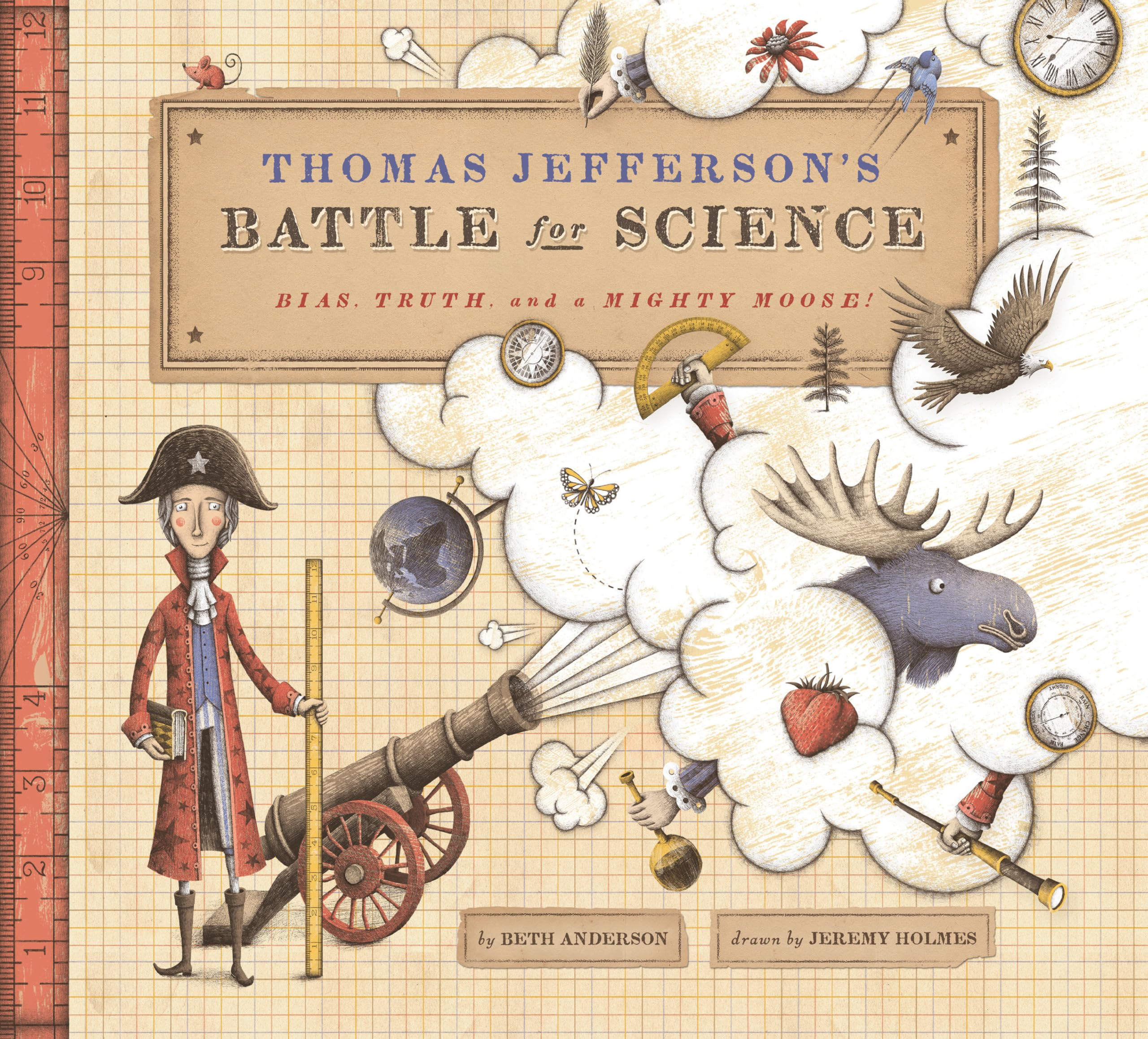
Thomas Jefferson’s Battle for Science: Bias, Truth, and a Mighty Moose! by Beth Anderson, illustrated by Jeremy Holmes (Calkins Creek, 48 pages, grades 2-5). Thomas Jefferson loved science, and one of his favorite books was Count Georges-Louis Leclerc de Buffon’s encyclopedia of the natural world. But he was incensed by Buffon’s descriptions of American wildlife, comparing it unfavorably to the animals found in Europe. Thomas decided to measure as many American animals as he could, and recruited friends from different parts of the country to assist him, eventually putting together his own book that he showed Buffon when he became minister to France. So committed to the truth about American fauna was Jefferson, that he actually had friends hunt a moose and ship it to France (you can read more about that here). When Buffon saw (and smelled) the enormous moose, he promised to revise his book, but unfortunately passed away a few months later. Jefferson’s book became well-known, and people started sending him information and artifacts to add to it, helping him to promote the idea that the New World was not inferior to the old one…just measurably different. Includes an author’s note, a list of five steps to use for a scientific inquiry process, a timeline of Jefferson’s life, and a bibliography.

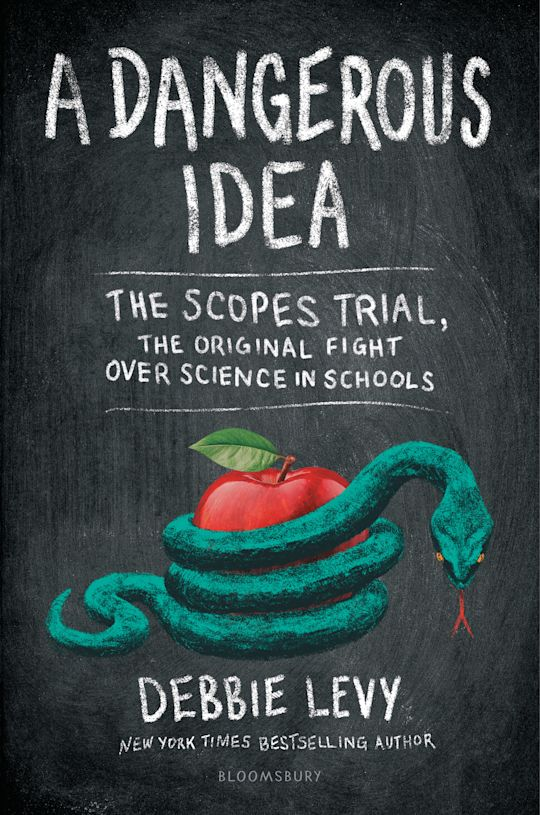
A Dangerous Idea: The Scopes Trial, the Original Fight Over Science in Schools by Debbie Levy (Bloomsbury Children’s Books, 288 pages, grades 6 and up). This account of the 1925 trial of John Scopes, a young high school teacher accused of teaching evolution, gives background information on evolution, the law that banned teaching it in Tennessee, and the two great orators, Clarence Darrow and William Jennings Bryan, who served as prosecuting and defense attorneys. The trial itself is described in detail, capturing both the serious debates about religion and the circus-like atmosphere. The story concludes with information about Susan Epperson, a biology teacher who challenged a similar law in Arkansas, leading to a 1968 Supreme Court ruling striking down the law and allowing evolution to be taught in high schools. There’s also information about the play and movie Inherit the Wind, which took some pretty big liberties with the truth about the Scopes trial. Includes an epilogue tying the case to current events, a detailed timeline from 1831-2005, and an extensive bibliography, index, and list of sources notes.

These books could not be more timely with their reminders that attacking science is a tale as old as time. Both are told with a lighthearted, humorous tone, but the back matter shows how extensively researched they are. I enjoyed the Jefferson illustrations that resemble a naturalist’s notebook, with lots of cartoon bubbles and captions. The authors’ notes will give readers plenty to think about, and I thought Debbie Levy did an especially good job of connecting the events of the Scopes trial to current news stories. Beth Anderson delves into the scientific method and explains how Jefferson made mistakes, too, lest any of us think we have any sort of monopoly on the truth.

Poetry to celebrate Black History

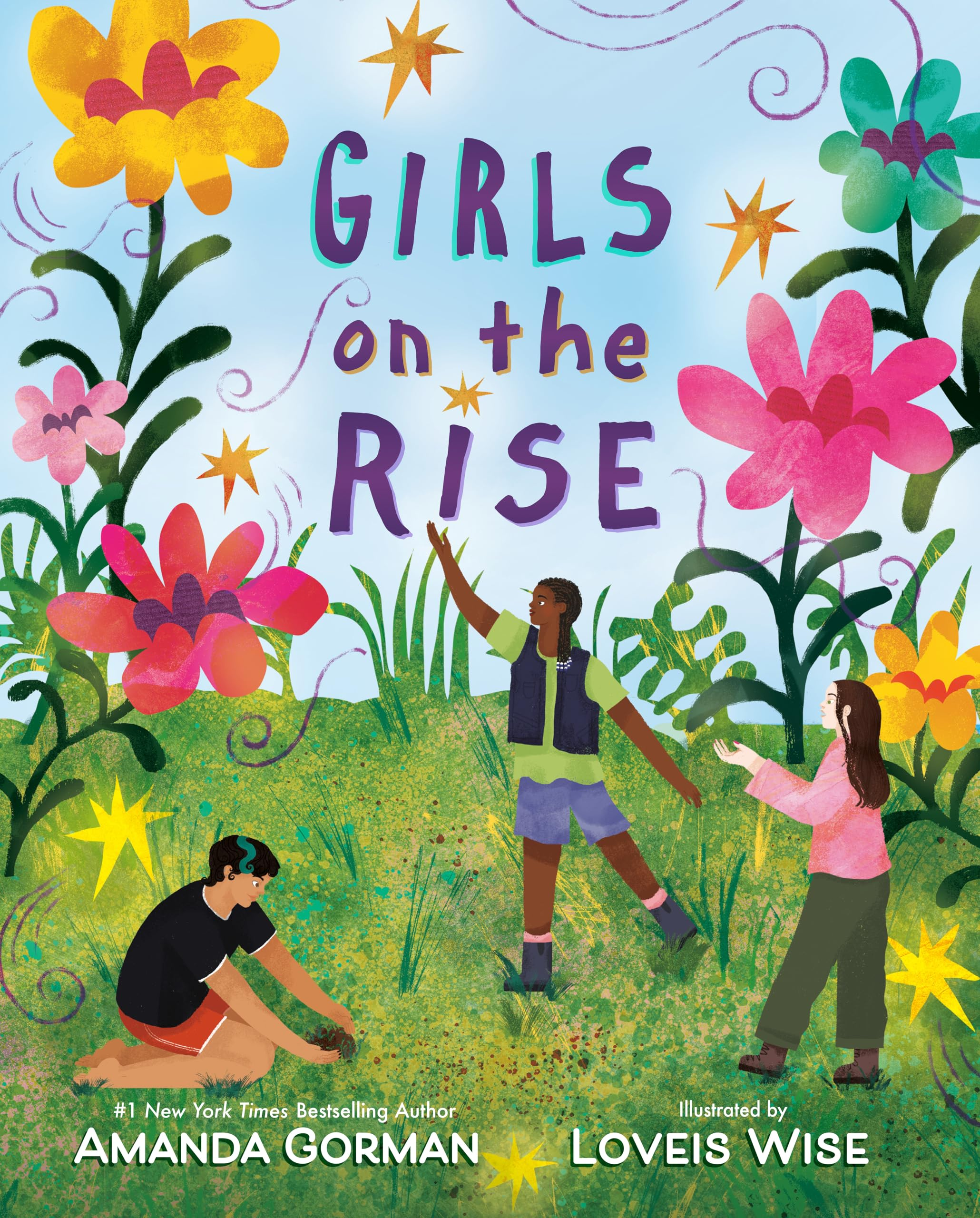
Girls on the Rise by Amanda Gorman, illustrated by Loveis Wise (Viking Books for Young Readers, 32 pages, ages 5-9). “We are girls on the rise./Today, everyone’s eyes/Are on us as we make waves/Pave the way, and save the day. Today, we finally have a say.” With simple rhymes and lush illustrations, this book celebrates girls of all types, encouraging them to support and empower each other through difficult times. Girls are celebrated for being strong and brave enough to right wrongs in the world. “Because when one girl is on the rise,/It means everyone else is, too.”

Dream a Dress, Dream a Poem: Dressmaker and Poet Myra Viola Wilds by Nancy Johnson James, illustrated by Diana Ejaita (Harry N. Abrams, 32 pages, ages 5-8). This book-length poem encourages readers to dream, citing the dreams of Myra Viola Wilds, a Black woman who grew up in Kentucky before moving to the city to get an education. She became an accomplished dressmaker until the close work damaged her eyes. Myra didn’t give up on her creative dreams, though, turning from sewing to poetry and publishing a book of her poems in 1915. The back matter includes additional biographical information and a photo, and the book begins and ends with two of Myra’s poems.

Both of these poetry books celebrate following dreams and lifting each other up. Amanda Gorman’s work speaks to these themes in general terms, while Nancy Johnson James offers a story of a woman who succeeded despite multiple hardships and was supported by the Black community that helped publish her work.

Both of these books would be excellent for celebrating Black History Month; if you’re looking for more resources, I have recently updated my Black History book list.

Get ready for Presidents’ Day

The Painter and the President: Gilbert Stuart’s Brush with George Washington by Sarah Albee, illustrated by Stacy Innerst (Calkins Creek, 40 pages, grades 2-5). George Washington was a man of action who preferred sitting astride a horse to posing for a portrait. Gilbert Stuart was a portrait painter with a knack for capturing his subjects while making the process fun for them. But Washington had him stumped. Not only did he show up with his face swollen from his ill-fitting false teeth, but he refused to engage with Stuart in any of the topics the painter tried desperately to introduce. Finally, he noticed Washington gazing happily at a horse out the window and started talking about horse racing. It worked! He invited George to bring family and friends to their next appointment, and that worked too. Today we see the happy (or not) results of Gilbert Stuart’s hard work every time we look at a dollar bill. Includes replicas of all six presidential portraits that Stuart completed, a time line, additional information about Washington’s teeth, how the painting was used to create the engraving for the dollar bill, and a bibliography.

This lighthearted introduction to Gilbert Stuart’s portraits would make a great addition to an art class. GW may not come off as a barrel of laughs, but readers will wince sympathetically when learning of his dental issues (although there’s no mention of the fact that he bought human teeth from enslaved people). Full disclosure, this book was published in 2024, but I thought it warranted a place in the Presidents’ Day post.

Hiding In Plain Sight: Kate Warne and the Race to Save Abraham Lincoln by Beth Anderson, illustrated by Sally Wern Comport (Calkins Creek, 48 pages, grades 2-5). When newly-elected U.S. President Abraham Lincoln traveled from his home in Illinois to Washington, DC in February, 1861, rumors of assassination were swirling. A plot was uncovered in Baltimore, and members of Allan Pinkerton’s detective agency took immediate steps to foil it. Central to their work was Kate Warne, the first female detective in the agency, whose undercover work as a lady from Alabama helped discover the Baltimore plot. Later, she posed as Lincoln’s sister, helping her “sick brother” board a train in Philadelphia that traveled in secret through Baltimore and on to Washington. When the supposed inaugural train arrived, word got out that Lincoln had already arrived, and Kate Warne faded into the cheering crowd, ready to take on her next assignment. Includes a six-page afterword with photos and additional information about Lincoln and Kate Warne, as well as a bibliography and illustrator’s note.

This exciting detective story would make an excellent read-aloud for both Presidents’ Day and Women’s History Month, with the mysterious Kate Warne playing a central role in preventing what could have been a national tragedy. The illustrations resemble period photographs and the whole book has kind of a scrapbook feel (the illustrator describes the scrapbooks that inspired her work in the note at the end). The additional information in the afterword provides some thought-provoking ideas and observations that could lead to some interesting discussions. Considering how little we know about Warne, there are quite a few children’s books about her: How Kate Warne Saved President Lincoln, The Eye That Never Sleeps: How Detective Pinkerton Saved President Lincoln, and the fictional The Detective’s Assistant.

George Washington’s Spectacular Spectacles: The Glasses That Saved America by Selene Castrovilla, illustrated by Jenn Harney (Calkins Creek, 32 pages, grades 2-5). By the end of the American Revolution, George Washington needed glasses, but he refused to let anyone see him wearing them. When he needed to read something, he would go into his office and slam the door. Everyone thought he was grouchy, but in March of 1783, it was his army officers who were the grouchy ones, after not getting paid for all the years of the war. They were threatening to storm Congress and demand their pay. Washington consulted a congressman about the issue, who wrote a reassuring letter that George thought would appease the officers. But when it came time to read it to them, he realized he needed his spectacles. He finally put them on, and his men, realizing what their beloved leader had sacrificed during the years of war, and agreed to wait on their pay. Includes additional information about this incident, an author’s note about her research and creative process in writing this story, and a bibliography.

Truth really is stranger than fiction, I thought as I read this quirky tale which ends unexpectedly with the army officers wiping away tears as they agree to continue to work without pay. All because George Washington put on his glasses, which, according to the back matter, is exactly how it happened. It’s an interesting story that will undoubtedly prompt some discussion, which could be seen as an example of Washington’s inspirational leadership or what happens when you’re willing to be vulnerable in front of your employees, but personally it kind of made me question the wisdom of those army officers.

Struggles at school

Mixed-Up by Kami Garcia, illustrated by Brittney Williams (First Second, 208 pages, grades 3-7). Stella is excited to start fifth grade, but her excitement turns to panic as the homework starts to pile up and she falls further and further behind. She and her two best friends often play a favorite video game, but when a new manual comes out, Stella feels alienated when she can’t keep up with her friends’ reading. And to add to her worries, the big fifth grade project isn’t the art project she was hoping for, but one that features students’ writing. When Stella’s teacher calls home, she’s sure she’s in trouble, but it turns out that the adults in her life want to help. Once she’s gotten a dyslexia diagnosis, Stella’s able to work with special education teachers to develop new skills to help with her reading. This also takes away her shame at feeling like she’s not as smart as everyone else, leading to an honest conversation with her friends that helps them resolve their issues. And Stella’s understanding teacher lets her create a graphic novel for the writing project that allows Stella’s artistic talents to shine.

Speechless by Aron Nels Steinke (Graphix, 256 pages, grades 3-7). Mira’s determined that middle school will be a fresh start for her, but on the first day, she finds that, once again, she can’t bring herself to talk at school. Home is a different story, the place where she can be herself and pursue her passion of stop-motion photography. But this haven is taken away when former-friend-turned-mean girl Chloe comes for an extended stay. A phone call from school alerts Mira’s parents to her selective mutism, and she begins to work on her issues with an understanding therapist. A kind and patient new friend, Alex, also helps her by volunteering to be Mira’s partner with a project and defending her from bullies. Mira learns to take things one step at a time, communicating with notes and whispers. She even finds a way to reach out to Chloe (by letter), opening the way for them to resolve their differences. By the end of the story, Mira’s enjoying sixth grade, learning to succeed in her own way. Includes a note from the author (creator of the Mr. Wolf’s Class series) about his own struggles with social anxiety and difficulties talking in public.

These graphic novels offer stories that will both empower kids who may be dealing with learning differences like Stella’s or social anxieties like Mira’s, and create empathy in kids who may have classmates like them. I loved how the girls got help and support both at school and home but ultimately had to find their own ways. Each was able to discover her own talents and see her struggles as something she could overcome while staying true to herself.

\