Orange you ready to celebrate art?

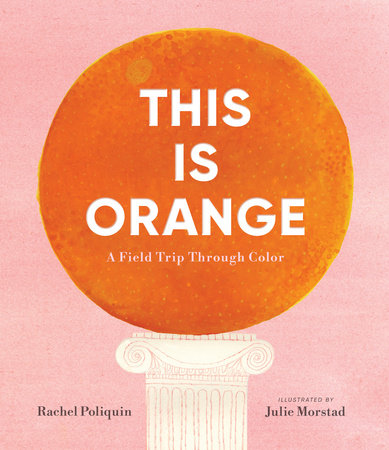
This Is Orange: A Field Trip Through Color by Rachel Poliquin, illustrated by Julie Morstad (Candlewick, 48 pages, grades K-4). Which do you think came first, the color orange or the fruit? If you guessed the color, as I did, you’re in for a surprise to kick off this book that traces the history of the color, then meanders through the worlds of art, science, nature, and history looking for examples of it. Birds’ feet are orange, and so are cantaloupe and mimolette cheese. A color called International Orange that shows up in murky skies or seas is used for astronauts’ suits and the Golden Gate Bridge. You’ll find orange in Halloween jack-o-lanterns, Buddhist monks’ robes (from orange turmeric), and a number of countries’ flags. “Now it is time for you to find orange in your world,” the book concludes. “If you look carefully, you will see orange almost everywhere.”

Although the tone is lighter, this book reminded me of Blue: A History of the Color as Deep as the Sky by Nana Ekua Brew-Hammond, in that both books wake readers up to colors so common that we take them for granted. This would be a great book for an art class, or just to sharpen observational skills. I was disappointed there was no back matter, but the last page does a great job of sending readers off into the world with a new appreciation for the color orange.
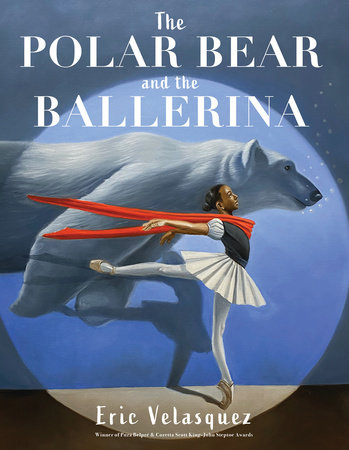
The Polar Bear and the Ballerina by Eric Velasquez (Holiday House, 48 pages, ages 4-8). A young ballerina and a polar bear bond at an aquarium in this wordless book. After the girl leaves with her mom, the bear notices that she’s left her long red scarf behind. Hoisting himself out of his tank, he walks across Manhattan to Lincoln Center, where he’s met with a “No polar bears allowed!” sign at the ticket window. His growl alerts the girl, who leaves the practice room to escort him inside to a seat. Despite disgruntled looks from his neighbors, the bear is enraptured by the show. Afterwards, he returns the scarf, then dances home, where he dreams about performing on stage with the girl. Endpapers give profiles of both the bear and the girl, a soloist at Harlem Children’s Ballet.

Kids will love the adorable polar bear and spunky ballerina in the gorgeous illustrations, and adults can use their story to facilitate conversations about making the arts accessible to everyone. For a moment, I thought ballerina Chloe Maldonado was a real girl, but then I realized the ballets listed on her resume are both books by Eric Velazquez! Those endpapers add some fun and depth to the story, though.
Two stories within stories that celebrate Indigenous cultures

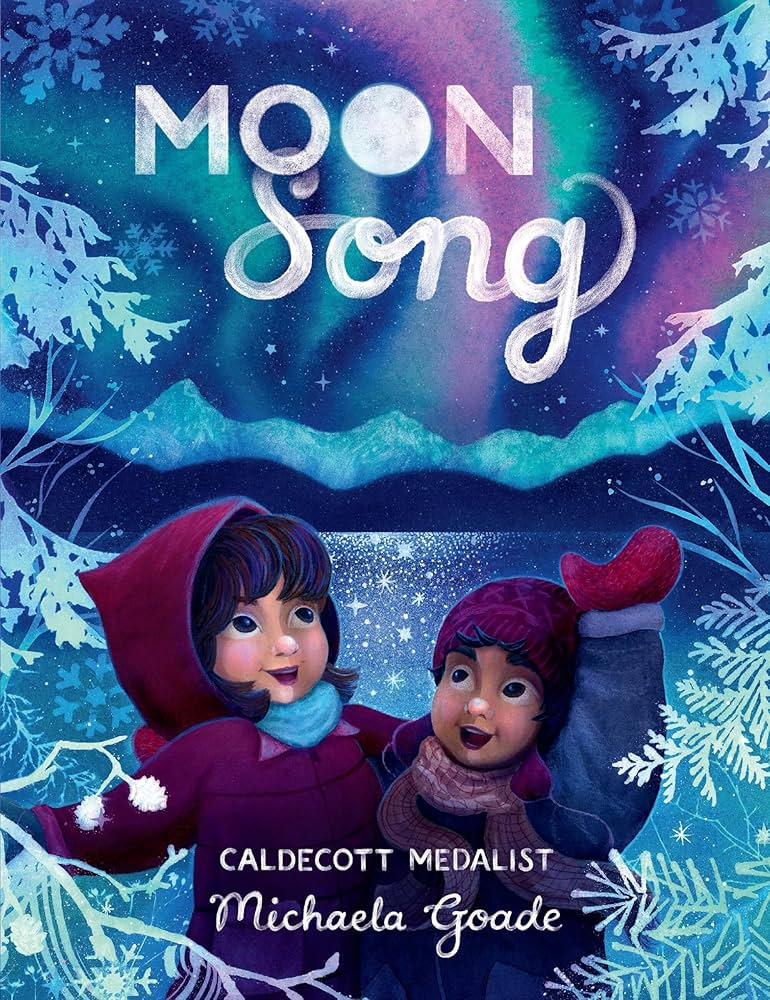
Moon Song by Michaela Goade (Little, Brown Books for Young Readers, 40 pages, ages 4-8). In this companion to Berry Song, the Tlingit family that gathered berries in the summer enjoys winter on their island. After scouting for deer and fishing for salmon in the dusky daytime, they gather for a cozy evening at home. The narrator helps her cousin overcome his fear of the dark by telling him a bedtime story about two children following the light of the moon. They walk through the dark forest, follow the edge of the sea, and finally come to a place where they see the magic of the aurora borealis, shown in a spectacular gatefold illustration. The last page shows the two cousins back home, settling in to go to sleep. Includes a note from the author about winters in her Tlingit community and some of her thoughts about winter, darkness, and light that inspired this book.

As always, Michaela Goade weaves together a lyrical story that includes Tlingit words and beautiful illustrations, just right for celebrating the winter. Definitely worth some Caldecott consideration.

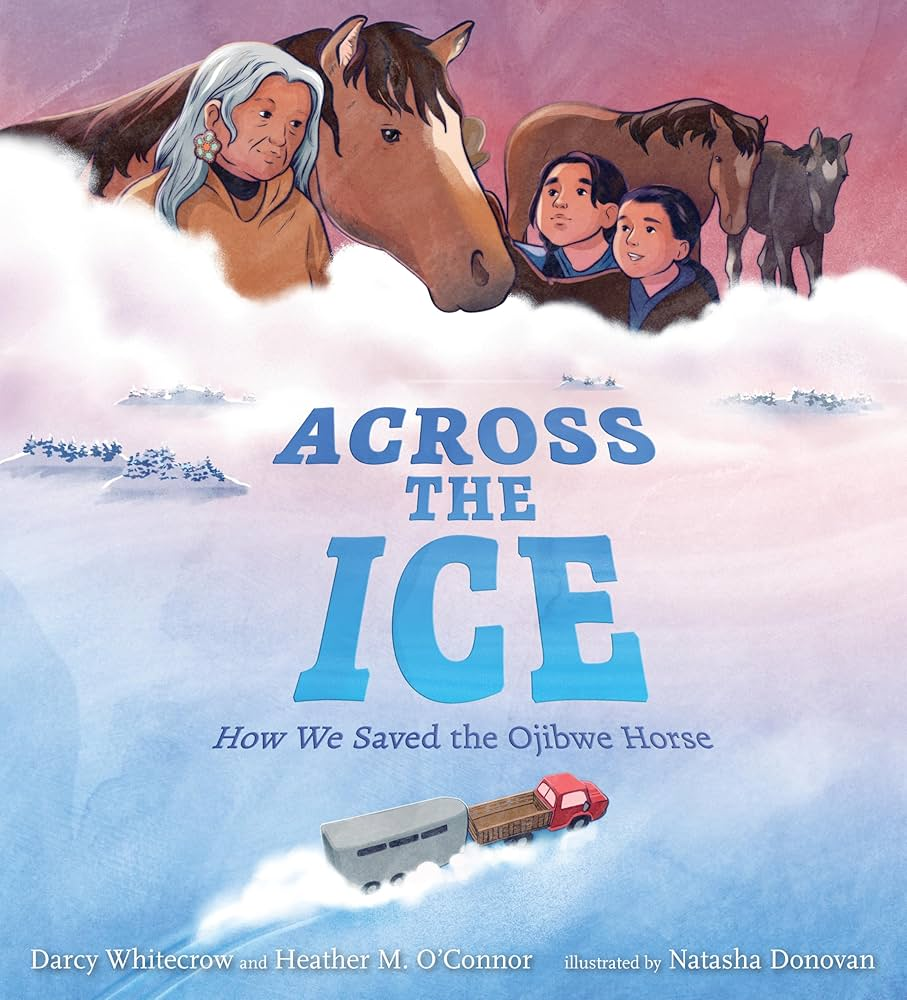
Across the Ice: How We Saved the Ojibwe Horse by Darcy Whitecrow and Heather M. O’Connor, illustrated by Natasha Donovan (Candlewick, 32 pages, ages 4-8). The two children narrating the story are too excited to sleep, so Nookomis (Grandmother) tells the story of the wild ponies tamed by the Ojibwe to help them with their work. In the summer, they set them free again to breed and roam the land. By the time Nookomis was born, though, there were only four ponies left, and all four were mares. A man from Minnesota named Fred Isham offered them a place to stay on his farm, and when Lac La Croix froze, the ponies were transported from Canada to the U.S., where they were bred, and a new herd started. On the night of the story, the whole family is waiting for six horses to be returned so they can start their own herd. Nookomis finishes her tale as the horses arrive, and the family goes out to welcome them. Includes an afterword with additional information about the Ojibwe horses.

A fascinating story told with beautiful illustrations that capture the colors and lights of the different seasons. Anyone interested in horses or Indigenous North American history will want to take a look at this book.

Two monster books to make you laugh

To Activate Space Portal, Lift Here by Antoinette Portis (Neal Porter Books, 56 pages, ages 4-8). Opening the front cover of the book takes readers immediately to a space portal that is opening up to reveal two aliens. Or are we the aliens? That’s the perspective of the creatures who make contact with humans, checking out their teeth to assure themselves they’re safe, exchanging information about planets, and introducing readers to a colorful assortment of their fellow creatures. As the “Power” and “Auto translate” buttons on the bottom go from green to yellow to red, the portal shuts down, and the final pages are black.

This would be a fun, interactive addition to storytime, with the audience being instructed to show their teeth and make a couple of faces to communicate with the aliens. It’s a little gimmicky, but kids are sure to get a kick out of it.

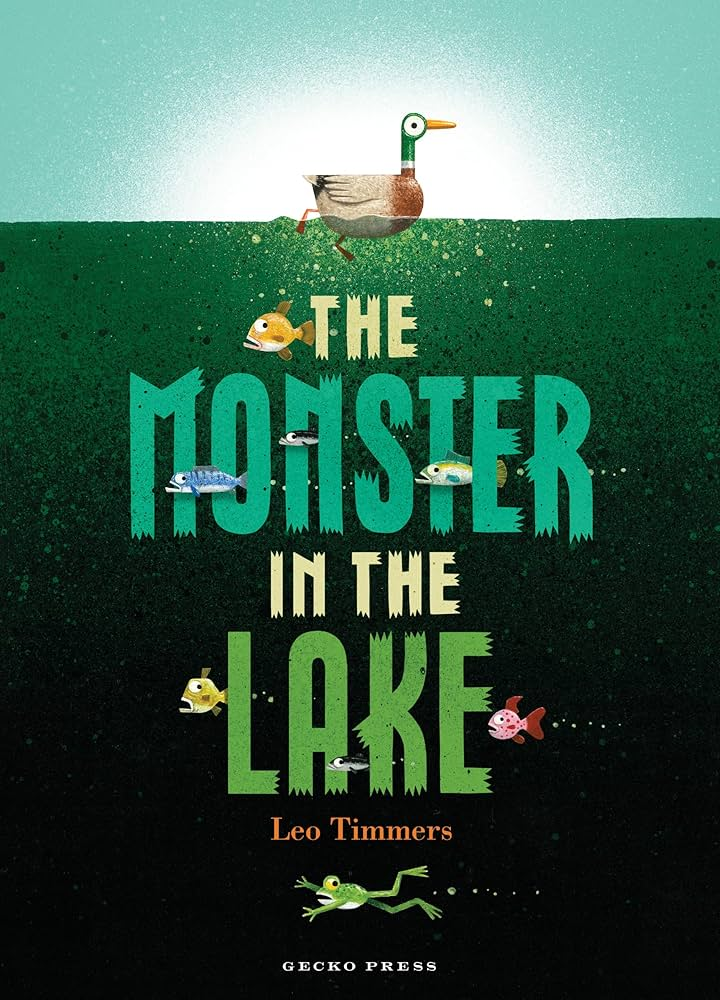
The Monster in the Lake by Leo Timmers (Gecko Press, 36 pages, ages 4-8). A group of birds go for a swim in the lake, but Eric the mallard duck is nervous about running into the monster. “That’s just a story, Eric. There’s no monster in the lake. Just boring old fish and frogs,” his friends assure him. Readers get an underwater view, showing those fish and frogs being chased by a monster. Eric sticks his head in the water and sees it too, but his friends refuse to believe him and keep swimming. As they continue on their way, Eric and the other undersea animals have a party with the monster, culminating with a colorful gatefold illustration of a whole monster neighborhood. When the birds realize Eric has disappeared, they’re afraid there really might be a monster that got Eric, but he emerges on the last page with a kind of ambiguous ending.

This Belgian import features plenty of colorful monster illustrations and lots of humor that will make kids feel like they’re outsmarting the clueless birds. The ending left me scratching my head a bit, but I think kids will enjoy the other elements enough not to really care.

Three feel-good picture books

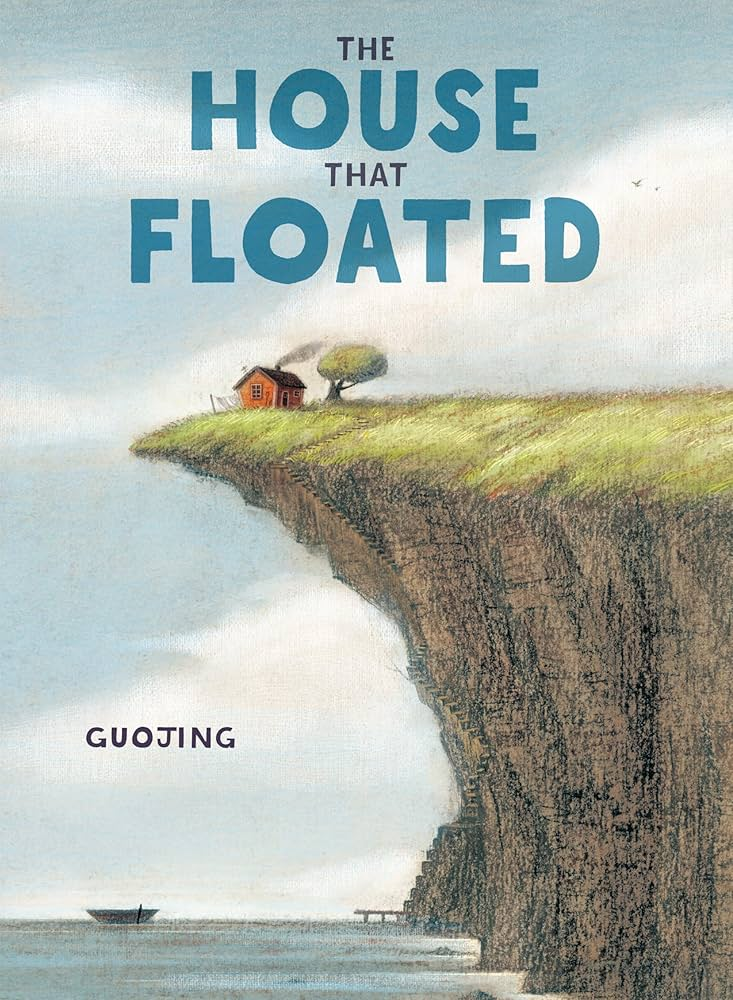
The House That Floated by Guojing (Random House Studio, 40 pages, ages 4-8). A couple lives in a small house perched on the edge of a cliff. Wordless pages show them enjoying their home and the sea below, rescuing a dolphin from a net, then commemorating the moment with a wood carving of the dolphin. They welcome a new baby into their loving home, and the child grows up to love the ocean and dolphins as well. When a storm threatens their home, the resourceful family builds a raft, takes the house off its foundation, and carries it to another cliff across the water. Others in the community help them reassemble it next to a lighthouse, and the final pages show them running toward their new home.

Kids generally love wordless books, and they tend to find a lot of details my old eyes miss, so I look forward to sharing this beautiful and heartwarming story. I liked the message about resilience in the face of change, particularly climate change. I was hoping this would be a Caldecott contender, but it looks as though Guojing lives in Canada.

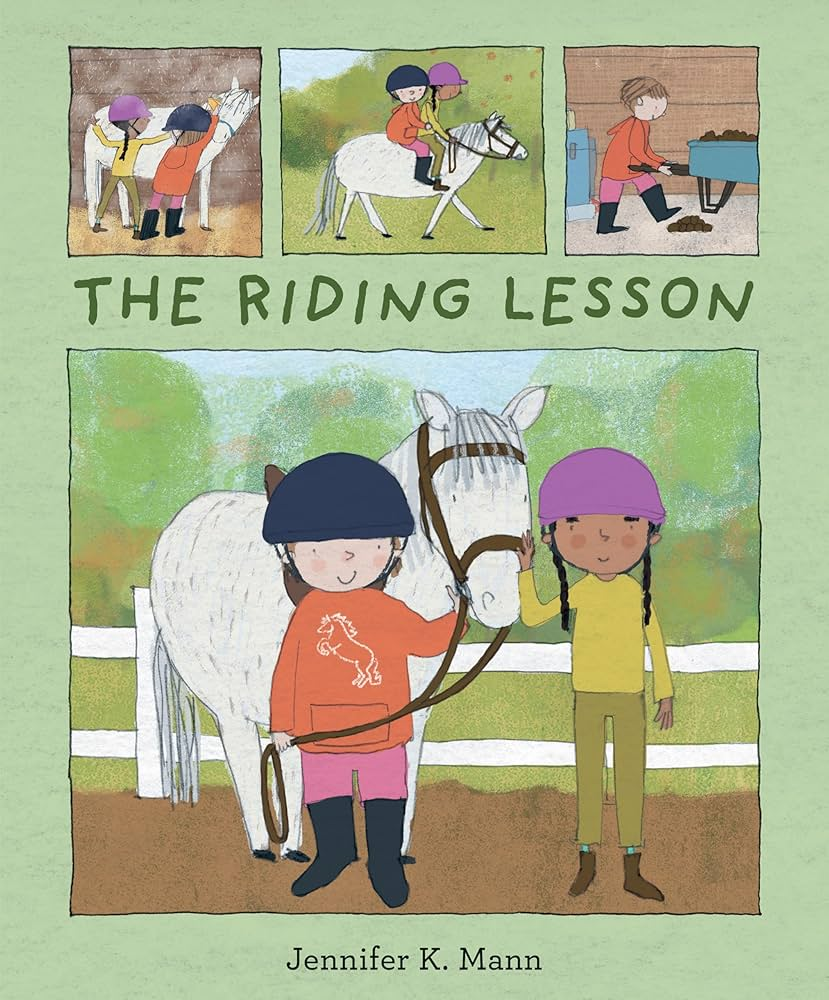
The Riding Lesson by Jennifer K. Mann (Candlewick, 56 pages, ages 4-8). Frances is excited to be going over to her friend Mae’s house for her first riding lesson. Although she’s sure she’s going to love riding–after all, she plays with toy horses all the time–that confidence vanishes when she’s confronted with a real horse named Snowball. Mae takes her through the steps of grooming and tacking up, but when it comes time to ride, Frances loses her nerve. Fortunately, Mae is a patient teacher, and after letting Frances ride double with her, Frances is ready to go it alone. Success! When they get back to the barn, the girls untack Snowball and give her a bath, then Frances gets a lesson in mucking out the horse stalls. All too soon, her mom is there to pick her up, and Frances can hardly wait until her next lesson.

I was delighted to see this book by the creator of The Camping Trip, one of my favorite end-of-the-year read-alouds. Like that book, this one captures both the excitement and fears that come with trying something new. Both narrators have an experienced peer to guide them through and to discover the joys of camping and horseback riding. The story and illustrations serve as a good introduction that will help any budding equestrian before a first lesson.

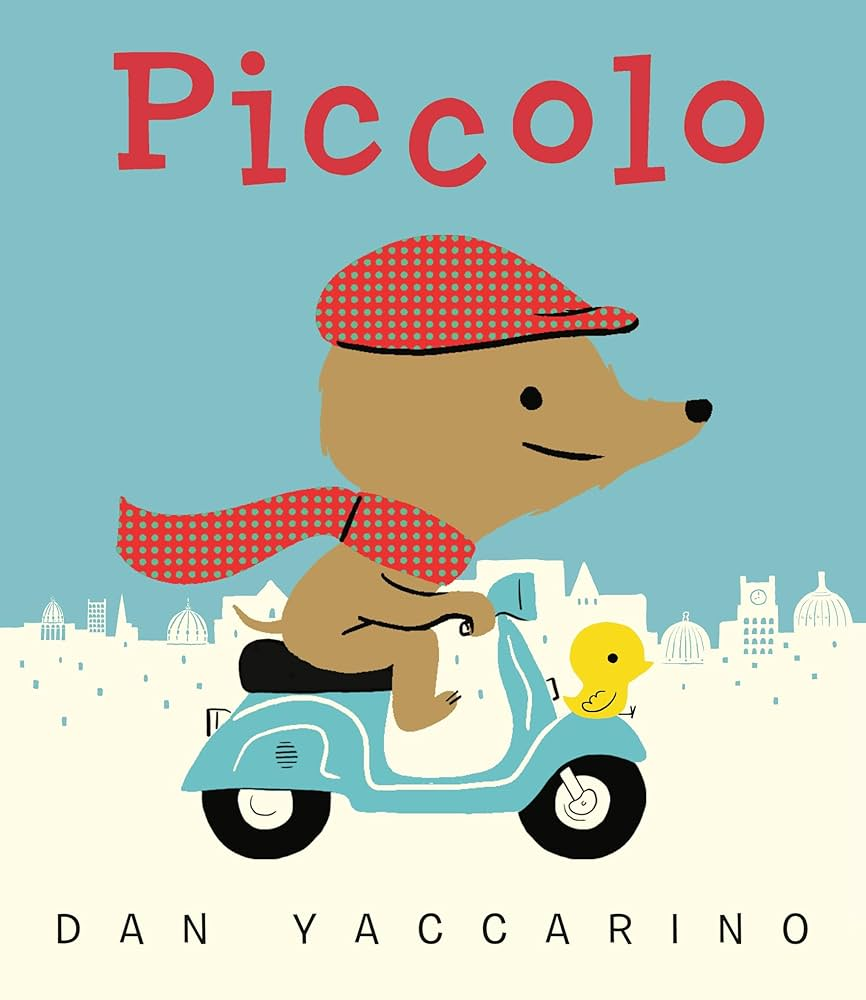
Piccolo by Dan Yaccarino (Christy Ottaviano Books, 40 pages, ages 4-8). Piccolo the shrew gives readers a taste of Italian culture while offering a few lessons in being a good friend. After making a list of where he wants to go in the cità bella (beautiful city), he sets out for the gelateria for some hazelnut gelato. Before he can take a first bite, he hears a cry for help, and dashes off to find his friend Mr. Rosso struggling to carry a painting into the museum. Fortunately, the museum is also on Piccolo’s list of destinations. The rest of the day goes that way, with Piccolo’s helpfulness leading him to enjoy the various places on the list. Alas, his day is so busy that by the time he’s ready to finish his hazelnut gelato, the gelateria has closed. Fortunately, his friend Miss Dolce needs some “help” finishing off her extra, and Piccolo’s day is complete. The end papers show the Italian phrases used in the story with English translations.

Aww, Piccolo and his friends are super cute and teach us all a good lesson about kindness and friendship! The Italian culture and language lessons are an added bonus. This would make a good introduction to young kids going to Italy for the first time.

Strangers in strange lands

How to Say Goodbye in Cuban by Daniel Miyares (Anne Schwartz Books, 240 pages, grades 4-8). Daniel Miyares tells the story of his father, Carlos, a young boy living in the Cuban countryside in 1956. When his father wins the lottery, he decides to pursue his dream of opening a furniture store, moving the family to the big city. Carlos is heartbroken to leave his friends and grandparents, but things take a darker turn as the political landscape in Cuba changes dramatically. The beginning of each chapter shows Castro’s slow rise to power, as he gathers enough supporters to overthrow Batista and takes over the country. Carlos’s parents aren’t particularly political, but that doesn’t protect them from the state taking his dad’s business. Carlos secretly watches Papi and some other men work every night building a boat, and shortly after that, his dad disappears. When life gets more dangerous in the city, the family returns to their grandparents’ farm, where Papi reunites with them and tells them they’re going to America. Carlos is heartbroken all over again, but his father convinces him it’s their only chance for a better life. After a dangerous nighttime journey, they arrive in Florida, ready to begin that life. Includes a four-page author’s note with additional information about Carlos and how his son Daniel came to write this book, along with several photos.

I was surprised to learn that Daniel Miyares has never won a Caldecott, and this graphic novel could easily remedy that situation–or win him a Newbery. The story and gorgeous artwork capture both the beauty of Cuba and the tension, confusion, and danger of the early days of Fidel Castro’s regime. The last part of the book, covering the family’s escape is both suspenseful and moving, and readers familiar with today’s immigration situation will be surprised at the welcome the Cubans get from the American military.

The Experiment by Rebecca Stead (Feiwel and Friends, 288 pages, grades 4-7). Despite his normal New York City upbringing, Nathan has always know that he’s different from other kids. He brushes his teeth five times a day with special pink toothpaste, his mother carefully records every calorie he eats, and…he and his family are aliens. Known as the Kast, his parents have raised Daniel on tales of how they traveled from their home planet as children to begin an experiment living on Earth. Nathan meets each month on Zoom with other Kast children, and he’s begun secretly texting one of them, a girl named Izzy. But recently a few of the kids, including Izzy, haven’t been on the calls, and when Nathan discovers that he’s growing a tail, he suspects he’ll be the next to disappear. He’s not wrong, and he and his parents are summoned to the mother ship, which sits in a parking lot outside a Pennsylvania mall, disguised as a storage container. As Nathan learns more about the ship and his parents’ past, he begins to suspect that it’s all a deception, and that he and the others might be human after all.

This science fiction story is hard to put down once you get through the first few chapters, and the last half has plenty of twists and turns that will keep readers guessing until the very end. It reminded me a little bit of a Margaret Peterson Haddix story and would make a great introduction to the sci-fi genre.

Early reader graphic novels: two mysteries and quite possibly the weirdest book ever!

Cabin Head and Tree Head by Scott Campbell (Tundra Books, 88 pages, grades K-4). Obviously, Cabin Head is a creature with a cabin on his head, complete with a family inside and smoke coming out of the chimney, and Tree Head likewise has a tree on his (aww, look at the kid in the tire swing!). They’re best friends who also enjoy hanging out with other members of their community like Library Head, Pool Head, Volcano Head, and Outhouse Head. In a series of stories, they show that they may not be the brightest lightbulb heads in the chandelier head, but they are loyal friends and funny storytellers. Readers will cheer at the declaration on the final page: “Cabin Head and Tree Head shall return for more wonderful book times.”

Around page 11, I paused to consider: is this the weirdest book I have ever read? I mean, we do have the Noodleheads, not to mention a hit series based on the premise of a dog’s head being attached to a man’s body. But Cabin Head and Tree Head are definitely in the running for weirdest, but also for funniest, and I found myself laughing aloud throughout the book, particularly at the illustrations. I predict great things for these two, so be sure to stock up and keep an eagle eye out for book 2.

Detective Beans and the Case of the Missing Hat by Li Chen (Andrews McMeel, 208 pages, grades 1-4). Beans is an adorable cat detective who sets out to solve the case of the mystery note giver when he finds a series of encouraging notes stuck to his stuff. He’s derailed from this case almost immediately, though, when his lucky detective hat goes missing. Beans spends the day traveling around town, tracking down clues, generally just one step behind the hat as it’s passed from one owner to the next. He finally gets it back, and in the process accidentally catches a wanted diamond thief. The last few pages remind the reader that the mystery note giver still hasn’t been identified, but perhaps this mystery is unraveled in book 2, which came out earlier this year.

This is actually a 2024 book, but I was unable to resist the cute cover, and the rest of the book did not disappoint. Kids will love the artwork, and the story is simple yet engaging enough to hook those who are just starting to read independently. 

Detective Stanley and the Mystery Museum by Hannah Tunnicliffe, illustrated by Erica Harrison (Flying Eye Books, 64 pages, grades 1-4). Detective Stanley is enjoying his first morning of retirement from the Narlybone Criminal Investigation Department when a letter arrives at his doorstep begging him to come to the Narlybone Museum and figure out who’s behind the break-in there. Unable to resist a heartfelt plea–despite having to leave his pancakes behind–Stanley heads to the museum, where he finds a big mess but no stolen items. When he’s framed for the theft of a police officer’s watch, Stanley unexpectedly winds up in jail. From his cell, he’s able to puzzle out what really happened at the museum and convince a police officer to accompany him back to the scene of the crime. There, he unmasks the real thief in dramatic fashion and is able to return to his pancakes in time for supper. Includes information on Piet Mondrian, whose artwork is featured in the story, as well as a preview of book 2.

Another fun mystery for early readers, this one had a surprising number of twists for such a short story, some sly humor, and artwork full of cute animals that brought to mind Richard Scarry’s work as they go about their day.

Dogs and a cat

If We Were Dogs by Sophie Blackall (Little, Brown Books for Young Readers, 40 pages, ages 4-8). At the end of a birthday party, two kids make plans from underneath a table. The more outgoing one decides they’ll be dogs, and a series of imaginative escapades follows, with the bigger dog taking the lead. Whether it’s doing tricks, digging holes, or racing to the dog park, the bigger dog is completely happy, while the little one looks a bit less certain. Finally, the little dog speaks up: “Being a dog is YOUR idea! Sometimes I HAVE IDEAS TOO!” If readers have been paying close attention, they won’t be surprised by what that idea is, and the two animals play happily together in the final pages.

In this follow up to If I Was a Horse, Sophie Blackall celebrates the power of imaginary play and the importance of speaking up to make your own ideas heard. It’s not much of a story, but the illustrations are adorable, and the message for younger siblings or quieter friends is a valuable one.

Cat Nap by Brian Lies (Greenwillow Books, 48 pages, ages 4-8). When a cat’s nap is disturbed by a mouse, he follows it through a poster advertising an exhibit of Egyptian antiquities at the Metropolitan Museum of Art. When he leaps through the poster, he’s in the panel from an ancient Egyptian tomb. The mouse leads him from one work of art to the next, including portraits, statues, and an illuminated manuscript. The lure of dinnertime leads him back where he started, and the Egyptians open a door that takes him back home, where he enjoys some food in a dish decorated with hieroglyphics. Includes an author’s note about the joys of creating art, with ten photos showing his process in making this book; also the artworks referenced in the book, with thumbnail descriptions of each.

Put this at the top of your list of Caldecott contenders. Each illustration is a marvel, based on a real work of art, and is made even more so by reading Brian Lies’ description of his painstaking recreations of each one. I loved how he celebrates making art with your own hands, as opposed to digitally or with artificial intelligence.

Rewriting the history books

White Lies: How the South Lost the Civil War and Rewrote History by Ann Bausum (Roaring Brook Press, 368 pages, grades 9 and up). Beginning with a list of the 20 lies covered in this book from “Slavery was a compassionate institution” to “We erase history when we remove symbols of the Confederacy,” the book goes on to debunk these lies in four sections. The first covers American history leading up to and including the Civil War, the second is how the myth of Lost Cause was constructed and spread after the war and reconstruction ended. Part three discusses how this propaganda was spread through the country via monuments, Hollywood films, and children’s education, and the final section brings us up to the present in which steps to remedy the lies and propaganda are being met with a powerful backlash. The “Gallery of the Lost Cause” throughout the book shows various statues and monuments to the Confederacy and its leaders, including information on the cost, history, and current status of each one. Includes a note from the author on the evolution of her own thinking from her Virginia public school education in the mid twentieth century to the present, a timeline, and extensive source notes, bibliography, and index.

This is a fascinating and relevant book about how slavery, racism, the Civil War, and the lies surrounding the Confederacy and its history have seeped into the American consciousness, largely through very deliberate efforts to infiltrate textbooks, public history, and Hollywood. Although I didn’t grow up in the South, I still absorbed much of this misinformation through my own education and consumption of popular culture. The final part of the book does an excellent job of showing how we are still living with the consequences of this propaganda today. I do wish this book were more accessible for middle school and high school readers. I’m a medium-fast adult reader, but even with daily reading it took me weeks to get through the text-dense pages unbroken by any sort of graphics or sidebars. It’s hard for me to imagine many teenagers sticking with this book all the way through, and that’s a shame. Educators might want to consider using excerpts from it in history classes as a way of bringing its valuable content to more readers.

How the Word Is Passed: Remembering Slavery and How It Shaped America by Clint Smith, adapted for young readers by Sonja Cherry-Paul (Little, Brown Books for Young Readers, 336 pages, grades 7 and up). Based on the 2021 book, this version for young readers tells of Clint Smith’s travels across America and to Africa looking for how the story of slavery is told. He starts his journey in at Thomas Jefferson’s home, Monticello, then continues to the Whitney Plantation and Angola Prison in Louisiana, Blandford Cemetery in Virginia, various sites in New York City, Galveston Island, Texas, and Gorée Island, off the coast of Senegal. His reports on what he sees and the people he speaks with show how the history of slavery has been taught, how that is (sometimes) changing, and how people react to those changes. Includes a glossary and a list of selected sources.

I read the original version of this book when I took a trip down south in 2023, and it really made me look at the museums I visited there differently. The writing is so engaging, with each section told as a personal sojourn to the various places that includes of a fascinating variety of voices. Smith writes in the epilogue about interviews with his own grandparents, which could serve as inspiration for kids to learn history by having conversations with older relatives. While this does not go nearly as deeply into the history as White Lies, it was a much quicker read and would be a useful book to read before going on historical field trips.

A year in the life of a middle schooler

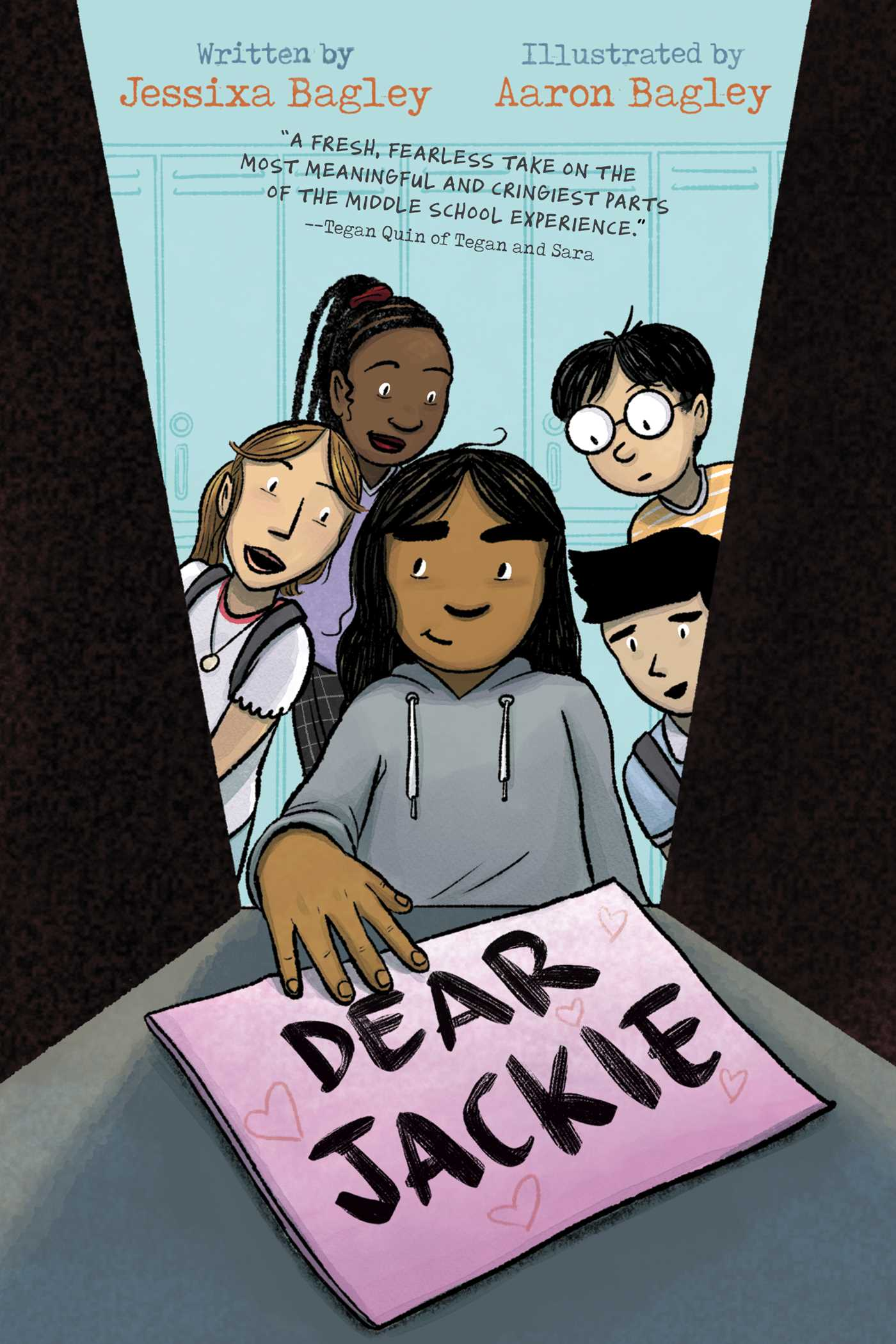
Dear Jackie by Jessixa Bagley, illustrated by Aaron Bagley (Simon and Schuster Books for Young Readers, 288 pages, grades 4-7). Jackie and Milo are best friends, born on the same day and growing up next door to each other. They’re nervous about sixth grade but certain they can navigate it together. When Milo starts hanging out more with his soccer teammates, and Jackie’s frenemy Adelle teases her about not dressing like a girl or having a crush, Jackie decides to take matters into her own hands. She types a letter to herself from a secret admirer and “accidentally” drops it into Adelle’s locker, which is right above her own. The cool kids are intrigued, so Jackie writes another note to get more positive attention. Before long, she’s in over her head, and she and Milo have both hurt each other with a series of misunderstandings and cruel pranks. Jackie gives into pressure and goes to the big school dance, but when the kids find out the identity of her “secret admirer,” she’s sure her life is over. With the help of her older sibling Bari, she figures out how to tell her parents who she really is and to make amends with Milo. A final letter to Bari at college reveals that she and Milo have found their people through a gaming club, and seventh grade promises to be a much better year for everyone. Includes notes from the wife-and-husband author and illustrator.

Fans of middle school graphic novels will enjoy this one, which really pours on the middle school cringe and cruelty in a way that all too many of us will find familiar. Non-binary Bari and Jackie will help kids see that there are many ways to express your identity, and the most important thing is to be true to yourself. I hope we get a sequel to find out how seventh grade turns out.

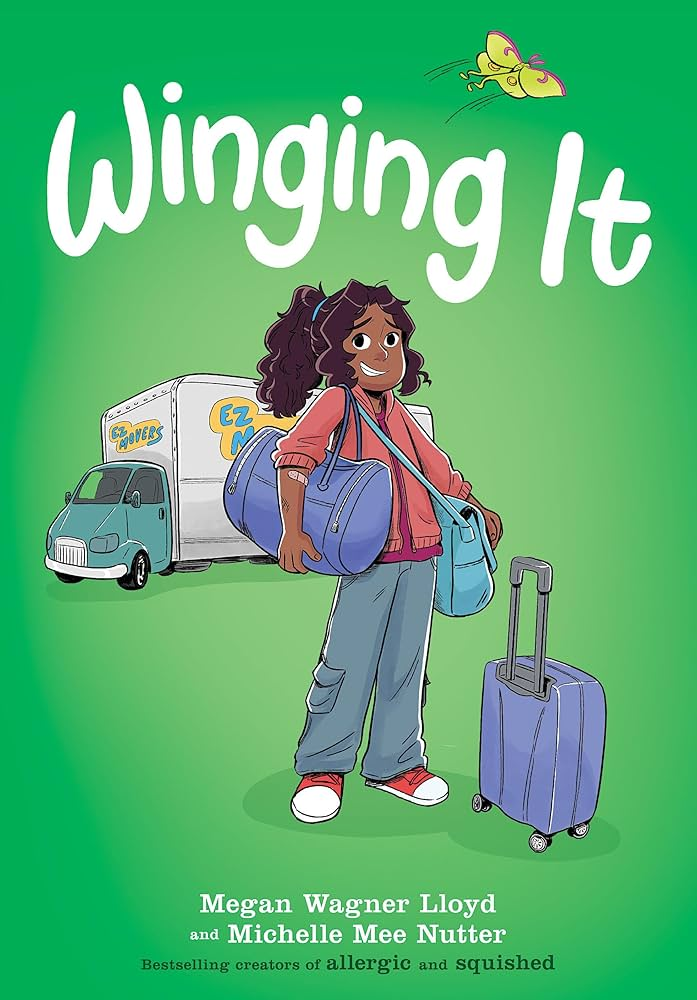
Winging It by Megan Wagner Lloyd, illustrated by Michelle Mee Nutter (Graphix, released October 21, 272 pages, grades 3-7). Luna’s unhappy when her dad tells her they’re moving from California to Washington, D.C., and even more so when she learns they’ll be living with her maternal grandmother until they can find their own place. Luna’s mom died when she was a baby, and while she would like to be closer to Grandma and learn more about her mom, her grandmother has always seemed stiff and distant. One day, though, Grandma shares her mother’s old nature journal, and Luna, who’s never enjoyed the outdoors, starts taking tentative steps to explore the natural world, with her biggest dream being to see the luna moth for whom she’s named. Slowly, she starts making friends with her neighbors and getting involved with her school’s environmental club. Even her busy father and her grandmother take an interest in sharing nature with Luna, and by the time a year has gone by, everything has changed so much that Luna feels like she’s truly found a new home.

Fans of Allergic and Squished will be excited to see a new graphic novel by the same team. Just like Dear Jackie, this story goes month by month through a school year, from one summer to the next, and shows the reader how much can happen in a middle school year, and how many changes there can be. Luna is forced to be brave as she deals with a big move and the adjustment of living with a grandmother she barely knows, but she rises to the occasion and discovers parts of herself she never knew existed.

Learning from the past

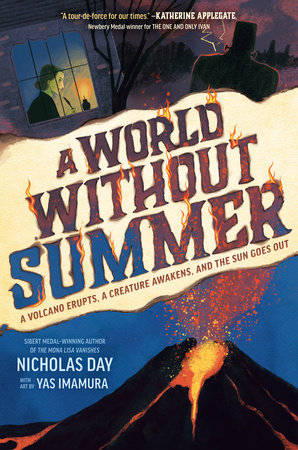
A World Without Summer: A Volcano Erupts, a Creature Awakens, and the Sun Goes Out by Nicholas Day, illustrated by Yas Imamura (Random House, 304 pages, grades 5-8). As he did in The Mona Lisa Vanishes, Nicholas Day connects a work of art with the historical events around it. Here, the story starts in 1815 with the catastrophic eruption of the Indonesian volcano Tambora. The enormous amount of ash and smoke caused changes in the global climate that resulted in droughts, floods, crop failures, and famine in the United States and Europe. The work of art in question is Mary Shelley’s novel Frankenstein, which was published in 1818, and which Day makes a compelling case for having been created from this dark time. Another byproduct of the time was a more scientific study of weather and climate, which is how we know that the climate is changing today. Throughout the narrative, Day pointedly addresses readers, making sure they are paying attention to the parallels of this tragic story with what is going on in our world right now. Includes extensive bibliography, notes, and index.

Since The Mona Lisa Vanishes was one of my favorite nonfiction books ever, I was thrilled to see that Nicholas Day has a new book out, and I was not disappointed.  Okay, I was a little disappointed, not because it wasn’t engaging, well-researched, and fascinating, but because any story that draws my attention to climate change fills me with existential dread in a way that a fun story about the Renaissance, Leonardo da Vinci, and the Louvre could never do. I would love to see this get some Sibert recognition.

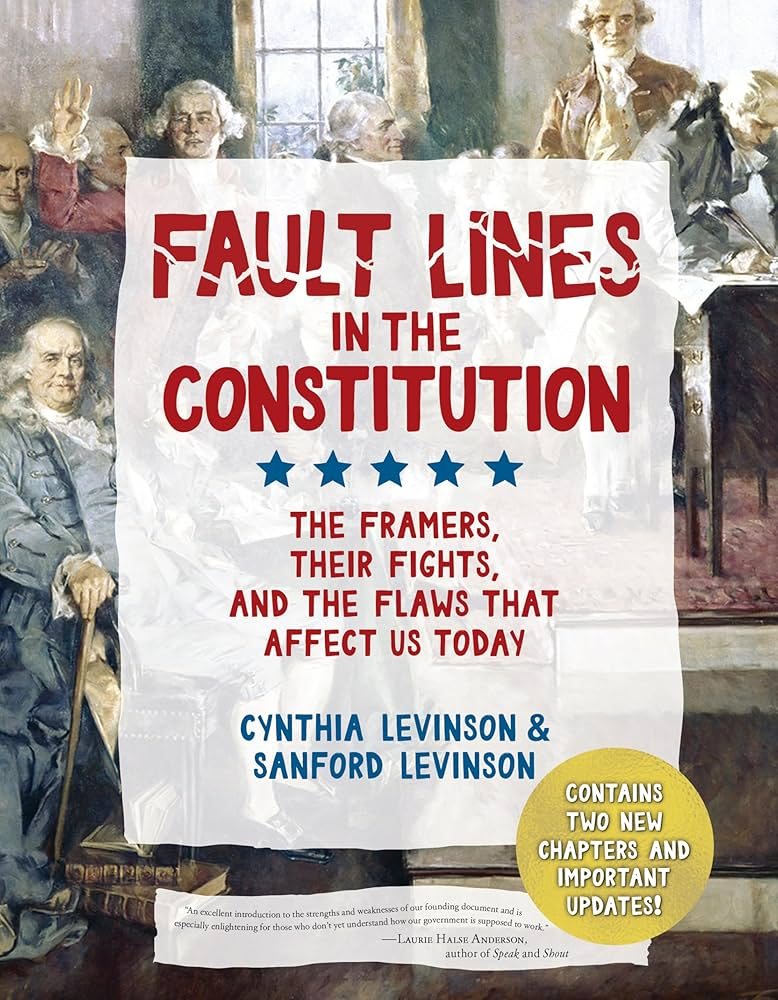
Fault Lines in the Constitution: The Framers, Their Fights, and the Flaws That Affect Us Today by Cynthia Levinson and Sanford Levinson (Peachtree, 2025, grades 6 and up). The Electoral College, lame duck presidents, gerrymandering, unequal representation: despite the best intentions of the Founding Fathers, the U.S. Constitution contains some serious flaws that affect the country today. The authors look at eight different issues, beginning each chapter with an episode from history that reveals the fault line, then going back to the origin of that section of the Constitution, and concluding with a look at how other states and countries deal with those issues differently. In the last part, they grade different parts of the Constitution (spoiler alert: overall, it’s a C-), then debate whether it would be better to call another Constitutional Convention to revisit the entire document or to work on amending it. Includes a timeline, bibliography, notes, and an index.

This is the third edition of the book originally published in 2017, with two new chapters and recent updates (there’s also a graphic novel version). I’m honestly shocked that this didn’t win any awards when it was first published, especially Sibert. The format makes the material engaging and relevant, and it really opened up my eyes to how flaws in the Constitution are causing so many of the problems we see today with voting and Congressional gridlock, among other things. It also made me think about how this makes sense, given how much the country and the world have changed in the last 250 years. This would make a great textbook for middle school and high school civics classes, as well as important reading for any U.S. citizen.