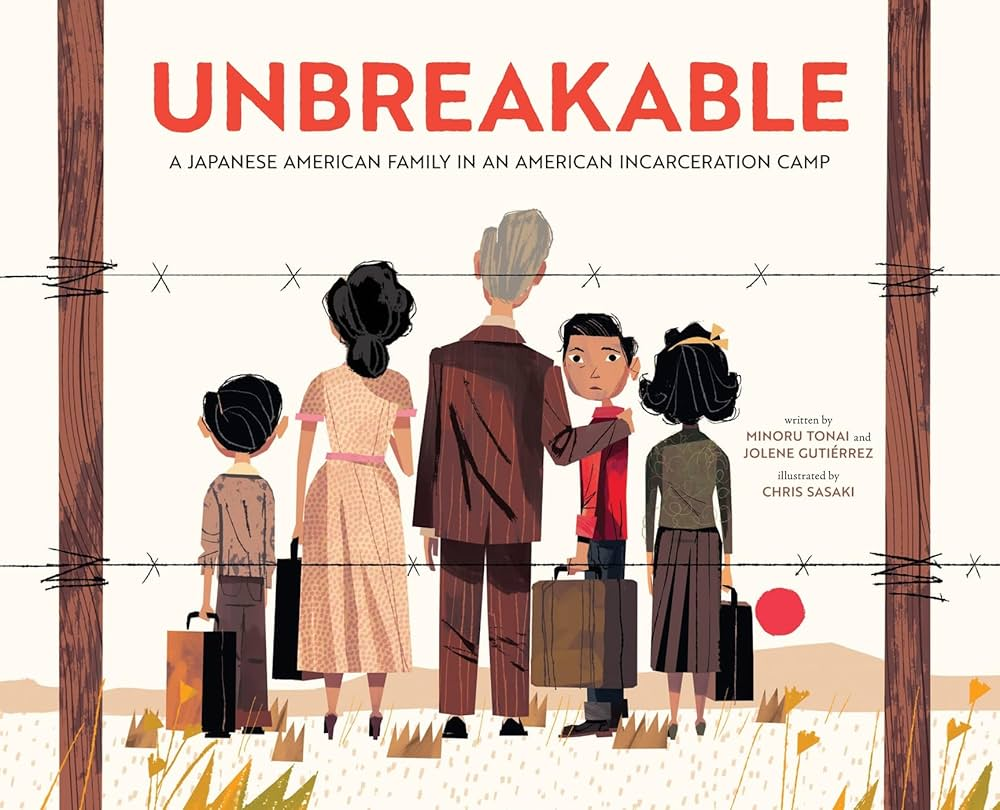
Unbreakable: A Japanese American Family in an American Incarceration Camp by Minoru Tonai and Jolene Gutiérrez, illustrated by Chris Sasaki (Harry N. Abrams, 40 pages, grades 2 and up). Minoru Tonai tells the story of his family’s imprisonment during World War II. His father was questioned as early as October of 1941 about being a spy, despite his work as a farmer and his near deafness, and was taken away shortly after Pearl Harbor. Just six months later, the rest of the family was forced to leave their farm and their dog to move to a “detention center.” For the next three years, they endured desert heat and cold, barracks living, and a constant wind that blew sand everywhere. After two years, Papa was finally allowed to join the rest of the family, and in the fall of 1945, after more than three years of imprisonment, the family was allowed to go back home to California. Includes extensive back matter with notes from the illustrator and author (Gutiérrez only, as Minoru Tonai passed away in 2023 at the age of 94), a timeline and other additional information, and a bibliography.
The spare text and stark, brown-toned illustrations capture this dark chapter in American history as seen through the eyes of a young boy. Min’s father collected rocks, and these are symbolic in the story of the strength and resilience the family needed to get through these difficult years. Min doesn’t shy away from the injustice of their situation and the pain of their many losses. His story is an extremely valuable resource for teaching kids about the experience of thousands of Japanese Americans, and the back matter gives plenty of additional information as well as opening up topics for discussion.
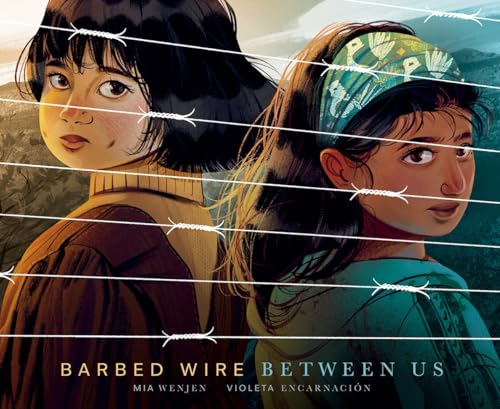
Barbed Wire Between Us by Mia Wenjen, illustrated by Violeta Encarnación (Red Cornet Press, 48 pages, grades 2 and up). “In this land of promise, we hoped to find a place to belong.” So begins–and ends–this reverso poem that shows a Japanese-American family in World War II and a contemporary immigrant family detained at the southern border. In both cases, families are separated, and children are imprisoned behind barbed wire. They suffer from “meager food” and dust everywhere but are also heartened by the kindnesses of strangers and other immigrants, while they try to find beauty where they can. The girl on the last page looks out at the reader as she stands next to barbed wire, with a hope–but no promise–of finding a place to belong. Includes information about Fort Sill, Oklahoma, the site of both imprisonments, as well as that of members of the Chiricahua Apache tribe in the late 19th century; reverso poems; and the author’s family’s experience as Japanese Americans during World War II.
Wow, this book is so powerful, and the reverso poem is absolutely masterful. With spare text and haunting illustrations, Mia Wenjen shows how shameful history continues to repeat itself in America. Mia, I know you are a subscriber to this blog, so congratulations to you on this beautiful book, and I hope it gets some awards recognition.


Janet, thank you so much for these beautiful reviews of UNBREAKABLE and BARBED WIRE BETWEEN US. Our books are a perfect pairing.
LikeLike
I agree, they are two very powerful books!
LikeLiked by 1 person
Thank you so much for including Barbed Wire Between Us!
LikeLike
My pleasure! Congratulations on an amazing book.
LikeLike
And for your kind words!
LikeLike