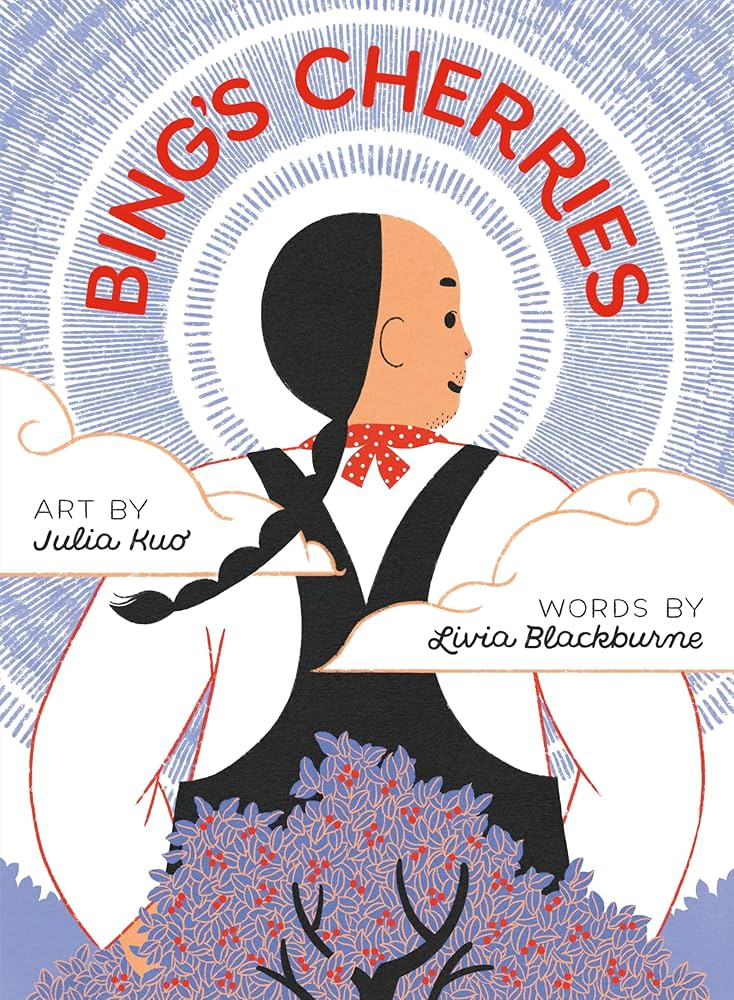
Bing’s Cherries by Livia Blackburne, illustrated by Julia Kuo (Knopf Books for Young Readers, 48 pages, grades K-3). As the narrator and her dad enjoy Bing cherries from the tree in their backyard, Daddy remarks that they should be grateful to Ah Bing for his cherries, adding that not much is known about him, just that he was Chinese “like us” and was an orchard man. Later that night, the girl imagines a story about Ah Bing. He was so tall he could pick fruit without a ladder, and his singing voice was so beautiful trees grew taller just to hear it. He had a happy life in Oregon, making many friends, but he missed his family back in China, and he was sad that he and the other workers encountered so much prejudice in America. One day, he planted a cherry tree, and a huge tear fell where it was planted. When it grew, it had the first Bing cherries, deep red and growing in groups of two, three, or four, so that each cherry always had a friend. When people ate the cherries, they would remember happy memories of home. Bing had so many good memories, that after thirty years, he finally returned home to his family. Includes notes from the author and illustrator and additional information about the real Ah Bing. Currently #5 on the Goodreads Mock Caldecott 2027 list.
This book was not at all what I was expecting; I thought it would be a straightforward nonfiction book, but instead it is a magical tall tale that incorporates elements of the real Ah Bing and his experiences as a Chinese-American immigrant. I loved the unique illustrations, all done in red, tan, black, and blue-gray, with a nod to Chinese art.
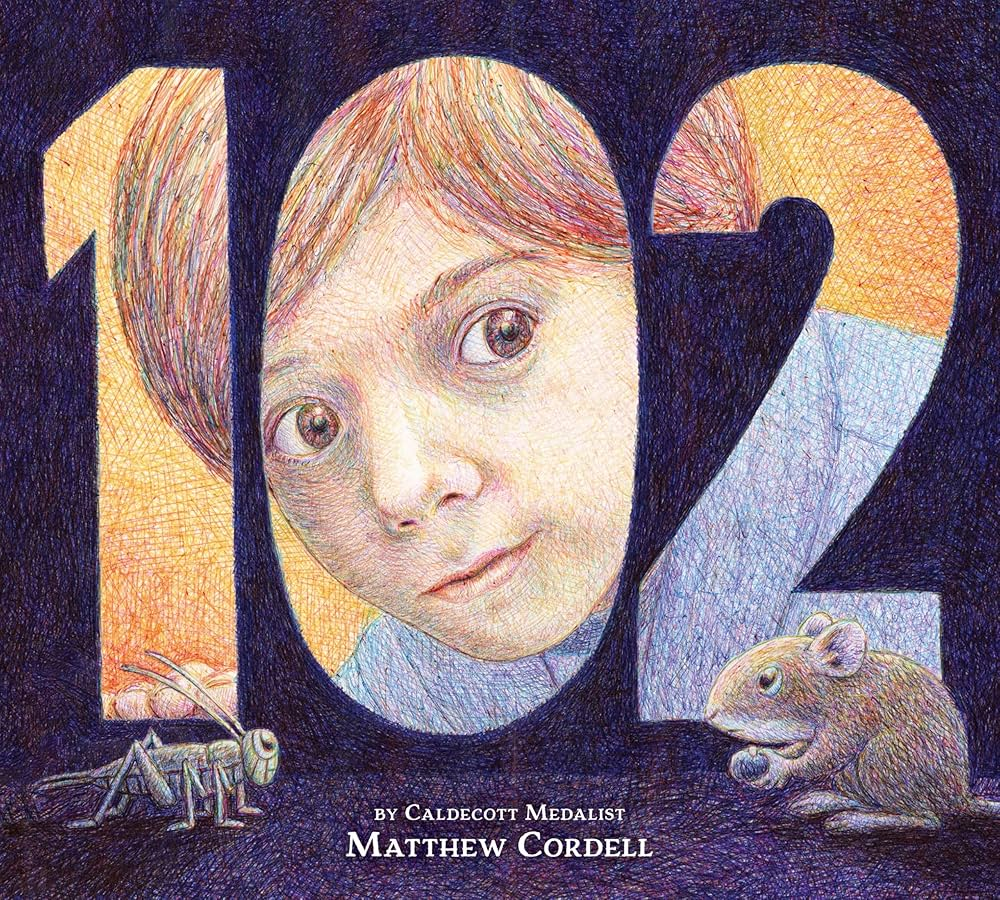
102 by Matthew Cordell (Little, Brown Books for Young Readers, 48 pages, ages 4-8). George remembers the day well–October 2–when he got sent home from school with a 101 degree fever. In his home at 102 Greenbriar Drive, he and his mother see a mouse running through the kitchen with something small and black in its teeth. His mother catches it, and George puts it in a tank. As his temperature climbs to 102, his mom tucks him in, and he falls asleep. At precisely 1:02 a.m., he wakes up to the sound of chirping. A cricket leads him out of bed, where he shrinks down to the size of a mouse, then follows the cricket on a series of adventures that wind up in a mouse’s house. There, a mother is making 102 bean soup for her sick son, and is lacking the 102nd bean necessary for its healing properties. George knows where the bean is, so he goes back home, is restored to his old size, and frees the father mouse who has the missing bean. Exhausted, George goes back to bed, where he sleeps until 1:02 PM, and wakes up completely cured. The last few pages reveal that a 102-year-old George is recounting this story. Currently #4 on the Goodreads list.
Caldecott Medalist Matthew Cordell will undoubtedly be considered by the committee for this book, which tells a weird and wonderful story that reads like a fever dream. It kind of reminded me of some of David Wiesner’s books and seems like a story you will want to revisit again and again–102 times, perhaps–undoubtedly seeing new things with each reading.
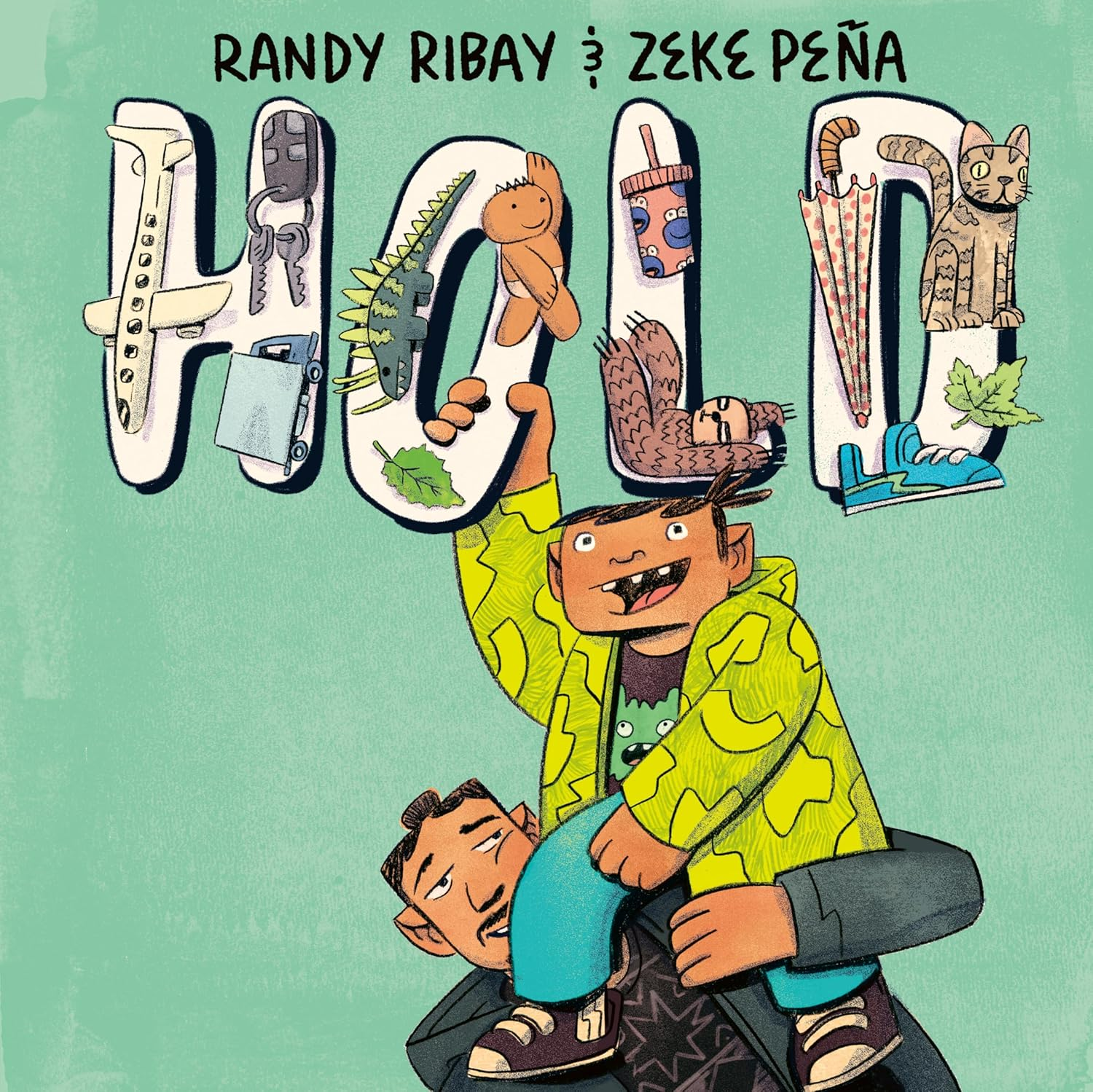
Hold by Randy Ribay, illustrated by Zeke Peña (Kokila, 40 pages, ages 3-6). A father and son are getting ready to walk out the door when the dad asks his son to hold his sippy cup. “Hold, please,” he says, to which the son replies, “Hold?” And with that, the little boy is off, wanting to hold more and more items: toys, the cat, a tree, rain, an airplane. The dad’s facial expressions show him moving from frustration to a playful joy, coming up with innovative ways to help his son, like giving him a leaf from the tree to hold. Finally, the father asks, “Ready now?” and the child drops everything with the request “Hold Daddy?”After a happy hug, they finally make it out the door. Currently tied with Bing’s Cherries for fifth place on the Goodreads list.
This simple story with minimal text shows almost everything through the bright, cartoon-style illustrations which are sure to appeal to young kids, and which make you want to slow down to absorb all the details. The addition of a couple of Spanish words (gato, listo) shows the family’s bilingualism.


One thought on “Caldecott contenders”