Two Friends: Susan B. Anthony and Frederick Douglass by Dean Robbins, illustrated by Sean Qualls and Selina Alko

Published by Orchard Books 

Summary:  Imagine Susan B. Anthony and Frederick Douglass, both civil rights activists who lived in Rochester, New York, sitting down to tea and cake together.  That’s the starting point of Two Friends, which then takes a look back at the early life of both Anthony and Douglass and how they became involved in the struggles to end slavery and give women the right to vote.  An author’s note gives a bit more information, as well as dates when both goals were achieved in the United States.  32 pages; grades K-3.

Pros:  An interesting introduction to two important 19th century activists whose civil rights struggles are still relevant today.  The colorful folk-artsy illustrations nicely portray Anthony, Douglass, and their homes in Rochester.

Cons:  A pretty brief introduction with only a little biographical information.

Save Me a Seat by Sarah Weeks and Gita Varadarajan

Published by Scholastic 

Summary:  Joe is dreading the start of fifth grade.  His only two friends moved away, and his learning disability makes it hard for him to focus and an easy target for Dillon, the class bully.  Ravi is freshly arrived from India, accustomed to social, academic, and athletic success, and in for a rude awakening when his skills don’t always translate well to American culture.  He’s sure that Dillon, the only other Indian boy in the class, will be his new friend.  Each day of the first week of school brings new troubles, until both boys take Thursday off, ready to call it quits.  Fortunately, both Joe and Ravi have loving and supportive, if occasionally misguided, families who are willing to listen and try to help them.  By Friday, they’ve each come up with a new plan, and, by working together, manage to at least temporarily derail Dillon and discover that a new friend can be found in the most unlikely circumstances.  240 pages; grades 3-6.

Pros:  A heartwarming and accessible story for elementary readers.

Cons:  Ravi may come across as arrogant at the beginning of the story.  Don’t give up on him…he learns some important lessons by Friday.

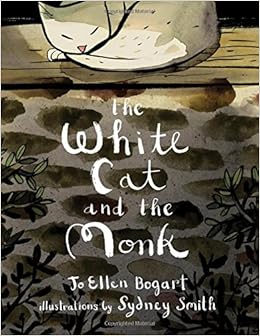
The White Cat and the Monk by Jo Ellen Bogart, illustrations by Sydney Smith

Published by Groundwood Books


Summary:  While a monk seeks knowledge among his manuscripts, his white cat, Pangur, seeks something a little more substantial; namely, a tasty mouse.  The first several pages are wordless, following Pangur as he explores the monastery, finally arriving at his master’s door and sticking a paw under to alert the monk to his presence.  The monk then narrates their activities, concluding with a happy ending in which the cat snares his prey and the monk finds an answer to his puzzle.  The author’s note at the end explains more about the poem “Pangur Ban”, written by a ninth-century Irish monk, on which this book is based.  32 pages; grades K-3.

Pros:  A poem by a ninth-century Benedictine monk seems like an unlikely source for a children’s book, but somehow this works, due in large part to the beautiful illustrations that perfectly enlarge upon the simple text.  Cat lovers will be captivated by Pangur and his antics.

Cons:  Probably better for one-on-one sharing than reading to a larger group.

Duck, Duck, Porcupine! by Salina Yoon

Published by Bloomsbury 

Summary:  Big Duck has all the answers…or at least she thinks she does, and isn’t afraid to let her friends Porcupine and Little Duck know about them.  It’s Little Duck, though, who’s really paying attention.  Even though he doesn’t say a word, he manages to fix things when Big Duck’s ways don’t quite work out.  Duck, Duck, and Porcupine have three adventures in this book: going on a picnic, celebrating Porcupine’s birthday, and planning a camping trip.  Each story is told entirely through dialog (in speech bubbles) and simple illustrations.  64 pages; grades K-2.

Pros:  These funny stories and colorful illustrations will find a ready audience with Elephant and Piggie fans.  Each character has a distinctive personality, even Little Duck, who never says a word.  I love how he gazes at the reader at the end of each story, as if he can’t really believe Big Duck is for real.  Perfect as either a read-aloud or for beginning readers.

Cons:  Porcupine’s character isn’t quite as well-developed as the two ducks; hopefully we’ll get to know him a bit better in future installments.

Every Day Birds by Amy Ludwig VanDerwater, illustrations by Dylan Metrano

Published by Orchard Books 

Summary:  20 North American birds are introduced in simple rhyming text (“Chickadee wears a wee black cap/Jay is loud and bold/Nuthatch perches upside down/Finch is clothed in gold”).  Each line of the rhyme is on a separate page with a large cut-paper illustration of the bird.  The entire text is included on two pages at the end, followed by smaller pictures and additional information about each bird, listed alphabetically.  32 pages; ages 2-5.

Pros:  Each line perfectly captures a characteristic of the bird it describes.  The illustrations are simple and bright, appealing for young kids, yet accurately depicting the bird.  Readers will be ready to head outside and look in trees and the sky for some feathered friends.

Cons:  So many birds in one place triggered a brief Alfred Hitchcock moment.

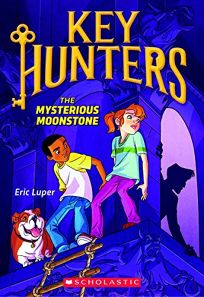
The Mysterious Moonstone (Key Hunters series) by Eric Luper

Published by Scholastic 

Summary:  Cleo and Evan miss their favorite school librarian, Mrs. Hilliard.  After she mysteriously disappeared, the strange Ms. Crowley took over.  One day, Ms. Crowley is acting odder than ever.  The two kids follow her, and discover a secret underground library.  They find a note from Mrs. Hilliard telling them she’s trapped in a book, and they need to solve the mysteries in the other books to free her and avoid getting stuck themselves.  Entering one of the books, they find themselves in 19th century London, where they help a teenage Sherlock Holmes-like detective figure out who stole a diamond from a wealthy family.  Ms. Crowley makes an appearance in this mystery, and after it’s solved, the three of them return to their school.  More mysteries await, however, as they work to free Mrs. Hilliard.  128 pages; grades 2-4.

Pros:  The mystery was surprisingly good, with a cast of suspicious characters and a bumbling, yet charming detective.   The story-within-the-story structure is a fun way to move the series along.

Cons:  The beginning was a little slow.

Finding Wild by Megan Wagner Lloyd, pictures by Abigail Halpin

 Published by Alfred A. Knopf 

Summary:  A boy and a girl explore the world around them, seeking to answer the questions posed on the first page: What is wild? And where can you go to find it?  They see it (“It leaps and pounces and shows its teeth”), hear it (“Wild roars and barks and hisses and brays”), smell it (“Every scent begging you to drink it in”), and taste it (“honey from bees and sap from trees”).  Sometimes wild burns or stings, but other times it soothes.  When the explorers enter the city, it seems as though wild has been completely covered over by pavement and buildings, but peeking through a fence they discover that wild is everywhere.  32 pages; ages 3-7.

Pros:  The vivid, mainly green illustrations nicely complement the descriptive text.  Younger readers will be inspired to explore the natural world around them; older readers may be inspired by the beautiful, descriptive language to write about it.

Cons:  Do kids really get to go off and explore the wild by themselves anymore?

Kids Book A Day goes AWOL

A little personal history:  a few weeks after starting this blog in 2015, I separated with my husband and moved out of my house with my two daughters.  We’ve lived in an apartment for a little over a year.  Six months later, I started a new job 60 miles away in western Massachusetts.  I stayed in the apartment to let my younger daughter finish high school.  In April, I closed on a house, and today is moving day.  It’s been an eventful year to say the least.  I’m not sure what my Internet status will be for the next few days, so I’m taking a bit of a vacation, and hope to be back later this week.

The Hole Story of the Doughnut by Pat Miller, illustrated by Vincent X. Kirsch

Published by Houghton Mifflin Harcourt 

Summary:  Hanson Gregory left his family’s farm for a life at sea in 1844 at the age of 13.  He quickly rose from cook’s assistant to become captain of a clipper ship.  By all accounts, he became an excellent commander, even receiving a medal for heroism from the queen of Spain after rescuing seven Spanish sailors.  But what Hanson Gregory is remembered for today is inventing the doughnut.  As cook’s assistant, he was charged with making breakfast cakes of fried dough.  Because the centers of these cakes remained raw and heavy, they were called sinkers.  One day Gregory had the brilliant idea to cut out the centers with the top of the pepper shaker.  The rest is baking history.  Over the years, legends arose about the genesis of the doughnut, and others even claimed to have invented it, but this book lays these rumors to rest once and for all.  An author’s note gives a bit more information about Gregory.  A timeline and bibliography are also included.  32 pages; grades K-3.

Pros:  An excellent introduction to the invention of ordinary items, told with plenty of humor in both the text and the illustrations.

Cons:  Does not really address the question, Dunkin’ or Krispy Kreme?


Flying Frogs and Walking Fish: Leaping Lemurs, Tumbling Toads, Jet-Propelled Jellyfish, and More Surprising Ways That Animals Move by Steve Jenkins and Robin Page

Published by Houghton Mifflin Harcourt 

Summary:  The Jenkins-Page team takes on animal movement, asking if you’ve ever seen a walking octopus or a swimming elephant.  After the page on the walking octopus, for example, comes a two-page spread of several other animals that walk in some unusual way.  The illustrations are done in Jenkins’ inimitable cut-paper style with amazing details.  The last two pages include thumbnail pictures of all the animals with a few sentences of additional information for each.  40 pages; ages 4-7.

Pros:  This award-winning team just keeps cranking out beautifully-illustrated, engaging science picture books.  Kids will love browsing through the pictures and descriptions, or listening to the book as a fun read-aloud.

Cons:  The format is nothing new, similar to other Jenkins books like What Do You Do With a Tail Like This? and How Many Ways Can You Catch a Fly?