My Favorite Pets by Gus W. for Ms. Smolinski’s Class by Jeanne Birdsall, illustrated by Harry Bliss

Published by Alfred A. Knopf 

Summary:  Gus has put together a report for school about the 17 sheep he has at his house.  It starts off pretty innocently: “A boy sheep is a ram. He has horns. The horns do not come off,” but when you look at the accompanying illustration of Gus tugging with all his might on a rope wrapped around the sheep’s horns, you may guess that Gus may be a bit of a mischief maker at his house.  And you would be right, as the report goes on to show Gus trading his brother for a lamb, cutting off a patch of wool to make himself a beard, and letting all 17 sheep into the house when his parents turn their backs for just a minute.  The last page shows Gus’s report with a B+ on it, and a comment from his teacher that indicates Gus’s mother knows what his teacher is up against.  40 pages; ages 4-8.

Pros:  The Penderwicks author Jeanne Birdsall has written an entertaining story; what kids will really appreciate, though, is Harry Bliss’s cartoon-style illustrations that show the story behind the story.  Read this one aloud and you will have a rapt audience and lots of laughs.

Cons:  A sheep eats a scarf.  Is that a form of sheep cannibalism?

Grover Cleveland, Again! A Treasury of American Presidents by Ken Burns, illustrated by Gerald Kelley

Published by Alfred A. Knopf 

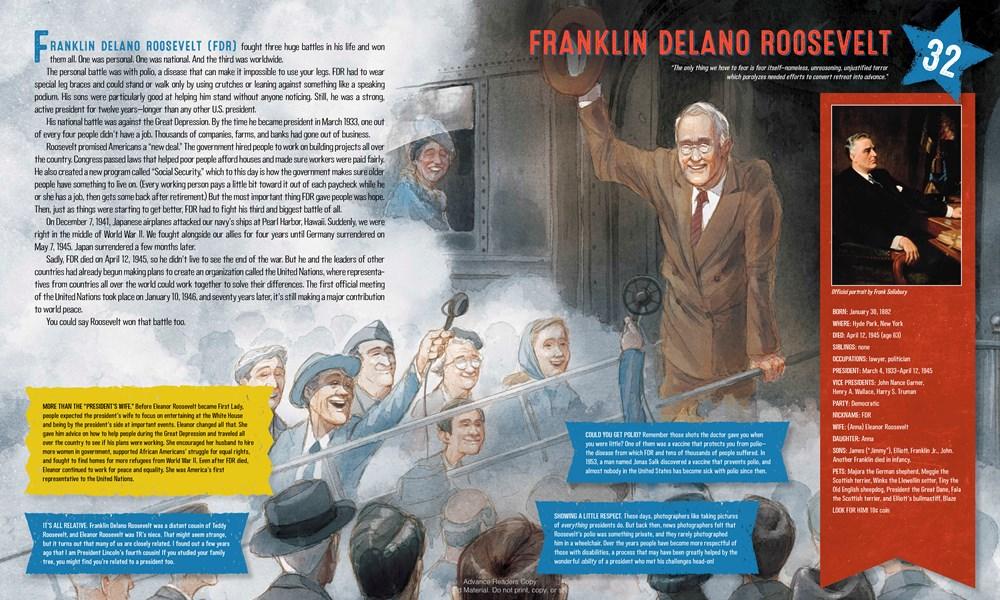
Summary:  Many years ago, Ken Burns used to recite the names of the U.S. presidents to his four daughters.  When he got to #24, the girls would say, “Grover Cleveland, again!”  He resolved then to write a book about the presidents for kids, and we now have the result of that.  Each two-page spread includes a chatty summary of that president’s term in office, a few highlighted facts, and a sidebar with fast facts such as family members, nickname, and pets.  There’s a large illustration covering both pages, plus a portrait at the top of the sidebar.  The last few pages include a glossary and a list of presidential birthplaces, libraries, museums, and historic sites arranged by state.  96 pages; grades 5 and up.

Pros:  This is a great book to browse or read cover to cover.  Burns uses his down-to-earth style to make each president’s history accessible to young readers.  The fast facts would be helpful for report writing.

Cons:  Burns doesn’t always write an unbiased account (Under Calvin Coolidge: “I believe that one of the best things the government can do is help people when their friends and neighbors can’t…”).  An astute reader will probably be able to guess who the author is hoping to write about for President #45.

Lucy by Randy Cecil

Published by Candlewick Press 

Summary:  Act I: Every morning, Lucy the dog awakens in the alley where she’s spent the night, and goes to wait on the front doorstep of a certain house.  Every morning, Eleanor, the little girl who lives in the house, prepares a treat and hangs it out the window on a string.  Every morning, Sam, Eleanor’s father, juggles a few items, then heads out to his job at the grocery store.  Every evening, Sam tries to juggle onstage, gets stage fright, and is pulled off with a giant hook.  This pattern repeats in the second section of the book, Act II.  But in Act III, some changes are afoot.  As Lucy becomes more and more a part of Eleanor’s life, she is able to help Sam overcome his anxiety, and to gradually show the world his juggling talent.  In Act IV, only two pages long, Sam juggles for Eleanor and Lucy, now a firmly established member of the family.  144 pages; ages 4-8.

Pros:  This may be the sweetest story of 2016 thus far.  Perfectly illustrated with small gray-toned pictures, Lucy and Eleanor’s tale will capture the hearts of young and old alike.

Cons:  At 144 pages, this book bends the picture book rules.  Librarians may be scratching their heads about where to shelve it.

The Infamous Ratsos by Kara LaReau, illustrated by Matt Myers

Published by Candlewick Press 

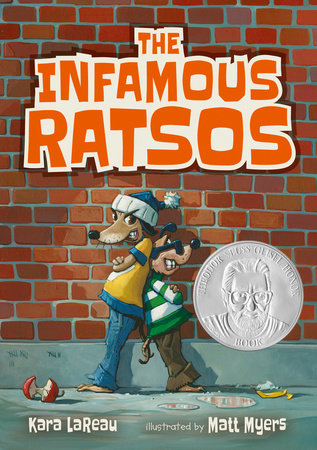
Summary:  Louie and Ralphie Ratso live with their father, Big Lou, who is one tough rat.  Their mother has been gone for a while, but they all try not to think about that.  Instead they focus on being tough.  For the boys, that means thinking up bullying schemes to torture their neighbors and classmates.  Trouble is, their plans keep backfiring to make them look like the good guys.  When they steal a hat from a boy in their class, it turns out he stole the hat to begin with.  He gets punished, while the Ratsos get praised by their teacher.  A plan to pile up snow in front of their neighbor’s store goes awry when the boys take a wrong turn and end up clearing his sidewalks.  As the final insult, the boys’ teacher sends home a note, letting their father know what upstanding citizens they are.  To their amazement, their tough-as-nails dad breaks down in tears and tells them how proud their mother would be of them.  From then on, the Ratsos go from trying to be infamous to being famous…for their good deeds.  64 pages; grades 1-4.

Pros:  What could have been a sappy, moralistic tale is actually very funny, with a lesson snuck in pretty surreptitiously.  Plenty of illustrations and large text make this a good choice for those just moving in to chapter books.

Cons:  If your young reader doesn’t get the concept of “irony” when reading about the Ratsos’ antics, you may be in for a long school year.

Superhero Instruction Manual by Kristy Dempsey, illustrated by Mark Fearing

Published by Alfred A. Knopf 

Summary:  Do you have what it takes to be a superhero?  This step-by-step manual takes a young hero-in-training through seven steps to launch his career saving the world.  While he chooses his super name, puts together a uniform, and decides on a sidekick, his sister looks on, hoping to help him, but eventually giving up and going her own (super) way.  Arriving at Step 7: Save the World, our hero goes forth to do just that.  His canine sidekick, however, has a different idea when a squirrel crosses their path.  The ensuing chase proves to be pretty much the opposite of saving the world; meanwhile, his sister is shown helping to clean up a spill, throw away trash, and fix a bike chain.  In the end, the two siblings realize that joining forces may be the quickest path to world redemption.  40 pages; grades K-3.

Pros:  A fun addition to the superhero picture book shelf.  Teachers could use this as a procedural writing mentor text.

Cons:  The ending was a little predictable.

Ghosts by Raina Telgemeier

Published by Graphix 

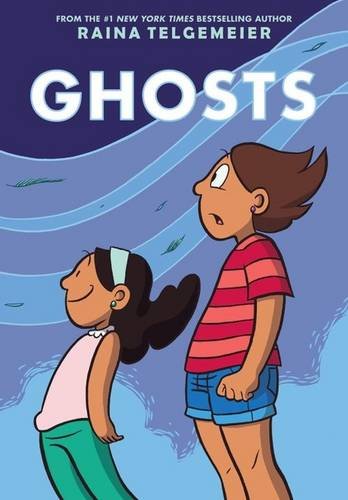
Summary:  Cat’s not happy about her family’s move from sunny Southern California to Bahia de la Luna in northern California, where the sun only shines 62 days a year.  Her dad has a new job, but the real reason is the climate is better for her younger sister, Maya, who has cystic fibrosis.  In their first days there, the sisters meet a neighbor boy, Carlos, who offers to take them on a ghost tour of their new town.  Turns out there really are ghosts all over town, and when the three kids run into a pack of them, Maya embraces them with her usual exuberance.  But dancing with ghosts proves to be unhealthy, Maya ends up in the hospital, and Cat blames Carlos.  As summer moves into fall, Cat makes new friends at school, continuing to snub Carlos, while Maya slowly makes a partial recovery from her ghostly encounter.  But the ghostliest time of year—Halloween and the Day of the Dead—are just around the corner, and Maya has to decide how she will deal with the spirits that are all around her.  An author’s note talks more about the inspirations for this book and provides a glimpse into her sketchbook.  256 pages; grades 3-7.
Pros:  Raina Telgemeier has created another graphic masterpiece.  Ghosts would make a great book group selection, with questions of life and death to discuss and consider.  Old fans will not be disappointed, and new ones will undoubtedly be created.

Cons:  This is a bit darker than Telgemeier’s previous books.

Ms. Bixby’s Last Day by John David Anderson

Published by Walden Pond Press 

Summary:  Topher, Steve, and Brand have had a good year in sixth grade with Ms. Bixby, one of the Good Ones, according to their system of rating teachers.  So it’s a horrible shock to learn that their teacher has cancer and will be out for the rest of the year.  There’s a farewell party planned for her one Friday, but she ends up in the hospital a few days before.  The three boys decide to skip school and visit her, picking up items along the way to give as gifts.  Most of the story takes place that Friday, told in the alternating voices of the three boys.  There are many adventures along the way, and each boy gradually reveals why Ms. Bixby has been extra special to him during their sixth-grade year.  Have the Kleenex handy for the poignant final chapter when the boys finally connect with their teacher at the hospital, and for the bittersweet epilogue.  320 pages; grades 4-7.

Pros:  The three boys are interesting and engaging main characters, each one with his own set of problems that are hinted at early on, but only slowly revealed to the reader.  Ms. Bixby proves to be an amazing teacher who has, unknown to the other two, reached out to each boy and changed his life in some significant way.

Cons:  In the scene at the hospital, the writing gets a little overwrought; Ms. Bixby occasionally seems too good to be true.

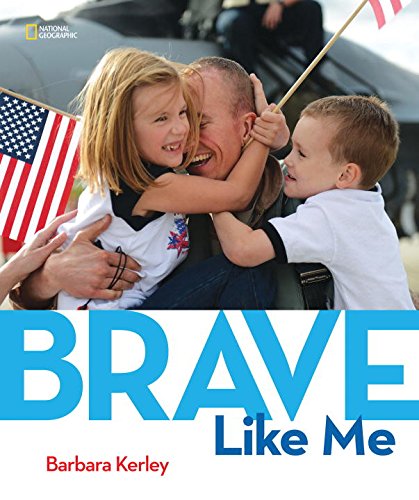
Brave Like Me by Barbara Kerley

Published by National Geographic Society 

Summary:  What’s it like when your mom or dad has to go overseas to do their job?  Through text and photos, this book explores kids’ feelings and day-to-day lives when their parents are deployed to another country.  The book opens with kids playing with their parents, then sending them off.  There are pictures of children and parents going through their days when they are separated.  The last two pages show the happy hugs of returning soldiers reuniting with their kids.  Back matter includes a map showing where all the photos in the book take place; and information on dealing with separation, who serves overseas from the United States, quotes on being brave, a note for caregivers, and additional resources.  48 pages; ages 4-8.

Pros:  This would be an extremely helpful book for kids whose parents are traveling abroad in any capacity.  The large clear photos and simple text focus more on the kids’ day-to-day lives and their feelings about separation than on the activities their parents are engaged in.

Cons:  Although many overseas workers are mentioned in the section at the end, the photos included are only of military personnel.

Dog Man by Dav Pilkey

Published by Graphix


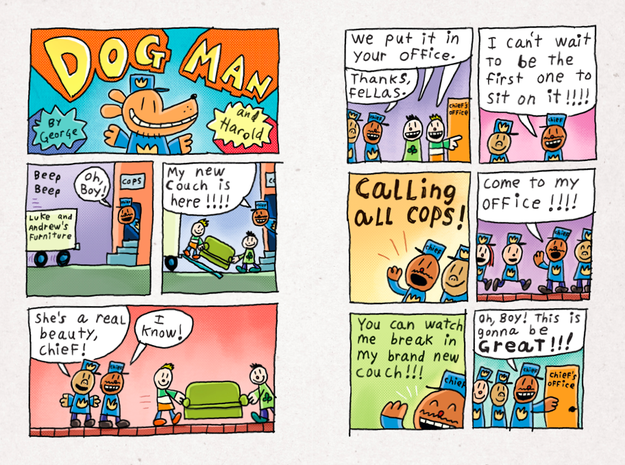
Summary:  George and Harold, creators of Captain Underpants, revisit a character they came up with in first grade.  Police officer Knight has a strong body but a weak brain; his canine companion Greg has a brilliant mind, but isn’t very big or powerful.  An accident results in Greg’s head being stitched on to Officer Knight’s body, creating superhero Dog Man.  Dog Man has four adventures in this comic book, all of them involving his nemesis, Petey the Cat.  The pictures and text channel a talented first grader, complete with occasional crossed-out words and grammatical errors.  “Extra cheesy Flip-o-ramas” are inserted throughout the text to create some “animation”.  The last few pages have instructions on how to draw some of the characters, and there is a preview of Dog Man 2: Unleashed, available January 2017.  240 pages; grades 2-4.

Pros:  Once again, Dav Pilkey has his finger firmly on the pulse of an 8-year-old.  Reluctant readers everywhere, as well as non-reluctant ones, will enthusiastically embrace Dog Man and his adventures.

Cons:  I fear that by reviewing Inspector Flytrap and Dog Man in the same week, I may have irrevocably labeled myself “literary lightweight”.

Every Breath We Take: A Book About Air by Maya Ajmera and Dominique Browning, with a foreword by Julianne Moore

Published by Charlesbridge 

Summary:  Brightly colored photographs illustrate the simple text describing how air is all around us and necessary for all kinds of life.  The last several pages talk about how dirty air is unhealthy, and makes several kid-friendly suggestions (ride bikes and walk more, turn out the lights) to help clean up polluted air.  The final two pages have six questions, such as “What is air?” and “Why is clean air so important?” with a few paragraphs of information on each topic.  40 pages; ages 4-8.

Pros:  A simple and beautifully illustrated introduction to the importance of clean air in our lives.

Cons:  Trying to answer the question “What is climate change, and how is it connected to air pollution?” in two paragraphs seems overly ambitious.