Once Was a Time by Leila Sales

Published by Chronicle Books 

Summary:  10-year-old Charlotte lives in England in 1940.  She and her best friend Kitty love to hear Charlotte’s father talk about the work he does researching time travel.  As World War II intensifies, his work becomes more and more secretive, until one night Charlotte and Kitty are kidnapped by Nazis and taken to her father’s lab.  The Nazis threaten to shoot the two girls if her father doesn’t tell them the secrets of time travel.  At the last second, much to her amazement, Charlotte sees a time-travel portal like her father has described to her many times before.  She runs through it, and finds herself in 2013 Wisconsin.  Knowing she can never travel back to her original time, she does the best she can to make a new life for herself, but she never forgets about Kitty.  Just when she has given up all hope of ever finding her, she opens a library book and finds a postcard from an adult Kitty, which just might be the clue she needs to reconnect.  272 pages; grades 4-7.

Pros:  An enchanting mix of friendship story, historical fiction, and science fiction.

Cons:  Be prepared to suspend some disbelief for the time travel portions of the story..
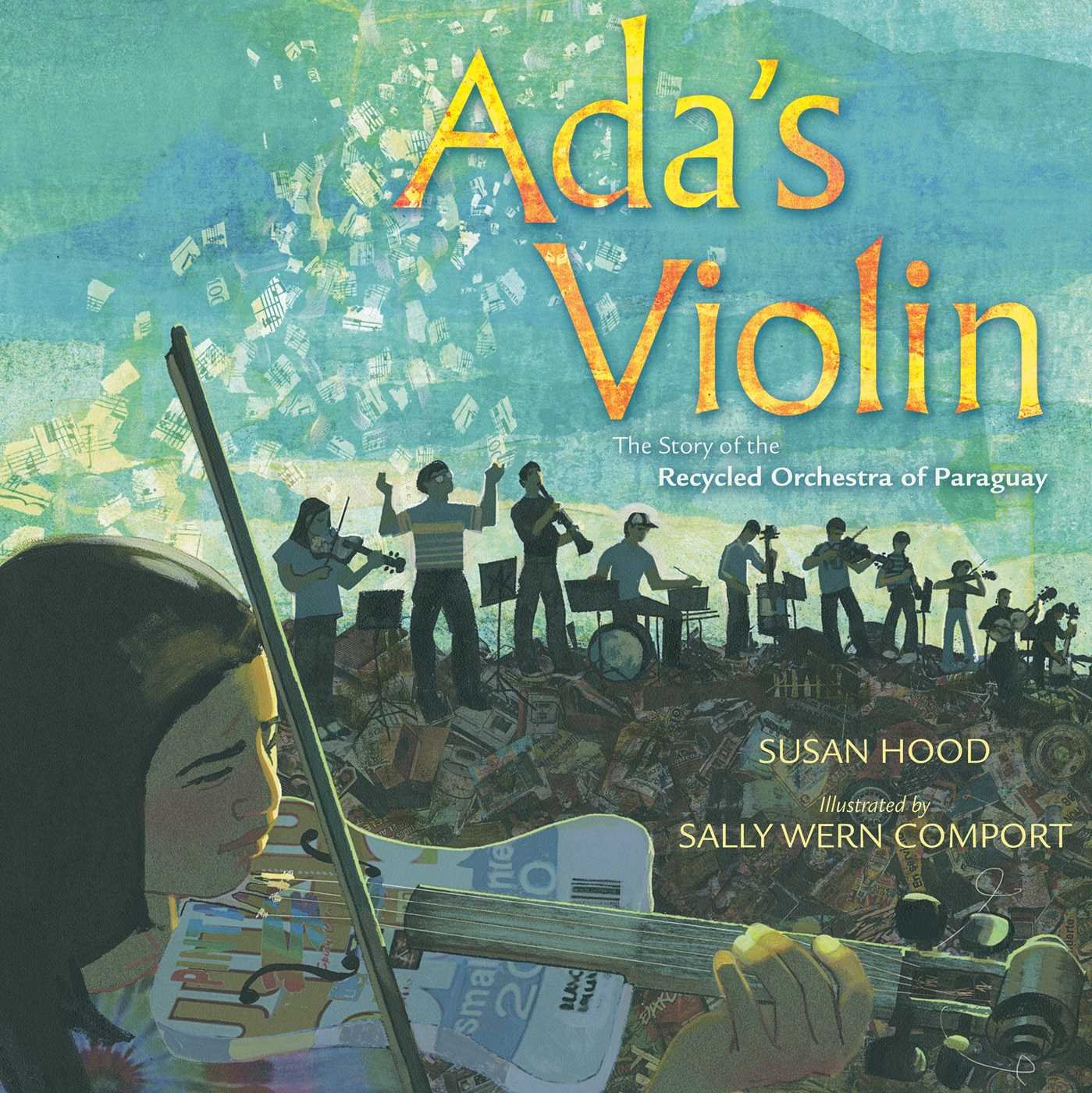
Ada’s Violin: The Story of the Recycled Orchestra of Paraguay by Susan Hood, illustrated by Sally Ward Comport

Published by Simon & Schuster Books for Young Readers

Summary:  Ada lived in one of the poorest places on earth, Cateura, Paraguay, home of the garbage dump for the capital city of Asuncion.  Most adults there survive by picking through trash, finding items they can recycle and resell to make a bare subsistence living.  Ada and her classmates appeared to be heading for the same lives as their parents, until a man named Favio Chavez came to town and offered music lessons.  The problem was, he only has a few instruments, and they were so valuable that the kids were afraid to carry them home.  So Chavez got to work making instruments from objects he found in the trash.  Before long, there were enough kids playing to form an orchestra.  Ada loved music and worked so hard that she became first violin.  The orchestra has traveled all over the world, and even opened for a Metallica concert.  Back matter includes an author’s note, sources, and photos of the orchestra and some of their instruments.  40 pages; grades 1-4.

Pros:  An inspiring story of how one man has made an amazing difference in the lives of an entire community. The illustrations do a great job of capturing the designs of the different instruments, as well as the emotions of their players.

Cons:  I wanted to hear the music!  Fortunately, YouTube helped me out.  Just search for “Recycled Orchestra of Paraguay” to learn more and to see and hear these amazing instruments in action.

The Hero Two Doors Down by Sharon Robinson

Published by Scholastic Press 

Summary:  Eight-year-old Stephen Satlow is beyond excited when he learns that Jackie Robinson and his family are moving into the house down the street.  As a huge Dodgers fan living in Brooklyn, he can’t believe that one of the most famous members of the team is his new neighbor.  Although there is a bit of resistance to the integration of Stephen’s mostly Jewish community, the Robinsons are welcomed by most of the families on Stephen’s street, and the Satlows and Robinsons soon become good friends.  Written by Jackie Robinson’s daughter and based on a true story, this book includes an afterword about the two families’ friendships and several photos of the main characters from the story.  208 pages; grades 3-6.

Pros:  A quick and engaging read about a true baseball fan, as well as a fun look back at post-World War II Brooklyn.

Cons:  Jackie Robinson comes across as a bit preachy, spouting words of wisdom almost every time he and Stephen have a conversation.

The Mummy Makers of Egypt written and illustrated by Tamara Bower

Published by Seven Stories Press 

Summary:  Paneb is the head of a family of embalmers; his young son Ipy is being trained to follow in his footsteps.  When Yuya, father of Queen Tiye, dies, Paneb and Ipy oversee a lengthy process of embalming and burial.  Each step is important in preserving the body for the afterlife, and there are many rituals that go with each part of the process.  The Egyptian religion is described, with beliefs about what happened to people after they died.  There’s also a section on the embalming process, with pictures of the tools and the people performing their jobs drawn in ancient Egyptian style.  A lengthy endnote describes the discovery of Yuya’s tomb in the early 20th century; there are also a few photos and drawings of items found in the tomb.  40 pages; grades 3-8.

Pros:  Written and illustrated by an expert on ancient Egypt, this book is clearly a labor of love designed to impart a great deal of information about many aspects of Egyptian culture, both through the text and the illustrations.  The end note, three pages of small type, is a bit daunting, but very interesting and informative.

Cons:  The section on the embalming process (e.g., brain removal through the nose) may not be everyone’s cup of tea.

The Most Important Thing: Stories About Sons, Fathers, and Grandfathers by Avi

Published by Candlewick


Summary:  What is the most important thing a father (or grandfather) can give his son?  Avi ponders this question in a collection of seven short stories about boys whose fathers (or grandfathers) are married, divorced, dead, distant, loving, know-it-all, clueless, proud, disappointed, or more than one of the above.  Ranging from the poignant (a beloved father unexpectedly dies the afternoon of a fishing trip to his son) to the appalling (Damon discovers on his once-a-month visit that his divorced dad has remarried and has a new baby on the way…all since his previous visit) to the humorous (Ryan devises a screening and application process when a man wants to marry his widowed mother), these stories explore many aspects of the parent-child relationship.  224 pages; grades 5-7.

Pros:  This would be a perfect book for a parent-child book discussion group.  With so many different stories and characters, there is much to look at and consider.

Cons:  The first story, in which an estranged grandfather heals his decades-old war wounds by talking non-stop to his newly-acquainted grandson, seems to be resolved too quickly and easily.

Are We There Yet? By Dan Santat

Published by Little Brown Books for Young Readers

Summary:  A boy’s trip to Grandma’s in the back seat of his parents’ car turns into an adventure in time travel.  The long trip gets boring, and time slows down so much that he finds himself moving back in time…to frontier days, pirate times, ancient Egypt, and finally, to prehistoric times.  When he decides to enjoy the present, time suddenly speeds up, and he’s afraid he’s missed the party.  But finally, the trip ends, and he’s back in the present again.  The last page has him unhappy once more as older relatives prove less than enthralling company.  40 pages; ages 4-8.

Pros:  Caldecott medalist Dan Santat takes readers on a whirlwind trip through time, even turning the book upside down for a section in the middle of the story.  Kids will want to spend extra time absorbing all that is going on in each two-page spread.

Cons:  The illustrations are more creative than the story.

Maybe a Fox by Kathi Appelt and Alison McGhee

Published by Atheneum 

Summary:  Sylvie and Jules are sisters who have also always been best friends, even closer because their mother died suddenly when they were both quite young.  Sylvie’s greatest wish is to run fast, although she never can articulate why she wants this so much.  One day she goes running into the woods, racing to get to a dangerous part of the river the girls’ father has warned them about, and she disappears.  While Jules and her father are still reeling from grief, in another part of the woods, a fox cub is born, a rare animal that is connected to a human spirit.  The book alternates between Jules’ story and the fox’s…until one fateful evening when the two of them are brought together.  272 pages; grades 4-7.

Pros:  A beautifully crafted book, filled with sadness, hope, grief, and healing.  I expect this one to be on the short list for the Newbery.

Cons:  Every main character in the book is grieving for someone, making it a bit of a heavy read.

More-igami by Dori Kleber, illustrated by G. Brian Karas

Published by Candlewick Press 

Summary:  Joey loves things that fold—tacos, road maps, his foldaway bed—so when Sarah Takimoto’s mother comes to his school one day to demonstrate origami, Joey is captivated.  He asks Mrs. Takimoto to teach him, to which she wisely replies, “I can show you the folds.  But if you want to be an origami master, you’ll need practice and patience.”  So Joey goes home and folds everything in sight.  After going through his homework, his sister’s sheet music, Aunt Vivian’s recipe, and the $38 in his mother’s purse, his family has had enough.  Discouraged, Joey wanders into the neighboring Mexican restaurant, where the sympathetic owner gives him a job folding napkins.  He starts simply, but doesn’t give up, and after months of practice, he is finally able to create a masterpiece. Includes instructions for an origami ladybug.  40 pages; ages 4-8.

Pros:  A charming story about the importance of persistence when learning a new skill.  Joey, who appears to be African-American, is taught by a Japanese American woman and helped by his Mexican American neighbor in a multicultural friendly community.

Cons:  Apparently I lack the “grit” necessary to master origami, because even the ladybug looks a bit challenging to me.

Good Night Owl by Greg Pizzoli

Published by Disney Hyperion 

Summary:  Owl is trying to go to sleep, but every time he lies down, he hears a squeak.  Could it be coming from the cupboard?  He empties out every shelf, but finds nothing.  Is it in the floor? Removing all the floorboards doesn’t help.  The roof? The walls?  Before long, Owl is lying in his bed under the stars.  That’s when he finally sees the mouse whose squeaking has been keeping him awake.  With the mystery solved, both animals are able to happily fall asleep.  40 pages; ages 3-7.

Pros:  A simple and funny bedtime story, with large, child-like illustrations.

Cons:  Why is Owl sleeping at night?

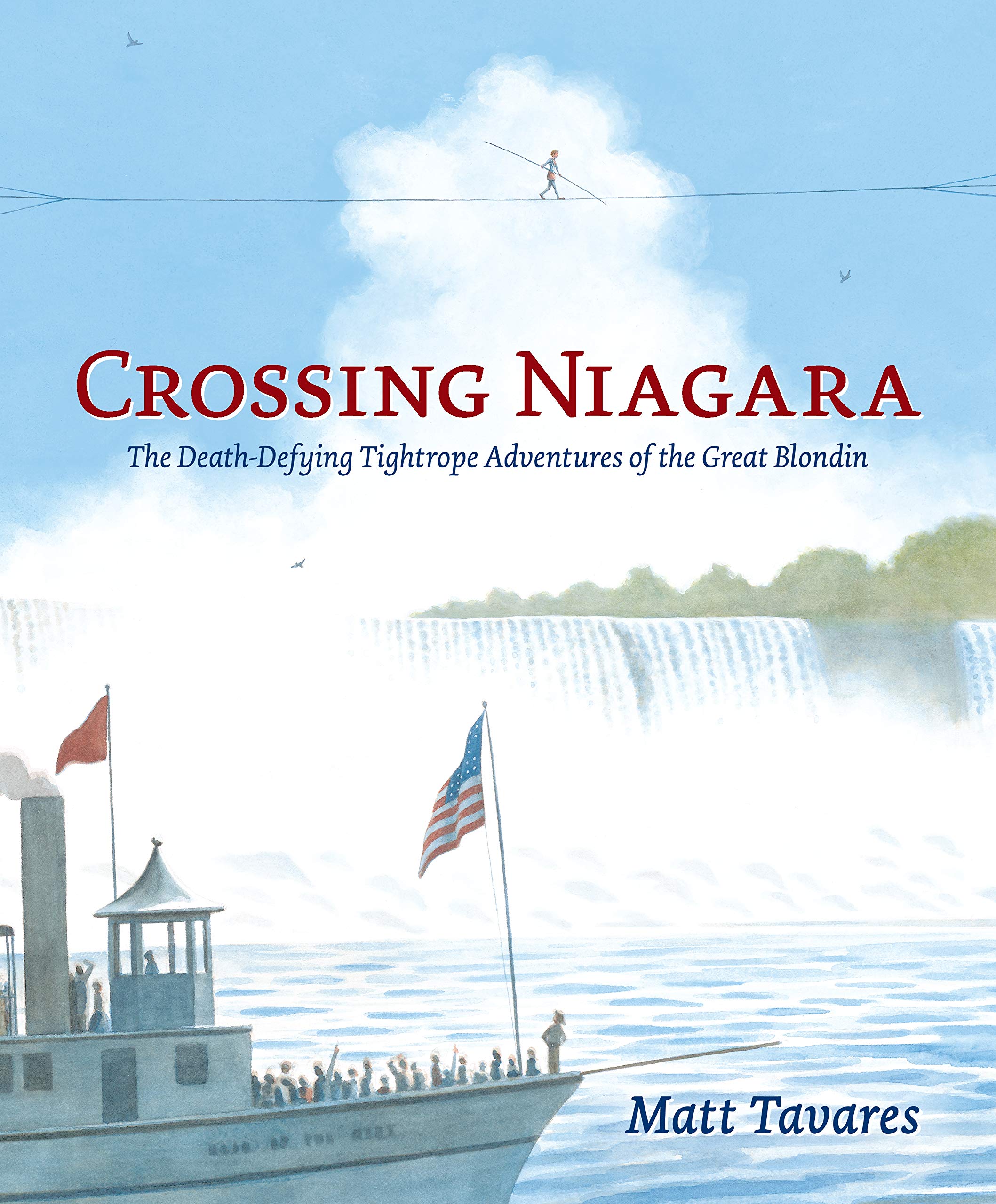
Crossing Niagara: The Death-Defying Tightrope Adventures of the Great Blondin by Matt Tavares

Published by Candlewick Press

Crossing Niagara: The Death-Defying Tightrope Adventures of the Great  Blondin: Tavares, Matt, Tavares, Matt: 9780763668235: Amazon.com: Books

Summary:  Jean Francois Gravelet, a.k.a. The Great Blondin was just five years old when he first performed on the tightrope.  Although he loved his circus career, he longed to do something even more daring.  When he first laid eyes on Niagara Falls, he knew what he wanted to do.  He set up a rope, contacted the newspapers, and on June 30, 1859, he made his first successful crossing, stopping along the way to perform a few tricks, including retrieving a bottle from the Maid of the Mist below and toasting the crowd.  He promised to return on July 4, and this time, he crossed the falls blindfolded.  Over the next two summers, he made many crossings, trying all kinds of stunts.  His ultimate challenge was carrying his manager across on his back (a trick his manager wasn’t terribly enthusiastic about).  When the crowds began to thin, The Great Blondin moved on, but he was forever remembered for his Niagara Falls crossings.  End matter includes a brief author’s note and a bibliography.  36 pages; grades 1-5.

Pros:  The storytelling and large, detailed illustrations combine to make a pulse-pounding tale of daring.

Cons:  I could have enjoyed a little more biographical detail about The Great Blondin.