Fabulous Frogs by Martin Jenkins, illustrated by Tim Hopgood

Published by Candlewick Press 

Summary:  “Did you know that there are more than 5,000 kinds of frogs?” begins this book, and then proceeds to describe some of the more unusual ones.  There are big frogs and little ones, poisonous frogs, and frogs that can jump sixteen feet, appear to fly, and live buried underground for years.  The last two pages include eight more frog portraits, a very short index, and a recommended website for learning more.  32 pages; ages 5-8.

Pros:  This would be a great nonfiction read-aloud for young animal lovers.  The big, colorful illustrations (by Tim Hopgood, how perfect is that?) nicely complement the conversational text.

Cons:  My curiosity at how the Australian water-holding frog lives underground for “years and years” in a very small hole was not satisfied.

What Are You Glad About? What Are You Mad About? by Judith Viorst, with art by Lee White

Published by Atheneum Books for Young Readers 

Summary:  These mostly humorous poems are divided into eleven sections, such as How Are You Feeling Today?; School Stuff; About the Family; Home and Away;  and Friends and Other People. As the title suggests, there are poems about glad topics, like a perfect day, home, and a fun “arithmetrick”, and others about mad/sad topics, like divorce or an ex-best friend.  Black, white, and blue illustrations are on every page.  112 pages; grades 1-4.

Pros:  Published a week after Judith Viorst’s 85th birthday, this fun collection shows she still excels at writing for an elementary audience.  The subjects are perfect for kids, and the poems have a good blend of humor and poignancy.

Cons:  Some of the lines of poetry were a little uneven, so the poems didn’t flow quite as smoothly as they could have.


The Quickest Kid in Clarksville by Pat Zietlow Miller, illustrated by Frank Morrison

Published by Chronicle Books 

Summary:  Alta’s pretty sure she’s the fastest kid in Clarksville, Tennessee, until Charmaine comes along and challenges her to a couple of races.  Charmaine’s got new sneakers, and Alta’s toes are poking out of hers, but the contest ends in a draw.  Alta’s unhappy about the new girl, until the next day, when she’s racing to get herself and her banner to the parade in time to see Olympic medalist Wilma Rudolph go by.  The two girls work together, and end up with a curbside seat to the parade.  Wilma gives them a wave and a smile, and the two girls find themselves smiling at each other as well.  An author’s note gives a brief history of Wilma Rudolph and her victory parade, which she insisted be open to all races, making it the first major integrated event in Clarksville’s history.  40 pages; ages 5-8.

Pros:  A fun story of friendship, served up with a slice of history.  Frank Morrison occasionally channels Hilary Knight in his action-packed illustrations.

Cons:  Kids will need a little background on Wilma Rudolph before reading this book to fully appreciate the story.


Pink is for Blobfish: Discovering the World’s Perfectly Pink Animals by Jess Keating, with illustrations by David Degrand

Published by Alfred A. Knopf 

Book trailer: https://www.youtube.com/watch?v=YKCGtE693T4

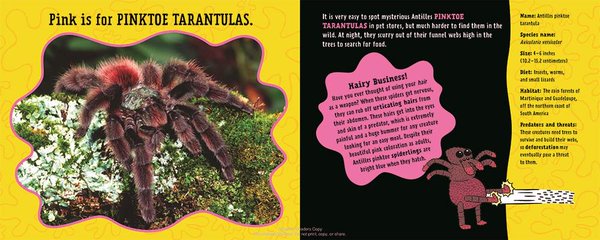
Summary: If your list of pink animals begins and ends with “flamingo”, you need to take a look at this book. And if you think pink is a dainty, girly-girl color, check out the photos of the pinktoe tarantula and the dragon millipede.  Not to mention the blobfish, recently voted the ugliest animal in the world by the Ugly Animal Preservation Society.  Each two-page spread includes a full-page photo and the name, species name, size, diet, habitat, predators and threats, and some fun facts.  End matter includes a glossary, list of further resources, and a color-coded map that shows where each animal lives.

Pros:  A unique approach to animal facts, written in an easy-to-read format that kids will enjoy.  This is the first in a series called “The World of Weird Animals”.

Cons:  I found the map a little difficult to use.

The Pages Between Us by Lindsey Leavitt and Robin Mellom

Published by Harper


Summary:  Best friends Olivia and Piper are disappointed to discover they have only one sixth grade class together.  To keep each other updated, and to avoid the detection of passing notes, they create a notebook in which they write to each other, then hand it off between classes.  They’re perfectly happy with their friendship until Piper’s  mother offers to give her a birthday party (a rare event for the third of five children), and she realizes she needs to make some more friends.  The two girls start sampling the after-school clubs.  Some are a lot more fun than expected, some a total disaster.  Each girl finds her niche, and there is some friction when they turn out to be different niches.  Drama threatens on the day of the big party, but all is resolved, and true friendship wins the day.  288 pages; ages 8-12.

Pros:  A sweet story of friendship, told in an enjoyable style, mostly through the notebook letters, but also with some texts, flyers, and other memorabilia.

Cons:  Not a lot of action, and the girls’ voices at times sound like middle-aged women trying to write like 11-year-olds.

Ida, Always by Caron Levis and Charles Santoso

Published by Atheneum Books for Young Readers 

Summary:  Gus and Ida are polar bears who live in a park in the middle of a huge city.  Every day the play, swim, and eat together.  Ida can’t see, but she tells Gus that she doesn’t have to see the city to feel it.  At night, each bear goes to his or her own cave to sleep.  Every day is the same until one morning when Ida doesn’t come out of her cave.  Sonya the zookeeper tells Gus that Ida is sick and she isn’t going to get better.  Gus and Ida still have some time together.  Some days Ida can play, but other days she has to rest.  Each night before sleeping, the two bears tell each other they will miss the other one.  Finally, one morning, with Gus at her side, Ida passes away.  Gus continues to enjoy each day, but never forgets his good friend. A brief author’s note tells of the real Ida and Gus who lived in New York City’s Central Park Zoo. 40 pages; ages 4-8.

Pros:  A beautiful story of love and loss, exploring terminal illness and death in a way that will be accessible to preschoolers and early elementary age readers.

Cons:  Good luck reading this one out loud.  Keep the Kleenexes handy.

Oops Pounce Quick Run! An Alphabet Caper by Mike Twohy

Published by Balzer + Bray 

Summary: An entire story is told with a single word per page, each word starting with a different letter of the alphabet. A mouse is Asleep when a Ball bounces into his hole, which he proceeds to Catch; the nose of a Dog pokes into the hole, soon followed by its Eye. You get the idea. The action is non-stop as the two animals pursue each other before the mouse finally has a clever idea to make peace. The word on the final page, not surprisingly, is Zzzzz. 32 pages; ages 3-7.

Pros: A clever concept for an alphabet book, with cute, action-packed illustrations. Younger kids will enjoy using this to learn the alphabet, while older ones could be challenged to make up an alphabetical story of their own.

Cons: A few pages (To Dog, Very Cool) don’t quite adhere to the one-word-per-page rule.


Glow: Animals with Their Own Night Lights by W. H. Beck

Published by Houghton Mifflin Harcourt 

Summary: An introduction to bioluminescence, showing a variety of glowing animals on a background of black pages with white text. The “how” of bioluminescence is very briefly described, as well as a variety of reasons why animals glow.  An author’s note explains that some photos have been enlarged and that some are a bit blurry due to the difficulties of photographing animals deep in the ocean.  Thumbnail photos and descriptions of all the animals are included on the last two pages.  32 pages; ages 4-7.

Pros:  Bioluminescence is very cool!  The photos are eye-catching and the text is simple enough for young children.

Cons:  The explanation of why animals glow is very brief.

Study Hall of Justice (Secret Hero Society series) by Derek Fridolfs, illustrated by Dustin Nguyen

Published by Scholastic 

Summary:  Young Bruce Wayne is looking forward to starting school at the prestigious Ducard Academy, but right from the first day, everyone seems incredibly mean, even the teachers.  He does manage to befriend two kids who are having similar struggles, a boy named Clark Kent and a girl named Diana Prince.  Together, they try to investigate the dark secrets of their new school and who is behind them.  The story is told through comics, letters, journal entries, school forms, and texts.  With the school mystery solved by the end, Bruce’s mention of an upcoming camp visit hints at a sequel.  176  pages; ages 8-12.

Pros:  Reluctant readers will flock to this book about the young Batman, Superman, and Wonder Woman.  The variety of formats (graphic novel, letters, texts, etc.) makes it an interesting and fast-paced read.

Cons:  The story was a little more complex than I was expecting, and the different types of text could make it a bit confusing.

Whose Hands Are These? A Community Helper Guessing Book by Miranda Paul, illustrations by Luciana Navarro Powell

Published by Millbrook Press 

Summary: Each page shows a different worker and describes in rhyming text what his or her hands do; turn the page to see who that person is. The answers get a little more difficult through the book, starting with farmers and cooks and moving up to architects and physicians (which may not be a word preschoolers are as familiar with as doctors).  The book ends by asking the reader what your hands could do; the last four pages give thumbnail profiles of all the professions illustrated.  32 pages; ages 4-7.

Pros:  Having done a unit on community helpers, I know there aren’t a lot of good picture books that introduce many different kinds of jobs.  This one is particularly fun and interactive with bright, interesting illustrations.

Cons:  Those of us who hail from northern New Jersey do not believe that “water” rhymes with “potter”.