Just My Luck by Cammie McGovern

Published by HarperCollins 

Summary:  Benny feels like he can’t get a break.  His father’s just out of the hospital following an accident that Benny feels was his fault, and he’s far from completely recovered.  He got Mr. Norris, supposedly the best fourth grade teacher, who is proving to be a bit of a disappointment.  And then there are the struggles Benny deals with every year, like low grades on spelling tests and keeping an eye on his older brother George, who has autism.  His oldest brother is on the basketball team and has a pretty girlfriend, even George can do tricks on his bicycle, but Benny can’t seem to find anything he’s good at.  He tries to follow his mother’s advice: when bad things happen, you should think about someone else’s problems and try to help them.  Slowly, with two steps forward and one backward, Benny begins to find his strengths and to realize he has the power to make his own luck.  240 pages; ages 8-12

Pros:  This beautifully written book will be enjoyed by fans of Wonder, Absolutely Almost, and The Meaning of Maggie…all stories of kids in difficult circumstances learning to find their own strengths with the help of caring teachers, friends, and family members.

Cons:  This is one of those books that’s hard to sell to kids.  It sounds like it could be kind of a downer without a lot of action, yet I found it so compelling I read it in less than 24 hours.

Swap! by Steve Light

Published by Candlewick Press

Summary: Two sailors have a problem: their ship is too old to sail. When one of them loses a button, the other has an idea.  Swap!  They swap the button for two teacups; two teacups for three coils of rope; two of the coils of rope for four oars.  Slowly their collection grows until they have enough items to refurbish the ship.  Then it’s anchors a-weigh, and they are back out to sea.  40 pages; ages 3-7.

Pros: Although the story is simple, the artwork is not. Similar to Light’s two previous books, Have You Seen My Dragon? And Have You Seen My Monster?, the main story is told with color, while the black-and-white activity is mostly in the background. That activity is pretty complex, though, and will have kids poring over the pages to see all that’s happening.

Cons:  Due to the detailed illustrations, this is probably better for one-on-one sharing than reading to a large group.

Bloom by Doreen Cronin, illustrated by David Small

Published by Atheneum 

Summary:  “Once upon a time, in a beautiful glass kingdom, there lived an unusual fairy named Bloom.”  Bloom uses her magic to help keep the kingdom beautiful, but she’s muddy and heavy-handed (and footed), and eventually, through mutual agreement, the kingdom and fairy part ways.  Many years later, the glass all over the kingdom is breaking, and no one can fix it.  It’s decided that a messenger should go into the forest and convince Bloom to return.  The king tries and fails, the queen tries and fails; the last hope is an ordinary girl named Genevieve.  Unlike the king and queen, Genevieve isn’t afraid to get her hands dirty, and Bloom teachers her how to use the mud to make bricks and build things.  Delighted, Genevieve returns, teaches others her new-found skills, and saves the kingdom. 40 pages; ages 4-8.

Pros:  Award-winning author-illustrator team Cronin and Small contribute to make a magical tale that extols the virtues of hard work and girl power.

Cons:  “[T]here is no such thing as an ordinary girl,” said Bloom.  Just in case you missed the message of the story the first two or three times.

Our Moon: New Discoveries About Earth’s Closest Companion by Elaine Scott

Published by Clarion Books


Summary:  Everything you ever wanted to know about the moon but were afraid to ask..  From the earliest ancient astronomers who observed Earth’s satellite with the naked eye to the scientists today who are trying to figure out a way to colonize the moon, Our Moon traces the history of humans’ lunar interactions.  It also looks at how the moon has also been studied to learn more about the history of the solar system, particularly after rocks and dust were brought back to Earth from the Apollo missions.  Back matter includes an extensive glossary and index and sources for further information.  72 pages; ages 10-13

Pros:  This book is positively dripping with information. The engaging writing style will appeal to researchers and browsers alike.  Filled with color photos, diagrams, and sidebars, this is nonfiction at its best.

Cons:  The subtitle makes it sound like this is a book about new discoveries about the moon, while that is actually only one small part of the whole.


The Great Pet Escape by Victoria Jamieson

Published by Henry Holt and Company 

Summary:  GW (real name, George Washington) has been stuck in his hamster cage for three months, two weeks, and one day.  He and his friends, Barry the bunny and Biter the ferocious guinea pig used to be the Furry Fiends until they were captured and turned into classroom pets.  As the story opens, GW has just figure out a way to unlock the cage.  At the end of the school day, he makes his break and goes off in search of his companions.  To his dismay, Barry seems pretty happy in first grade, and Biter has completely gone over to the dark side of kindergarten, calling herself Sunflower and practicing yoga to handle her anger issues.  GW finally convinces them to return to their previous life, but their plans are interrupted by Harriet, the fourth grade mouse, leading an army that includes the fifth grade snake and ten more mice (or wait, is it nine and a well-fed snake?).  War breaks out in the halls and cafeteria of the school, and a single food fight could change the course of class pet history forever.  64 pages; ages 6-10.

Pros:  Victoria Jamieson is a genius. Roller Girl was a Newbery winner and one of my favorite graphic novels of 2015.  Now she’s gone in a totally new direction with a hilarious new graphic.  Unlike some “humorous” kids’ books that just seem silly, this one had me laughing out loud on every page.

Cons:  I can’t decide which sequel I want to see first…Roller Girl 2 or another installment of Pets on the Loose.

Emma and Julia Love Ballet by Barbara McClintock

 Published by Scholastic Press


Summary:  Emma and Julia both love ballet.  Emma goes to her beginners’ class, while Julia takes a class with the company she’s part of.  When Emma warms up and stretches, Julia is doing the same in her class.  Both work hard at the barre, then soar through their dance moves.  At the end of the day, Emma is excited to be going to a ballet performance.  Afterwards, she gets to go backstage, where she meets some of the dancers, including Julia.  Emma gets a big hug, and some words of encouragement that Julia was also once a little girl who loved ballet.  32 pages; ages 4-8.

Pros:  Young ballerinas will love seeing the dancers of all ages on these pages.  The illustrations are simple, yet detailed enough to give a real feel for the world of ballet.  Bringing the two ballet fans together creates a satisfying and inspiring ending.

Cons: How did Emma get to go backstage? Readers might think this is a standard part of every performance.


The Almost Terrible Playdate written and illustrated by Richard Torrey

Published by Doubleday Books for Young Readers 

Summary:  A boy and a girl ask each other, “What do you want to play?”  Unfortunately, neither one has an answer the other one likes.  The boy wants to a dinosaur or a dragon or a race car driver; the girl a magical wizard or a ballet instructor or queen of the universe.  As each one makes a suggestion, the other one’s imagined interpretation of the idea is shown in a crayon cartoon bubble, purple for the girl and green for the boy.  Finally, unable to agree on anything, they go their separate ways.  Each one starts creating with blocks, but is unable to keep from looking at what the other is doing.  Finally, they break down and tell what they’re making; this inspires them to make up a game that includes both creations, and by the end of the playdate, they’re ready to make plans to get together another time.  40 pages; ages 3-7.

Pros:  A good lesson on the art of compromise.  Kids will enjoy the illustrations of what the two characters are thinking.

Cons:  The ideas for games were a little gender stereotypical.

The Nine Lives of Jacob Tibbs by Cylin Busby

Published by Alfred A. Knopf 

Summary: Narrator Jacob is the runt of his litter, born to seafaring wonder cat Mrs. Tibbs, a champion ratter who also can predict when a storm is coming. All his brothers and sisters find homes on other ships, but Jacob stays behind with his mother.  He’s devoted to Captain Natick, but not so fond of Archer, the new first mate, who’s the son of the shipping company’s owner and doesn’t have a clue about sailing.  On the first day out, Archer persuades the captain to ignore Mrs. Tibbs’ warning of bad weather.  Disaster follows, setting in motion a chain of events that eventually results in accusations of mutiny, and several sailors, including Jacob, being cast adrift.  It’s one adventure after another in this tale of life on the high seas in a nineteenth-century sailing vessel.  272 pages; ages 8-12.

Pros:  From storms to mutiny to shipwreck, the action never stops.  Jacob is an endearing narrator.  This would make an engaging classroom read-aloud.

Cons:  Beloved characters die.


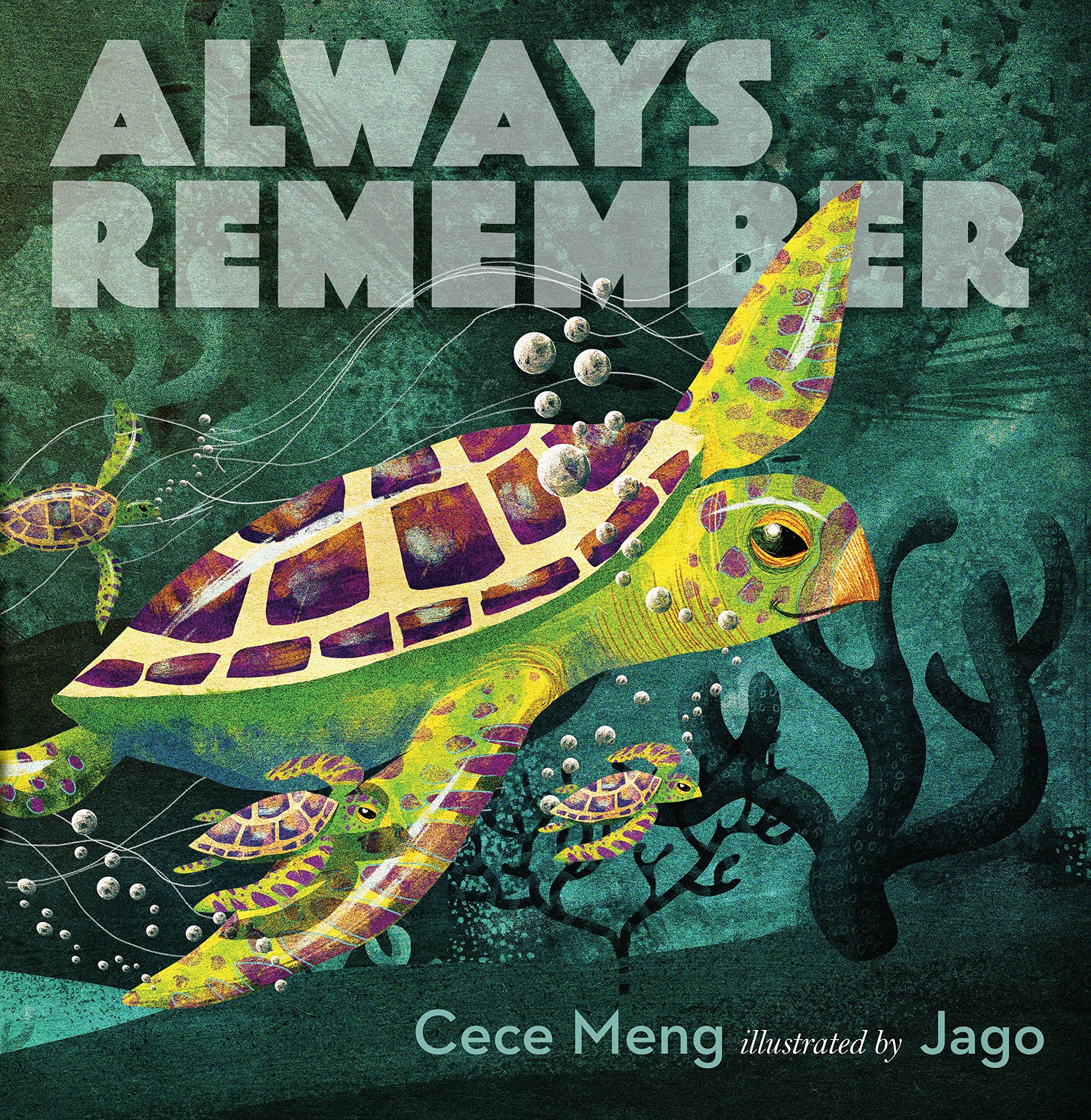
Always Remember by Cece Meng, illustrated by Jago

Published by Philomel Books

Always Remember: Meng, Cece, Jago: 9780399168093: Amazon.com: Books

Summary:  When Old Turtle takes his last breath and swims his last swim, the waves carry him away, and his friends remember him.  The young turtles remember how he taught them how to swim; the otters remember how he loved to play and have fun; the manatee remembers how he rescued him when he was tangled in a fishing net.  At the end, they conclude that Old Turtle lived a life filled with kindness, love, and helpfulness, and his legacy will live on through their own lives.  32 pages; ages 3-7.

Pros:  A beautifully illustrated simple story that celebrates a life well-lived and gives children a way to look at death as the completion of life.

Cons:  Another three-Kleenex read-aloud.

Before I Leave by Jessixa Bagley

Published by Roaring Brook Press 

Summary: A hedgehog learns she is moving to a new home, and is heartbroken to be leaving her anteater best friend. They decide to play together one last time just the way they always have.  The two friends are sad, and the hedgehog is scared about moving some place new, but they manage to have one more day of fun together before they have to go their separate ways.  When the hedgehog starts to unpack at her new house, she finds that her friend has snuck pictures and notes into her suitcase.  The last pages shows her sitting in her room, the papers clipped to a clothesline, beginning a letter to her friend.  40 pages; ages 4-7.

Pros:  This simple story would be a good way to help children express their feelings about a move or a friend who is moving.  The sweet illustrations show the fun the two friends have shared.

Cons:  The hedgehog’s face is so small sometimes it’s hard to see her expressions.