The Nest by Kenneth Oppel, illustrated by Jon Klassen

Published by Simon and Schuster Books for Young Readers 
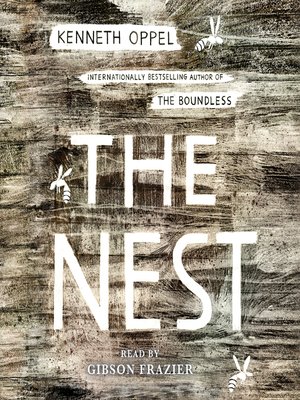
Summary:  There’s a new baby at Steven’s house, and something is seriously wrong with him.  As near as Steven can tell, the baby has a congenital issue that is causing heart problems, and that may prevent him from ever learning to talk, walk, or feed himself.  Steven himself suffers from anxiety and nightmares, so the last thing he needs is another worry in his life.  When he dreams about an angel who tells him she can fix the baby, he is immensely relieved and ready to do whatever it takes to help.  As the dreams come back night after night, he learns that the angel is really a queen wasp, and her plans for “fixing” the baby start to sound more and more sinister.  Meanwhile, a large wasps’ nest appears right outside the baby’s window; when Steven gets stung, he learns he has an allergy.  Then a shadowy figure starts appearing in the family’s life…is he sinister or a savior?  All forces come together one terrifying day when Steven must learn to draw on courage he never suspected he had.  256 pages, grades 5-8.

Pros:  A psychological thriller told by an unreliable narrator leaves the reader guessing right up to the last chapter.  The creepiness is great fun, but there’s also an interesting message about human perfection and the question of what is normal and what is not.

Cons:  Any phobias around stinging insects?  You may experience some serious nightmares if you read this.

Oskar and the Eight Blessings by Richard Simon and Tanya Simon, illustrated by Mark Siegel

Published by Roaring Brook Press 

Summary:  After the Night of Broken Glass, Oskar’s parents put him on a ship to America.  His father’s last words to him are, “Even in bad times, people can be good.  You have to look for the blessings.”  Oskar arrives in New York City on the seventh day of Hanukkah, which is also Christmas Eve.  He has to walk over one hundred blocks to find his Aunt Esther.  As he walks, he looks for blessings.  An old woman feeding pigeons gives him a loaf of bread to eat.  A boy playing in the snow gives him a pair of mittens.  And Eleanor Roosevelt herself gives him a few kind words.  As night falls, and the Hanukkah candles begin to glow in windows, Oskar at last reaches his destination and finds a new home.  Grades 1-3.

Pros:  A beautifully illustrated, moving story about finding good in the world during a bleak time in history.  An author’s note explains that the events of Christmas Eve 1938 are historically accurate, including Eleanor Roosevelt’s visit to New York City.

Cons:  While very young children would enjoy this story, it does require at least a basic explanation of Nazi Germany and the beginning of the Holocaust.

Happy Hanukkah!

My Family Tree and Me by Dugan Petricic

Published by Kids Can Press 

Summary:  A boy traces his family tree from both sides.  Starting at the beginning of the book, we meet his father’s family back to his great-great grandparents (who look to be of European descent).  The last page of the book shows his mother’s great-great grandparents (apparently Chinese).  Working forward or backward, the reader is introduced to great grandparents, grandparents and parents, until the two families meet in the middle with a two-page family portrait of the narrator with his parents, grandparents, aunts, uncles and cousins.  Studying the pictures, it’s easy to see how physical traits have been passed down from both sides of the family.  Ages 3-7.

Pros:  A fun introduction to family structure and inherited traits.  Kids will be inspired to trace their own family trees.  The cartoon illustrations with somewhat exaggerated features will produce some chuckles.

Cons:  It’s a pretty basic introduction to the topic and doesn’t take into account today’s wide diversity of family structures.


Drowned City: Hurricane Katrina and New Orleans written and illustrated by Don Brown

Published by Houghton Mifflin Harcourt


Summary:  In graphic novel format, Don Brown traces the history of Hurricane Katrina. He begins in early August, 2005, when a “swirl of unremarkable wind” leaves Africa and travels toward North America, gathering strength over the Atlantic Ocean.  As it closes in on New Orleans, residents begin to evacuate, but some choose or are forced to stay behind.  The pictures tell the story, as houses become submerged and residents are forced into their attics and onto their roofs.  Rescue efforts are alternately heroic and ridiculously bungled.  The Superdome debacle is described in detail that is horrific, yet appropriate for younger kids.  The final page describes New Orleans seven years later, still only at 80% of the pre-Katrina population, but slowly rebuilding and coming back to life.  96 pages; ages 10-up.

Pros:  Readers ready to move on from the “I Survived” series will be captivated by this history of a recent U.S. catastrophe.  The graphic novel format is perfect to show what happened from many different perspectives, and the takeaway message is one of resilience.

Cons:  Pretty much every official and politician comes across as inept.

Sonya’s Chickens by Phoebe Wahl

Published by Tundra Books 

Summary:  Sonya loves her three new chickens, and is very responsible about taking care of them.  She gives them food and water every day, cleans the coop, and is thrilled when she finds the first warm brown egg.  One night, she hears a loud squawking and is heartbroken to discover that a fox has found a hole in the fence and gotten one of her chickens.  Sonya’s father comforts her by telling her a story about how the fox needs food to feed his family.  “Even though it’s sad for us,” he explains, “we can understand why he did it.”  The family has a chicken funeral and fixes the fence, and Sonya goes back to taking good care of her chickens.  She is rewarded one day when one of the brown eggs hatches, and she now has three chickens again.  Ages 4-8.

Pros:  The cycle of life and death on a farm is well explained in a story that young children will be able to relate to.

Cons:  It’s not clear how two hens manage to produce a fertilized egg that hatches.

Little Robot by Ben Hatke

Published by First Second          

Summary:  A little girl who likes to explore discovers a box containing a small robot floating down a stream.  Thanks to the first few pages, the reader knows this robot has fallen off a delivery truck.  The girl and robot become friends; although she’s young, the girl is a pretty good mechanic and helps the robot with a few issues.  She also tries to create some robot friends for him. Meanwhile, back at the factory, an alarm goes off when the robot is discovered missing, and a bigger, badder robot is sent in pursuit.  As the girl and her new friend learn the ups and downs of friendship, the mean robot is seen closing in.  Suspenseful chase scenes conclude with a positive resolution brought about by the girl’s ingenuity, mechanical skill, and caring.  The robots she has created celebrate with a loud dance party.  When the noise attracts the attention of a pair of children, the girl and her original robot friend escape into the woods together.  144 pages; grades 1-4.

Pros:  The beautiful artwork of this graphic novel tells most of the story (there are no words until page 27 and they are sparse after that).  Young children will enjoy making up their own tale, with just a little reading thrown in.  The smart, independent girl and funny, caring robot make an endearing pair.

Cons:  I didn’t really understand why the girl and the robot left the party at the end.  She seemed pretty unhappy at the possibility of contact with other humans.

Simple Machines by D. J. Ward, illustrated by Mike Lowery

Published by HarperCollins 

Summary:  Machines make work easier.  The six simple machines—lever, wheel and axle, pulley, screw, ramp, and wedge are all around us, helping us in our everyday life.  This book looks at each simple machine in turn, describing how it works and showing common examples.  Compound machines are briefly explained.  End matter includes a lever activity called “Seesaw Cents”, a glossary, and a couple of websites to check out for more simple machine information.  Grades 1-5.

Pros:  I am a huge longtime fan of the Let’s-Read-and-Find-Out Science series.  Started in 1960, it’s an amazing resource for explaining scientific concepts to young children.  There are two levels (Simple Machines is level 2); level 1 could be used with preschoolers, and level 2 is appropriate for all elementary grades.  They provide basic but thorough explanations told in a down-to-earth tone with plenty of real-world examples and fantastic illustrations.  I challenge anyone to find a basic scientific concept that hasn’t been written about in a Let’s-Read-and-Find-Out Science book.  (Okay, I once tried to write an article for The Horn Book on this series, but it was turned down for being too promotional.  Gee, imagine that).

Cons:  You might not get all your questions about how simple machines work answered in this book.  It’s a good starting point, not a comprehensive treatise.

Secret’s Out!: The Top-Secret Diary of Celie Valentine by Julie Sternberg, illustrated by Johanna Wright

Published by Boyds Mills Press 

Summary:  So much is going on in 10-year-old Celie’s life—her sister has a new boyfriend, her best friend has a new friend, and her Granny is having memory issues—that it’s sometimes tempting to try to figure out what’s going on by snooping.  So Celie reads her sister’s texts and swipes a note her best friend Lula passed to Violet.  But the consequences of these actions are more conflict, and Celie learns some important lessons about respecting other people’s privacy.  The second installment of a series, this book is written in diary format, liberally illustrated with Celie’s sketches.  Readers will be glad to see the sneak peek into diary #3 at the end of this book.  176 pages; grades 2-6.

Pros:  Fans of diary-type books will enjoy reading Celie’s journal.  A bit more serious than Diary of a Wimpy Kid or Dork Diaries, this nonetheless captures perfectly a 10-year-old’s view of the world and her sometimes inappropriate choices on how to deal with difficult issues.

Cons:  I accidentally started with book 2 and wished I had the background from the first installment.

North Woods Girl by Aimee Bissonette with illustrations by Claudia McGehee

Published by Minnesota Historical Society Press 

Summary:  Grandma doesn’t look like other grandmas.  She’s tall and bony, and she likes to tuck her pants into her boots and go tramping through the woods.  She doesn’t bake cookies, but she knows how to grow and can tomatoes and string beans.  Grandma’s daughter worries about her living alone in the woods, but her granddaughter knows she would be unhappy if she had to live away from the animals and birds that she loves.  As the two of them lie in the snow out by the pond on a moonlit night, the little girl hopes that she grows up to be just like Grandma.  Grades K-3.

Pros:  A beautiful intergenerational story illuminated with lovely illustrations showing Grandma’s cozy cabin and the woods surrounding it.  This would be a great mentor text for characterization.

Cons:  I can’t help thinking there must be a real “North Woods Girl”, but there was no author’s note.

Alphabet School by Stephen T. Johnson

Published by Simon and Schuster Books for Young Readers


Summary:  It’s been quite a few years since Stephen Johnson received a Caldecott honor for his Alphabet City but he’s back for a similar foray into a school.  From the easel that forms an A to the yellow lines on a blacktop that make a Z, Johnson has found the shapes of letters in the classroom, library, gym, cafeteria, and playground.  Readers will be on the lookout for letters and numbers all around them and may be inspired to try to make an alphabet book of their own.  Ages 3-7.

Pros:  The artwork is unique and beautiful.  Kids will enjoy finding the shape of the letter in each picture, then looking to find those shapes around them.

Cons:  I would have liked a description of how the distinctive artwork was created.  It’s a cross between a photo and a painting.